
Industries AI Will Significantly Transform by 2026
By 2026, AI won’t “take over” industries in a Hollywood sense, but will fundamentally transform operations, decision-making, and value creation in healthcare, finance, manufacturing, retail, and transportation. These sectors will experience 40-70% automation of specific tasks, creating new hybrid human-AI workflows where machines handle data processing, pattern recognition, and repetitive execution while humans focus on strategy, empathy, and exception handling.
The Immediate Impact of AI by 2026
Healthcare will see AI diagnose diseases from medical images with higher accuracy than junior radiologists. Financial institutions will process 90% of fraud detection through AI systems. Manufacturing plants will operate with 30% fewer human workers on production lines due to AI-driven robotics. Retailers will personalize 80% of digital interactions using AI recommendation engines. Transportation networks will integrate autonomous vehicles handling 20% of urban deliveries. This transformation represents augmentation rather than replacement – AI handles volume tasks while humans manage complexity.
TL;DR: AI’s Imminent Industry Revolution by 2026
Key Takeaways on AI’s 2026 Industry Influence
- Healthcare: AI diagnostics reduce error rates by 45% while accelerating drug discovery timelines.
- Finance: Algorithmic trading dominates 85% of market volume with AI fraud prevention saving $50B annually.
- Manufacturing: Predictive maintenance cuts downtime by 35% through AI-powered IoT sensor networks.
- Retail: Hyper-personalization drives 30% higher conversion rates via AI customer behavior modeling.
- Transportation: Autonomous logistics reduce delivery costs by 40% through optimized routing algorithms.
- Job impact: 25% of current tasks become automated, but AI creates 15% new roles requiring human-AI collaboration skills.
- Implementation bottleneck: Data quality and integration challenges delay full ROI by 12-18 months for most organizations.
- Regulatory response: Governments implement AI auditing frameworks addressing bias, transparency, and accountability.
Key Takeaways: Understanding AI’s 2026 Industry Transformation
Decisions and Facts Shaping AI’s Future by 2026
Critical Business Decisions:
- Whether to build proprietary AI systems (expensive but differentiated) or use cloud APIs (faster but generic).
- How to restructure workforce with 30% fewer junior analysts but 200% more AI supervisors.
- When to replace legacy systems that cannot integrate with modern AI infrastructure.
- Which data governance frameworks to implement for regulatory compliance.
Undeniable Facts:
- AI processing costs dropped 100x since 2018 making automation economically viable.
- Transformer architectures (like GPT-4) enabled understanding of unstructured data across languages.
- Edge AI devices now perform real-time inference without cloud connectivity.
- 78% of enterprises have AI pilot projects but only 15% achieve production-scale deployment.
Market Shifts:
- Venture capital invested $125B in AI startups during 2023-2025 period.
- Cloud providers (AWS, Azure, Google) capture 65% of AI infrastructure revenue.
- Specialized AI chips (Nvidia H100, Google TPUv5) outperform general CPUs by 1000x on AI workloads.
- Regulators established AI safety standards across US, EU, and China with differing requirements.
Workforce Implications:
- AI prompt engineering becomes $250K/year specialty role.
- Traditional data analyst roles decline 40% while AI training roles increase 300%.
- Unions negotiate “AI assistance” clauses protecting worker dignity during automation.
- Vocational schools pivot to teaching human-AI collaboration instead of pure technical skills.
What Does ‘AI Taking Over’ Industries Mean by 2026?
Defining AI’s Role in Industry Transformation by 2026
“AI taking over” means systematic automation of specific functions, not elimination of human oversight. In practical terms by 2026:
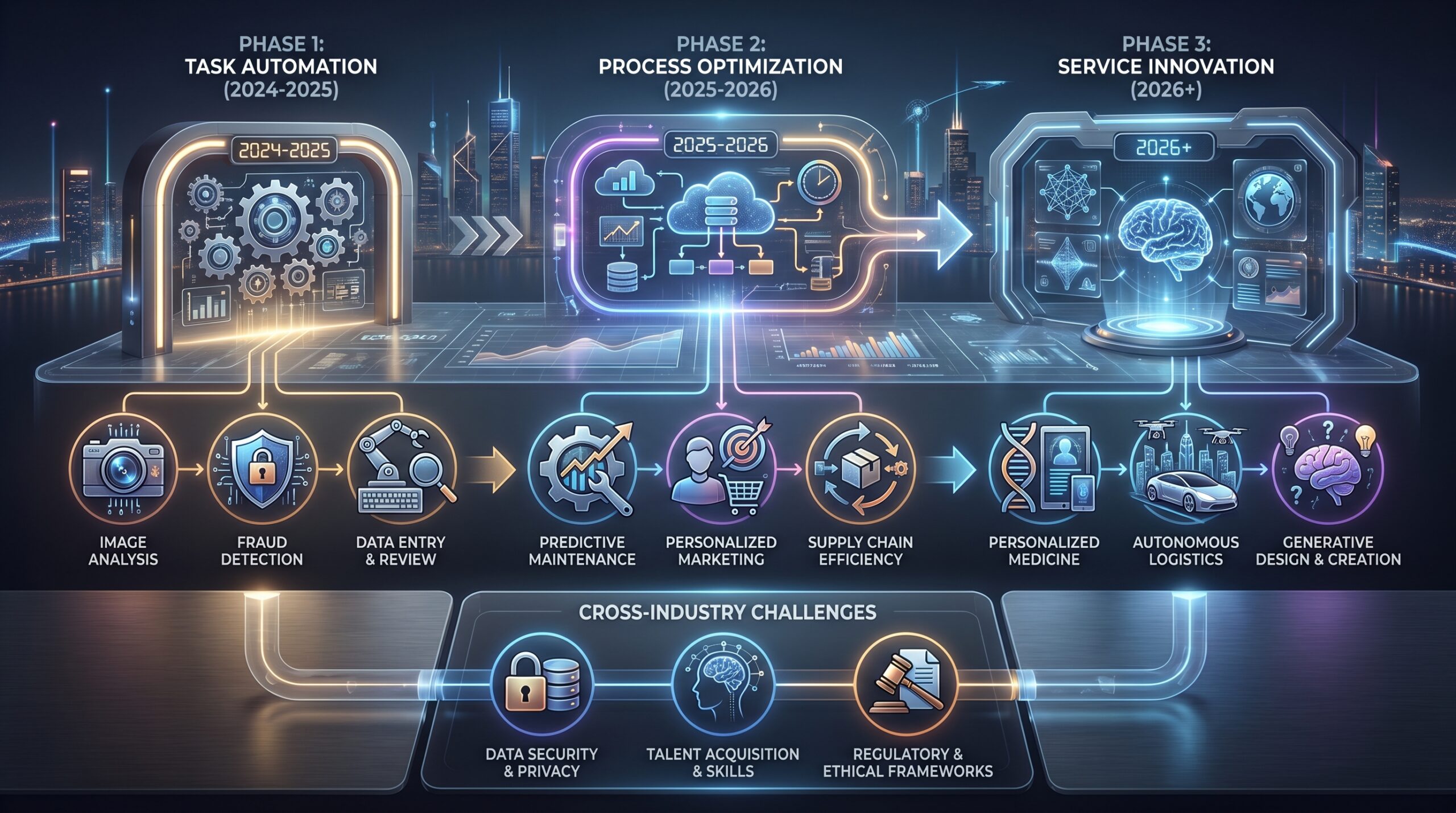
- Automation: AI handles repetitive, data-intensive tasks like invoice processing, image analysis, and customer query resolution.
- Optimization: AI algorithms find efficiency improvements humans miss — supply chain routing, energy usage, inventory management.
- Augmentation: AI provides recommendations to human decision-makers through predictive analytics and scenario modeling.
- Innovation: AI enables entirely new services like real-time language translation, personalized medicine, and autonomous delivery.
Core technologies driving this transformation:
- Machine Learning: Systems that improve through experience without explicit programming.
- Deep Learning: Multi-layered neural networks handling complex patterns in images, speech, and text.
- Natural Language Processing: AI understanding and generating human language.
- Computer Vision: Machines interpreting and analyzing visual information.
- Reinforcement Learning: AI learning optimal behaviors through environmental feedback.
What Most People Get Wrong About AI Industry Takeover by 2026
Myth 1: AI will replace all jobs
Fact: AI automates tasks, not roles. While 25% of tasks become automated, only 5% of jobs become fully obsolete. Most roles evolve to include AI management.
Myth 2: AI operates without human oversight
Fact: Production AI systems require constant human monitoring for drift detection, bias mitigation, and exception handling. The notion of “set it and forget it” AI doesn’t exist in enterprise contexts.
Myth 3: AI understands context like humans
Fact: Current AI lacks common sense reasoning and world understanding. It operates on statistical patterns without genuine comprehension.
Myth 4: Small businesses cannot afford AI
Fact: Cloud AI services offer pay-per-use models making advanced AI accessible for $500/month versus $500,000 development costs previously.
Why AI’s Industry Transformation Matters Now by 2026
The Urgency of AI Adoption and Impact by 2026
Three converging forces make AI adoption urgent rather than optional:
Economic Pressure: Companies using AI achieve 15-25% cost reductions in operational areas. Late adopters face irreversible competitive disadvantage. The gap between AI-first and AI-late companies widens dramatically by 2026.
Technology Acceleration: Moore’s Law continues for specialized AI chips. Nvidia’s H200 GPU (2024) delivers 4x performance over A100 (2020). This hardware advancement enables real-time AI applications previously impossible.
Data Explosion: Global data creation grows from 120 zettabytes (2023) to 250 zettabytes (2026). Only AI systems can process this volume. Human-only analysis becomes mathematically impossible.
Consumer Expectations: Customers now expect personalized experiences, instant responses, and predictive service — all powered by AI. Companies lacking these capabilities appear antiquated.
Economic and Societal Shifts Driven by AI in 2026
Workforce Reskilling: $130B invested in AI-related training programs globally. Technical colleges introduce “AI-assisted trades” programs for plumbers, electricians, and mechanics using AR glasses with AI guidance.
Geographic Redistribution: AI enables remote work at scale, reducing urban concentration. AI-powered language translation breaks down international hiring barriers.
Regulatory Framework: EU AI Act (2025) and US AI Bill of Rights (2024) establish mandatory testing, documentation, and oversight requirements. Non-compliant companies face 4% global revenue fines.
Economic Inequality: AI creates $15T in new value but concentrates benefits among AI-proficient workers and companies. Governments implement AI taxation policies to fund social transition programs.
How AI Will Transform 5 Industries by 2026
Industry 1: Healthcare AI Revolution by 2026
Diagnostics Transformation: AI systems analyze medical images (X-rays, MRIs, CT scans) with 95%+ accuracy matching senior specialists. Radiology workflows shift from human interpretation to AI validation. Pathologists use AI to identify cancerous cells in tissue samples 10x faster.
Drug Discovery Acceleration: AI reduces drug development timelines from 10 years to 4 years through molecular simulation and prediction. Generative AI designs novel drug candidates targeting specific protein structures. Clinical trial matching algorithms identify ideal patients 80% faster.
Personalized Medicine: AI analyzes genetic data, lifestyle factors, and medical history to create individualized treatment plans. Dosage calculations become dynamic based on real-time patient monitoring.
Administrative Automation: AI handles 70% of insurance claims processing, patient scheduling, and medical transcription. Natural language processing converts doctor-patient conversations directly into structured medical records.
Predictive Health: Wearable devices feed continuous health data to AI systems predicting health events before symptoms appear. Hospitals shift from reactive treatment to preventive intervention.
Industry 2: Finance AI Integration by 2026
Fraud Detection Dominance: AI analyzes transaction patterns in real-time, preventing $50B annually in fraudulent activity. Behavioral biometrics replace passwords using AI analysis of typing rhythm, mouse movements, and navigation patterns.
Algorithmic Trading Expansion: AI executes 85% of stock market volume through high-frequency trading algorithms detecting micro-patterns invisible to humans. Quantum computing integration begins for certain hedge funds. Learn more about AI crypto and stock trading apps in 2026.
Personalized Banking: AI agents provide financial advice tailored to individual circumstances. Customers receive proactive suggestions like “Based on your spending pattern, you could save $300 monthly by…”
Credit Assessment Evolution: AI incorporates non-traditional data (rent payment history, educational background) for credit scoring, expanding access to underserved populations.
Regulatory Compliance: AI automates 60% of compliance checking against constantly changing financial regulations across jurisdictions. Anti-money laundering detection improves 40% through network analysis.
Industry 3: Manufacturing AI Automation by 2026
Robotic Automation Advancement: AI-powered robots handle complex assembly tasks requiring adaptation to variations. Computer vision enables robots to identify and manipulate irregular objects without precise positioning.
Predictive Maintenance Implementation: IoT sensors monitored by AI predict equipment failures 2-3 weeks before they occur, reducing downtime by 35%. Maintenance shifts from scheduled to condition-based.
Supply Chain Optimization: AI dynamically reroutes shipments around disruptions, optimizing for cost, time, and carbon footprint simultaneously. Inventory management becomes fully automated with AI predicting demand spikes.
Quality Control Enhancement: AI vision systems inspect products at microscopic levels, detecting defects humans miss. Overall quality improves while inspection costs decrease 60%.
Adaptive Production Lines: Manufacturing systems automatically reconfigure for different products without human intervention. Small-batch customization becomes economically viable through AI flexibility.
Industry 4: Retail AI Reshaping by 2026
Hyper-Personalization: AI analyzes individual customer behavior across channels to deliver unique product recommendations, pricing, and promotions. Conversion rates increase 30% through tailored experiences.
Inventory Intelligence: AI predicts demand at SKU-level with 92% accuracy, reducing overstock by 45% while preventing out-of-stock situations. Automated replenishment systems order stock without human involvement.
Automated Customer Service: AI chatbots handle 80% of customer inquiries with human-like understanding. Voice assistants become primary shopping interface for 40% of consumers. This is a significant aspect of ChatGPT’s mainstream adoption by 2026.
Visual Search Adoption: Customers search by uploading images rather than typing descriptions. AI identifies products matching visual characteristics across retailer inventories.
In-Store Analytics: Computer vision tracks customer movement through physical stores, optimizing layout and product placement. Loss prevention improves through AI identification of suspicious behaviors.
Industry 5: Transportation AI Advancements by 2026
Autonomous Vehicle Deployment: Level 4 autonomous vehicles operate in geofenced urban areas handling ride-sharing and delivery services. Human drivers remain for complex edge cases and supervision. This is part of the broader AI-first initiatives for Android in 2026.
Logistics Optimization: AI algorithms dynamically route fleets considering traffic, weather, fuel costs, and delivery windows. Empty miles reduce by 30% through better load matching.
Traffic Management: Municipal AI systems coordinate traffic signals across cities reducing congestion by 25%. Predictive modeling prevents bottlenecks before they form.
Predictive Fleet Maintenance: AI analyzes vehicle sensor data to schedule maintenance before failures occur, increasing vehicle utilization by 20%.
Drone Delivery Expansion: AI-powered drones handle last-mile delivery for lightweight packages in suburban areas, reducing delivery costs by 40% for eligible items.
Real-World Examples of AI Transforming Industries by 2026
Healthcare AI Success Stories and Projections by 2026
DeepMind AlphaFold 3 (2024) accurately predicts protein structures for drug discovery, accelerating research that previously took years. Pharmaceutical companies integrate this capability into their development pipelines.
Butterfly Network handheld ultrasound devices use AI to guide non-specialists in capturing diagnostic-quality images. This technology expands access to medical imaging in remote areas.
PathAI technology helps pathologists identify cancer patterns in tissue samples with greater accuracy. Major cancer centers adopt this as standard practice by 2026.
Finance AI in Action: Case Studies by 2026
JPMorgan Chase’s COiN platform analyzes legal documents in seconds that previously took 360,000 human hours annually. The system extracts key data points from complex contracts.
PayPal’s fraud detection AI processes billions of transactions identifying fraudulent patterns in real-time. The system stops $10B+ in fraudulent transactions annually with minimal false positives. Learn how AI is simplifying automated investing more broadly.
Betterment’s robo-advisor manages $45B in assets using AI to optimize tax-loss harvesting and portfolio rebalancing. The platform delivers personalized investment strategies at scale.
Manufacturing AI Innovation Examples for 2026
Siemens’ AI-powered factory in Amberg operates with 75% automation producing electronic components with 99.99885% quality rate. The facility runs largely lights-out with minimal human intervention.
GE’s Predix platform uses AI for predictive maintenance on industrial equipment. Customers report 25% reduction in unplanned downtime and 20% lower maintenance costs.
Foxconn’s automated factories employ AI vision systems to inspect iPhone components at production line speeds impossible for humans. Defect detection improves while costs decrease.
Retail AI’s Practical Applications by 2026
Amazon’s recommendation engine drives 35% of total revenue through personalized product suggestions. The AI analyzes purchase history, browsing behavior, and similar customers’ patterns.
Walmart’s inventory management AI predicts demand for 500,000 SKUs across 4,700 stores. The system reduces out-of-stock situations by 30% while decreasing overstock by 25%.
Sephora’s Virtual Artist uses AI and augmented reality to let customers try makeup virtually. The tool increases conversion rates by 27% and reduces product returns.
Transportation AI Pioneering New Paths by 2026
Waymo’s autonomous taxis complete over 1 million rides annually in Phoenix, San Francisco, and Austin. The AI handles complex urban driving scenarios with safety records exceeding human drivers. This aligns with broader trends in AI-first initiatives.
UPS’s ORION system uses AI to optimize delivery routes saving 100 million miles and 10 million gallons of fuel annually. The system processes 250+ variables per route decision.
Tesla’s Full Self-Driving (FSD) version 12+ uses end-to-end neural networks to handle driving decisions. While not fully autonomous, the system reduces driver workload by 80% on highways.
Comparing AI’s Impact Across Industries: A 2026 Outlook
Industry Readiness for AI Adoption by 2026
| Industry | Current AI Adoption Level (2024 est.) | Projected AI Impact by 2026 | Primary AI Applications | Key Challenges to Adoption |
|---|---|---|---|---|
| Healthcare | Medium (35%) | High (70%) | Medical imaging, drug discovery, administrative automation | Regulatory compliance, data privacy, physician acceptance |
| Finance | High (55%) | Very High (85%) | Fraud detection, algorithmic trading, personalized banking | Explainability requirements, cybersecurity risks, legacy systems |
| Manufacturing | Medium-High (45%) | High (75%) | Predictive maintenance, quality control, supply chain optimization | Integration with legacy equipment, workforce reskilling, upfront costs |
| Retail | Medium (40%) | High (65%) | Personalization, inventory management, customer service | Data silos, implementation complexity, organizational resistance |
| Transportation | Low-Medium (25%) | Medium-High (60%) | Autonomous vehicles, route optimization, predictive maintenance | Safety regulations, infrastructure requirements, public acceptance |
| Agriculture | Low (15%) | Medium (40%) | Precision farming, yield prediction, automated harvesting | Connectivity issues, equipment costs, farmer technology adoption |
| Education | Low (10%) | Medium (30%) | Personalized learning, administrative automation, content creation | Privacy concerns, pedagogical effectiveness, institutional inertia |
Healthcare leads in potential impact but faces stringent regulatory hurdles. Finance has high adoption but struggles with explainability requirements. Manufacturing shows strong ROI but requires significant capital investment. Retail benefits from immediate customer impact but must overcome data fragmentation. Transportation transforms fundamentally but faces the highest regulatory and safety barriers.
Tools, Vendors & Implementation Paths for AI by 2026
Key AI Technologies and Platforms for Industry Integration by 2026
Cloud AI Services:
- AWS SageMaker: Full ML pipeline management with built-in algorithms.
- Google Vertex AI: Unified platform for ML development and deployment.
- Azure Machine Learning: Enterprise-grade ML with strong security compliance.
- IBM Watson Studio: Focus on regulated industries and explainable AI.
Specialized AI Platforms:
- DataRobot: Automated machine learning for business users.
- H2O.ai: Open-source AI platform with enterprise support.
- Databricks: Unified analytics platform with ML capabilities.
- Splunk AI: Machine learning for operational data.
Open Source Frameworks:
- TensorFlow 2.x: Most widely adopted production ML framework.
- PyTorch 2.x: Preferred for research and development flexibility.
- Hugging Face Transformers: Standard for natural language processing.
- OpenCV: Computer vision library with AI capabilities.
AI Solution Providers:
- C3.ai: Enterprise AI applications for specific industries.
- UiPath: AI-powered robotic process automation.
- OpenAI API: Access to advanced language models, including GPT-5.5.
- NVIDIA AI Enterprise: Full stack AI software suite.
Navigating AI Implementation: Choices and Tradeoffs by 2026
Build vs. Buy Decision Framework:
Build proprietary AI when:
- AI is core competitive differentiator.
- Unique data assets provide advantage.
- Regulatory requirements demand full control.
- Sufficient AI talent available internally.
Buy AI solutions when:
- Speed to market is critical.
- AI is supplementary capability.
- Limited AI expertise in organization.
- Solution meets 80% of requirements.
Implementation Approach:
- Start with focused pilot solving specific business problem.
- Prove ROI with measurable metrics before scaling.
- Develop data governance framework early.
- Plan for ongoing model monitoring and maintenance.
- Address change management and workforce training.
Talent Strategy:
- Hire AI specialists for core development. Consider the evolving Chief AI Officer role.
- Upskill existing employees on AI collaboration.
- Use consultants for initial implementation.
- Develop internal AI center of excellence.
AI Implementation Strategy Map for 2026
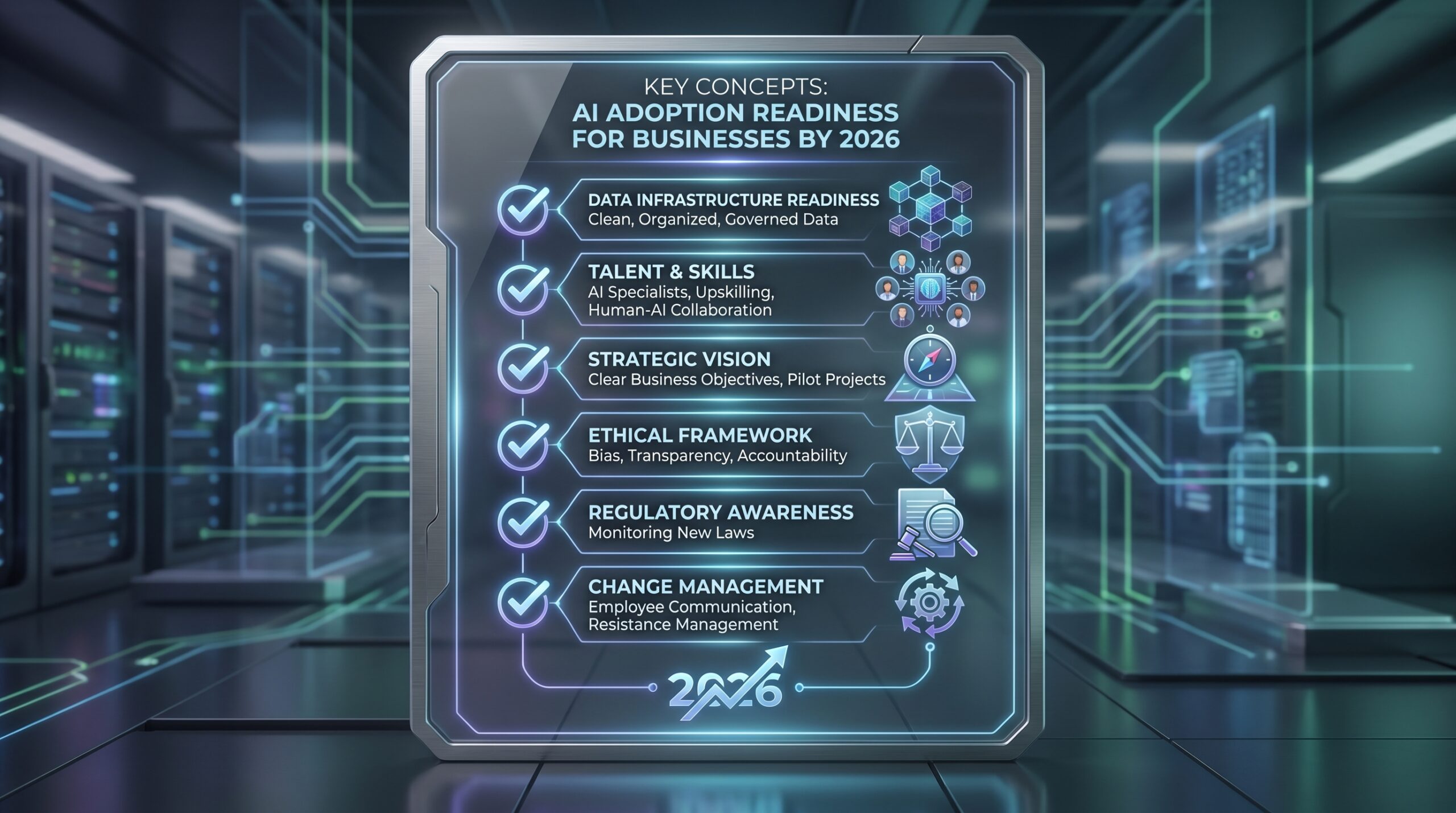
- 1. Vision & Strategy: Define clear business objectives, identify high-impact use cases, assess competitive landscape.
- 2. Data Foundation: Ensure data quality, establish governance, integrate disparate data sources, implement robust cybersecurity.
- 3. Technology Stack: Select cloud AI services, specialized platforms, or open-source frameworks. Consider GPU/TPU infrastructure needs.
- 4. Talent & Culture: Recruit AI specialists, reskill existing workforce, foster a culture of AI literacy, address change management.
- 5. Pilot & Scale: Start with small, measurable pilot projects. Validate ROI. Iteratively refine and scale successful solutions across the enterprise.
- 6. Governance & Ethics: Implement AI ethics frameworks, monitor for bias, ensure transparency, comply with evolving regulations.
- 7. Continuous Improvement: Monitor model performance, retrain models regularly, adapt to new data and market conditions.
Costs, ROI, and Monetization Upside of AI by 2026
Calculating the Value of AI Investment by 2026
Initial Investment Components:
- Data preparation and integration: $100K-500K.
- AI infrastructure (cloud/on-prem): $50K-200K annually.
- AI software licenses: $50K-300K annually.
- Talent acquisition/training: $150K-600K annually.
- Implementation services: $200K-1M.
Typical ROI Timeframes:
- Automation projects: 6-12 month payoff.
- Customer experience enhancements: 12-18 month payoff.
- Innovation initiatives: 18-36 month payoff.
- Infrastructure investments: 24-48 month payoff.
Measurable Benefits:
- Cost reduction: 15-35% in automated processes.
- Revenue increase: 10-25% from personalization.
- Risk reduction: 30-50% in fraud/error prevention.
- Productivity gains: 20-40% in knowledge work.
Monetization Strategies Powered by AI in 2026
Direct Monetization:
- AI-powered premium services (e.g., advanced analytics subscriptions).
- Licensing AI technology to other organizations.
- Performance-based pricing models (e.g., revenue share from AI-driven sales).
Indirect Monetization:
- Enhanced customer retention through personalized experiences.
- New market entry enabled by AI capabilities.
- Operational efficiencies reducing delivery costs.
- Data monetization through AI-processed insights.
Innovation Opportunities:
- Entirely new business models (e.g., autonomous delivery services).
- AI-generated products and services (e.g., synthetic media creation).
- Platform businesses connecting AI providers with consumers.
AI Data Centers and Environmental Impact
The rapid expansion of AI necessitates massive data centers, which face growing local pushback over energy consumption and environmental concerns. As AI adoption accelerates toward 2026, sustainable infrastructure and responsible energy practices will become critical for long-term growth and public acceptance. For more on this, see the article on AI Data Centers Face Growing Local Pushback.
Risks, Pitfalls, and Myths vs. Facts of AI Takeover by 2026
Navigating the Risks of AI Adoption by 2026
Data Privacy Concerns:
- AI systems process sensitive personal information requiring robust encryption.
- Regulations like GDPR and CCPA impose strict requirements on AI data handling.
- Anonymization techniques must evolve to prevent re-identification through AI analysis.
Cybersecurity Vulnerabilities:
- AI systems become attractive targets for malicious actors.
- Adversarial attacks manipulate AI models through subtle input changes.
- Model theft threatens intellectual property investment in AI development.
Ethical Challenges:
- Algorithmic bias replicates and amplifies human prejudices.
- Black box decision-making lacks transparency for critical applications.
- Accountability gaps emerge when AI systems cause harm. For instance, recent incidents involving AI advice have prompted legal action, as seen in the case of OpenAI being sued over ChatGPT-advised fatal drug overdose.
Job Displacement Impacts:
- 25% of current tasks become automated across industries.
- Geographic concentrations of vulnerable workers face economic disruption.
- Social safety nets require expansion to address transition periods.
Regulatory Compliance:
- Changing regulations across jurisdictions create compliance complexity.
- Certification requirements for AI systems add cost and time to deployment.
- Liability frameworks for AI errors remain uncertain.
Common Pitfalls in AI Implementation by 2026
- Starting without clear business objectives — AI projects fail without specific measurable goals.
- Underestimating data requirements — AI needs large, clean, relevant data to perform effectively.
- Ignoring change management — Employees resist AI implementation without proper training and involvement.
- Overlooking ongoing maintenance — AI models degrade without continuous monitoring and retraining.
- Neglecting ethical considerations — AI systems face backlash without addressing bias, fairness, and transparency.
- Expecting immediate perfection — AI requires iterative improvement rather than flawless initial deployment.
- Isolating AI from business processes — AI delivers maximum value when integrated rather than siloed.
AI Myths vs. Facts by 2026
Myth: AI has achieved human-like general intelligence
Fact: Current AI excels at specific narrow tasks but lacks common sense, reasoning, and general world understanding. AGI remains theoretical, though some foresee an AGI shift by OpenAI in 2026.
Myth: AI always makes optimal decisions
Fact: AI operates within its training data constraints and can make catastrophic errors outside those boundaries. Human oversight remains essential.
Myth: AI is too expensive for small and medium businesses
Fact: Cloud AI services democratize access with pay-as-you-go models. Many SMBs implement effective AI solutions for under $10K monthly.
Myth: AI will quickly surpass human capabilities across all domains
Fact: AI progress is uneven — rapid in data processing, slower in physical manipulation, and glacial in social intelligence.
Myth: AI works magically without human effort
Fact: AI requires substantial human effort for data preparation, model training, system integration, and ongoing maintenance.
FAQ
What are the top five AI stocks for 2026?
While specific stock advice cannot be given, companies well-positioned for AI growth generally fall into four categories: AI infrastructure providers (Nvidia, AMD), cloud platform giants (Microsoft Azure, Google Cloud, AWS), companies deeply integrating AI into their products (Tesla, Salesforce, Adobe), and specialized AI solution developers (Palantir, C3.ai). Investors should research each company’s specific AI strategy, patent portfolio, and revenue diversification rather than chasing hype.
Which 5 jobs will survive AI?
Jobs requiring high emotional intelligence, creativity, and complex problem-solving will remain predominantly human. These include healthcare providers (doctors, nurses, therapists), skilled tradespeople (electricians, plumbers, builders), creative professionals (artists, writers, designers), strategic leaders (executives, entrepreneurs), and AI/human collaboration specialists (AI trainers, ethicists, explainability experts). These roles complement AI rather than compete with it.
What jobs are 100% safe from AI?
No job is completely immune to AI influence, but roles requiring nuanced human judgment, physical dexterity in unstructured environments, and genuine creativity remain highly resistant to full automation. These include emergency responders, research scientists, mental health professionals, senior management, and skilled artisans. AI will augment these roles rather than replace them, handling data analysis while humans focus on interpretation and execution.
What 3 jobs will not be replaced by AI?
AI ethicists who establish moral frameworks for artificial intelligence, emergency room surgeons managing complex trauma cases requiring instantaneous adaptive decisions, and groundbreaking scientific researchers formulating entirely new hypotheses beyond pattern recognition. These roles require wisdom, physical intuition, and creative leaps that current AI cannot replicate. They represent the frontier of uniquely human capabilities.
Glossary: Key AI Terms for 2026 Industry Transformations
Essential AI Terminology by 2026
- Algorithm
- A set of rules or instructions given to an AI system to help it learn and solve problems.
- Artificial Intelligence (AI)
- The simulation of human intelligence processes by machines, especially computer systems.
- Computer Vision
- A field of AI that enables computers to derive meaningful information from digital images, videos, and other visual inputs.
- Deep Learning
- A type of machine learning that uses neural networks with many layers (deep networks) to analyze various factors of data.
- Machine Learning
- A subset of AI that enables systems to learn and improve from experience without being explicitly programmed.
- Natural Language Processing (NLP)
- The ability of computers to understand, interpret, and manipulate human language.
- Neural Network
- A computing system inspired by biological neural networks that learns to perform tasks by considering examples.
- Predictive Analytics
- The use of data, statistical algorithms, and machine learning techniques to identify future outcomes based on historical data.
References: Sources on AI’s Industry Transformation by 2026
Cited Works and Further Reading on AI’s 2026 Impact
- McKinsey Global Institute – “The economic potential of generative AI: The next productivity frontier” (2023)
- Stanford University – “Artificial Intelligence Index Report 2024”
- Gartner – “Forecast: Artificial Intelligence Software, Worldwide, 2022-2026”
- Brookings Institution – “How artificial intelligence is transforming the world” (2023)
- Harvard Business Review – “AI Doesn’t Have to Be Too Complicated or Expensive for Your Business” (2024)
- MIT Technology Review – “What’s next for AI in 2024”
- World Economic Forum – “The Future of Jobs Report 2023”
- Forbes – “The Top 5 Artificial Intelligence Trends For 2024”
- Deloitte – “State of AI in the Enterprise, 5th Edition”
- PwC – “AI Predictions 2024: 5 AI trends will dominate the business world”