
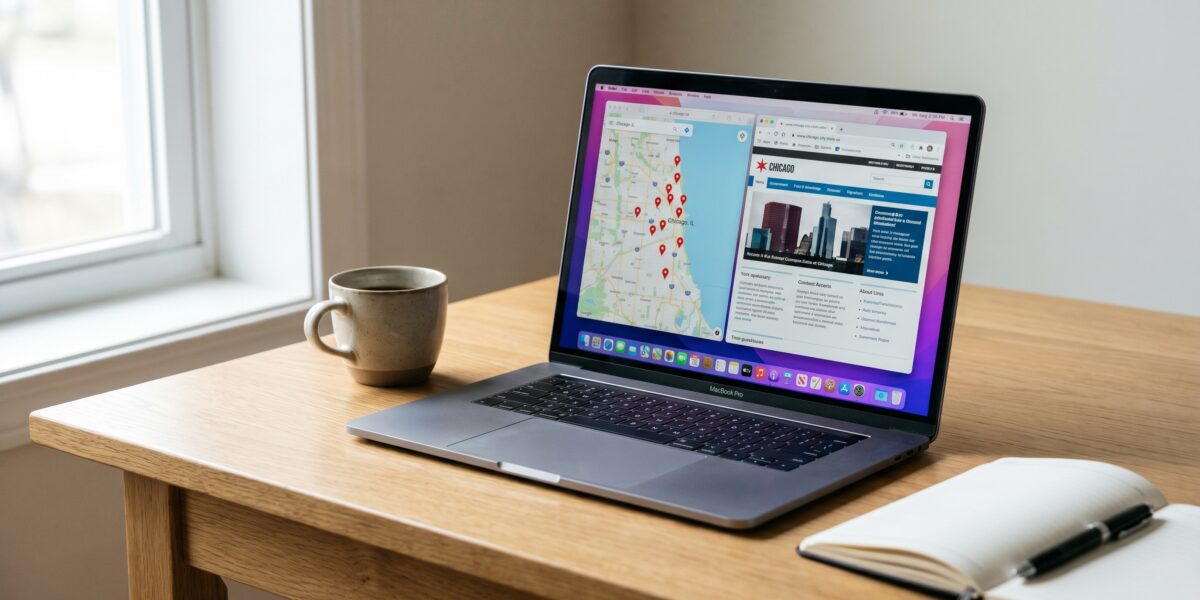
Setting up a free *.city.state.us locality domain involves selecting an available domain, securing DNS hosting, and registering through a delegated registrar. While some registrars offer free registration, DNS hosting typically costs $3–$12/month. Geographic verification is mandatory, and early adoption provides local SEO advantages before market saturation.
TL;DR
- Locality domains (e.g.,
yourbusiness.city.state.us) offer hyperlocal branding within the .us namespace. - Registration isn’t universally free—some delegated registrars charge fees while others may offer limited free tiers.
- DNS hosting remains mandatory and typically costs $3–$12/month.
- Setup requires navigating legacy registration systems and meeting geographic criteria.
- Act now: Early adopters gain SEO advantages in local search results before market saturation.
Key takeaways
- Locality domains offer unique local branding that .com addresses can’t match.
- Registration isn’t universally free—budget for DNS hosting at minimum.
- Geographic verification is mandatory—have documentation ready.
- Setup requires working through delegated registrars—not standard domain platforms.
- Act quickly—good locality names are still available but won’t last forever.
What is a *.city.state.us locality domain?
A locality domain is a geographically specific web address following the structure name.locality.state.us. Unlike standard domains (.com, .net), these domains tie your online presence directly to a physical location.
Historical context: Until 2002, .us domains were strictly organized this way. The system was designed for schools, governments, and businesses to claim their geographic digital real estate. While most .us domains now use simpler structures, the legacy locality system remains active for those who qualify.
Why this matters: If you operate a local business, community organization, or location-specific project, these domains provide instant geographic credibility. They signal “we’re from here” more effectively than a .com with a city name in the content.
Why locality domains matter in 2026
Three factors drive renewed interest in locality domains:
- Local SEO advantages: Search engines prioritize geographic signals in results.
- Brand differentiation: Generic .com names are increasingly scarce and expensive.
- Community trust: Hyperlocal domains signal authentic local presence versus national chains.
Who should care most:
- Local business owners (restaurants, shops, service providers)
- Community organizers and non-profits
- Real estate agents and property managers
- City government projects and initiatives
How locality domains work
The system operates on three levels:
- Registration: You must work through a delegated registrar authorized for .us locality domains.
- Verification: Registrants must meet geographic criteria (physical presence or legitimate connection to the locality).
- DNS hosting: Required to translate your domain name into a working website.
| Component | Purpose | Typical cost |
|---|---|---|
| Domain registration | Secures your chosen name | $0–$25/year |
| DNS hosting | Makes your domain functional | $3–$12/month |
| Website hosting | Where your content lives | Varies by provider |
Real-world examples
- Portland.oregon.us: Used by a coalition of local businesses for tourism promotion.
- Cambridge.mass.us: City government portal for official communications.
- Boulder.colorado.us: Outdoor recreation guide and event calendar.
Why these work: They immediately communicate geographic relevance without needing to explain “we’re based in X city.” Users instantly understand the scope and context.
Locality domains vs. traditional domains
| Factor | Locality domains | Traditional domains (.com, .net) |
|---|---|---|
| Cost | Potentially free registration | $10–$15/year |
| Geographic signaling | Built into the domain | Requires content/SEO to establish |
| Availability | Many names still available | Most good names taken |
| Brand recognition | Requires education | Instantly understood |
| SEO value | Strong local ranking signals | Requires local optimization |
Choose locality domains when: Your audience is primarily local, you need strong geographic signals, or you want to prevent domain squatters from claiming your location.
Stick with traditional domains when: You operate nationally/internationally or need maximum brand recognition without explanation.
Step-by-step setup guide
- Check availability
- Use WHOIS lookup tools or delegated registrar search functions.
- Verify both the exact locality spelling and your desired name.
- Select a delegated registrar
- Choose from current active registrars authorized for .us locality domains.
- Avoid defunct registrars mentioned in historical discussions.
- Prepare documentation
- Proof of geographic connection (business license, utility bill, etc.).
- Personal identification for verification.
- Register the domain
- Submit through registrar’s specific locality domain process.
- Some registrars offer free registration; others charge minimal fees.
- Set up DNS hosting
- Configure through providers like Amazon Lightsail, Cloudflare, or similar.
- Point nameservers to your hosting provider.
- Verify and test
- Ensure domain resolves correctly.
- Set up email forwarding if needed.
Tools and vendors
DNS hosting providers:
- Amazon Lightsail ($3.50/month starting)
- Cloudflare (free tier available)
- Google Cloud DNS ($0.20–$0.50/month per zone)
Implementation priority: Start with domain registration since names are unique. Then add DNS hosting. Website hosting can come later.
Costs and ROI
Direct costs:
- Domain registration: $0–$25/year (varies by registrar)
- DNS hosting: $3–$12/month
- Optional website hosting: $5–$50/month
Return opportunities:
- Local SEO dominance: Outrank competitors in geographic searches.
- Monetization: Sponsor local businesses on your domain once established.
- Career leverage: Become the local domain expert in your area.
Break-even scenario: If a locality domain brings just 2–3 additional customers monthly, it pays for itself. For service businesses, that’s easily achievable.
Risks and pitfalls
- Registrar reliability: Some delegated registrars have outdated systems.
- Verification challenges: Not everyone qualifies for geographic criteria.
- DNS complexity: Beginners often struggle with nameserver configuration.
- Renewal risks: Forgetting to renew could lose your domain permanently.
Mitigation strategy: Use calendar reminders for renewals, choose well-established registrars, and keep backup copies of your DNS settings.
Myths vs. facts
Myth: “All .us locality domains are free.”
Fact: Some delegated registrars offer free registration, but DNS hosting always costs money.
Myth: “These domains work exactly like .com domains.”
Fact: They have different verification requirements and geographic limitations.
Myth: “Locality domains are obsolete.”
Fact: They’re actively maintained and provide unique local advantages.
Myth: “Anyone can register any locality.”
Fact: You must prove legitimate connection to the geographic area.
FAQ
What are the specific criteria for registering a locality-based domain?
You must have a verifiable connection to the locality through physical presence, business operations, or legitimate community involvement.
Are there current, active registrars for *.city.state.us domains?
Yes, though the list changes. Check official .us domain resources for updated registrars.
What are the costs associated with DNS hosting?
Typically $3–$12 monthly depending on provider and features.
How can I verify domain availability?
Use WHOIS lookup tools or search through delegated registrar websites.
What’s the biggest challenge in setup?
Navigating the legacy registration systems and meeting geographic verification requirements.
Key takeaways
- Locality domains offer unique local branding that .com addresses can’t match.
- Registration isn’t universally free—budget for DNS hosting at minimum.
- Geographic verification is mandatory—have documentation ready.
- Setup requires working through delegated registrars—not standard domain platforms.
- Act quickly—good locality names are still available but won’t last forever.
Glossary
Locality domain: A domain name containing a specific geographic location within the .us hierarchy.
DNS hosting: Service that translates domain names into server IP addresses.
Delegated registrar: Organization authorized to manage specific domain types.
WHOIS: Protocol for querying domain registration information.
Nameservers: Servers that handle DNS requests for your domain.