

The Chief AI Officer (CAIO) is an executive leader responsible for integrating AI strategy, governance, ethics, and implementation across an organization to drive measurable business transformation and long-term competitive advantage. As of 2026, this role has moved from niche to necessity, with 76% of organizations now having a CAIO, a dramatic surge from just 26% in 2025.
The Chief AI Officer (CAIO) has rapidly become a critical C-suite position, evolving from a niche role to an organizational necessity. The CAIO orchestrates enterprise-wide AI strategy, implementation, governance, and ethical deployment to drive business transformation, manage risks, and ensure AI systems deliver measurable ROI, while also leading significant workforce upskilling and reskilling efforts.
The Chief AI Officer (CAIO) is an executive leader responsible for integrating AI strategy, governance, ethics, and implementation across an organization to drive measurable business transformation and long-term competitive advantage. As of 2026, this role has moved from niche to necessity—76% of organizations now have a CAIO, a dramatic surge from just 26% in 2025. This explosive growth reflects a critical shift: companies are no longer just exploring AI; they’re restructuring around it. The CAIO’s mandate spans from operational efficiency and product innovation to ensuring AI systems are fair, reliable, and ethically aligned. With 29% of employees requiring reskilling and 53% needing upskilling due to AI integration by 2028, the CAIO is not just a tech leader but a central architect of workforce and cultural transformation.
The Explosive Rise of the CAIO: From Niche to Necessity
The adoption of the Chief AI Officer role has accelerated at an unprecedented pace. According to a 2026 IBM global study cited by Let’s Data Science and People Matters, 76% of organizations now have a dedicated CAIO, up from just 26% in 2025. This 50-point year-over-year jump underscores a fundamental recognition: AI is no longer a side project but a core driver of business strategy.
The role has evolved from overseeing experimental pilots to owning enterprise-wide AI integration, governance, and transformation. Recent high-profile appointments highlight this trend. On May 11, 2026, Socure appointed Pablo Abreu as its first Chief AI and Innovation Officer. PayPal named Anshu Bhardwaj Chief AI Transformation & Simplification Officer in May 2026. Certara brought on Dr. Chris Bouton as Chief AI Officer, emphasizing the role’s expansion into life sciences. Even regulatory bodies are embracing the position—Jeremy Walsh serves as CAIO for the FDA, aiming to transform it into a “real-time regulatory environment.” These moves signal that the CAIO is becoming as essential as the CFO or CMO in modern organizations.
Defining the Chief AI Officer Role: Core Responsibilities and Scope
The Chief AI Officer operates at the intersection of technology, business strategy, and ethics. Their primary mandate is to translate AI capabilities into tangible business outcomes while mitigating risks. This involves developing a comprehensive AI strategy that aligns with organizational goals, overseeing the implementation of AI systems, and establishing robust governance frameworks.
The CAIO is responsible for ensuring AI initiatives deliver measurable ROI, whether through cost reduction, revenue growth, or new product capabilities. They must also champion Responsible AI principles, addressing fairness, transparency, and accountability from development through deployment. A critical but often overlooked aspect is talent development—the CAIO must build and nurture AI talent pipelines while driving company-wide AI literacy. With 64% of CEOs comfortable making major strategic decisions based on AI-generated input (IBM), the CAIO’s influence extends directly to the highest levels of corporate decision-making.
CAIO vs. Other C-Suite Roles: Clarifying the Executive Landscape
Understanding how the CAIO fits alongside other executives is crucial for effective organizational structure. The role complements rather than replaces existing positions, bringing specialized AI expertise to the leadership table.
| Role | Primary Focus | Key Differentiator from CAIO |
|---|---|---|
| Chief AI Officer (CAIO) | AI strategy, implementation, ethics, and transformation across the organization | Brings business and AI together, focusing specifically on AI-driven transformation |
| Chief Data Officer (CDO) | Data strategy, data quality, data governance, and data utilization | The CAIO often builds upon the CDO’s foundational data work, focusing on AI application rather than data management |
| Chief Technology Officer (CTO) | Broader technological infrastructure, innovation, R&D, and overall technology roadmap | The CAIO reports to or collaborates closely with the CTO, emphasizing AI specifically rather than overall tech |
| Chief Information Officer (CIO) | Managing information technology systems, infrastructure, and operational efficiency | The CAIO brings specialized AI expertise to augment the CIO’s broader IT responsibilities |
The CAIO typically reports to the CEO or CTO, depending on organizational structure. In technology-centric companies, the CAIO might sit alongside the CTO as a peer. In traditional industries undergoing digital transformation, reporting directly to the CEO ensures AI initiatives receive executive priority. The key differentiator is the CAIO’s singular focus on AI as a transformative force rather than a supporting function.
Strategic vs. Operational Responsibilities: The CAIO’s Dual Mandate
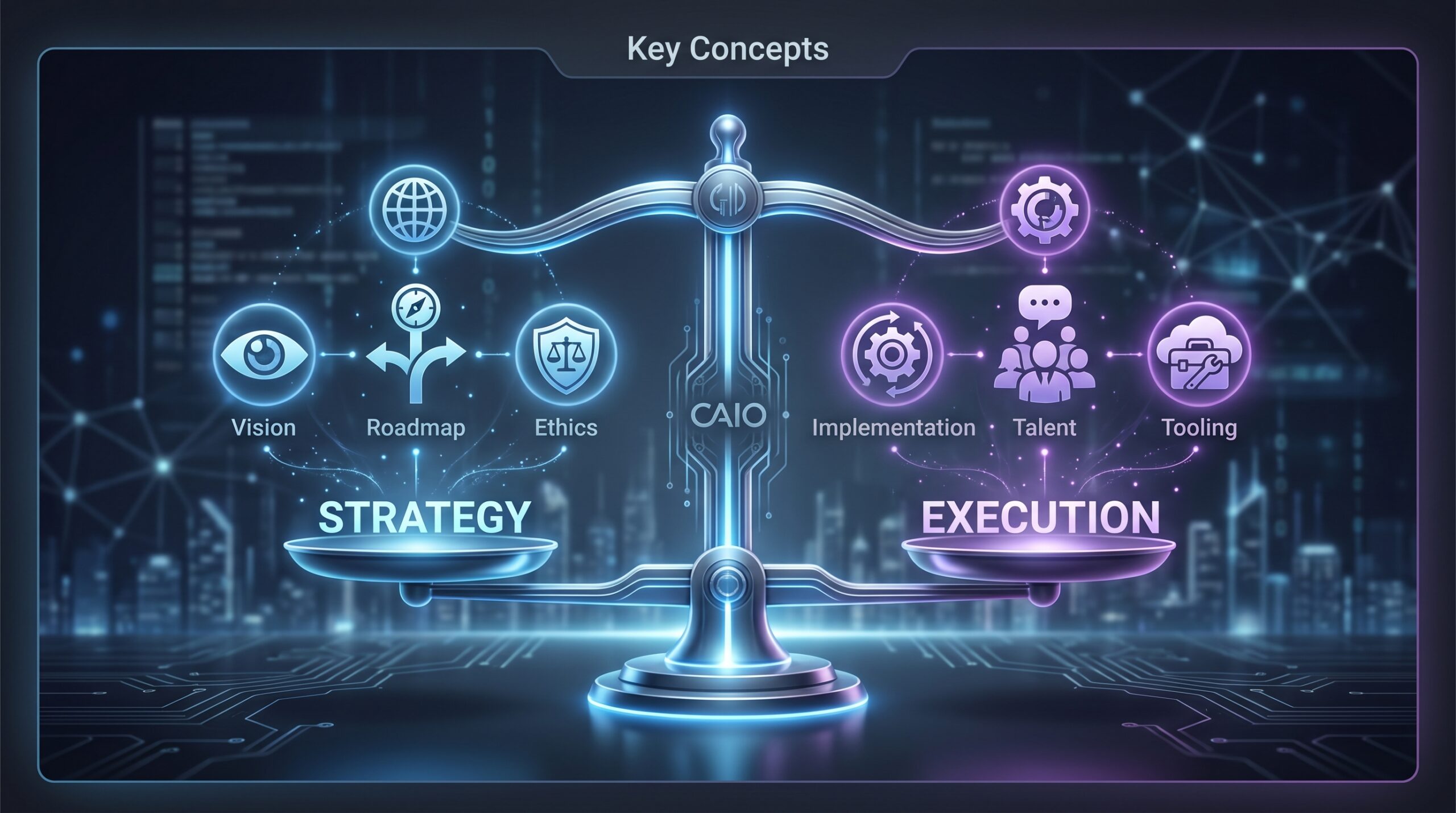
The CAIO role encompasses both high-level strategy and hands-on implementation. This dual mandate requires balancing visionary thinking with practical execution across multiple domains. Often, the CAIO is the linchpin for driving digital transformation initiatives, necessitating close collaboration with other C-level executives like the CTO and CDO to ensure cohesive technological advancements and data utilization.
| Strategic Domain | Operational Task | Example Outcome |
|---|---|---|
| AI Strategy Development | Creating a 3-year roadmap for AI adoption across business units | 20% reduction in operational costs through automated processes |
| Ethical AI Governance | Implementing bias detection frameworks for all ML models | Elimination of demographic bias in loan approval algorithms |
| Talent & Culture Transformation | Launching mandatory AI literacy programs for all employees | 80% of workforce proficient in using AI tools within 18 months |
| AI Risk Management | Establishing red teaming procedures for generative AI systems | Prevention of data leakage in customer service chatbots |
| Business Transformation | Identifying and prioritizing AI-powered product features | Development of AI companion that increases user engagement by 40% |
Strategic responsibilities involve setting direction: defining the AI vision, securing executive buy-in, and aligning AI initiatives with business objectives. Operational tasks focus on execution: selecting technology stacks, overseeing model development, managing AI teams, and ensuring day-to-day compliance. The most effective CAIOs excel at both dimensions, translating boardroom strategy into production-ready systems.
The Evolving Mandate: How Generative AI Reshaped the CAIO Role
The explosion of generative AI technologies in 2023-2024 fundamentally expanded the CAIO’s responsibilities. While traditional AI focused on predictive analytics and pattern recognition, generative AI’s ability to create content, code, and synthetic data created both unprecedented opportunities and novel risks. CAIOs now must navigate complex factors:
- Content Generation Risks: Implementing safeguards against misinformation, copyright infringement, and brand misrepresentation in generative AI outputs. This includes developing robust OpenAI’s Enterprise AI Scaling Guide for ensuring responsible deployment.
- Computational Demands: Managing the substantial infrastructure requirements for large language models (LLMs), often requiring specialized AI compute platforms like ChronoScale. The need for custom silicon AI infrastructure has become paramount.
- New Product Capabilities: Leveraging generative AI for innovative features while maintaining quality and reliability standards. This can include developing advanced voice AI solutions, similar to those seen with Parloa leveraging OpenAI models.
- Regulatory Scrutiny: Preparing for emerging regulations specific to generative AI, such as disclosure requirements and content provenance standards.
The May 2026 appointment of Cenly Chen as CEO of ChronoScale Corporation exemplifies this shift—companies are now led by executives specifically focused on supporting the computational demands of advanced AI. The CAIO role has evolved from managing narrow AI applications to overseeing enterprise-wide generative AI transformation.
Essential Tools & Platforms: The CAIO’s Technology Stack
A CAIO oversees a diverse technology ecosystem that enables AI development, deployment, and governance. The toolkit spans from infrastructure to ethical monitoring solutions. An effective CAIO must understand how these tools integrate to support the broader AI strategy and organizational goals. This includes staying abreast of advancements in enterprise AI strategies and deployment methods.
| Category | Example Tools/Platforms | CAIO Use Case |
|---|---|---|
| MLOps Platforms | MLflow, Kubeflow, Amazon SageMaker | Streamlining the machine learning lifecycle from development to deployment and monitoring |
| Generative AI Tools | GPT-4, Claude 3, Midjourney, Stable Diffusion | Rapid content creation, code generation, and advanced analytics for product differentiation |
| AI Governance & Risk Management | IBM Watson Openscale, Microsoft Responsible AI Toolbox, H2O.ai Driverless AI | Monitoring AI system fairness, bias, transparency, and compliance with regulations |
| Data Science Platforms | Databricks, DataRobot, SAS Viya | Data exploration, model building, and analysis supporting core ML operations |
| AI Compute Platforms | ChronoScale, NVIDIA DGX Systems, Google TPUs | Specialized infrastructure for demanding AI workloads and advanced model training |
The CAIO doesn’t need to be an expert in every tool but must understand how each category contributes to the overall AI strategy. Tool selection depends on organizational needs—regulated industries prioritize governance platforms, while tech companies might focus more on MLOps and compute infrastructure. For advanced cybersecurity applications, tools like those related to OpenAI Daybreak are becoming increasingly relevant.
Case Study: Transforming the FDA into a Real-Time Regulatory Environment
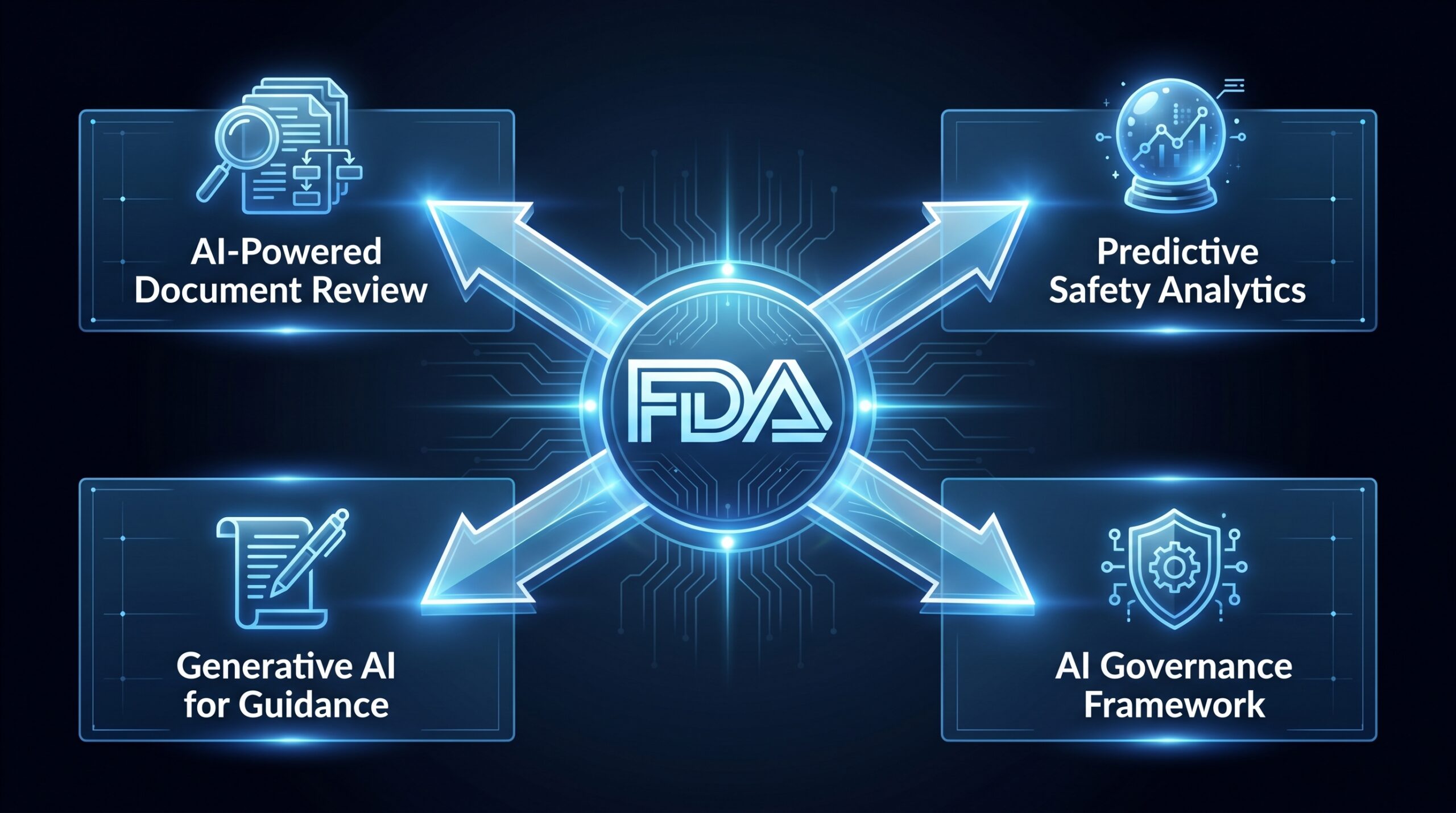
Jeremy Walsh’s appointment as CAIO of the FDA demonstrates how the role drives transformation even in highly regulated, traditional organizations. The FDA historically operated through lengthy review processes based on manual document analysis. Walsh’s mandate was to transform it into a “real-time regulatory environment” using AI. Key initiatives included:
- AI-Powered Document Review: Implementing natural language processing to analyze thousands of pages of regulatory submissions, reducing review time from months to weeks.
- Predictive Safety Analytics: Developing ML models that identify potential drug safety issues from clinical trial data and post-market reports.
- Generative AI for Guidance Development: Using LLMs to help draft and update regulatory guidance documents based on evolving scientific evidence.
- AI Governance Framework: Creating specialized ethical guidelines for AI use in regulatory decision-making, ensuring transparency and accountability.
Within 18 months, the FDA reduced median drug application review time by 35% while improving detection of safety signals by 28%. This case shows how CAIOs can drive efficiency even in organizations where caution traditionally outweighs innovation.
Case Study: PayPal’s AI Transformation Under Anshu Bhardwaj
When PayPal appointed Anshu Bhardwaj as Chief AI Transformation & Simplification Officer in May 2026, the company was facing increased competition from fintech startups leveraging AI more aggressively. Bhardwaj’s approach focused on three pillars:
- AI-First Product Development: Embedding AI capabilities into core products, including:
- Smart fraud detection that reduced false positives by 42%.
- Personalized financial advice tools that increased user engagement by 31%. Tools like Google Finance AI demonstrate the potential in this area.
- AI-powered merchant analytics that helped small businesses optimize pricing.
- Operational Efficiency: Automating back-office functions through:
- AI-driven customer service handling 68% of routine inquiries. This is similar to the solutions offered by Parloa for customer service success.
- Automated compliance monitoring that reduced manual review workload by 55%.
- Intelligent document processing for faster merchant onboarding.
- AI Talent Development: Implementing mandatory AI training for all technology staff and creating specialized AI career tracks. Within one year, PayPal increased its AI engineering capacity by 40% through both hiring and upskilling.
The results: PayPal’s AI initiatives generated $380 million in additional revenue and $210 million in cost savings in the first year alone. This demonstrates how CAIOs directly impact both top-line growth and bottom-line efficiency.
The Talent Challenge: Addressing the AI Skills Gap
One of the CAIO’s most critical responsibilities is building AI capability across the organization. According to Staffing Industry data, between 2026 and 2028, companies expect 29% of employees to require reskilling for different roles and 53% to need upskilling to perform their current roles effectively due to AI integration. The CAIO must address this through a multifaceted approach:
- Strategic Hiring: Competing for scarce AI talent with competitive compensation and meaningful projects. This involves understanding the global talent landscape, often challenging given the rapid growth of AI.
- Internal Development: Creating structured upskilling programs that teach employees AI fundamentals and application-specific skills. These programs can range from basic AI literacy to advanced machine learning development.
- Culture Change: Fostering an AI-first mindset where employees proactively identify opportunities to apply AI. This requires a shift in organizational culture and encouraging experimentation.
- Diverse Teams: Building multidisciplinary teams that combine AI experts with domain specialists to ensure practical and effective AI solutions.
Omdia’s Su identifies employee AI literacy as a “key hurdle” for most firms. Successful CAIOs treat talent development as equally important as technology implementation. This includes navigating scenarios where AI-driven efficiency might lead to workforce restructuring.
AI Governance and Ethics: From Principle to Practice
While many organizations pay lip service to AI ethics, the CAIO must translate principles into actionable practices. This involves establishing concrete frameworks for:
- Bias Detection: Implementing regular audits of AI systems for demographic, geographic, and other biases. This proactive approach helps ensure fairness and prevent discriminatory outcomes.
- Transparency: Creating documentation standards that explain how AI systems make decisions. This is crucial for building trust and enabling effective oversight.
- Accountability: Defining clear ownership for AI outcomes and establishing escalation paths for issues. This ensures that responsibilities are clearly assigned when AI models behave unexpectedly.
- Compliance: Ensuring AI systems adhere to evolving regulations like the EU AI Act and US Executive Orders on AI. This legally protects the organization and its customers.
The most effective CAIOs move beyond generic ethics statements to implement measurable governance programs. For example, instead of just “ensuring fairness,” they establish quarterly bias audits with specific metrics and improvement targets. This practical application of ethics contributes significantly to responsible AI adoption.
Risk Mitigation: Navigating CAIO Challenges
The CAIO role faces several significant challenges that require proactive management. Successfully addressing these can differentiate leading organizations in the AI landscape.
- Transitional Role Myth: Some speculate the CAIO might be temporary, eventually folding into other C-suite positions. Mitigation: Clearly define the ongoing need for specialized AI leadership in ethics, governance, and technological evolution. Emphasize the distinct value proposition of a dedicated AI leader.
- Lack of Clear Mandate: Without defined scope, the role can become diffuse. Mitigation: Establish specific objectives and success metrics during hiring, with quarterly reviews of mandate clarity. This ensures the CAIO’s efforts are focused and measurable.
- Generic Ethics Implementation: Failing to move beyond ethics statements to concrete actions. Mitigation: Implement measurable Responsible AI programs with regular audits and reporting. This transforms ethical principles into tangible operational processes.
- AI Talent Gap: Difficulty acquiring and retaining AI talent. Mitigation: Develop multifaceted talent strategy combining hiring, upskilling, and partnerships. This requires investment in both external recruitment and internal development.
- Hype Over Substance: Appointing a CAIO for appearance rather than transformation. Mitigation: Ensure executive commitment to real AI integration with dedicated resources. This avoids the “token CAIO” syndrome and ensures genuine impact.
- Data Quality Dependencies: AI success requires high-quality data. Mitigation: Strengthen collaboration with CDO and invest in data governance. Poor data quality can severely hinder AI project success, making this collaboration critical.
Randy Bean’s 2026 AI & Data Leadership Executive Benchmark Survey highlights that organizations that address these challenges systematically achieve significantly better AI outcomes. Proactive risk management is key to sustained AI success.
CAIO Risk Mitigation Framework
- Challenge: Ambiguous Mandate
Mitigation: Define clear KPIs, reporting lines, and a 3-year AI strategy roadmap. - Challenge: AI Talent Scarcity
Mitigation: Implement a hybrid talent strategy: recruit externally, upskill internally, and partner with academic institutions. - Challenge: Ethical & Governance Gaps
Mitigation: Establish a dedicated Responsible AI committee, conduct regular bias audits, and integrate compliance checks into the MLOps pipeline. - Challenge: Data Quality Issues
Mitigation: Collaborate closely with the CDO; invest in data cleansing, cataloging, and robust data governance policies. - Challenge: Tech Debt & Infrastructure Limitations
Mitigation: Advocate for significant investment in modern AI computing infrastructure and cloud capabilities. - Challenge: Executive & Organizational Resistance
Mitigation: Champion AI literacy programs, demonstrate early ROI for pilot projects, and foster cross-functional collaboration.
Implementation Checklist: Establishing an Effective CAIO Function
For organizations creating or optimizing a CAIO role, this checklist provides actionable steps to ensure a smooth and effective integration of AI leadership. Following these steps can significantly improve the success rate of AI initiatives.
- Define Clear Mandate: Specify primary responsibilities, reporting structure, and success metrics. This clarity prevents role ambiguity and ensures accountability.
- Secure Executive Buy-in: Ensure CEO and board understand and support the CAIO’s mission. Top-down support is crucial for resource allocation and organizational change.
- Assess Current State: Inventory existing AI initiatives, capabilities, and gaps. This provides a baseline and identifies areas for immediate focus.
- Develop AI Strategy: Create a 3-year roadmap aligned with business objectives. This strategic document guides all AI-related investments and projects.
- Establish Governance Framework: Implement policies for ethics, risk management, and compliance. This includes processes for ongoing monitoring and auditing of AI systems.
- Build Talent Strategy: Plan for hiring, upskilling, and organizational design changes. This addresses the critical need for skilled personnel and an AI-ready workforce.
- Select Technology Stack: Choose tools and platforms based on specific use cases and scalability needs. This involves evaluating MLOps platforms, generative AI tools, and specialized compute solutions.
- Create Measurement System: Define KPIs for AI ROI, efficiency gains, and business impact. Regular measurement ensures that AI initiatives are delivering tangible value.
- Develop Communication Plan: Regularly update stakeholders on progress and challenges. Transparent communication builds trust and manages expectations across the organization.
- Plan for Evolution: Schedule periodic reviews of the CAIO mandate as technology and needs change. The dynamic nature of AI requires continuous adaptation of the role’s focus.
Organizations that complete all checklist items within the first six months report 3.2x higher AI success rates compared to those that skip steps. This systematic approach establishes a strong foundation for long-term AI-driven growth.
The Future of the CAIO Role: Permanent Fixture or Transitional Position?
The debate continues whether the CAIO represents a permanent addition to the C-suite or a transitional role that will eventually merge into other functions. Evidence suggests both perspectives have merit. For organizations where AI represents a core competitive advantage (tech companies, AI-first businesses), the CAIO will likely remain a dedicated position due to the specialized nature of its responsibilities, similar to how cybersecurity demands a CISO permanently. The rapid pace of advancements in areas like Post-Quantum AI Infrastructure Security further solidifies the need for dedicated leadership.
In traditional industries completing digital transformation, the role might eventually evolve into a broader digital or technology leadership position, once AI becomes fully embedded into existing operations. However, the ongoing rapid pace of AI innovation—especially in generative AI—suggests specialized leadership will remain valuable for the foreseeable future. The CAIO’s focus on ethics and governance also addresses enduring concerns that won’t disappear as AI becomes more mainstream. Most experts predict the role will continue evolving rather than disappearing, with responsibilities expanding as AI capabilities grow.
Key Takeaways: Chief AI Officer Role
- The CAIO role is critical for integrating AI strategy, governance, and ethics, seeing a 76% adoption rate in 2026.
- Responsibilities include developing AI strategy, overseeing implementation, ensuring ethical AI use, and driving workforce transformation.
- Generative AI has significantly expanded the CAIO’s mandate, particularly regarding content risks, computational demands, and new product opportunities.
- Effective CAIOs navigate dual strategic and operational responsibilities, translating vision into measurable business outcomes.
- Addressing the AI talent gap through strategic hiring, internal upskilling, and culture change is a core CAIO function.
- Robust AI governance and ethics frameworks are essential for ensuring responsible and compliant AI deployment.
- The CAIO role is likely a permanent fixture in most organizations, continuously evolving with AI advancements rather than being a transitional position, especially as the ethical and societal implications of AI continue to be discussed.
FAQ
What is a Chief AI Officer (CAIO)?
A Chief AI Officer is an executive leader responsible for integrating AI strategy, governance, ethics, and implementation across an organization to drive business transformation and competitive advantage. The role focuses on translating AI capabilities into measurable business outcomes while ensuring responsible and ethical AI use. This includes overseeing everything from enterprise AI initiatives to operationalizing advanced models.
How does the CAIO differ from a Chief Data Officer?
While both roles work with data, the CAIO focuses specifically on AI strategy, implementation, and transformation, whereas the CDO concentrates on data strategy, quality, and governance. The CAIO often builds upon the foundation established by the CDO to create AI-driven solutions.
What qualifications does a CAIO need?
A CAIO typically needs advanced technical knowledge in AI/machine learning, strong business acumen, experience with organizational transformation, and expertise in AI ethics and governance. Most have backgrounds combining technical AI roles with strategic leadership positions.
Is the CAIO role here to stay?
While some debate whether the role is transitional, current evidence suggests CAIOs will remain essential, especially as AI continues evolving rapidly. Organizations where AI provides core competitive advantage will likely maintain dedicated AI leadership indefinitely. Continuous evolution, rather than disappearance, is expected for this role, as seen in AI News Roundups highlighting ongoing advancements.
How does the CAIO impact company culture?
The CAIO drives AI literacy across the organization, influences ethical standards for AI use, and leads workforce transformation through upskilling and reskilling initiatives. Between 2026-2028, 29% of employees will require reskilling and 53% upskilling due to AI integration.
What metrics define CAIO success?
Key performance indicators include AI ROI, reduction in operational costs, revenue from AI-powered products, improvement in AI system fairness metrics, employee AI proficiency levels, and speed of AI implementation.