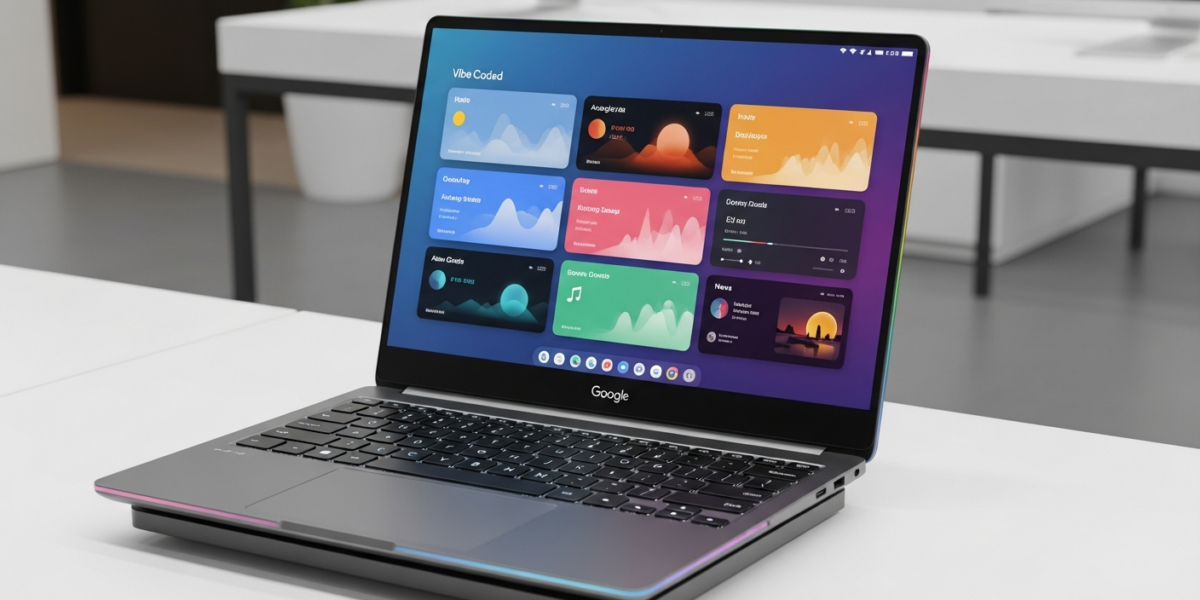
Google unveiled AI-first Googlebooks laptops, agentic Gemini features, and vibe-coded Android widgets at its Android Show, signaling a deeper AI integration across its ecosystem.
Google’s unveiled a suite of AI-first products and features, most notably new Googlebooks laptops and significantly more agentic Gemini capabilities across Android 17. This push signals Google’s commitment to embedding advanced AI directly into its core hardware and software, moving beyond simple voice commands to proactive, cross-application task completion and personalized user interfaces, which will redefine how operators build and interact with the Android ecosystem.
Ahead of its annual I/O conference, Google showcased several key advancements at its , emphasizing an “AI-first” paradigm. A major announcement was the introduction of AI-first Googlebooks laptops, marking a new category of hardware designed around integrated artificial intelligence capabilities. This move extends Google’s AI strategy beyond mobile devices and into its computing platforms, suggesting a future where local AI processing and cloud-based intelligence work hand-in-hand to enhance user experience and productivity. For operators, this means a new hardware target for optimized AI applications and potentially new benchmarks for performance on-device.
The core of the software updates revolves around a more agentic Gemini, Google’s AI assistant. These enhanced capabilities allow Gemini to perform complex tasks across multiple applications, browse the web autonomously, fill out forms, and dictate speech with improved accuracy. TechCrunch highlighted Gemini’s ability to “complete tasks across apps” and “browse the web,” while 9to5Google noted its capacity to “research and even complete tasks” like booking appointments. This shift from reactive assistant to proactive agent implies a significant change in how users will interact with their devices, moving towards delegating multi-step processes to AI. Operators developing applications for Android will need to consider how their services can integrate with or be orchestrated by these more powerful AI agents, potentially opening new avenues for automation and user engagement.
Android 17 also introduces a new era of generative UI, exemplified by “vibe-coded” widgets and custom homescreen elements. These widgets can be created and populated with information from the web and Google apps simply by user voice commands, as reported by TechCrunch and 9to5Google. This goes beyond static widgets, allowing for dynamic, personalized interfaces that adapt to user preferences and context. Engadget noted that widgets are also coming to Googlebooks and Wear OS, indicating a pervasive UI strategy. The Verge further added that Android 17 will include new emoji and improved dictation. This focus on generative UI means developers will need to think about how their data and services can be surfaced and presented in highly customizable, AI-driven interfaces, potentially reducing the need for traditional app-centric navigation and increasing the importance of API-driven data accessibility.
What operators should do
Operators, particularly those in application development and hardware manufacturing, must immediately begin exploring how to integrate with a more agentic Gemini and leverage generative UI capabilities. For app developers, this means designing APIs that expose core functionalities in a way that Gemini can understand and orchestrate, moving beyond simple intents to multi-step task completion. Hardware manufacturers should evaluate the computational requirements for on-device AI processing to support features like vibe-coded widgets and consider how their devices can differentiate themselves through seamless AI integration, especially with the emergence of Googlebooks. The era of static applications and siloed experiences is rapidly fading; success will hinge on how effectively products can participate in an interconnected, AI-driven ecosystem.
Sources
- Everything Google announced at its Android Show, from Googlebooks to vibe-coded widgets | TechCrunch
- Everything announced at The Android Show: I/O 2026 edition – Engadget
- Google brings agentic AI and vibe-coded widgets to Android | TechCrunch
- Everything announced at The Android Show: Gemini Intelligence, Googlebooks, and more — 9to5Google
- The 9 biggest new features in Android 17 | The Verge
- Android Show 2026: all the news and announcements – 1023 Jack
- The Android Show: Everything Google announced including Gemini Intelligence and Googlebooks — Tech.Yahoo
- Android Show I/O 2026: Every Major Announcement — Explosion