
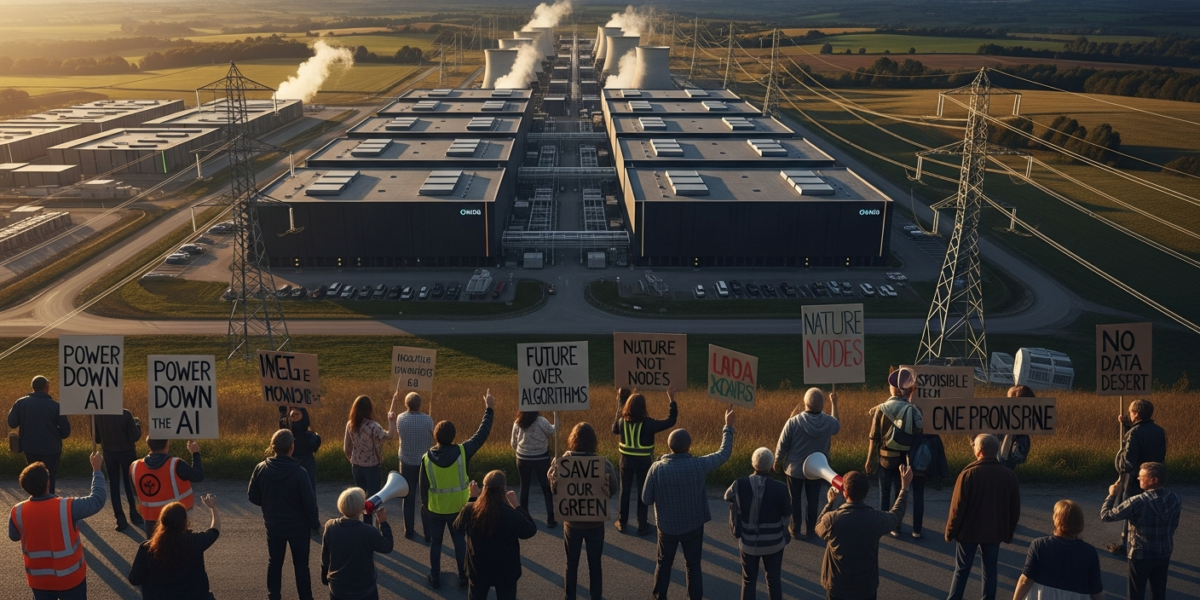
The rapid expansion of AI data centers is sparking widespread community opposition across the US and globally due to concerns over energy consumption, environmental impact, and rising utility costs.
The unbridled expansion of AI data centers is creating a significant political and social backlash, forcing operators to confront escalating community opposition, regulatory scrutiny, and rising energy costs. This isn’t just NIMBYism; it’s a fundamental challenge to the economic and environmental viability of current AI infrastructure models, demanding a strategic pivot toward distributed, efficient, and locally integrated solutions.
What’s actually at stake
For operators, the stakes are concrete and immediate: project delays, increased regulatory hurdles, and potentially higher operational costs. The rush to build massive data centers, the physical backbone of AI ambitions, is colliding with community concerns over power grids, utility bills, and environmental impact. In , a 40,000-acre data center project in Utah was approved despite significant local outcry, highlighting the tension between development and community interests [2, 3]. This isn’t an isolated incident; 43 percent of Americans blame data centers for rising power bills, and jurisdictions are actively considering bans or pauses on new builds [3, 4].
The energy demands of AI are staggering. While AI workloads represented only a quarter of data center activity in , primarily driven by training, the growth trajectory is steep [5]. This demand is already straining existing infrastructure. Lake Tahoe, for instance, is seeking new power sources due to soaring data center demand [7]. In Maryland, citizens face a $2 billion grid upgrade bill partly attributed to out-of-state AI data centers [6]. The Federal Energy Regulatory Commission’s order allowing data centers direct connections to power plants, and the Secretary of Energy’s support for un-retiring coal plants, underscore the severity of the energy challenge [1]. Operators who fail to proactively address these concerns risk significant financial and reputational damage, facing legal battles and public relations crises that can derail projects and erode trust.
The strongest case for the other side
Proponents of large-scale AI data center development argue that these facilities are indispensable for technological progress and economic growth. They are the foundational infrastructure for advancements in AI, which promises to revolutionize industries, create jobs, and solve complex societal problems. Without these centers, the compute power necessary for training and deploying sophisticated AI models simply wouldn’t exist. Companies like NVIDIA emphasize that their data center solutions are crucial for driving the future of AI reasoning, enabling real-time decisions at the edge for various sectors from manufacturing to healthcare [8].
Furthermore, developers often point to the economic benefits brought to local communities, including job creation during construction and operation, and increased tax revenues. They argue that modern data centers are designed with energy efficiency in mind, utilizing advanced cooling techniques and renewable energy sources where possible to mitigate environmental impact. The direct connection to power plants, as greenlit by FERC, could be framed as a way to ensure stable, dedicated power supply for critical infrastructure, rather than a drain on existing grids [1]. From this perspective, the opposition is often seen as short-sighted, failing to grasp the broader economic and technological imperatives that necessitate these developments. The argument is that the long-term benefits of AI innovation far outweigh the localized inconveniences or perceived environmental costs, and that effective regulation and technological advancements will eventually address these concerns.
Why we still disagree
While the economic and technological benefits of AI are undeniable, the current approach to data center expansion is fundamentally unsustainable and socially inequitable. The “economic benefits” often accrue disproportionately to tech giants and a select few, while the costs—in the form of increased utility bills, environmental degradation, and strain on local resources—are externalized onto communities. The approval of the Utah data center despite “hundreds of protesters” and the fact that 14 states are considering legislation to ban or pause new data centers, from Oklahoma to New York, demonstrates that this is not merely a localized “Not In My Backyard” issue, but a widespread systemic concern [2, 4].
The narrative of “energy-efficient” data centers often glosses over the sheer scale of demand. Even if individual facilities are optimized, the cumulative impact of dozens or hundreds of new mega-centers is immense. Relying on un-retiring coal plants, as supported by the Secretary of Energy, is a step backward for climate goals and directly contradicts claims of sustainable development [1]. The idea that communities should bear the burden of a $2 billion grid upgrade for out-of-state data centers, as seen in Maryland, is a clear example of this inequitable distribution of costs [6]. Operators must recognize that public sentiment is shifting; the political battleground around data centers is forming, and ignoring community concerns will lead to increasing regulatory friction and project failures [3]. The long-term viability of AI infrastructure hinges on a model that genuinely integrates with, rather than extracts from, local environments and economies.
What to watch
- State-level legislative action: Monitor the progress of bills in the 14 states considering bans or pauses on new data centers [4]. The passage of such legislation will signal a significant shift in the regulatory landscape, potentially forcing operators to reconsider site selection and development strategies.
- Mandatory energy usage surveys: Observe the implementation and findings of forthcoming “mandatory” energy usage surveys for data centers [7]. These surveys will provide concrete data on actual consumption, which could fuel further regulatory action or public pressure.
- Utility rate cases and grid investments: Track utility rate cases and proposed grid infrastructure investments in areas with high data center concentration, particularly those where communities are being asked to fund upgrades [6]. These will indicate how the financial burden of AI’s energy demand is being distributed.
- Tech company commitments to local power: Look for concrete, verifiable commitments from major tech companies, beyond pledges, to fund their own power supply infrastructure or invest directly in local, renewable energy solutions that benefit the community, not just their operations [7].
Sources
- AI data center – Wikipedia — https://en.wikipedia.org/wiki/AI_data_center
- Why Utah residents are protesting a massive AI data center project backed by Kevin O’Leary | CNN Business — https://www.cnn.com/2026/05/09/tech/ai-data-center-utah-kevin-oleary-opposition
- All the latest updates on AI data centers — https://www.techbuzz.ai/articles/all-the-latest-updates-on-ai-data-centers
- Tiny data centers may be coming into the homes of Americans in the future — https://www.cnbc.com/2026/05/09/ai-data-center-construction-public-opposition.html
- 2026 Global Data Center Outlook — https://www.jll.com/en-us/insights/market-outlook/data-center-outlook
- AI data center bans are rapidly multiplying across the US — 69 jurisdictions block new builds, with four moves noted as permanent | Tom’s Hardware — https://www.tomshardware.com/tech-industry/artificial-intelligence/ai-data-center-bans-are-rapidly-multiplying-across-the-us-69-jurisdictions-block-new-builds-with-four-moves-noted-as-permanent
- All the latest updates on AI data centers — https://www.theverge.com/ai-artificial-intelligence/902546/data-centers-ai-energy-power-grids-controversy
- NVIDIA Data Centers: Driving the Future of AI Reasoning — https://www.nvidia.com/en-us/data-center/