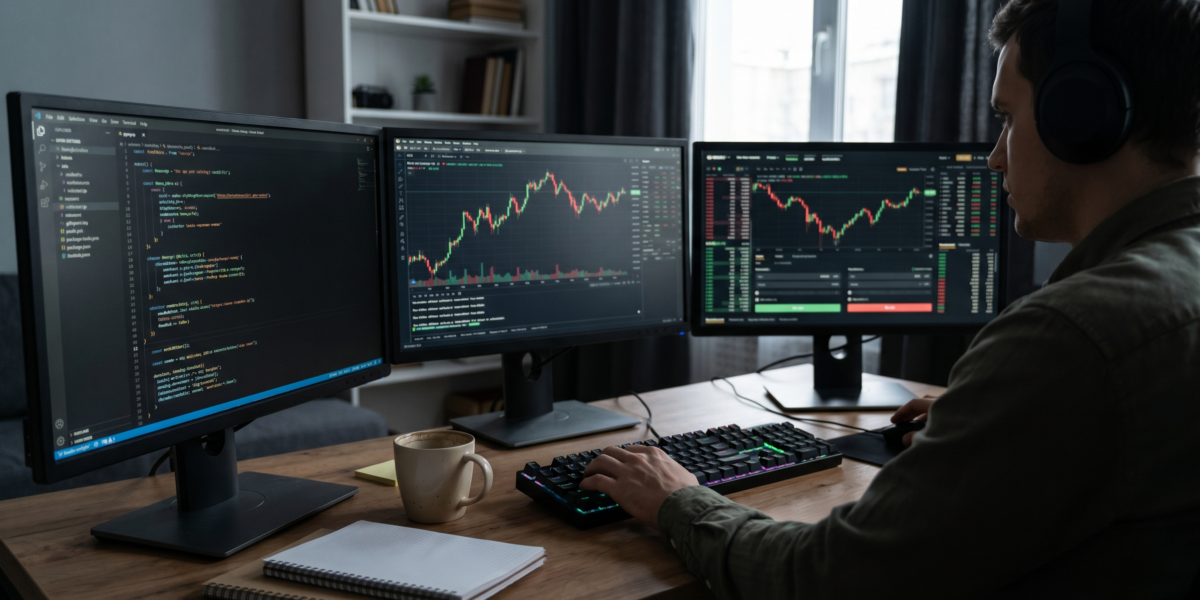
An AI trading bot in 2026 is a software program that utilizes artificial intelligence algorithms to analyze extensive market data, identify trading opportunities, and execute trades automatically. These systems have advanced significantly to offer enhanced user-friendliness, sophisticated analytical capabilities, and adaptability. Modern bots seamlessly integrate with various AI models, including local and cloud-based language models, for real-time sentiment analysis from diverse financial news and social media platforms. The most cutting-edge development is agent-native trading, where AI agents autonomously manage trades through standardized protocols.
What is an AI Trading Bot in 2026?

The 2026 AI Trading Bot Explained
An AI trading bot is a software program that uses artificial intelligence algorithms to analyze market data, identify trading opportunities, and execute trades automatically on behalf of a user. In 2026, these systems have evolved significantly with advancements in user-friendliness, sophisticated analysis capabilities, and market adaptability. Modern bots now integrate seamlessly with various AI models, including local and cloud-based language models, enabling real-time sentiment analysis from diverse sources like Bloomberg news feeds and social media platforms.
The key evolution in 2026 is the shift toward agent-native trading platforms where AI agents can operate with 100% automation. Platforms like AI-Trader allow major AI agents such as OpenClaw, nanobot, Claude Code, and Codex to register and trade automatically through standardized integration protocols like ai4trade.ai/SKILL.md. This represents a significant leap beyond traditional API-based trading systems.
TL;DR: AI Trading Bot Setup in 2026
Key Takeaways for AI Trading Bot Setup
- AI trading bot setup in 2026 emphasizes user-friendly platforms and automated strategy execution, making it accessible for beginners.
- Platforms like HaasOnline allow integration with local or cloud-based AI models for sophisticated sentiment analysis from sources like Bloomberg or X (Twitter).
- Specialized bots exist for different asset classes: Polymarket for prediction markets, MoneyFlare for managed stock trading, and 3Commas for crypto customization.
- Beginner-friendly options in 2026 include BulkQuant, Coinrule, Pionex, AriseAlpha, MoneyFlare, and StockHero, offering simplified AI quantitative trading and no-code automation. For more simplified automated investing, consider exploring AI Crypto and Stock Trading Apps.
- Advanced users can connect their AI agents to platforms like AI-Trader (ai4trade.ai/SKILL.md) to enable 100% fully-automated agent-native trading.
- Key criteria for selecting a bot in 2026 are platform stability, automation quality, market adaptability, beginner accessibility, and long-term usability.
- A typical setup involves selecting a pre-configured AI strategy, allocating funds, and allowing the system to optimize positions based on real-time market behavior.
Table of Contents: Your AI Trading Bot Journey
- What is an AI Trading Bot in 2026?
- TL;DR: AI Trading Bot Setup in 2026
- Key Takeaways: Maximizing Your AI Trading Bot Success in 2026
- AI Trading Bots Defined: What They Are and How They Evolved for 2026
- Why AI Trading Bots Matter Now: The 2026 Market Landscape
- How AI Trading Bots Work: A Step-by-Step Guide for 2026
- Real-World Examples & Use Cases of AI Trading Bots in 2026
- AI Trading Bots Comparison: Choosing the Right Platform for 2026
- Tools, Vendors & Implementation Paths for Your AI Trading Bot in 2026
- Costs, ROI & Monetization Upside with AI Trading Bots in 2026
- Risks, Pitfalls & Myths vs. Facts in AI Trading Bot Setup 2026
- AI Trading Bot Setup 2026: Frequently Asked Questions (FAQ)
- Glossary: Key Terms for AI Trading Bots in 2026
- References & Further Reading on AI Trading Bots 2026
Key Takeaways: Maximizing Your AI Trading Bot Success in 2026
Essential Insights for AI Trading Bot Deployment
- Agent-native trading represents the cutting edge of AI trading in 2026, with platforms like AI-Trader enabling complete automation through integration with specialized AI agents.
- Custom language model integration through platforms like HaasOnline allows for advanced sentiment analysis from traditional and non-traditional data sources.
- The “one tool vs. stacks” decision is critical – smart traders in 2026 often build specialized tool stacks rather than relying on single all-in-one solutions.
- Prediction market bots for platforms like Polymarket offer niche but significant opportunities beyond traditional crypto and stock trading.
- Holistic evaluation criteria should include platform stability, automation quality, market adaptability, beginner accessibility, and long-term usability – not just potential returns.
- Simple strategy setup has become a core strength for long-term investors, with platforms focusing on user experience and ease of adoption.
AI Trading Bots Defined: What They Are and How They Evolved for 2026
Decoding the AI Trading Bot: Core Principles
An AI trading bot is fundamentally a software program that uses artificial intelligence algorithms to analyze market data, identify trading opportunities, and execute trades automatically. The 2026 iteration of these systems represents a significant evolution from earlier versions, with enhanced capabilities in three key areas: sophisticated market analysis through advanced AI integration, improved user experience with simplified interfaces, and greater adaptability to various market conditions and trading styles.
The core functionality remains consistent – these systems continuously monitor market data, apply predefined or learned trading strategies, and execute trades without human intervention. However, the 2026 version incorporates more advanced machine learning techniques, deeper integration with external data sources, and more robust risk management protocols.
Key Components of a Modern AI Trading Bot
Modern AI trading bots consist of six essential components that work together seamlessly:
Data Ingestion Module: Responsible for collecting real-time market data from exchanges, news feeds, social media platforms, and alternative data sources. In 2026, this includes integration with platforms like Bloomberg Terminal data feeds and X (Twitter) API streams for comprehensive market intelligence.
AI Algorithms Engine: The core intelligence system employing machine learning (supervised and unsupervised learning), deep learning (neural networks), and natural language processing techniques. This component analyzes ingested data to identify patterns, predict market movements, and generate trading signals.
Strategy Module: Contains the trading rules and logic that determine when to enter and exit positions. In 2026, this includes both pre-configured strategies for beginners and customizable frameworks for advanced users, with options for strategy backtesting and optimization.
Risk Management System: Implements position sizing, stop-loss orders, take-profit targets, and other risk controls. Advanced systems in 2026 incorporate dynamic risk adjustment based on market volatility and portfolio performance metrics.
Execution Module: Handles the actual trade execution through API connections to cryptocurrency exchanges, stock brokers, or other trading venues. This component ensures fast, reliable order placement and management.
User Interface: Provides dashboard access for monitoring performance, adjusting parameters, and reviewing historical results. Modern interfaces prioritize simplicity and mobile accessibility while providing deep analytical capabilities for advanced users.
Modern AI Trading Bot Architecture
- Data Ingestion: Real-time feeds from exchanges, news (Bloomberg), social media (X/Twitter), alternative data.
- AI Algorithms Engine: Machine Learning (supervised/unsupervised), Deep Learning (NNs), Natural Language Processing.
- Strategy Module: Pre-configured trading rules, customizable frameworks, backtesting, optimization.
- Risk Management System: Position sizing, stop-loss, take-profit, dynamic risk adjustment.
- Execution Module: API connections to exchanges/brokers, order placement, and management.
- User Interface: Performance monitoring, parameter adjustment, historical results, mobile access.
Why AI Trading Bots Matter Now: The 2026 Market Landscape
Current Market Shifts Driving AI Trading Bot Adoption
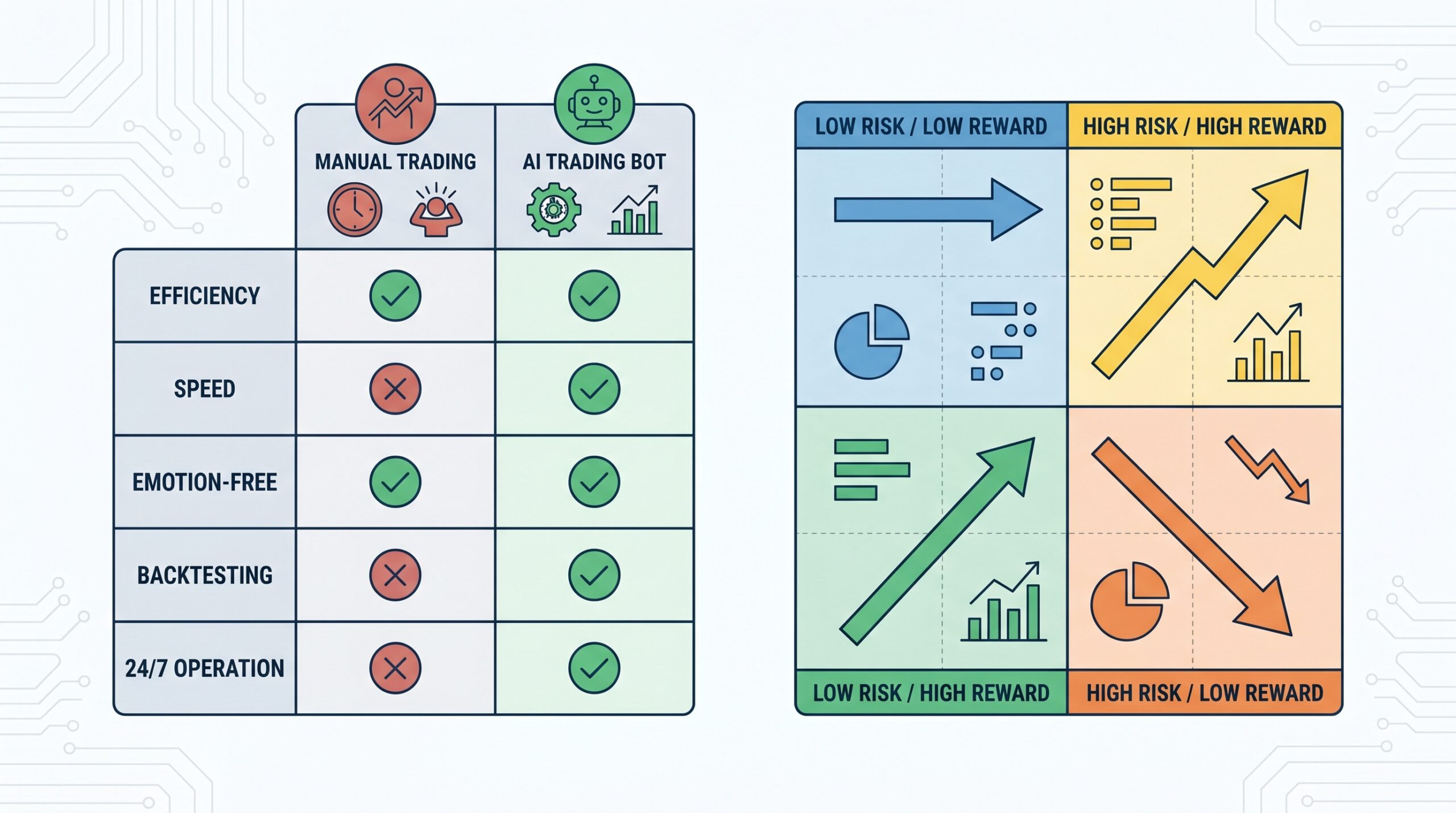
Several key market trends are accelerating AI trading bot adoption in 2026. Increased market volatility across all asset classes, driven by geopolitical uncertainty and rapid information dissemination, creates both opportunities and challenges that human traders struggle to navigate effectively. The sheer volume of market data now available – from traditional financial metrics to alternative data sources like social media sentiment and supply chain information – exceeds human processing capacity.
The demand for automated efficiency has grown significantly as traders seek to capitalize on opportunities across multiple markets and time zones without 24/7 manual monitoring. The rise of retail quant trading has democratized algorithmic strategies that were previously accessible only to institutional players with substantial resources. Learn more about market dynamics in What AI Predicted for 2026.
AI trading bots address these trends by providing continuous market monitoring, rapid data processing capabilities, emotion-free execution, and the ability to operate across multiple markets simultaneously. They represent a practical solution to information overload and the need for disciplined, systematic trading approaches.
Behavioral Changes: The Trader’s Evolution with AI
Trader behavior has evolved significantly with AI adoption. The shift from manual to automated trading represents more than just technological change – it reflects a fundamental rethinking of how trading decisions are made. Traders are moving from reactive approaches (responding to market events) to proactive strategies (anticipating market movements based on predictive analytics).
Emotional bias removal stands as one of the most significant benefits. Human traders often struggle with fear, greed, and other emotions that lead to suboptimal decisions. AI systems execute based on predefined logic regardless of market conditions, maintaining discipline during both favorable and challenging periods. This highlights one of the industries AI will take over by 2026.
The emergence of “agent-native trading” represents a paradigm shift in how traders interact with AI systems. Instead of manually configuring trading parameters, traders can now deploy specialized AI agents that autonomously manage trading activities. This evolution moves beyond simple automation to truly intelligent trading systems that adapt and learn from market conditions.
How AI Trading Bots Work: A Step-by-Step Guide for 2026
The AI Trading Bot Workflow: From Data to Execution
1. Data Collection: Modern AI trading bots ingest data from multiple sources in real-time. This includes price feeds from exchanges (cryptocurrency, stocks, forex), order book data, trading volumes, and time-series market data. Additionally, bots incorporate alternative data sources such as news feeds from Bloomberg, Reuters, or specialized financial news APIs; social media sentiment from platforms like X (Twitter), Reddit, and StockTwits; economic indicators from government and private sources; and even satellite imagery or supply chain data for certain trading strategies.
2. AI Analysis: The collected data undergoes sophisticated analysis using various AI techniques. Pattern recognition algorithms identify technical chart patterns and statistical anomalies. Predictive modeling uses machine learning to forecast price movements based on historical patterns and current market conditions. Natural language processing analyzes textual data from news and social media to gauge market sentiment. Deep learning neural networks process complex, non-linear relationships in market data that traditional models might miss.
3. Strategy Formulation: Based on the analysis, the bot identifies potential trading opportunities according to its programmed strategies. This involves calculating entry and exit points, position sizes, and timing parameters. Strategies can range from simple moving average crossovers to complex multi-factor models incorporating dozens of variables. The system evaluates potential trades against risk parameters and portfolio constraints before proceeding to execution.
4. Risk Management: Before any trade execution, the system applies rigorous risk controls. This includes position sizing based on portfolio percentage or volatility-adjusted metrics, setting stop-loss orders to limit potential losses, establishing take-profit targets to secure gains, and evaluating correlation impacts on the overall portfolio. Advanced systems dynamically adjust risk parameters based on changing market conditions and portfolio performance.
5. Trade Execution: The bot executes trades through API connections to exchanges and brokers. This involves placing market orders, limit orders, or more complex order types depending on the strategy. Execution algorithms may incorporate tactics to minimize market impact, such as volume-weighted average price (VWAP) strategies or implementation shortfall algorithms. The system monitors order status and manages partial fills or failed executions.
6. Performance Monitoring & Learning: After execution, the system continuously monitors trade performance and overall portfolio results. Machine learning algorithms analyze outcomes to identify improvements to strategies or parameters. The system may automatically adjust strategies based on performance data or market regime changes. This feedback loop creates a continuously improving trading system that adapts to evolving market conditions. This cycle of adaptation is a hallmark of OpenAI’s 2026 Breakthroughs in AI models.
AI Trading Bot Workflow Overview
-
- Data Collection: Real-time market data, order books, news feeds, social media sentiment, economic indicators.
-
- AI Analysis: Pattern recognition, predictive modeling (ML), sentiment analysis (NLP), deep learning for non-linear relationships.
-
- Strategy Formulation: Identifies opportunities, calculates entry/exit points, position sizes, timing based on programmed rules.
-
- Risk Management: Applies position sizing, stop-loss orders, take-profit targets, dynamic risk adjustment.
-
- Trade Execution: Executes trades via API, placing market/limit orders, optimizing for minimal market impact.
-
- Performance Monitoring & Learning: Continuously monitors trade outcomes, adjusts strategies based on performance, adapts to market changes.
Understanding AI Algorithms in Trading Bots
Machine Learning: Supervised learning algorithms use historical data with known outcomes to train predictive models. These can include regression models for price prediction or classification models for market direction forecasting. Unsupervised learning identifies patterns and relationships in data without predefined labels, useful for discovering novel market relationships or clustering similar market conditions.
Deep Learning: Neural networks, particularly recurrent neural networks (RNNs) and long short-term memory (LSTM) networks, excel at processing sequential data like time series. Convolutional neural networks (CNNs) can analyze visual chart patterns or process alternative data types. Transformer architectures, popular in natural language processing, are increasingly applied to financial time series data.
Natural Language Processing: Sentiment analysis algorithms process vast amounts of textual data from news articles, social media posts, and financial reports to gauge market sentiment. Named entity recognition identifies mentions of specific companies, products, or events. Topic modeling algorithms detect emerging themes or narratives that might impact markets.
Real-World Examples & Use Cases of AI Trading Bots in 2026
AI for Day Trading and Scalping Strategies
AI trading bots excel in high-frequency trading environments where speed and precision matter most. Day trading bots monitor short-term price movements, often operating on minute or second timeframes, to identify micro-opportunities that human traders would miss. These systems typically employ technical analysis patterns, order book analysis, and short-term sentiment indicators to make rapid trading decisions.
Scalping strategies take this further, aiming to profit from very small price movements through high-volume trading. AI bots for scalping require ultra-low latency connections to exchanges and sophisticated execution algorithms to minimize slippage. They often incorporate market-making strategies, providing liquidity while capturing bid-ask spreads.
Long-Term Portfolio Management with AI
For investors with longer time horizons, AI trading bots assist with portfolio construction, asset allocation, and periodic rebalancing. These systems analyze fundamental data, macroeconomic trends, and risk factors to optimize portfolio composition. They can automatically rebalance portfolios back to target allocations when market movements cause deviations.
Tax-loss harvesting represents another valuable application, where bots identify opportunities to realize losses that offset capital gains while maintaining similar market exposure. Some advanced systems incorporate goals-based investing, adjusting portfolio strategy based on specific investor objectives and time horizons.
Specialized AI Bots for Crypto and Prediction Markets
Cryptocurrency markets operate 24/7 with high volatility, making them ideal for AI trading strategies. Bots like those offered by 3Commas and Pionex provide specialized functionality for crypto trading, including arbitrage between exchanges, market-making strategies, and volatility-based trading approaches. For a deeper dive into this area, explore The State of Crypto Trading Automation in 2026.
Prediction markets like Polymarket represent a growing niche where AI bots can automate trading based on event outcomes. These systems analyze probability shifts in prediction markets and can hedge positions across related markets. For example, a bot might trade political prediction markets while simultaneously taking positions in related currency or equity markets.
Sentiment-Driven Trading: AI Analyzing News and Social Media
Sentiment analysis bots process vast amounts of textual data from news sources, social media platforms, and financial reports to gauge market sentiment. Platforms like HaasOnline can integrate with local or cloud-based language models to scan Bloomberg news feeds or X (Twitter) posts for sentiment indicators.
These systems typically use natural language processing to classify text as positive, negative, or neutral toward specific assets or the market overall. Advanced systems incorporate nuance recognition, detecting sarcasm, uncertainty, or mixed sentiment. The resulting sentiment scores feed into trading algorithms that might, for example, increase long positions when sentiment turns unexpectedly positive or implement hedging strategies during periods of extreme negative sentiment.
AI Trading Bots Comparison: Choosing the Right Platform for 2026
Beginner-Friendly AI Trading Bot Platforms
BulkQuant: Focuses on simplified AI quantitative trading with low-maintenance strategy management. The platform offers pre-configured strategies that automatically adjust to market conditions, making it ideal for users who want automated trading without deep technical knowledge.
Coinrule: Remains one of the most accessible entry points for beginners seeking simple AI trading apps or no-code crypto automation tools. The platform features an intuitive drag-and-drop interface for creating trading rules without programming knowledge.
Pionex: Helped democratize crypto trading bots by integrating them directly into the exchange interface. Users can access multiple built-in bot strategies with minimal configuration required.
AriseAlpha: Noted for high automation and user-friendly design, suitable for beginners focused on passive income generation. The platform emphasizes simplicity with automated strategy selection and management.
MoneyFlare: Recommended as a top option for beginners in 2026 for managed AI stock trading. The platform makes AI trading easier to understand, activate, and manage with simplified portfolio management tools.
StockHero: Designed for simple bot creation specifically for stock trading. The platform offers straightforward strategy creation tools with educational resources tailored for novice users.
Advanced AI Trading Bot Solutions for Experienced Users
HaasOnline: Offers advanced trading capabilities with custom AI model integration. The platform allows connection to local or cloud-based language models for sophisticated sentiment analysis from sources like Bloomberg or X (Twitter). Users can develop complex trading strategies with extensive customization options.
AI-Trader: Represents the cutting edge of agent-native trading, supporting major AI agents such as OpenClaw, nanobot, Claude Code, and Codex for 100% fully-automated trading. The platform requires agents to register via ai4trade.ai/SKILL.md protocol, enabling truly autonomous trading operations.
Trade Ideas: Recommended for advanced users focusing on stock trading customization. The platform provides extensive screening tools, alert systems, and strategy backtesting capabilities for developing sophisticated equity trading strategies.
3Commas: Offers extensive customization options for crypto trading with advanced order types, portfolio management tools, and strategy development capabilities. The platform caters to experienced traders who want fine-grained control over their trading algorithms.
AI Trading Bot Comparison Table: 2026 Overview
| Platform | Primary Focus | Market Support | Accessibility | Unique Feature |
|---|---|---|---|---|
| HaasOnline | Advanced strategies, custom AI integration | Likely broad based on custom integration | Intermediate to Advanced | Hooks to local/cloud LMs for sentiment analysis |
| AI-Trader | Agent-native trading, full automation | Supports all major AI agents | Advanced | 100% fully-automated agent-native trading |
| BulkQuant | Simplified AI quantitative trading | Unspecified | Beginner-friendly | Low-maintenance strategy management |
| Coinrule | No-code crypto automation | Crypto | Beginner-friendly | Easiest starting point for simple AI trading apps |
| Pionex | Integrated crypto trading bots | Crypto | Beginner-friendly | Bots integrated directly into the exchange |
| AriseAlpha | Passive income and simplicity | Likely crypto based on mentions | Beginner-friendly | High automation and user-friendly design |
| MoneyFlare | Managed AI stock trading | Stocks | Beginner-friendly | Makes AI trading easier to understand and manage |
| StockHero | Simple bot creation | Stocks | Beginner-friendly | Focus on simple bot creation |
| Trade Ideas | Customization | Stocks | Advanced Users | Extensive customization for stock trading |
| 3Commas | Customization | Crypto | Advanced Users | Extensive customization for crypto trading |
Tools, Vendors & Implementation Paths for Your AI Trading Bot in 2026
Top AI Trading Bot Platforms and Their Specialties
HaasOnline: Specializes in advanced trading strategies with custom AI model integration. The platform excels at connecting external language models for sophisticated sentiment analysis from traditional and and alternative data sources. Users can develop highly customized trading systems with extensive parameter control and strategy optimization tools.
AI-Trader: Focuses on agent-native trading ecosystems where AI agents operate with full autonomy. The platform supports major AI agents including OpenClaw, nanobot, Claude Code, and Codex through standardized integration protocols. This approach represents the most advanced form of AI trading automation available in 2026.
BulkQuant: Targets users seeking simplified quantitative trading approaches with minimal maintenance requirements. The platform offers pre-configured strategies that automatically adapt to market conditions, making complex quantitative techniques accessible to non-experts.
Coinrule: Provides the most accessible entry point for beginners with its no-code approach to trading automation. The platform’s drag-and-drop interface allows users to create sophisticated trading rules without programming knowledge, particularly focused on cryptocurrency markets.
MoneyFlare: Specializes in managed AI stock trading with emphasis on user understanding and ease of management. The platform simplifies portfolio construction and management through AI-driven allocation and rebalancing strategies.
Connecting Your AI Agents: The AI-Trader Ecosystem
The AI-Trader platform represents a paradigm shift in how traders interact with AI systems. Instead of manually configuring trading parameters, users connect specialized AI agents that operate autonomously within the trading environment. These agents register through the ai4trade.ai/SKILL.md protocol, which standardizes how AI systems interact with trading platforms.
Major AI agents compatible with AI-Trader include:
- OpenClaw: Specializes in volatility-based strategies and market regime detection
- nanobot: Focuses on high-frequency trading and micro-structure analysis
- Claude Code: Excels at natural language processing for sentiment-driven strategies
- Codex: Provides advanced technical analysis and pattern recognition capabilities
This ecosystem approach allows traders to leverage specialized AI capabilities without developing expertise in each area. The platform handles position management, risk controls, and execution while the AI agents provide trading signals and strategy recommendations. This is a core aspect of the OpenAI AGI Shift and How to Position Yourself.
Implementation Paths: From No-Code to Custom Code
No-Code Solutions: Platforms like Coinrule, Pionex, and AriseAlpha offer pre-built strategies that users can activate with minimal configuration. These solutions typically provide dashboard interfaces where users select strategies, set parameters like investment amount and risk level, and monitor performance. Implementation involves creating an account, connecting exchange APIs, allocating funds, and activating strategies.
Custom AI Integration: Intermediate users can leverage platforms like HaasOnline that allow integration with custom AI models. This path involves developing or selecting language models for sentiment analysis, configuring data feeds, and creating trading rules based on model outputs. Implementation requires technical knowledge of API integration and model deployment but doesn’t necessitate full coding expertise.
Agent-Native Systems: Advanced implementation involves platforms like AI-Trader where users connect specialized AI agents that operate autonomously. This path requires understanding agent capabilities, registration protocols, and performance monitoring but minimal ongoing configuration. The agents handle strategy development and adaptation automatically.
Full Custom Development: For institutions or highly technical users, developing custom trading bots using programming languages like Python with libraries such as TensorFlow, PyTorch, or specialized financial libraries represents the most flexible approach. This path requires significant development resources but offers complete control over trading logic and infrastructure.
AI Trading Bot Implementation Paths
-
- No-Code Solutions: Beginner-friendly, pre-built strategies, dashboard interfaces (e.g., Coinrule, Pionex, AriseAlpha).
-
- Custom AI Integration: Intermediate, integrate custom AI models, sentiment analysis, data feeds (e.g., HaasOnline).
-
- Agent-Native Systems: Advanced, connect specialized AI agents for autonomous operation (e.g., AI-Trader ecosystem).
-
- Full Custom Development: Expert-level, programming with Python, TensorFlow, PyTorch for complete control, significant resources required.
Costs, ROI & Monetization Upside with AI Trading Bots in 2026
AI Trading Bot Setup Guide 2026: Complete Guide to Automated Trading Success Framework 3
- Signal: What changed and why this matters now.
- Decision framework: Compare options by cost, risk, and implementation effort.
- Execution checklist: Concrete next step and measurable outcome.
Understanding the Costs of AI Trading Bot Setup and Operation
Subscription Fees: Most platforms charge monthly or annual subscription fees ranging from $19-$299 per month depending on features and trading volume limits. Advanced platforms with custom AI integration capabilities typically sit at the higher end of this range.
Development Costs: For custom solutions, development costs can range from $5,000-$50,000+ depending on complexity. This includes strategy development, backtesting infrastructure, and integration with data sources and exchanges.
Exchange Fees: Trading bots generate exchange fees on each transaction. These typically range from 0.1%-0.5% of trade value depending on the exchange and trading volume. High-frequency strategies can accumulate significant fees despite small percentages.
Data Costs: Access to premium data sources like Bloomberg terminals, specialized news feeds, or alternative data providers can cost $1,000-$5,000+ monthly. Some platforms include basic data access in their subscription fees.
Infrastructure Costs: Running bots 24/7 requires reliable server infrastructure. Cloud hosting costs typically range from $50-$500 monthly depending on computing requirements and data storage needs.
Calculating Return on Investment (ROI) for AI Trading
ROI calculation for AI trading bots must account for multiple factors beyond simple profit percentages. The formula should incorporate:
ROI = (Net Profit – Total Costs) / Capital Invested
Net profit includes trading gains minus all associated costs (subscription fees, exchange fees, data costs, etc.). Capital invested refers to funds allocated to trading strategies rather than total portfolio value.
Realistic ROI expectations vary significantly based on strategy, market conditions, and risk parameters. Conservative strategies might target 5-15% annual returns after costs, while aggressive approaches might aim for higher returns with corresponding risk increases. Historical backtesting provides guidance but doesn’t guarantee future performance.
Critical factors influencing ROI include:
- Strategy effectiveness in current market conditions
- Risk management implementation and drawdown control
- Capital allocation efficiency
- Cost structure optimization
- Market volatility and opportunity availability
Monetization Upside: Beyond Personal Gains
Strategy Development and Sales: Successful traders can package and sell their proven trading strategies through marketplace platforms. Premium strategies with proven track records can command prices ranging from $100-$5,000+ depending on performance history and complexity.
Fund Management: Traders with consistently successful algorithms can manage funds for other investors, typically charging management fees (1-2% of assets annually) plus performance fees (10-20% of profits). This requires regulatory compliance and appropriate licensing.
Signal Provisioning: Providing trading signals to other traders through subscription services represents another monetization path. Signal services typically charge $50-$300 monthly depending on signal frequency and historical accuracy.
Platform Development: For technically skilled traders, developing custom platforms or tools for other traders can create revenue streams. This might include specialized indicators, risk management tools, or integration utilities.
Educational Content: Creating courses, tutorials, or consulting services around successful trading strategies can generate revenue while helping other traders improve their results.
Risks, Pitfalls & Myths vs. Facts in AI Trading Bot Setup 2026
What Can Go Wrong: Common Risks in AI Trading Bot Use
Over-reliance on Pre-configured Strategies: Using strategies without understanding underlying mechanics can lead to significant losses when market conditions change. Many traders activate popular strategies without comprehending their risk profiles or performance characteristics.
Misconfigured Bot Settings: Incorrect parameter settings can cause unintended trading behavior. Common issues include excessive position sizes, inappropriate stop-loss levels, or incorrect signal interpretation that leads to unintended trades.
Market Volatility Losses: Even well-designed bots can experience losses during extreme market conditions. Flash crashes, liquidity crises, or unexpected news events can trigger rapid price movements that exceed risk management parameters.
Security Vulnerabilities: API connections to exchanges create potential security risks. Poor key management, insecure storage, or platform vulnerabilities can lead to unauthorized access and fund theft. For insights into cybersecurity, refer to AI News Roundup, 2026-05-10.
Emotional Decision Overrides: Traders often override bot logic during stressful market conditions, typically making poor decisions driven by fear or greed. This defeats the purpose of automated trading and often results in worse outcomes than fully automated approaches.
Outdated Information Analysis: Bots relying on external data feeds may act on stale or incorrect information. Delayed news feeds, API outages, or incorrect sentiment analysis can lead to poor trading decisions.
Common Mistakes Even Experienced Traders Make
Insufficient Backtesting: Deploying strategies without thorough historical testing across various market conditions. Proper backtesting should include multiple market regimes, stress testing under extreme conditions, and out-of-sample validation.
Ignoring Risk Management: Focusing on potential profits while neglecting proper risk controls. This includes inadequate position sizing, missing stop-loss orders, or failing to consider correlation risks within portfolios.
Complexity Over Simplicity: Choosing overly complex strategies when simpler approaches would perform better. Complexity often introduces additional failure points without corresponding performance benefits.
Chasing Profits Without Stability: Selecting strategies based solely on historical returns without considering stability, drawdown characteristics, or market adaptability. High returns often come with corresponding high risk that may not align with investor objectives.
Inadequate Performance Monitoring: Failing to regularly review bot performance and adjust parameters. Markets evolve, and strategies that worked previously may become ineffective under new conditions.
Assuming Guaranteed Profits: Treating bots as profit guarantees rather than tools that enhance trading efficiency. No trading system can guarantee profits, and all involve risk of loss.
What Most People Get Wrong About AI Trading Bots
Myth: AI trading bots guarantee continuous profits.
Fact: Bots are tools that execute strategies efficiently but cannot eliminate market risk. Even well-designed strategies experience losing periods, and all trading involves potential loss of capital.
Myth: Once set up, AI bots require no maintenance or monitoring.
Fact: Bots require regular monitoring to ensure proper operation, adapt to changing market conditions, and address technical issues. Market regimes change, and strategies may need adjustment to remain effective.
Myth: All AI trading bots are equally effective across all market conditions.
Fact: Bot performance varies significantly based on strategy design, market conditions, and implementation quality. Different bots excel in different environments, and no single solution performs optimally in all circumstances.
Myth: Free AI bots are as powerful and reliable as paid, advanced solutions.
Fact: Free bots typically offer limited functionality, basic strategies, and restricted access to premium features. Advanced capabilities, sophisticated risk management, and reliable infrastructure typically require paid subscriptions.
Myth: You need to be an expert coder to use an AI trading bot in 2026.
Fact: Modern platforms offer no-code and low-code solutions that make bot usage accessible to non-technical users. While coding knowledge enables deeper customization, it’s not required for basic implementation.
FAQ
Which AI is best to build a trading bot?
The “best” AI for building a trading bot in 2026 depends on your specific needs: for advanced sentiment analysis, integrating local or cloud-based language models with platforms like HaasOnline is effective. For agent-native trading, platforms like AI-Trader support major AI agents such as OpenClaw and Claude Code.
Do AI trading bots actually work?
Yes, AI trading bots can work by automating trades, performing rapid market analysis, and executing strategies with consistency. Their effectiveness, however, relies on proper configuration, robust strategy, adaptability to market conditions, and realistic expectations regarding returns and risks.
Can ChatGPT code a trading bot?
While ChatGPT (or similar large language models) can generate code for trading bots, simply porting that code without thorough understanding, testing, and integration knowledge is risky. Specialized platforms like AI-Trader allow AI agents to join, but direct coding for live trading requires expertise beyond just generating code. For additional context on AI capabilities, see Inside OpenAI’s 2026 Breakthrough.
What is the average return of AI trading bots?
There is no single average return for AI trading bots, as performance widely varies based on the bot’s strategy, market conditions, asset class, risk management, and the user’s trading expertise. Reputable sources do not provide a blanket average return, as it can range from negative returns to significant profits, emphasizing that bots are tools, not guarantees.
Glossary: Key Terms for AI Trading Bots in 2026
AI Trading Bot Definitions
AI Trading Bot: A software program that uses artificial intelligence algorithms to analyze market data, identify trading opportunities, and execute trades automatically on behalf of a user.
Sentiment Analysis: The process of computationally identifying and categorizing opinions expressed in a piece of text to determine the writer’s attitude toward a particular topic, often used by AI bots to gauge market sentiment from news feeds or social media.
Polymarket: A decentralized information market platform where users can bet on the outcome of future events, which can be automated with AI trading bots.
Quantitative Trading: A trading strategy that relies on mathematical models and computational tools to identify trading opportunities, often employed by AI bots for high-frequency or complex strategies.
No-Code Automation: Tools or platforms that allow users to create and deploy trading strategies without writing any programming code, simplifying the setup process for non-technical traders.
Agent-Native Trading: A trading approach where specialized AI agents operate with full autonomy within trading platforms, making decisions and executing trades without human intervention.
Backtesting: The process of testing a trading strategy using historical data to evaluate how it would have performed during past market conditions.
API (Application Programming Interface): A set of protocols and tools that allows different software applications to communicate with each other, used by trading bots to connect with exchanges and data sources.
References & Further Reading on AI Trading Bots 2026
Cited Sources for AI Trading Bot Information
-
- HaasOnline trading core and language model integration capabilities (exmon.pro, 2026)
-
- AI-Trader platform specifications and agent integration protocols (github.com/HKUDS/AI-Trader, 2026)
-
- BulkQuant beginner-friendly features and strategy management (ventureburn.com, 2026)
-
- Coinrule accessibility and no-code automation approach (ambcrypto.com, 2026)
-
- Pionex exchange-integrated bot functionality (ambcrypto.com, 2026)
-
- AriseAlpha automation and user experience design (memeburn.com, 2026)
-
- MoneyFlare managed stock trading capabilities (blocktelegraph.io, 2026)
-
- StockHero simple bot creation features (beingshivam.com, 2026)
-
- Long-term investor bot requirements (ambcrypto.com, 2026)
-
- AI-Trader SKILL.md integration protocol (ai4trade.ai/SKILL.md)
-
- Bloomberg news feed API documentation
-
- X (Twitter) developer platform and API specifications