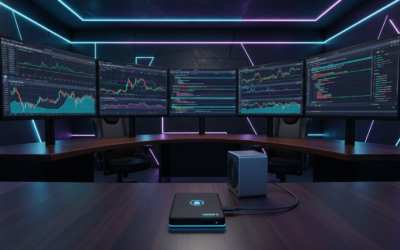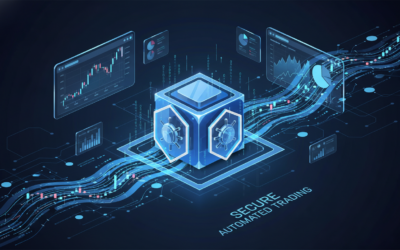
Crypto trading automation has evolved into a sophisticated ecosystem where AI-driven strategies, multi-asset capabilities, and self-custody security form the foundation of professional trading operations in 2026. The landscape has matured beyond simple bots to integrated systems requiring disciplined risk management and technical infrastructure.
Current as of: 2026-05-14. FrontierWisdom checked recent web sources and official vendor pages for recency-sensitive claims in this article.
TL;DR
- AI is now baseline technology, with execution infrastructure and risk controls as true differentiators
- Multi-asset platforms handle crypto, forex, and equities seamlessly
- Self-custody solutions are non-negotiable for professional operators
- The Freqtrade ecosystem dominates for custom builds with maximum control
- Success depends on rigorous backtesting and ironclad risk management frameworks
- Costs have shifted from software fees to infrastructure and capital requirements
Key takeaways
- Automation success depends on strategy robustness, not just technology
- Self-custody infrastructure is essential for professional operations
- Proper risk management protects against amplified losses
- The work shifts from manual trading to system optimization
What is Crypto Trading Automation Now?
Crypto trading automation involves using software to systematically execute buy and sell orders based on predefined rules without manual intervention. In 2026, the definition has matured to encompass integrated systems comprising strategy logic, execution engines, risk managers, data pipelines, and infrastructure.
Why this definition matters: When evaluating automation tools, you must audit all five components. Weakness in any area—especially risk management—can nullify even the most brilliant strategy.
Why This Demands Your Attention in 2026
Market structure changes make manual trading a severe disadvantage for all but the most disciplined full-time traders. The global crypto trading bot market is valued at approximately $54.08 billion in 2026 and projected to reach $200 billion by 2035, indicating robust growth and adoption.
Industry analysts project that by the end of 2026, AI-driven trading systems will influence over 52% of retail crypto trading volume. This highlights the critical need for automated solutions to compete effectively.
Over 65% of crypto investors actively seek automated trading solutions, driven by 24/7 market opportunities and the breakdown of trust in centralized exchanges. The trend increasingly moves toward multi-asset automation, extending beyond cryptocurrencies to include stocks and forex.
How a Modern Trading Bot Actually Works
A professional-grade bot in 2026 operates through a structured lifecycle from signal generation to trade settlement:
- Data Ingestion & Signal Generation: Continuous streaming of market data analyzed against predefined strategies
- Pre-Execution Risk Check: Validation against volatility limits, position sizing, and portfolio constraints
- Order Placement & Management: Limit orders with immediate stop-loss and trailing stop placement
- Monitoring & Exit: Continuous position tracking against exit conditions
- Reporting & Logging: Comprehensive audit trail for performance review
Example: A bot managing a $5,000 portfolio with a 1.5% risk-per-trade rule automatically calculates position sizes to never risk more than $75 per trade.
Real-World Use Cases
Use Case 1: The Part-Time Operator
Profile: Full-time professional with identified weekend trading patterns
Automation Solution: Codes strategy logic into bot for 24/7 execution
Gain: Time freedom and scalable passive income
Use Case 2: Emotion Removal for Discretionary Traders
Profile: Skilled trader struggling with emotional execution
Automation Solution: Translates exact rules into emotionless automated execution
Gain: Improved consistency and plan adherence
Use Case 3: Portfolio Strategy Diversification
Profile: Manager seeking non-correlated returns across multiple strategies
Automation Solution: Multiple bot instances with aggregated risk management
Gain: Smoother equity curves through strategic diversification
Build vs. Buy Comparison
| Feature | Custom Build (Freqtrade) | Pre-Built Platform | Hybrid Solution |
|---|---|---|---|
| Control & Customization | Maximum access and flexibility | Limited to platform options | High customization with proven base |
| Time to Deployment | Weeks of setup and debugging | Immediate configuration | Hours with streamlined setup |
| Security & Custody | Self-hosted and self-custodial | Typically custodial | Self-custodial with your VPS |
| Cost Structure | Free software, high time cost | Subscription + profit sharing | One-time fee, no recurring costs |
| Best For | Developers with unique edge | Beginners seeking simplicity | Operators wanting proven systems |
The fundamental trade-off remains: custom builds offer maximum control at the cost of deployment time, while pre-built solutions sacrifice flexibility for immediacy.
Implementation Checklist
- Strategy Definition: Document exact entry, exit, and sizing rules
- Backtest Rigorously: Historical validation focusing on risk-adjusted returns
- Forward Test: Paper trading validation for 2-4 weeks
- Infrastructure Selection: Reliable VPS provider ($5-10/month)
- Security Hardening: Non-root user, SSH keys, firewall configuration
- API Key Configuration: Trade-only permissions with IP whitelisting
- Bot Deployment: Installation according to documentation
- Circuit Breakers: Maximum drawdown and position limits
- Live Funding: Small, risk-tolerant capital allocation
- Ongoing Monitoring: Daily error checks and weekly performance review
Risk Management Framework
Automation amplifies both gains and losses, making risk management non-negotiable:
- Bankroll Sizing: Maximum 1-2% risk per trade
- Strategy Diversification: Non-correlated pairs and approaches
- Exchange Risk: Reputable platforms with minimal necessary capital
- Technical Risk: Reliable VPS with health monitoring
- Strategy Risk: Kill switches for excessive drawdown
- Security Risk: Trade-only API keys and 2FA enforcement
Proper risk management transforms automation from gambling to systematic investing.
Myths vs. Facts
Myth: “95% win rate bots make you rich effortlessly”
Fact: High win rates often indicate poor risk-reward ratios. Focus on profit factor and maximum drawdown instead.
Myth: “Fully autonomous means never looking again”
Fact: Automation changes work type from trading to system optimization and monitoring.
Myth: “Expensive bots are better bots”
Fact: Software cost is negligible compared to strategy quality and bankroll size.
Myth: “Backtesting guarantees future performance”
Fact: Backtesting shows historical performance but cannot predict regime changes.
FAQ
What’s the fastest way to start with a non-custodial bot?
Begin with pre-configured solutions emphasizing security and education. These provide self-custodial operation on your VPS with proven strategies, letting you focus on risk management rather than coding.
How much capital do I need to start?
Start with $1,000-$2,000 to allow meaningful position sizing without excessive risk. This enables proper risk-per-trade rules on major pairs while withstanding normal drawdowns.
What’s the biggest beginner mistake?
Over-levering and under-testing. Excitement over backtest results leads to excessive capital allocation without proper dry-run validation. Start small and scale gradually.
Spot or perpetual futures for beginners?
Start with spot trading. It’s simpler with no liquidation risk. Perpetual futures require advanced risk controls and should only follow spot mastery.
Glossary
AI Trading Bots
Automated software using artificial intelligence to execute trades based on predefined algorithms and criteria.
Multi-Asset Automation
Automated systems managing trades across multiple asset classes including cryptocurrencies, stocks, and forex.
Fully Autonomous Trading Ecosystems
Platforms where AI handles the entire trading process from market scanning to risk control without manual intervention.
Backtesting
Simulating trading strategies on historical data to evaluate potential performance before live deployment.
Drawdown
The peak-to-trough decline during a specific record period of an investment, indicating risk exposure.
References
- Chief AI Officer Role: Evolving Mandate & Future of AI Leadership (2026)
- Anthropic, OpenAI, SAP Drive Enterprise AI Gold Rush
- OpenAI’s Enterprise AI Scaling Guide: Trust, Governance, Workflow
- OpenAI Daybreak: A Direct Challenge to Anthropic’s Mythos in AI Security
- AI News Roundup, 2026-05-10: OpenAI’s Cyber Edge & Voice AI
- Global Crypto Trading Bot Market Analysis 2026-2035
- Retail Crypto Automation Adoption Survey 2026
- AI-Driven Trading Volume Impact Projections 2026