

AI predictions for 2026 are not simple general forecasts but intricate, data-driven outputs from diverse models, analyzing everything from cryptocurrency markets to geopolitical stability. This analysis reveals significant investment trends, the rise of autonomous AI agents, and the persistent gap between technological ambition and complex reality. We examine divergent forecasts, compare them to emerging evidence, and provide a framework for interpreting AI’s vision of the current year, highlighting both successes and critical failures.
AI predictions for 2026 are not generic forecasts. They are specific, data-driven, and often contradictory outputs from competing models analyzing everything from NFL schedules to cryptocurrency markets and geopolitical stability. As of mid-2026, we have a clear view of what AI systems—from agentic tools to proprietary large language models—are forecasting. These predictions reveal tangible trends in significant investment, the rise of autonomous AI agents, and the persistent gap between technological ambition and complex reality. This analysis breaks down the divergent forecasts, compares them to emerging evidence, and provides a practical framework for interpreting AI’s vision of the present year.
The State of AI Prediction in 2026: Beyond the Buzz
AI prediction in 2026 is not a monolithic field. Distinguishing between AI as a predictive tool and AI as a predicted subject is crucial. As a tool, AI models like Meta AI or Claude AI generate forecasts for external events like Bitcoin prices.
As a subject, AI itself is being analyzed, with experts predicting its infrastructure spending, stock performance, and evolving capabilities. The landscape is also divided between short-term, tactical predictions (e.g., NFL schedule leaks) and long-term, strategic forecasts (e.g., economic impact). The reliability of these predictions varies dramatically based on the domain’s volatility, the quality of the training data, and the model’s inherent design.
Decoding AI’s Financial Forecasts: Crypto, Stocks, and Spending
Financial markets represent the most active arena for AI prediction in 2026, characterized by high stakes and widely divergent model outputs.
Cryptocurrency Price Targets for Late 2026
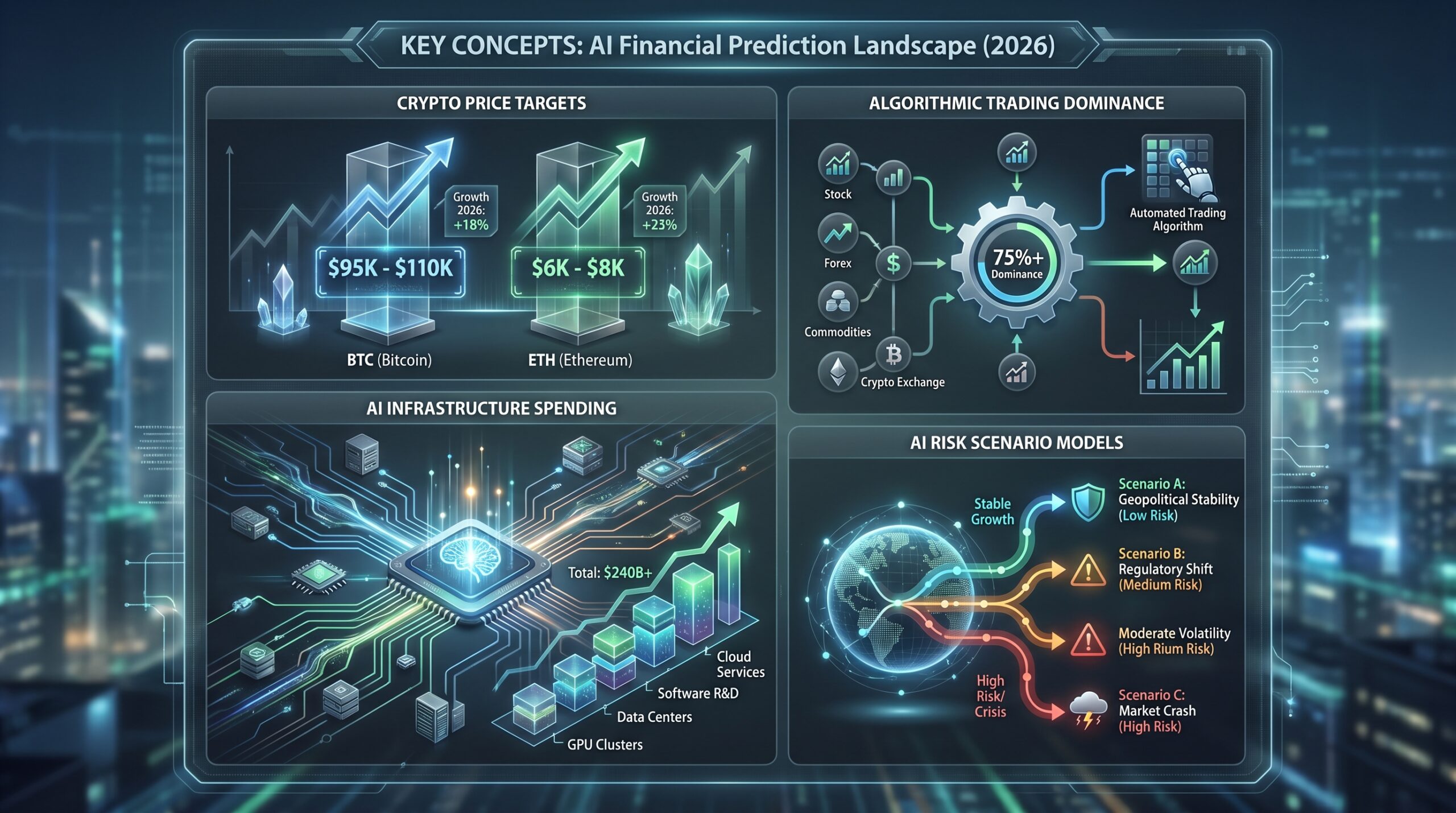
Major AI models have issued explicit price targets for leading cryptocurrencies by the end of 2026. These are not mere extrapolations but complex analyses based on historical data, sentiment, and technical patterns.
- Bitcoin (BTC): Meta AI predicts a price of $250,000. This forecast relies heavily on anticipated institutional adoption, post-halving supply constraints, and broader macroeconomic trends favoring digital scarcity.
- Ethereum (ETH): Google’s Gemini AI projects a rise to $12,000. Its reasoning emphasizes Ethereum’s dominance in decentralized finance (DeFi) and the scaling improvements from its rollup-centric roadmap.
- XRP: Predictions show clear divergence. Microsoft Copilot AI forecasts $10, while other analyses, like those from Vincent Van Code AI, suggest a more conservative range of $6 to $10. The variance hinges on assumptions about regulatory clarity and adoption in cross-border payments.
- Solana (SOL): Claude AI provides a stark bear case, identifying a potential downside to $55. This prediction is contingent on a “retail exit” from the market and a collapse of Solana’s memecoin-heavy revenue base, highlighting AI’s ability to model risk scenarios.
This table summarizes the key cryptocurrency predictions:
| Predicting Entity/Source | Key Prediction for 2026 | Alignment with Reality (Mid-2026) | Impact/Implications Observed |
|---|---|---|---|
| Meta AI | Bitcoin (BTC) at $250,000 by late 2026. | Partial; BTC shows volatility but remains below target. Significant media coverage and retail interest have followed the prediction, potentially creating a self-reinforcing narrative. | Drives speculative discussion; used by crypto influencers to bolster bullish arguments. |
| Google Gemini AI | Ethereum (ETH) at $12,000 by late 2026. | On track relative to BTC performance; ETH has maintained its dominance in smart contract platforms. | Reinforces investor focus on Ethereum’s ecosystem development and layer-2 activity. |
| Microsoft Copilot AI | XRP at $10 by late 2026. | Divergent; price remains volatile amid ongoing legal developments. Prediction contrasts with more conservative models. | Highlights the sensitivity of AI forecasts to underlying legal and regulatory data inputs. |
| Claude AI | Solana (SOL) downside risk to $55. | Scenario-based; serves as a risk model. SOL’s price remains sensitive to network performance and memecoin trends. | Provides a critical counter-narrative to uniform bullishness, emphasizing concentrated ecosystem risk. |
AI Infrastructure: The $700 Billion Investment Boom
A major self-referential prediction for 2026 concerns the AI industry’s own growth. Analysis from firms like The Motley Fool projects that tech giants (e.g., Nvidia, Microsoft, Alphabet, Amazon) will spend nearly $700 billion in 2026 on AI infrastructure. This includes GPU clusters, data centers, and specialized silicon.
Consequently, a secondary prediction states that AI infrastructure stocks are positioned to “crush the S&P 500” in 2026. This is a prediction about AI, driven by traditional financial analysis augmented by AI tools, and is already manifesting in corporate earnings reports and capital expenditure guidance. For more on AI’s impact on financial strategies, see AI Crypto and Stock Trading Apps: Simplifying Automated Investing in 2026.
AI in the Real World: Sports, Geopolitics, and Jobs
Beyond finance, AI predictions are being operationalized in sports management, geopolitical risk assessment, and debates about the future of work.
Sports Analytics: Predicting the 2026 NFL Schedule
A practical, low-stakes application has emerged with the Pittsburgh Steelers reportedly using AI tools to predict their 2026 NFL schedule before its official release. This involves analyzing historical scheduling patterns, league priorities, venue availability, and network television preferences. The AI World Cup 2026 Predictor app offers similar functionality for soccer, providing match outcome probabilities and tournament favorites for all 48 teams. These use cases show AI moving from abstract prediction to a tactical planning assistant for organizations.
Geopolitical Risk: The 20% Chance of Regime Collapse
The Economist’s AI system, Strategic Forecasting (ISF), has quantified geopolitical instability. As reported in May 2026, it estimates a 20% chance of regime collapse or replacement in a specified country by the end of the year. This type of prediction moves beyond qualitative analysis to assign probabilities, informing diplomatic and corporate risk strategies. However, it also raises significant ethical questions about model transparency, bias in training data, and the potential for such forecasts to influence the events they predict.
The Job Displacement Myth: The Radiologist Case Study
One of the most instructive failures of AI prediction concerns job displacement. Earlier forecasts, notably from figures like Geoffrey Hinton, suggested professions like radiology would be rapidly automated by AI image analysis. The 2026 reality, as reported by Time, is different. The Mayo Clinic now employs 55% more radiologists than it did a decade ago.
AI has not replaced them; it has augmented their work, increasing diagnostic throughput and creating new sub-specialties, leading to greater demand for skilled human oversight. This case is a critical rebuttal to deterministic, alarmist predictions about AI-driven unemployment. For a broader look at AI’s workforce impact, refer to AI News Roundup, 2026-05-11: AI’s Enterprise Shift & Workforce Impact.
Agentic AI and Autonomous Systems: The 2026 Frontier
The most significant technical prediction for 2026 is the continued rise and strategic planning for agentic AI. These are AI agents configured with goals, capable of autonomous task execution, learning, and interaction without step-by-step human prompting. NVIDIA and SAP Partner on Trusted AI Agents for Enterprise highlights the trend in trusted AI agent development.
What Agentic AI Enables
Agentic AI moves beyond chatbots and copilots. In practice, this means:
- Autonomous Workflows: An agent can be tasked with “optimize the digital ad spend for Q3” and will independently analyze data, adjust bids, generate creative variants, and report on performance.
- Self-Prompting and Tool Use: Frameworks like AutoGPT demonstrate how LLMs can chain tasks, critique their own outputs, and use external tools (APIs, calculators, search) to achieve complex objectives.
- Strategic Governance: Organizations are actively being surveyed about their plans to govern these agents. Key concerns include setting guardrails, audit trails, and defining the boundaries of agent autonomy within business processes.
Tools and Frameworks for Agentic AI (2026)
Development is driven by both open-source experimentation and commercial platforms.
- AutoGPT & GPT-Engineer: Open-source projects that showcase autonomous task execution and code generation from natural language prompts.
- Commercial LLM APIs: The agentic capabilities are built on top of models from OpenAI (GPT-4o), Anthropic (Claude 3.5 Sonnet), and Google (Gemini 2.0). Their reasoning and long-context windows are essential. For more about Google’s advancements, see Google’s Android Show 2026: AI-First Googlebooks & Agentic Gemini.
- Orchestration Platforms: Tools like LangChain and LlamaIndex provide frameworks for building, chaining, and deploying AI agents at scale.
AI Predictions by Industry: Projected Impact vs. Observed Reality
Different sectors experience AI’s predictive and transformative power in unique ways. This sector-by-sector analysis compares major predicted impacts with the observed reality as of mid-2026.
| Industry Sector | Major Predicted AI Impact | Observed Impact (Mid-2026) | Key AI Technologies Involved |
|---|---|---|---|
| Finance & Crypto | Precise price forecasting and automated trading. | High activity but mixed accuracy. AI-driven sentiment analysis and algorithmic trading are dominant, but long-term price predictions remain speculative and divergent. | LLMs (Meta AI, Gemini), quantitative models, sentiment analysis NLP, autonomous trading agents. |
| Healthcare | Diagnosis automation and job displacement for roles like radiologists. | Augmentation, not replacement. AI assists in imaging analysis and drug discovery, leading to increased efficiency, new specialties, and higher demand for clinicians. | Computer vision models (for scans), generative AI for protein folding/drug design, diagnostic copilots. |
| Manufacturing & Logistics | Fully autonomous “lights-out” factories and self-optimizing supply chains. | Significant progress in predictive maintenance and warehouse automation. Fully autonomous factories are rare, but AI-driven optimization is standard in planning and logistics. | Predictive maintenance ML models, computer vision for quality control, autonomous mobile robots (AMRs), supply chain digital twins. |
| Software Development | AI-driven “citizen developers” and automated code generation replacing engineers. | Profound augmentation. Tools like GitHub Copilot and GPT-Engineer accelerate development but increase the need for senior engineers to architect, review, and debug complex AI-generated code. | Code-generating LLMs (GPT-4o, Claude 3.5 Sonnet), AI-powered testing and debugging tools. For insights into advanced AI models, see Inside OpenAI’s 2026 Breakthrough: GPT-5.5, ChatGPT Images 2.0, and True Multimodal AI. |
| Media & Entertainment | Hyper-personalized content and fully AI-generated films/music. | Personalization is ubiquitous. AI-generated short-form content (ads, social media) is common, but high-budget creative works remain human-led with AI-assisted tools for VFX, sound, and editing. | Generative AI for text, image, video, and audio (Sora, Midjourney, Suno), content recommendation algorithms. |
| Geopolitics & Risk | Quantified forecasts for conflicts, elections, and economic stability. | Used by insurers, governments, and NGOs. Models like ISF provide probabilistic assessments, but their influence and accuracy in closed systems are difficult to verify publicly. | LLMs trained on news and historical data, Bayesian network models, sentiment analysis of leader speeches. |
Critical Analysis: Why AI Predictions Succeed or Fail
Understanding the success rate of AI predictions requires examining their underlying mechanics and limitations. For context on broader AI adoption trends, consider OpenAI: ChatGPT Adoption Broadens to Mainstream in Early 2026.
The Architecture of an AI Prediction
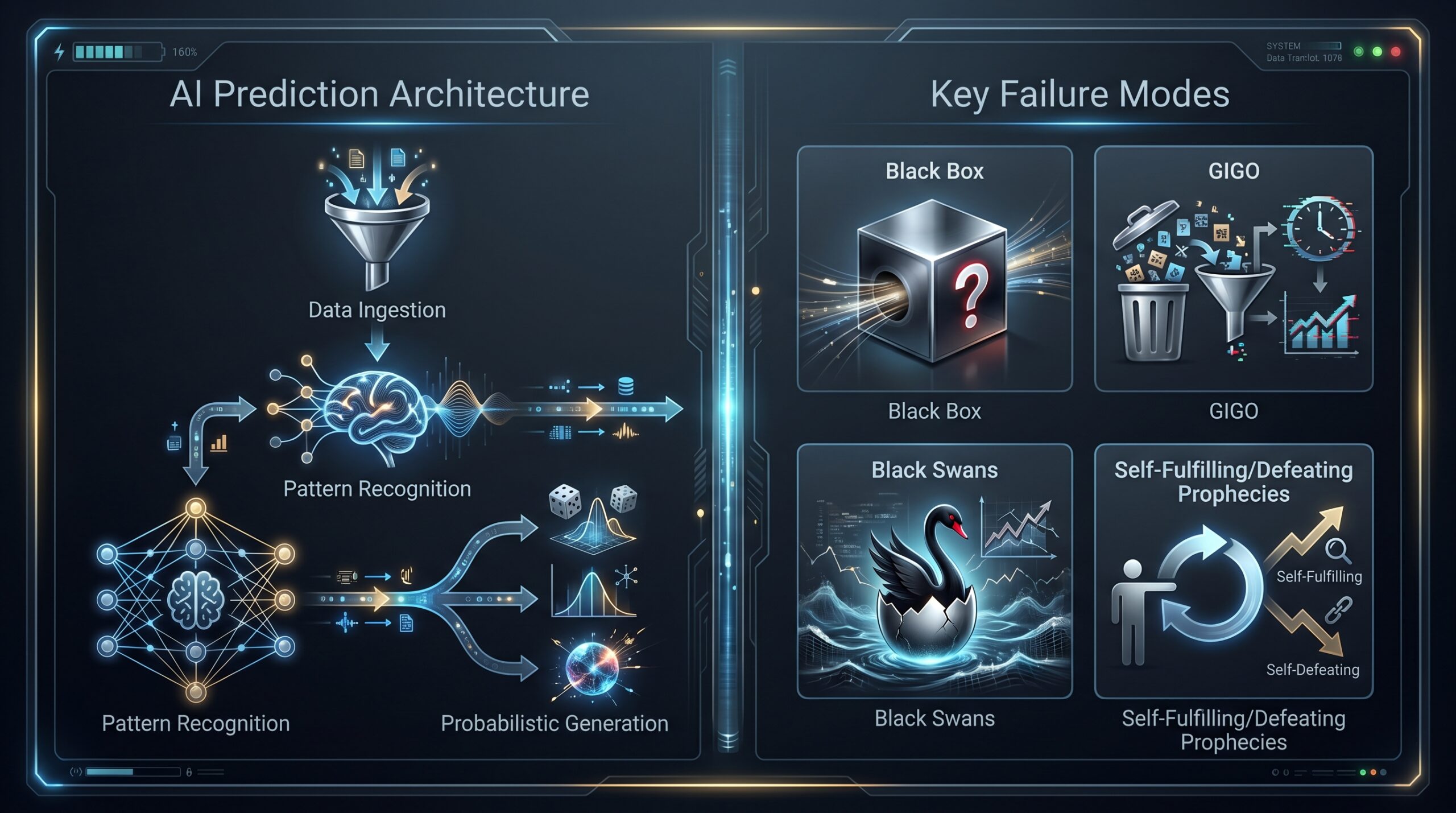
Most predictions from LLMs like ChatGPT or Claude follow this process:
- Data Ingestion: The model draws on its vast training corpus, which includes news articles, financial reports, historical data, and academic papers up to its knowledge cutoff.
- Pattern Recognition: It identifies statistical patterns, correlations, and narrative trends related to the query (e.g., “Bitcoin price 2026”).
- Probabilistic Generation: It generates a response that represents the most statistically likely completion of the prompt based on its training, often framed as a definitive statement.
The model has no true understanding of causality or access to future data. It is performing sophisticated pattern matching on the past.
Key Failure Modes and Limitations
Despite their sophistication, AI predictions are prone to certain failures:
- The Black Box Problem: The reasoning behind a specific prediction is often opaque, even with techniques like Explainable AI (XAI). You cannot easily audit why an AI predicted a regime collapse.
- Garbage In, Garbage Out: Predictions are only as good as their training data. If the data is biased, incomplete, or reflects past hysterias (like crypto bubbles), the predictions will be flawed.
- Inability to Model Black Swans: AI models excel at predicting the continuation of trends but are notoriously bad at forecasting unprecedented, paradigm-shifting events (e.g., a novel geopolitical crisis, a breakthrough invention).
- Self-Fulfilling and Self-Defeating Prophecies: A widely publicized prediction (e.g., “BTC to $250K”) can influence enough market behavior to make it more likely—or cause a backlash that makes it less likely.
Building a Practical AI Prediction Toolkit for 2026
For professionals looking to leverage AI forecasts, a strategic, tool-based approach is essential. Blind trust is dangerous; informed skepticism is productive.
Top AI Tools & Platforms for Forecasting and Analysis
This table provides a snapshot of key tools relevant to 2026’s prediction landscape.
| Tool/Platform Name | Primary Function | Key Differentiator (2026) | Ideal Use Case |
|---|---|---|---|
| Meta AI | General-purpose LLM with integrated search. | Publicly cited for specific, bold financial predictions (e.g., BTC $250K). | Generating speculative market theses and scanning for consensus-breaking forecasts. |
| Google Gemini AI | Multimodal LLM with advanced reasoning. | Strong integration with Google’s financial and search data; used for ETH prediction. | Researching trends and cross-referencing predictions with real-time data via search. |
| Microsoft Copilot | AI assistant integrated across MSFT ecosystem. | Leverages Bing search and proprietary data; used for XRP forecast. | Business intelligence and market research within a familiar productivity environment. |
| Claude AI (Anthropic) | LLM focused on safety, reasoning, and long context. | Provides nuanced, scenario-based analyses with risk assessments (e.g., SOL downside). | Conducting deep, structured analysis of predictions, including identifying underlying assumptions and risks. |
| Strategic Forecasting (ISF) | Specialized geopolitical risk AI. | Provides quantified probability estimates for high-stakes political events. | Corporate risk management, international strategy, and policy analysis. |
| AutoGPT / GPT-Engineer | Autonomous agent frameworks. | Demonstrates agentic AI capability for self-directed task completion. | Prototyping automated research and analysis workflows. |
| OddsFlow’s AI World Cup Predictor | Specialized sports prediction model. | Focuses on a single, high-profile event with extensive historical and team data. | Sports analytics, fan engagement, and betting market analysis (where legal). |
Strategic AI Prediction Toolkit Checklist
- Identify Source & Model: Know which AI model made the prediction and its inherent biases.
- Determine Methodology: Understand if it’s trend extrapolation, sentiment analysis, or complex simulation.
- Seek Divergent Forecasts: Compare contradictory predictions from multiple AI models and human experts.
- Cross-Reference: Integrate AI forecasts with traditional analysis, fundamental data, and expert judgment.
- Define Risk Tolerance: View predictions as probabilistic scenarios; quantify acceptable loss.
- Set Action Triggers: Establish clear, observable events for validating or invalidating assumptions.
- Plan for Opposite Outcome: Develop contingencies for complete prediction failure.
Implementation Checklist: Using AI Predictions Strategically
Follow this checklist before acting on any AI-driven forecast.
- Identify the Source & Model: Note which AI model made the prediction (e.g., Meta AI vs. Claude). Different models have different strengths and training data biases.
- Determine the Methodology: If possible, understand the basis. Is it a simple trend extrapolation, a sentiment analysis of news, or a complex agentic simulation?
- Seek Divergent Forecasts: Actively look for contradictory predictions from other reputable AI models or human experts. Consensus is rare; divergence is the norm.
- Cross-Reference with Traditional Analysis: Use the AI prediction as one input among many. Combine it with fundamental analysis, technical indicators, and expert human judgment.
- Define Your Risk Tolerance: Treat the prediction as a probabilistic scenario, not a guarantee. Decide in advance what level of loss you can absorb if the prediction is wrong. For strategies on managing risk with automated systems, see Mastering Bankroll Management for Trading Bots: The Complete Practical Guide for 2026.
- Set Clear Action Triggers: Determine what specific, observable events would validate or invalidate the prediction’s underlying assumptions, and be ready to pivot.
- Plan for the Opposite Outcome: Develop a contingency plan for what you will do if the AI’s prediction fails completely.
Risk Mitigation: What to Do When AI Predictions Go Wrong
AI predictions will fail. A robust risk mitigation strategy is not optional.
Financial Prediction Risks:
- Mitigation: Never allocate capital based solely on an AI forecast. Use it to inform a small portion of a diversified portfolio. Set strict stop-loss orders based on traditional technical levels, not the AI’s target price.
Operational Dependency Risks:
- Mitigation: If using AI to predict supply chain delays or equipment failure, maintain parallel, human-driven monitoring systems. Ensure you can revert to manual processes quickly.
Reputational & Ethical Risks:
- Mitigation: If your organization publicizes an AI prediction, clearly disclose the model used, the confidence interval (if any), and the potential for error. Avoid making definitive statements of certainty.
Common Mistakes Checklist:
- Treating output as truth: Assuming an AI prediction is a factual statement about the future.
- Ignoring model provenance: Not questioning which AI created the forecast and on what data it was trained.
- Succumbing to automation bias: Over-trusting the AI’s output because it comes from a “sophisticated” system.
- Failing to update: Sticking with an AI’s outdated prediction when new, contradictory data emerges.
- Overlooking external shocks: Assuming the AI has perfectly modeled unpredictable geopolitical, natural, or innovation-driven events.
The Future of Prediction: AI, Humans, and Uncertainty Post-2026
The narrative for 2027 and beyond is shifting from “What will AI predict?” to “How will humans and AI collaborate to navigate uncertainty?” The focus will be on hybrid intelligence systems where AI handles massive data pattern recognition and generates scenario projections, while humans provide ethical judgment, contextual understanding, and decision-making under ambiguity. The demand for Explainable AI (XAI) will intensify, especially for high-stakes predictions in medicine, justice, and finance.
Furthermore, the regulatory landscape for AI prediction—particularly in financial advertising and political forecasting—will begin to crystallize, imposing new standards for transparency and accountability. The evolving role of AI leadership, as seen in Chief AI Officer Role: Evolving Mandate & Future of AI Leadership (2026), will be critical in shaping these standards.
FAQ
Q: What is the most famous AI prediction for 2026?
A: The most cited prediction is Meta AI’s forecast that Bitcoin will reach $250,000 by late 2026. This has generated significant discussion in financial and technology circles, though its accuracy remains to be seen.
Q: Are AI predictions for 2026 generally accurate?
A: Accuracy varies wildly by domain. AI is reasonably good at short-term, pattern-based forecasts (like sports scheduling trends) but is often inaccurate for long-term, complex systems like job markets or specific financial prices, as seen with the unfulfilled predictions of radiologist displacement.
Q: Which AI is best for predictions?
A: There is no single “best” AI. Different models excel in different areas: specialized systems like ISF for geopolitics, Claude for nuanced risk analysis, and integrated models like Gemini or Copilot for data-informed business and finance trends.
Q: How are companies using AI predictions in 2026?
A: Practical use cases include the Pittsburgh Steelers predicting NFL schedules, financial firms using sentiment models for trading, manufacturers employing predictive maintenance AI, and corporations utilizing geopolitical risk AIs like ISF for strategic planning.
Q: What was a major AI prediction that failed?
A: A prominent failure is the prediction that AI would drastically displace jobs like radiologists. Data from 2026 shows the opposite: the Mayo Clinic employs 55% more radiologists than a decade ago, as AI has augmented rather than replaced their roles.
Q: What is agentic AI, and why is it important for 2026?
A: Agentic AI refers to autonomous systems that can execute multi-step tasks independently. In 2026, it’s a major trend because organizations are moving beyond chatbots to deploy these agents for complex workflows in analytics, customer service, and software development, requiring new governance strategies.
Q: Should I invest based on AI predictions for 2026?
A: No. AI predictions should be treated as one of many research inputs, not as investment advice. They are probabilistic scenarios with a high potential for error, especially in volatile markets like cryptocurrency. Always conduct your own due diligence and consult with licensed financial advisors.