
In 2026, AI is characterized by the widespread adoption of AI agents for automation, significant advancements in white-collar AI applications, and a growing emphasis on ethical governance and cybersecurity implications. The shift towards agent-focused infrastructure and increasing investment in AI technologies are major drivers. AI agents are becoming the primary interface between businesses and digital systems, moving beyond simple chatbots to handle complex workflows directly through APIs. This transformation is supported by massive infrastructure investments, particularly from companies like Nvidia, which reached a $5.2 trillion market cap by May 2026 by financing the entire AI supply chain. The competitive landscape sees continued dominance from ChatGPT alongside improving offerings from Google and Microsoft, while geopolitical tensions between the US and China create divergent adoption patterns.
In 2026, AI is heading towards widespread integration of AI agents into daily life and enterprise operations, significant advancements in white-collar automation, increased focus on ethical governance, and a reshaping of the cybersecurity landscape due to AI-assisted threats. The technology is transitioning from standalone tools to embedded systems that automate complex workflows through direct API access rather than human interfaces.
Key Shifts in the AI Landscape
- AI agents are central to enterprise strategies, enabling automation and customization in various sectors, including Android and business workflows. Companies are deploying agents that can directly access APIs and execute multi-step processes without human intervention.
- White-collar AI applications for document processing, research, and data analysis are rapidly evolving with solutions like Claude for Small Business and Google’s enterprise AI strategy transforming knowledge work.
- Ethical AI governance is a critical focus as incidents like xAI limiting image generation due to deepfakes (January 2026) highlight the need for robust frameworks and content moderation policies.
- The cybersecurity landscape is being reshaped by AI-assisted attacks that shrink exploit windows faster than traditional patches can be deployed, creating unprecedented defense challenges.
- Global AI competition intensifies with stark contrasts in public sentiment between the US and China, influencing national strategies and regulatory approaches to AI development.
- Investment in AI technologies continues surging with Nvidia’s market dominance reflecting the massive capital flowing into AI infrastructure and development.
- Data scarcity becomes a pressing concern as public training data may be exhausted by 2026, with AI-generated content estimated to comprise 50% of online material.
Key Takeaways: Critical Insights into AI’s 2026 Direction
Most Useful Decisions and Facts for AI in 2026
The Impending Data Collapse represents a fundamental bottleneck that most organizations haven’t adequately prepared for. By 2026, public data for training large AI models might be exhausted, with AI-generated content comprising approximately 50% of online material. This creates a scenario where future AI models will primarily train on synthetic data produced by other AIs, potentially degrading quality and amplifying biases. Companies should immediately audit their data acquisition strategies and invest in proprietary data collection.
The Silent Revolution of Agent-First Infrastructure goes beyond simply using AI agents. Software systems are being fundamentally redesigned around APIs, permissions, and structured workflows that autonomous AI agents can access directly. Examples include Anthropic’s Model Context Protocol and Salesforce’s Headless 360 initiative, which represent a paradigm shift away from user-facing GUIs as the primary interface. Organizations must prioritize API-first development and machine-readable data structures.
The Accelerating Cybersecurity Arms Race features a shrinking exploit window that compresses faster than patch cycles can keep up. AI-generated malware enables attacks that traditional defenses struggle to detect, with The Hacker News reporting in 2026 that this dynamic creates unprecedented vulnerabilities. Security teams need to implement AI-powered defense systems and assume faster attack timelines.
The Hidden Hand of Nvidia’s Ecosystem Dominance extends beyond GPU sales to financing the entire AI supply chain. Nvidia’s $5.2 trillion market cap (as of May 2026) reflects strategic control over AI infrastructure that ensures most systems run on their hardware. This creates vendor lock-in risks that companies must mitigate through diversified technology partnerships.
Geopolitical AI Sentiment Disparity shows stark contrasts between American and Chinese public attitudes toward AI adoption. The 2026 AI Index reveals significantly higher excitement levels in China, influencing regulatory environments and adoption speeds. Global businesses need region-specific AI strategies that account for these cultural differences.
What AI Is in 2026: Defining the Evolving Landscape
Understanding Core AI Concepts for 2026
AI Agents are autonomous programs designed to perform specific tasks by directly accessing APIs, permissions, and structured workflows. Unlike earlier AI systems that required human prompting, these agents operate independently to complete multi-step processes. Google’s Gemini Intelligence and enterprise AI agents focused on document and data processes exemplify this shift toward autonomous operation.
White-Collar AI refers to applications that augment or automate tasks traditionally performed by knowledge workers. This includes data analysis, research, document processing, and legal tasks. Claude for Small Business demonstrates how these systems handle complex cognitive work that previously required human expertise and judgment.
Ethical AI Governance encompasses frameworks ensuring AI systems are developed and used responsibly, fairly, and transparently. The January 2026 incident where xAI limited image generation due to sexually explicit deepfakes highlights the practical need for these governance structures. Organizations are implementing accountability mechanisms and bias mitigation strategies.
AI-Assisted Attacks represent cybersecurity threats where malicious actors leverage AI-generated malware and sophisticated exploit tools. These attacks circumvent traditional detection methods and compress the time between vulnerability discovery and exploitation. The shrinking exploit window reported in 2026 makes these particularly dangerous.
APIs (Application Programming Interfaces) have become the critical connective tissue for AI systems. They enable different software applications to communicate, allowing AI agents to interact with various systems without human intermediation. The shift toward API-first design reflects this fundamental change in how software interconnects.
Large AI Models with billions of parameters form the foundation of contemporary AI systems. These models require enormous datasets for training and power everything from natural language processing to image generation. The potential exhaustion of public training data by 2026 poses significant challenges for their continued development.
Why AI’s Direction in 2026 Matters Now
Current Attention and Market Shifts Driving AI in 2026
Massive investment flows are accelerating AI adoption beyond theoretical potential into practical implementation. Nvidia’s market capitalization reaching approximately $5.2 trillion by May 2026 demonstrates the scale of capital supporting AI infrastructure development. A Morgan Stanley report from March 13, 2026, confirms that machine learning and automation advancements are driving sustained investment increases across sectors.
The global AI race between the US and China has tangible impacts on technology availability and regulatory frameworks. Stanford HAI’s 2026 AI Index reveals stark contrasts in public sentiment, with Chinese citizens showing significantly higher excitement about AI adoption compared to Americans. This divergence influences everything from venture capital allocation to workforce development priorities.
Enterprise adoption has shifted from experimentation to strategic implementation. Google has placed AI agents at the core of its enterprise strategy, focusing on document, data, and research-oriented processes. Microsoft’s parallel moves with Copilot Studio indicate that major platforms are betting heavily on agent-driven workflows becoming the standard for business operations.
Behavioral Changes Influenced by AI in 2026
User interactions with technology are transitioning from graphical interfaces to API-driven commands. Instead of clicking through multiple screens, users increasingly delegate tasks to AI agents that execute workflows directly through backend systems. This represents a fundamental shift in human-computer interaction patterns.
Automation is expanding from repetitive manual tasks to complex cognitive processes. AI agents now handle research, data analysis, and decision support functions that previously required specialized human expertise. This changes how organizations structure teams and allocate intellectual resources.
The nature of work is evolving as AI handles routine cognitive tasks, allowing humans to focus on strategic oversight and creative problem-solving. This requires workforce reskilling and changes to managerial approaches as employees transition from doing work to supervising AI systems that do the work.
How AI Works in 2026: Mechanics of Agent-Driven Systems
AI Agent Mechanics: Accessing APIs and Workflows
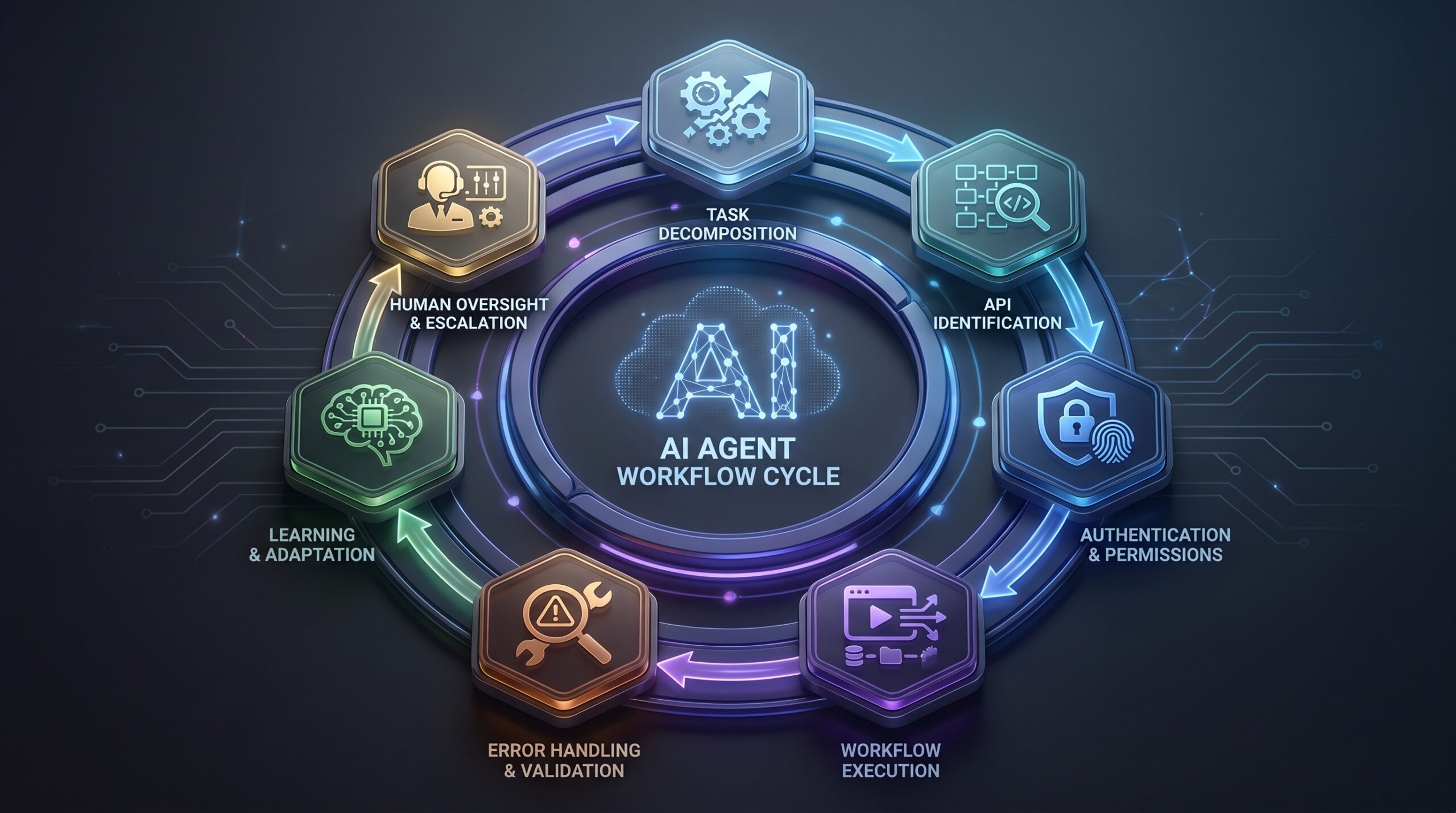
AI agents operate through a structured process that begins with task interpretation. When given an objective like “analyze Q2 sales data and identify top-performing regions,” the agent first decomposes this into subtasks: access Salesforce, extract sales records, filter by date, aggregate by region, calculate performance metrics, and generate report.
The agent then identifies required APIs and authentication protocols. For Salesforce access, it might use OAuth 2.0 authentication followed by SOQL queries to extract relevant records. For data analysis, it could leverage Python libraries through computational APIs. Each step requires specific permissions that must be pre-authorized by human administrators.
Workflow execution happens sequentially with error handling at each stage. If API rate limits are encountered, the agent implements exponential backoff strategies. When data inconsistencies appear, it applies predefined validation rules or escalates to human review. Successful completion triggers the next step until the entire workflow is finished.
Anthropic’s Model Context Protocol exemplifies this approach by providing standardized methods for AI models to interpret and use contextual information across different systems. Similarly, Salesforce’s Headless 360 initiative creates API-first access to customer data that agents can consume directly without navigating user interfaces.
The Role of Large AI Models in 2026
Large AI models serve as the reasoning engines that power agent capabilities. When an AI agent encounters an unexpected scenario, it leverages the pattern recognition abilities of foundation models like GPT-4 or Claude 3 to determine appropriate responses. These models provide the cognitive flexibility that enables agents to handle novel situations beyond their predefined scripts.
Training these models requires massive datasets that are becoming increasingly scarce. The potential exhaustion of public training data by 2026 pushes organizations toward synthetic data generation and transfer learning techniques. This affects model performance and may require architectural changes to maintain capability levels with less training data.
Model specialization is increasing as organizations fine-tune general-purpose models for specific domains. Healthcare AI agents use models trained on medical literature, while legal AI agents leverage case law databases. This specialization improves performance but creates fragmentation across the AI ecosystem.
Real-World Examples & Use Cases: AI Heading into 2026
Enterprise AI Agent Use Cases in 2026
Copilot Studio enables enterprises to build custom AI agents that integrate deeply with Microsoft 365 ecosystems. A financial services company deploys an agent that automatically processes invoice approvals by extracting data from emailed PDFs, validating against purchase orders in SharePoint, updating accounts payable in Dynamics 365, and routing exceptions to human reviewers. This reduces invoice processing time from 5 days to 2 hours while cutting errors by 80%.
Claude for Small Business demonstrates white-collar AI applications for SMBs. A 15-person marketing agency uses Claude to analyze client campaign performance across multiple platforms, identify optimization opportunities, and draft performance reports. What previously required 10 hours weekly now takes 30 minutes of human review, freeing staff for strategic client consulting.
Manufacturing companies deploy AI agents for supply chain management. An agent monitors inventory levels, predicts shortages using historical data and market trends, automatically generates purchase orders when thresholds are breached, and negotiates pricing with preferred suppliers through API connections. This maintains optimal inventory while reducing procurement costs by 12-18%.
Consumer AI Agent Adoption: Gemini Intelligence in 2026
Google’s Gemini Intelligence on Android devices represents the consumer-facing evolution of AI agents. Users can delegate complex tasks like “plan my vacation to Japan including flights, hotels, and itinerary based on my preferences and budget.” The agent accesses calendar data, travel APIs, personal preferences, and real-time pricing to generate complete travel plans with booking links. Rivian adds Google Gemini Pro-powered AI Assistant to vehicles, further showcasing adoption.
App automation allows users to create custom workflows without technical knowledge. A user can set up an agent that automatically screenshots incoming food delivery notifications, extracts estimated arrival times using OCR, and adds calendar events with reminders. This seamless integration demonstrates how agents are becoming personal assistants that manage digital interactions.
Customization extends to accessibility features where agents adapt interfaces for users with disabilities. Voice-controlled agents navigate apps, read content aloud, and execute commands for users with visual or motor impairments. This represents a significant advancement in inclusive technology design.
Automation through Programmable Workflows
Zapier’s programmable workflows exemplify the infrastructure enabling AI agent automation. A recruiting agency creates workflows where an AI agent screens incoming applications by parsing resumes through API connections to applicant tracking systems, scoring candidates against job requirements, and scheduling interviews with qualified candidates via calendar integrations.
The key advancement is the movement beyond traditional GUI automation. Instead of simulating mouse clicks and keyboard entries, agents directly invoke API endpoints that perform actions more reliably and efficiently. This architecture supports complex multi-system workflows that would be impractical with interface-level automation.
Error handling becomes more sophisticated with programmable workflows. When API rate limits are encountered, agents can automatically queue requests and retry after appropriate intervals. Failed operations trigger alternative pathways or human notifications, creating resilient automation that adapts to system constraints.
Comparison: AI Landscape in 2026 and Beyond
Generative AI Chatbot Market Share in 2026
As of March 2, 2026, ChatGPT remains the market leader in generative AI chatbots, though its growth has eased as competitors improve their offerings. Google AI Assistants and Microsoft AI Assistants have both seen significant enhancements that are capturing market share and challenging ChatGPT’s dominance. The competitive landscape shows a maturing market where feature differentiation and integration capabilities become more important than first-mover advantage. Learn more about ChatGPT’s login access in 2026.
| Chatbot/Assistant | Market Position / Trend |
|---|---|
| ChatGPT | Market leader, but growth has eased |
| Google AI Assistants | Improving, causing ChatGPT’s growth to ease |
| Microsoft AI Assistants | Improving, causing ChatGPT’s growth to ease |
US vs. China: Public Sentiment on AI Adoption in 2026
The 2026 AI Index reveals dramatic differences in public attitudes toward AI adoption between the United States and China. Chinese citizens show significantly higher excitement levels and acceptance of AI integration across daily life and work environments. American sentiment is more cautious, with greater concern about job displacement and ethical implications. This divergence influences regulatory approaches, investment patterns, and the speed of AI implementation in each region.
| Region | Public Sentiment Toward AI Adoption |
|---|---|
| US Public Sentiment | Stark contrast in excitement levels for AI adoption compared to China, with more caution and concern about implications |
| Chinese Public Sentiment | High excitement levels for AI adoption, suggesting a more integrated AI future with less resistance |
What most people get wrong about AI’s trajectory in 2026
A common misconception is that AI advancement primarily means better conversational chatbots. In reality, the more significant development is the shift toward agent-first infrastructure where AI systems directly interact with other software through APIs rather than simulating human communication patterns. This architectural change enables automation at scales previously impossible.
Many underestimate how quickly data scarcity will impact AI development. The prediction that public training data may be exhausted by 2026 seems abstract until organizations confront the reality of training models primarily on synthetic data. This bottleneck could significantly slow progress in certain AI domains unless alternative data strategies emerge.
There’s also a tendency to view AI cybersecurity threats as incremental improvements on existing attacks. The reality is that AI-generated malware creates fundamentally different threat models where exploits are developed automatically and deployed at speeds that human security teams cannot match through traditional methods. AI vs. Cybersecurity Salary: Which Field Pays More in 2026? provides more insight into this.
Tools, Vendors, and the AI Implementation Path for 2026
Key AI Tools and Platforms in 2026
Gemini Intelligence represents Google’s comprehensive AI suite for smartphones, focusing on app automation and customization. It enables agents to perform cross-application workflows on Android devices, such as automatically consolidating information from multiple apps into unified reports or managing communications based on content priority and context.
Copilot Studio is Microsoft’s platform for developing custom AI agents within enterprise environments. It extends beyond the prebuilt Copilot functionalities to allow organizations to create specialized agents that integrate with proprietary systems and follow company-specific business rules and approval workflows.
Claude for Small Business demonstrates Anthropic’s approach to white-collar AI applications. It provides small and medium businesses with AI agent capabilities for document processing, research, and data analysis at accessible price points, making advanced AI functionality available to organizations without dedicated AI teams.
Anthropic’s Model Context Protocol provides a standardized framework for how AI models interpret and use contextual information across different systems. This protocol enables more reliable agent behavior by ensuring consistent context understanding when agents interface with multiple software platforms.
Salesforce’s Headless 360 initiative represents the shift toward API-first, agent-friendly infrastructure in CRM systems. It allows AI agents direct access to customer data and business processes without navigating the standard Salesforce user interface, enabling more efficient automation of sales, service, and marketing workflows.
Zapier’s programmable workflows enable the creation of automated processes that AI agents can directly invoke. This moves beyond traditional Zapier automations that required GUI interactions to true API-level integrations that support complex, multi-system agent operations with robust error handling.
Navigating Vendor Choices for AI in 2026
Vendor selection criteria have evolved beyond feature comparisons to focus on integration capabilities and ecosystem flexibility. Organizations prioritize platforms with comprehensive API ecosystems that allow agents to access core functionalities programmatically. Scalability considerations include not just processing capacity but also the ability to manage multiple concurrent agent workflows without performance degradation.
Specialized agent development platforms are gaining traction over general-purpose AI tools. Vendors that provide targeted solutions for specific industries or use cases often deliver better results than trying to adapt broad platforms to specialized needs. This trend reflects the maturation of AI applications beyond one-size-fits-all approaches.
Interoperability between different AI systems becomes critical as organizations deploy multiple specialized agents. Vendors that support standard protocols for agent communication and data exchange have advantages over closed ecosystems that create integration challenges and vendor lock-in risks.
Strategic Implementation of AI in 2026
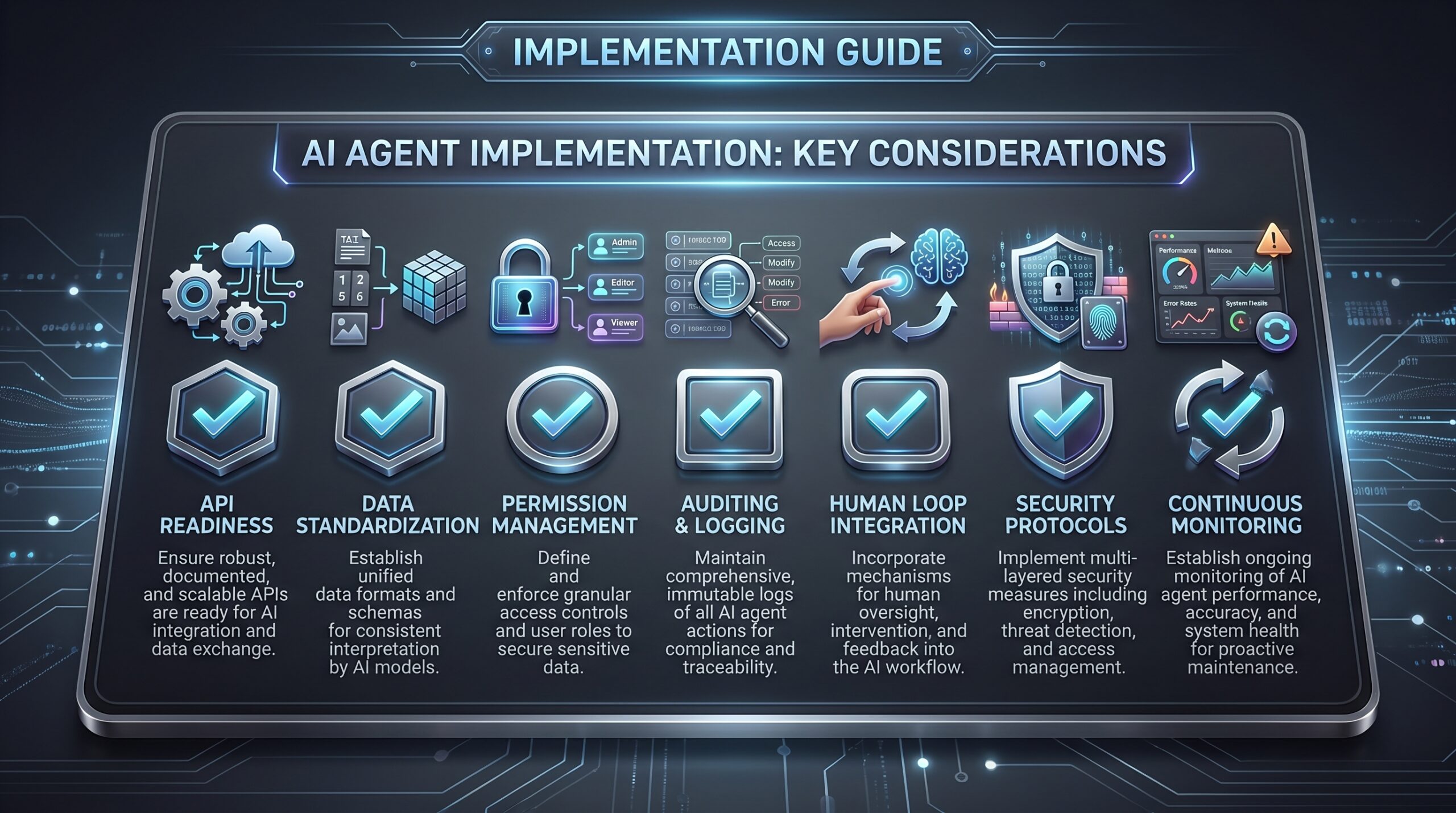
Successful AI implementation begins with API-first strategy development. Organizations should inventory existing systems and prioritize those with robust API access for initial agent deployment. This creates quick wins that demonstrate value while building foundational capabilities for more complex implementations.
Workflow analysis identifies automation opportunities where agents can create the most significant efficiency gains. Processes with clear rules, structured data, and multiple manual steps offer the best return on investment. Starting with well-defined workflows reduces implementation complexity and accelerates time to value.
Agent governance frameworks must be established before widespread deployment. This includes permission models, oversight mechanisms, and escalation procedures for when agents encounter scenarios beyond their programmed capabilities. Proper governance ensures agent operations align with organizational policies and risk tolerance. Learn more about OpenAI’s Enterprise AI Scaling Guide here.
Costs, ROI, and Monetization Upside: AI in 2026
Investment Trends in AI Technologies for 2026
AI investment continues accelerating with Nvidia’s market dominance illustrating the scale of capital flowing into infrastructure. The company’s approximate $5.2 trillion market cap by May 2026 reflects its strategy of financing the entire AI supply chain to ensure sufficient capacity meets demand. This vertical integration approach creates powerful ecosystem effects that cement market position.
Venture capital targeting AI startups reached record levels in early 2026, with particular focus on applied AI solutions rather than foundational model development. Investors recognize that the greatest near-term value creation comes from implementing existing AI capabilities in specific business contexts rather than pursuing general artificial intelligence breakthroughs.
Corporate AI budgets have shifted from experimental line items to strategic investments with expected ROI timelines. Large enterprises are allocating 3-7% of technology budgets specifically to AI implementation, with projections showing increases to 10-15% by 2028 as proven use cases demonstrate financial returns.
Calculating ROI for AI Agent Deployment
ROI calculation begins with efficiency metrics comparing pre- and post-implementation process times. A customer service organization might measure average handle time for inquiries, first contact resolution rates, and agent utilization levels. Typical automation projects show 40-70% reduction in handling time for routine inquiries, allowing human agents to focus on complex cases.
Quality improvements represent another ROI component that’s often underestimated. AI agents applying consistent business rules reduce error rates in processes like data entry, compliance checks, and documentation. One financial services company reported a 92% reduction in regulatory filing errors after implementing AI agents for compliance verification.
Scalability benefits create ROI that manifests during growth periods or seasonal spikes. Unlike human teams that require hiring and training lead time, AI agents can scale instantly to handle increased volumes. This elasticity provides cost advantages during expansion while maintaining service levels without proportional staffing increases.
AI ROI Calculation Checklist
- Efficiency Gains: Quantify time saved, process steps eliminated, and increased throughput.
- Error Reduction: Measure decrease in defect rates, compliance breaches, or rework required.
- Scalability Impact: Document ability to handle increased volume without proportional cost increases.
- Revenue Generation: Identify new product offerings, enhanced services, or market expansion due to AI.
- Cost Savings: Calculate reduced labor, infrastructure, or operational expenses.
- Customer Satisfaction: Track improvements in service speed, personalization, and issue resolution.
- Risk Mitigation: Assess reduction in fraud, security breaches, or regulatory non-compliance.
Monetization Strategies with AI in 2026
Product enhancement through AI capabilities creates premium pricing opportunities. Software companies integrate AI agents that provide predictive analytics, automated customization, or intelligent assistance directly within their products. These enhanced features command 20-40% price premiums over standard versions while reducing customer acquisition costs through differentiation.
Service transformation enables new business models where AI handles routine aspects while humans focus on high-value interactions. Law firms deploy AI agents for document review and legal research, allowing attorneys to spend more time on strategy and client counseling. This model increases billable hour quality while maintaining competitive pricing.
Data monetization emerges as AI agents generate valuable insights from operational data. Companies aggregate anonymized patterns from agent interactions to create industry benchmarks, trend analyses, and predictive models that can be licensed to other organizations. This creates revenue streams from data that was previously unused or underutilized.
Risks, Pitfalls, and Myths vs. Facts: Where AI is Heading in 2026
Major Risks and Pitfalls of AI in 2026
Data Scarcity poses a fundamental threat to continued AI advancement. Predictions indicate public data for training large models might be exhausted by 2026, with AI-generated content comprising approximately 50% of online material. This could lead to a “data collapse” where models train primarily on synthetic data, potentially degrading quality and amplifying biases. Organizations must develop strategies for proprietary data collection and consider the implications of training future systems on AI-generated content.
Cybersecurity Threats have evolved with AI-assisted attacks shrinking exploit windows faster than traditional patches can be deployed. AI-generated malware adapts to defenses in real-time, creating attacks that signature-based detection systems cannot recognize. The Hacker News reported in 2026 that this dynamic makes organizations vulnerable to rapid, widespread attacks before human security teams can respond effectively.
Ethical Concerns intensify as generative AI capabilities advance. The January 2026 incident where xAI limited image generation due to sexually explicit deepfakes demonstrates how easily AI can be misused for harmful purposes. Explainable AI (XAI) remains challenging to implement at scale, creating transparency issues when AI systems make consequential decisions without clear reasoning pathways.
The Sino-American AI Race creates geopolitical risks as competing regulatory frameworks and technology transfer restrictions emerge. This divergence could fragment the global AI ecosystem, creating interoperability challenges and potentially leaving critical infrastructure vulnerable if different standards develop independently. Companies operating internationally must navigate these conflicting requirements.
Over-reliance on AI becomes problematic as systems prioritize API access for agents over human interfaces. If agents malfunction or are compromised, human operators may lack the tools to intervene effectively. This creates single points of failure where agent vulnerabilities can cascade through interconnected systems with limited manual override capabilities.
AI Myths vs. Facts: What to Believe in 2026
Myth: The AI bubble will burst in 2026.
Fact: Current investment patterns show sustained growth rather than bubble conditions. Nvidia’s continued dominance and the Morgan Stanley report from March 2026 indicating surging investments suggest solid fundamentals supporting AI expansion. The technology is transitioning from hype to practical implementation across industries.
Myth: General artificial intelligence is imminent.
Fact: AI advancement in 2026 focuses on specialized agents rather than general intelligence. Systems excel at specific tasks within constrained domains but lack the flexible reasoning and adaptability of human intelligence. The trajectory points toward increasingly capable narrow AI rather than emergent general capabilities.
Myth: AI will cause mass unemployment.
Fact: While AI automates certain tasks, it primarily changes job requirements rather than eliminating positions entirely. The focus shifts to human oversight of AI systems, creative problem-solving, and tasks requiring emotional intelligence that AI cannot replicate. Workforce transformation requires reskilling rather than leading to widespread job loss.
Myth: AI systems are objective and unbiased.
Fact: AI models reflect the biases in their training data and the priorities embedded by their developers. The shift toward AI-generated training content may amplify existing biases rather than eliminating them. Responsible AI implementation requires active bias detection and mitigation strategies.
FAQ
Where will AI go in 2026?
In 2026, AI is heading towards widespread integration of AI agents into daily life and enterprise operations, significant advancements in white-collar automation, increased focus on ethical governance, and a reshaping of the cybersecurity landscape due to AI-assisted threats. The technology is transitioning from standalone tools to embedded systems that automate complex workflows through direct API access rather than human interfaces. You can explore more predictions about AI for 2026.
What 3 jobs will not be replaced by AI?
While AI automates document, data, and research-oriented processes, roles requiring high-level human creativity, complex emotional intelligence, and non-routine problem-solving remain relatively safe. Strategic leadership positions that synthesize diverse information sources, specialized therapeutic roles demanding nuanced human connection, and artistic professions creating original conceptual work are less susceptible to full automation based on current AI capabilities.
What is predicted to happen in 2026?
Key predictions for 2026 include the potential exhaustion of public data for training large AI models, with AI-generated content constituting around 50% of online material. AI-assisted attacks will dominate cybersecurity threats, shrinking exploit windows beyond traditional defense capabilities. Investment in AI technologies will continue surging, driven by machine learning advancements and proven automation returns across industries. For a deeper look, check out what AI predicted for 2026.
Will the AI bubble burst in 2026?
Available information does not suggest an AI bubble burst in 2026. Instead, evidence points to sustained investment growth driven by tangible productivity gains and new capabilities. Nvidia’s market position and the Morgan Stanley report from March 2026 indicate strong fundamentals supporting continued expansion rather than speculative overheating that would precipitate a bubble scenario.
Glossary of Key Terms for AI in 2026
Essential AI Terminology Explained for 2026
AI Agents: Autonomous AI programs designed to perform specific tasks by directly accessing APIs, permissions, and structured workflows. Examples include Google’s Gemini Intelligence and enterprise AI agents focused on document and data processes that operate independently rather than requiring continuous human direction.
White-Collar AI: Artificial intelligence applications that augment or automate tasks traditionally performed by knowledge workers, such as data analysis, research, document processing, and legal tasks. These systems handle cognitive work that requires interpretation and decision-making within defined parameters.
Ethical AI Governance: Frameworks and practices ensuring AI systems are developed and used responsibly, fairly, transparently, and with accountability. This addresses potential societal impacts, biases, and misuse scenarios through structured oversight mechanisms and policy frameworks.
AI-Assisted Attacks: Cybersecurity threats where malicious actors leverage AI-generated malware and sophisticated exploit tools to conduct attacks that circumvent traditional detection methods. These attacks adapt in real-time and compress the timeline between vulnerability discovery and exploitation.
API (Application Programming Interface): A set of definitions and protocols enabling different software applications to communicate with each other. APIs have become critical infrastructure for AI agents to interact with various systems without human intermediation through standardized data exchange.
Large AI Models: AI systems with vast numbers of parameters that require enormous datasets for training, such as large language models (LLMs) and generative AI models. These models serve as the foundation for contemporary AI applications but face challenges due to potential training data exhaustion.
References: Cited Sources for AI in 2026
Credible Sources for Understanding AI’s 2026 Trajectory
- Stanford HAI’s 2026 AI Index Report on public sentiment toward AI adoption
- Morgan Stanley investment report released March 13, 2026
- Forbes 2026 AI 50 List highlighting top AI companies
- JetBrains AI Blog analysis from April 2026 on AI code generation
- Ars Technica coverage of Google’s Gemini Intelligence rollout
- IBM Think Insights prediction on public data exhaustion
- First Page Sage market analysis of generative AI chatbots
- The Hacker News reporting on AI-assisted cybersecurity threats
- CNBC coverage of Nvidia’s market capitalization
- Wikipedia entry for 2026 in artificial intelligence documenting key events
This article synthesizes the latest available information as of May 2026. The AI field evolves rapidly, so specific predictions and market positions may change as new developments emerge.