

Why Matthew 17:21 is Removed From the Bible: A Direct Answer
Matthew 17:21 is not present in most modern Bible translations because it is absent from the oldest and most authoritative Greek manuscripts of the New Testament. The verse, which reads ‘Howbeit this kind goeth not out but by prayer and fasting’ in the King James Version, is considered by textual scholars to be a later addition, or interpolation, that was not part of the original Gospel of Matthew. Its inclusion in later manuscripts is likely the result of scribes copying the text from a parallel passage in Mark 9:29 or a desire to emphasize spiritual disciplines.
The Core Reason for Matthew 17:21’s Absence
The core reason is grounded in the principles of textual criticism. When scholars compile the Greek text that serves as the basis for modern translations, they compare thousands of ancient manuscripts. The most reliable witnesses, such as the 4th-century Codex Sinaiticus and Codex Vaticanus, do not contain Matthew 17:21. Its sudden appearance in later, less reliable manuscripts signals that it was probably added centuries after Matthew was first written. The decision to omit it is not an act of censorship but a commitment to restoring the text as closely as possible to its original form based on the best available evidence.
TL;DR: Matthew 17:21 and its Removal
Key Summaries of Matthew 17:21’s Disappearance
- Matthew 17:21, which mentions ‘prayer and fasting,’ is missing from the oldest and most authoritative Greek manuscripts, including Codex Sinaiticus and Codex Vaticanus.
- Scribes likely added the verse later, possibly by harmonizing the Matthew account with Mark 9:29 (‘This kind can come out by nothing but by prayer and fasting’) or to provide a stronger spiritual emphasis.
- Modern scholarly translations (like the NIV, ESV, and NASB) prioritize textual accuracy by relying on the earliest manuscript evidence, which leads to the verse’s omission or relegation to a footnote.
- The omission of Matthew 17:21 does not change core Christian doctrines, as the principles of prayer and fasting are taught extensively elsewhere in the Bible, such as in Will We Still Be Male & Female in Heaven? The Definitive Bible Answer a FrontierWisdom article on biblical interpretation.
- This specific case highlights the careful, scientific process of biblical textual criticism, which aims to identify and correct centuries of copying variations.
- Understanding the reasoning behind this omission helps clarify differences between Bible translations and fosters informed Scripture reading.
Key Takeaways: Understanding the Removal of Matthew 17:21
Crucial Insights into ‘Why is Matthew 17:21 Removed from the Bible’
- Most Important Decision: Always consult multiple Bible translations from different textual traditions (e.g., compare an ESV with a KJV) and pay close attention to footnotes, which often explain textual variants like the absence of Matthew 17:21.
- Critical Fact: The verse is completely absent from the earliest and most highly regarded uncial manuscripts, such as Codex Sinaiticus (01, 4th century) and Codex Vaticanus (B, 4th century). Its first appearance is in much later manuscripts.
- Key Implication: This situation showcases the dynamic and human process of biblical transmission over centuries. It demonstrates that modern Bibles are the product of rigorous scholarly work, not a static, perfectly preserved text from the first century.
- Practical Decision: Avoid basing significant theological doctrines or personal practices solely on verses with weak or disputed manuscript support. Build convictions on passages with overwhelming textual evidence.
- Reassuring Fact: The concept that prayer and fasting are powerful spiritual disciplines is not dependent on Matthew 17:21. It is explicitly taught in numerous other passages, including Matthew 6:16-18, Acts 13:2-3, and 1 Corinthians 7:5. This aligns with broader ethical guidelines often found when considering advanced technologies, as explored in Post-Quantum AI Infrastructure Security 2026: The Complete Implementation Guide.
- Fundamental Insight: The “removal” is more accurately a “correction” based on a broad scholarly consensus. It reflects a commitment to authenticity, not an attempt to alter or suppress Christian doctrine.
What Matthew 17:21’s Removal Is: A Clear Definition
Defining the Omission of Matthew 17:21
The omission of Matthew 17:21 from modern Bibles is not a “removal” in the sense of deliberate censorship or theological editing. It is a scholarly decision based on the field of textual criticism. Textual criticism is the scientific discipline that compares all available ancient copies of a text to determine the most likely original wording. When the earliest and most reliable witnesses unanimously lack a passage, scholars conclude it was not part of the original autograph (the document written by the author). In this case, the evidence strongly suggests a scribe added the phrase about prayer and fasting to Matthew’s account at a later date. Therefore, modern translators “omit” it to present a text that more accurately reflects what the apostle Matthew originally wrote.
The Role of Early Manuscripts in Understanding Matthew 17:21
The significance of early manuscripts like Codex Vaticanus and Codex Sinaiticus cannot be overstated. These are two of the oldest near-complete copies of the Greek Bible, dating to the 4th century AD. They were copied within 250-300 years of the original New Testament writings. Generally, older manuscripts are preferred in textual criticism because they are closer to the source and have undergone fewer cycles of copying, reducing the accumulation of errors or additions. The fact that these cornerstone manuscripts, along with other early sources like Codex Regius (L, 8th century), do not contain Matthew 17:21 is the primary evidence for its later origin. Later manuscripts that include it, which form the basis of the Textus Receptus used for the KJV, are considered secondary witnesses in this instance.
Why the Absence of Matthew 17:21 Matters Now
Current Relevance of Matthew 17:21’s Textual History
The discussion around Matthew 17:21 is highly relevant today. It sits at the center of online debates about biblical inerrancy, the reliability of modern scholarship, and public trust in Christian institutions. Critics of modern translations often point to “missing verses” like this one as evidence of corruption or a liberal agenda. Understanding the factual, evidence-based reasons for the omission is a powerful tool against misinformation. For the average Bible reader, it demystifies why their NIV looks different from their grandmother’s KJV. It also reinforces that the Bible has been transmitted through history via human hands, and that God’s providence is seen in the painstaking scholarly work that gives us highly accurate translations today.
Market Shift: The Demand for Accurate Bible Translations
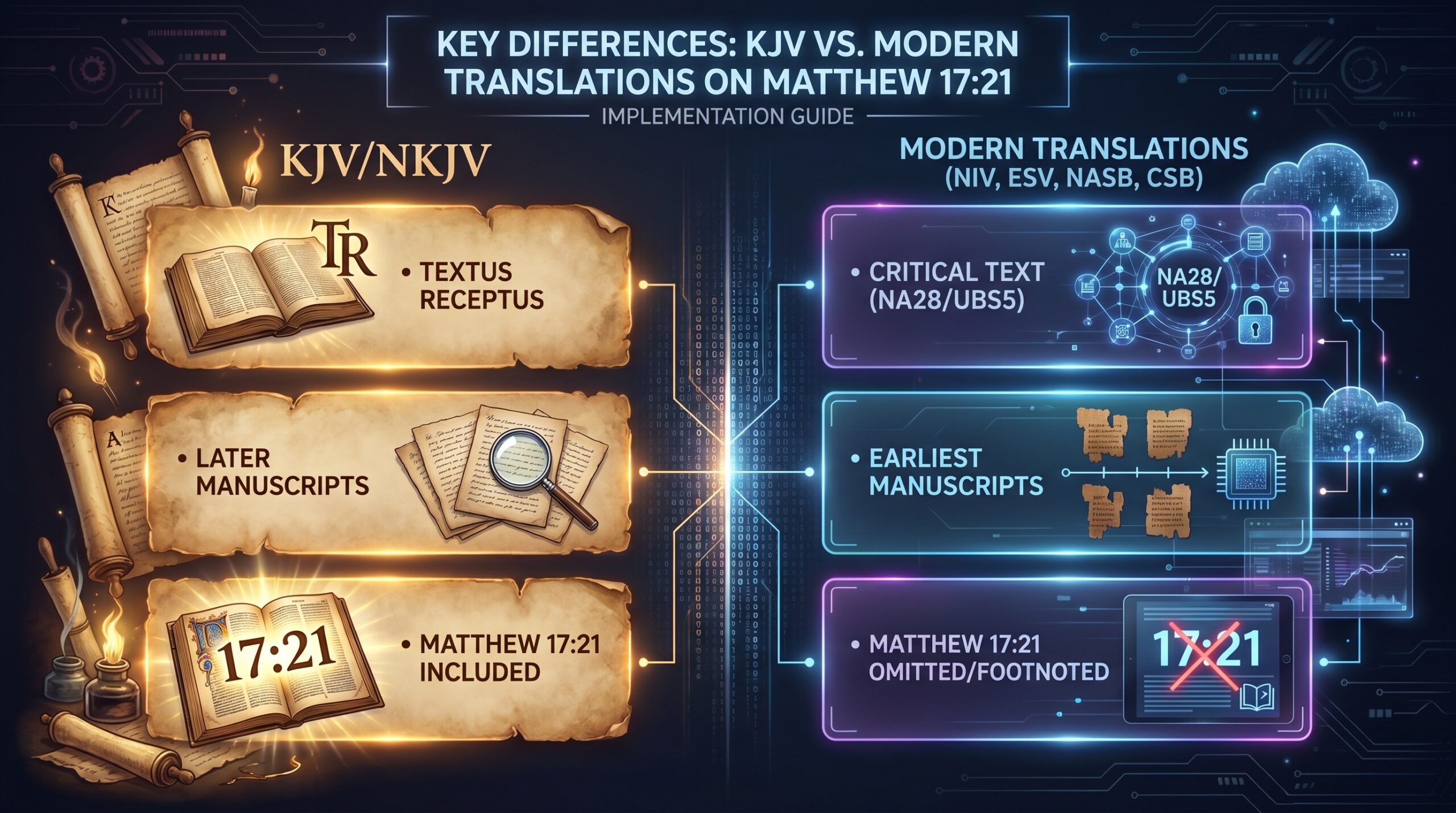
There has been a significant market shift over the last 150 years toward translations that prioritize scholarly rigor and early manuscript evidence. Translations like the New American Standard Bible (NASB, 1971/1995), English Standard Version (ESV, 2001), and Christian Standard Bible (CSB, 2017) explicitly base their New Testament on the Nestle-Aland Greek Novum Testamentum Graece (Critical Text), which omits Matthew 17:21. This reflects a demand from pastors, theologians, and lay readers for translations that are as transparent and accurate as possible. In contrast, the King James Version (KJV, 1611) and its descendant, the New King James Version (NKJV, 1982), are based on the Byzantine text-type (the Textus Receptus), which represents the form of the Greek text that was standard in the later medieval period and includes the verse. This creates a clear dividing line in the Bible translation market, much like the distinctions seen in the rapidly evolving What Is the Most Promising AI Stock: Complete Guide for May 2026.
How Textual Criticism Works for Matthew 17:21
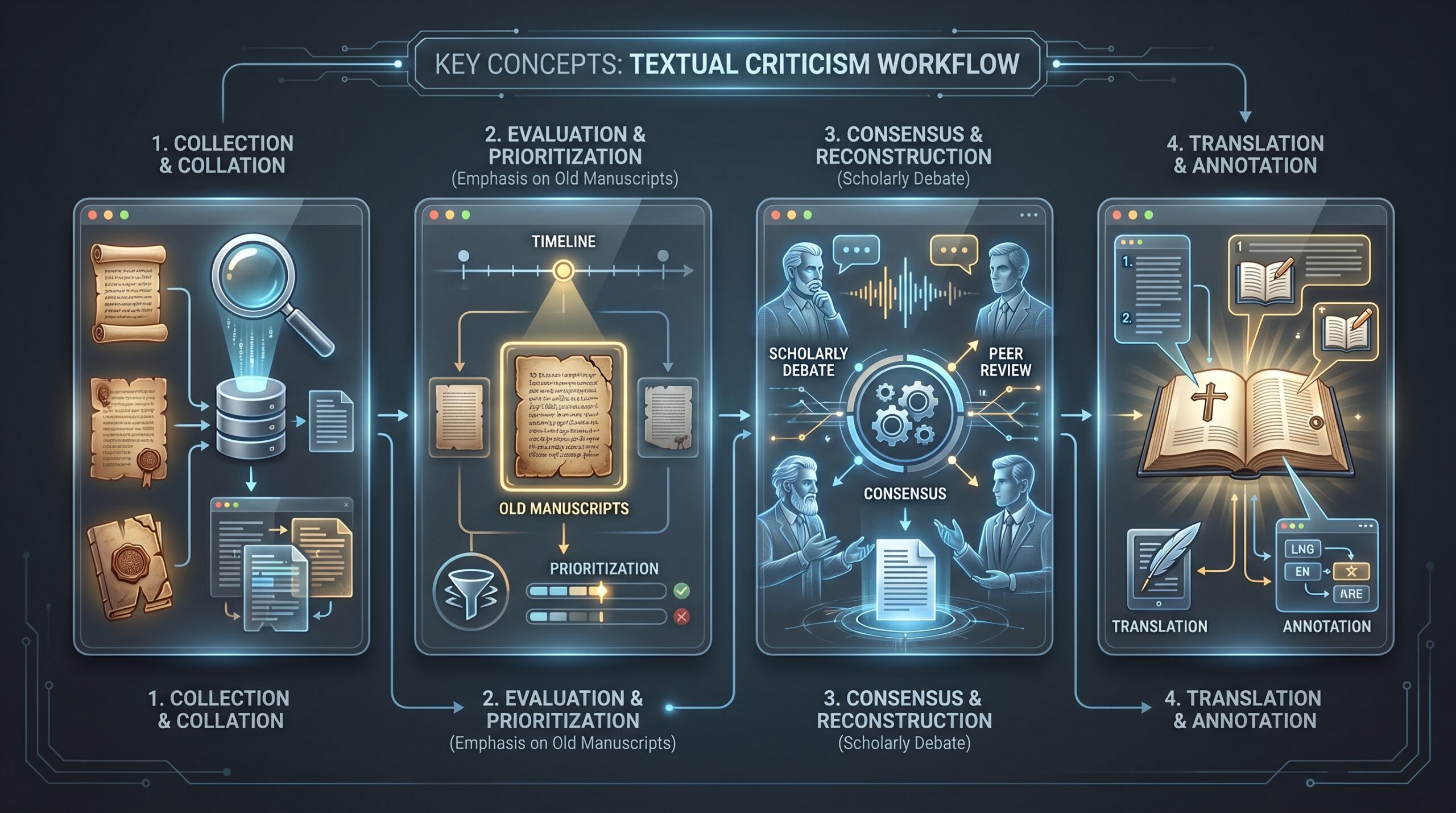
Step-by-Step: The Process of Identifying and Omitting Matthew 17:21
The decision to omit Matthew 17:21 follows a meticulous process:
- Sourcing Manuscripts: Scholars gather all available ancient copies of the Gospel of Matthew in Greek, as well as early translations (Versions) into Latin, Syriac, Coptic, and other languages, and quotations from early Church Fathers.
- Comparing Variations: They collate these sources, noting every difference, or “variant reading.” For Matthew 17, they observe that some manuscripts have a verse 21 and others skip directly from verse 20 to verse 22.
- Prioritizing Evidence: Using established principles, they weigh the evidence. Older manuscripts (4th-century codices) are given more weight than later ones (12th-century minuscules). Geographically diverse manuscripts that agree (e.g., an Egyptian codex and a Latin version from Italy) provide strong evidence.
- Identifying Interpolations: The presence of the verse only in later, predominantly Byzantine-era manuscripts suggests it is an interpolation—a later addition. The content itself, echoing Mark 9:29, points to “harmonization,” where a scribe made the accounts in different Gospels more similar.
- Reaching Scholarly Consensus: Committees of textual critics (e.g., those for the UBS5 or NA28 Greek New Testaments) debate the evidence and reach a consensus on the original text. For Matthew 17:21, the consensus is overwhelmingly that it was not original.
- Translators Incorporate Findings: Bible translation committees use these critical Greek texts as their base. When a verse like Matthew 17:21 is bracketed or omitted in the Greek base, they omit it in the translation, typically adding a footnote like “Some manuscripts add…”
The Evidence Against Matthew 17:21’s Originality
The manuscript evidence against the originality of Matthew 17:21 is substantial and specific.
- Key Omissions: The verse is absent from Codex Vaticanus (B, 4th cent.), Codex Sinaiticus (01, 4th cent.), Codex Regius (L, 8th cent.), and Codex Koridethi (Θ, 9th cent.). These represent the Alexandrian text-type, considered the most reliable.
- Early Versions: It is missing from early Syriac translations (the Sinaitic Syriac, Old Syriac) and the earliest Coptic (Sahidic) versions.
- Church Fathers: Notably, early Church Fathers like Origen (3rd century) and John Chrysostom (4th century), who extensively commented on Matthew, make no reference to this verse in their discussions of this passage.
- Internal Evidence: The narrative flow from Matthew 17:20 to 17:22 is smooth and logical without verse 21. The insertion disrupts the timeline, as Jesus is speaking about the disciples’ lack of faith in verse 20 and then immediately begins speaking about his coming betrayal in verse 22. The added verse feels like an explanatory note.
Real-World Examples: Matthew 17:21 Across Bible Translations
Case Studies of Matthew 17:21Why is Matthew 17:21 Removed from the Bible
Examining how different translations handle the verse provides a clear, real-world picture of the textual issue.
- New International Version (NIV): Omits the verse entirely. The text moves from Matthew 17:20 to 17:22. A footnote at the end of verse 20 states: “Some manuscripts include here words similar to Mark 9:29.”
- English Standard Version (ESV): Also omits the verse. Footnote 21 explains: “Some manuscripts insert verse 21: ‘But this kind never comes out except by prayer and fasting'”
- New American Standard Bible (NASB): Omits the verse. It uses a common notation, showing verses 18-20, then has “[21]” in brackets with the verse text in a footnote, indicating its disputed status.
- Christian Standard Bible (CSB): Omits the verse. The footnote reads: “Other mss add v. 21: “However, this kind does not come out except by prayer and fasting.””
- King James Version (KJV): Includes the verse as a full part of the text: “Howbeit this kind goeth not out but by prayer and fasting.” No footnote is provided, as the translators of the KJV did not have access to the older manuscripts we have today.
- New King James Version (NKJV): Includes the verse in the main text but adds a footnote: “NU-Text omits this verse.” This is a helpful compromise, showing readers that modern critical texts (Nestle-Aland/United Bible Societies) differ.
Pastoral and Theological Interpretations of Matthew 17:21’s Absence
How this issue is handled pastorally varies. Many pastors who use modern translations simply never preach from the verse, as it’s not in their Bibles. When the topic arises, a common approach is to use it as a teaching moment about how we got our Bibles. They explain that the principle—prayer and fasting for difficult spiritual challenges—is biblically sound, even if this specific verse is not original to Matthew. Seminaries teach textual criticism as a core component of biblical studies, ensuring future pastors understand the evidence behind the translations they use. For hermeneutics (interpretation), this case reinforces the principle of not building a doctrine on a disputed text. It encourages interpreters to seek confirmatory evidence from passages with stronger textual support. This methodical approach to biblical texts can be compared to the rigorous problem-solving needed in How Does TensorRT Affect Model Accuracy: The Complete Guide to Performance and Precision, where data interpretation is key.
Comparison Section: Why Matthew 17:21 is Removed from Different Bibles
Modern Translations vs. Older Translations and Matthew 17:21
The handling of Matthew 17:21 hinges on the underlying Greek text a translation committee uses. This table illustrates the key differences.
| Translation | Textual Basis | Inclusion of Matthew 17:21 | Note/Explanation |
|---|---|---|---|
| King James Version (KJV) | Textus Receptus (primarily later Byzantine manuscripts) | Included in main text | Based on the Greek text available in the 16th-17th centuries, which included the verse. |
| New King James Version (NKJV) | Majority Text (similar to Textus Receptus) | Included in main text, but footnoted | Aims to update the KJV language while largely retaining its textual base; notes modern critical text omissions. |
| New International Version (NIV) | Nestle-Aland/United Bible Societies (NU) Critical Text | Omitted, mentioned in footnote | Prioritizes the earliest Alexandrian manuscripts, which lack the verse. |
| English Standard Version (ESV) | Nestle-Aland/United Bible Societies (NU) Critical Text | Omitted, mentioned in footnote | Follows the same scholarly Greek text as the NIV, emphasizing “essentially literal” translation. |
| New American Standard Bible (NASB) | Nestle-Aland/United Bible Societies (NU) Critical Text | Omitted, bracketed and footnoted | Known for its literal precision; reflects the critical text’s judgment on the verse. |
| New Living Translation (NLT) | Nestle-Aland/United Bible Societies (NU) Critical Text | Omitted, mentioned in footnote | A thought-for-thought translation that still relies on the same critical Greek text as more literal versions. |
| Christian Standard Bible (CSB) | Nestle-Aland/United Bible Societies (NU) Critical Text | Omitted, mentioned in footnote | Seeks a balance between literal and thought-for-thought; follows the modern scholarly consensus. |
Other Disputed Verses and Matthew 17:21
Matthew 17:21 is not an isolated case. Understanding it helps contextualize other well-known textual variants.
- The Longer Ending of Mark (Mark 16:9-20): The earliest and most reliable Greek manuscripts end the Gospel of Mark at verse 16:8. Verses 9-20 are a later addition, summarizing resurrection appearances found in the other gospels. Most modern Bibles include it with a strong explanatory note or bracket it.
- The Pericope Adulterae (John 7:53–8:11): The story of the woman caught in adultery is a beloved passage, but it is absent from the earliest Greek manuscripts of John. Its writing style also differs from the rest of the Gospel. It appears to have been a floating tradition that later scribes inserted into John’s Gospel. Modern Bibles typically bracket it or include a note about its disputed status.
- The Comma Johanneum (1 John 5:7-8): A Trinitarian formula in the KJV (“the Father, the Word, and the Holy Spirit: and these three are one”) is almost certainly a later theological addition. It appears in no Greek manuscript before the 15th century. It is universally omitted from modern critical texts and translations.
These examples show that textual criticism is a consistent discipline applied across the New Testament. The goal is always to recover the original text, even when it means setting aside familiar but later additions. This kind of academic rigor is vital in all fields, including the rapidly changing landscape of AI, as seen in topics like AI Regulatory Policy Changes in 2026: The Operational Playbook You Need Now.
Tools and Scholars: Analyzing Matthew 17:21’s Omission
Essential Tools for Understanding Matthew 17:21’s Textual History
Serious study of this issue requires access to specialized tools that present the raw data of textual criticism.
- Novum Testamentum Graece (NA28): Often called the “Nestle-Aland” after its editors, this is the standard critical edition of the Greek New Testament for scholarly work. It presents the Greek text at the top of the page and a comprehensive critical apparatus at the bottom, listing manuscript evidence for every variant. For Matthew 17:21, the apparatus shows its absence from key early witnesses.
- The Greek New Testament (UBS5): Published by the United Bible Societies, this edition is very similar to the NA28 but is designed with translators in mind. Its apparatus is less exhaustive but focuses on the variants most important for translation. It gives Matthew 17:21 a “C” rating, indicating a considerable degree of doubt about its authenticity.
- A Textual Commentary on the Greek New Testament (by Bruce M. Metzger): This is an indispensable companion to the UBS/NA texts. Metzger’s commentary explains the reasoning of the editorial committee for each major variant. For Matthew 17:21, he clearly states the verse is an early addition, likely assimilated from Mark 9:29.
- Online Resources: Websites like BibleHub.com or BlueLetterBible.org allow users to compare translations side-by-side and see interlinear Greek texts, making the differences visually apparent. The New Testament Virtual Manuscript Room (ntvmr.uni-muenster.de) provides direct access to images of many ancient manuscripts. This digital access to ancient texts parallels the demand for new ways to interact with information, much like Google’s Gemini Update Rewrites the Rules for Android and Your Car focuses on integrating modern technology.
Key Scholars and Their Role in Matthew 17:21’s Examination
Modern understanding of this textual issue rests on the work of foundational scholars.
- B.F. Westcott & F.J.A. Hort: Their 1881 edition of The New Testament in the Original Greek was revolutionary. They argued forcefully for the superiority of the Alexandrian text-type (represented by Vaticanus and Sinaiticus) over the Textus Receptus. Their work laid the groundwork for the modern critical text that omits Matthew 17:21.
- Bruce M. Metzger (1914-2007): A towering figure in 20th-century textual criticism. His Textual Commentary and his book The Text of the New Testament have educated generations of students. His clear explanations of variants like Matthew 17:21 have shaped the consensus view.
- Daniel B. Wallace: A contemporary scholar and executive director of the Center for the Study of New Testament Manuscripts (CSNTM). Through his writings, lectures, and the work of CSNTM (which digitally photographs Greek manuscripts), Wallace has made the evidence for textual decisions accessible to a wider audience, often addressing questions about “missing” verses.
These scholars, and the committees they served on, did not make decisions lightly. Their work was a collective, peer-reviewed effort to establish the most reliable Greek text possible.
Modern Biblical Scholarship Framework
- Pillar 1: Textual Criticism
- Goal: Reconstruct the original wording of biblical texts.
- Method: Compare thousands of ancient manuscripts; prioritize older, geographically diverse, and internally consistent witnesses.
- Application (Matthew 17:21): Identifies the verse as a later scribal addition not found in the earliest manuscripts.
- Pillar 2: Historical-Critical Method
- Goal: Understand the historical, cultural, and literary context of biblical texts.
- Method: Analyze authorship, dating, literary genres, and historical events.
- Application (Matthew 17:21): Considers how scribal practices (e.g., harmonization with Mark 9:29) influenced the transmission.
- Pillar 3: Hermeneutics / Interpretation
- Goal: Determine the meaning and significance of biblical texts for contemporary audiences.
- Method: Apply linguistic, theological, and contextual principles.
- Application (Matthew 17:21): Even if omitted, the principle of prayer and fasting is affirmed elsewhere, ensuring core doctrines remain intact.
Costs, ROI, and Monetization Upside of Textual Criticism for Matthew 17:21
The Investment in Textual Purity for Translations of Matthew 17:21
The effort behind textual criticism represents a significant investment. The “costs” are immense: decades of scholarly training, painstaking manual collation of manuscripts, international academic collaboration, and the financial burden of preserving, photographing, and cataloging ancient documents. Publishers like the Deutsche Bibelgesellschaft (for NA28) and the United Bible Societies invest heavily in producing and updating the critical Greek texts. The return on investment (ROI) is not financial for the scholars but intellectual and spiritual. The ROI for the Christian community is a Bible translation with unparalleled accuracy and transparency. This builds deep trust in the Scripture as a reliably transmitted document, ultimately strengthening faith and enabling sound doctrine.
Monetization: The Value of Reliable Bible Editions and Matthew 17:21
For Bible publishers, adherence to scholarly standards is a key part of their brand identity and market positioning. Publishers like Crossway (ESV), Zondervan (NIV), and Holman (CSB) gain credibility and market share by demonstrating that their translations are based on the best available scholarship. While omitting a familiar verse like Matthew 17:21 can cause initial confusion, providing clear footnotes educates the reader and reinforces the publisher’s commitment to integrity. This trust is a form of “monetization”—it leads to long-term customer loyalty, adoption by churches and seminaries, and a reputation for reliability that drives sales. In a crowded market, a reputation for scholarly rigor is a significant competitive advantage. This approach is similar to how companies position themselves in the tech sector, as discussed in The State of AI in 2026: Read the Signal, Not Just the Headlines, where trust and transparency are critical factors.
Risks, Pitfalls, and Myths vs. Facts About Matthew 17:21’s Removal
Risks and Pitfalls When Discussing Matthew 17:21 Removal
Navigating this topic requires care to avoid several pitfalls.
- Spreading Misinformation: The most common risk is repeating conspiracy theories (e.g., “The Vatican removed the verse”) without understanding the actual, evidence-based reasons.
- Causing Unnecessary Doubt: For believers with a simplistic view of biblical inspiration, learning about textual variants can be unsettling. It’s crucial to frame it as a story of God’s providence in preserving the text, not as a reason for skepticism.
- Creating Division: This issue can become a wedge between Christians who prefer different translations (e.g., KJV-only advocates vs. others). A polemical approach damages Christian unity.
- Over-reliance on a Single Translation: The pitfall is using only one Bible version. Comparing translations quickly reveals these textual notes and provides a more complete picture. This mirrors the need for a comprehensive view in complex domains, such as navigating Can You Make $1000 a Day Trading Crypto in 2026? The Realistic Guide, where multiple data sources lead to better decisions.
What Most People Get Wrong About ‘Why is Matthew 17:21 Removed from the Bible’
The most common misunderstanding is assuming the word “removed” implies a malicious or theologically motivated act by modern scholars. People often imagine a council of theologians deciding to delete a verse they dislike. In reality, the process is the opposite: scholars are adding a verse back into the text when they include it. The default position of modern criticism, based on the earliest evidence, is that the verse was never there to begin with. The “removal” is actually the refusal to add a later interpolation. Another major error is thinking this undermines biblical authority. It actually strengthens it by demonstrating a transparent and honest approach to the textual data.
Addressing the “Removal” Misconception
Many perceive the absence of Matthew 17:21 in modern Bibles as a deliberate “removal.” However, this is largely a misunderstanding of the textual critical process.
- It’s not censorship: Scholars are not omitting text they disagree with; they are striving to present what Matthew originally wrote.
- It’s a correction: Think of it not as removing something, but as removing an addition that wasn’t original. Subsequent discoveries of older manuscripts allowed for a correction to the traditional text.
- It strengthens reliability: This transparent process, based on evidence, actually bolsters the credibility of modern Bibles, showing a commitment to scholarly integrity over tradition when evidence dictates.
Myths vs. Facts: Matthew 17:21’s Disappearance
Myth: Modern Bible translations are corrupting the text by removing verses.
Fact: Modern translations are restoring the text to a form that is closer to the original autographs by relying on manuscripts that are centuries older than those used by the KJV translators.
Myth: The doctrine of prayer and fasting is weakened if Matthew 17:21 is not original.
Fact: The practice and power of prayer and fasting are explicitly taught in many other undisputed passages throughout both the Old and New Testaments (e.g., Matthew 6:16-18, Acts 13:2-3). The core doctrine remains entirely intact.
Myth: The King James Version is the only “true” or “inspired” Bible because it contains Matthew 17:21.
Fact: The KJV is a fine translation, but its textual base (the Textus Receptus) is based on a small number of late medieval manuscripts. It does not have a special claim to inspiration that overrides the evidence of older, more reliable manuscripts discovered since the 17th century.
Myth: This is a new, liberal idea.
Fact: Scholars have been aware of this textual variant since at least the 19th century when older manuscripts like Codex Sinaiticus were rediscovered. The consensus is based on evidence, not theology.
FAQ
- Can a female be a pastor according to the Bible?
- This is a separate theological question with a long history of interpretation. Some Christian traditions point to passages like 1 Timothy 2:11-14 to reserve the pastoral office for men. Others emphasize the empowerment of the Spirit in Acts 2:17-18 and the equality expressed in Galatians 3:28 to affirm women in pastoral leadership. Different denominations hold varying views based on their hermeneutical approaches, and it remains a topic of sincere debate within Christianity.
- What does the Trump Bible contain?
- The “God Bless the USA Bible,” often called the Trump Bible, contains the King James Version of the Bible, the U.S. Constitution, the Bill of Rights, the Declaration of Independence, and the Pledge of Allegiance. It also includes a handwritten chorus from Lee Greenwood’s song “God Bless the USA.” Marketed as a patriotic symbol, it has been controversial due to its blending of religious and political elements and its promotional tactics.
- What is the controversy over Matthew 17:21?
- The controversy stems from the fact that Matthew 17:21 is present in the Greek text underlying the King James Version (the Textus Receptus) but is absent from the older Greek manuscripts used for most modern translations (the Critical Text). This leads to its omission in Bibles like the NIV and ESV, causing confusion and leading some to accuse modern translators of removing Scripture. The controversy is essentially about which ancient manuscript tradition is more reliable.
- Is there a Matthew chapter 17 verse 21?
- In most modern English translations (NIV, ESV, NASB, etc.), there is no verse numbered “21” in Matthew 17. The chapter moves directly from verse 20 to verse 22. However, in the King James Version and the New King James Version, a verse 21 is present: “Howbeit this kind goeth not out but by prayer and fasting.” Modern translations that omit it will typically mention it in a footnote. The historical and textual journey of such verses is a fascinating subject, similar to tracking the evolution of AI models as discussed in Grokarium: What Is It? A 2026 Explainer.
Glossary of Terms for Matthew 17:21 Textual Discussion
Key Definitions for Understanding Matthew 17:21’s Absence
- Textual Criticism: The academic discipline that seeks to determine the original wording of a text by comparing and evaluating all existing ancient copies.
- Manuscript (MS): A handwritten copy of a biblical text. Thousands of Greek New Testament manuscripts survive.
- Codex: An ancient book form, with pages bound together, as opposed to a scroll. Most biblical manuscripts are codices.
- Uncial: A style of handwriting used in early Greek manuscripts (4th-9th centuries) characterized by large, separated capital letters. Codex Sinaiticus and Vaticanus are uncials.
- Minuscule: A cursive style of Greek handwriting that became dominant from the 9th century onward, allowing for faster copying. Most New Testament manuscripts are minuscules.
- Textus Receptus (“Received Text”): The name given to the series of printed Greek texts in the 16th-17th centuries that formed the basis of the KJV. It primarily represents the Byzantine text-type.
- Critical Text: The modern scholarly edition of the Greek New Testament (e.g., NA28/UBS5) that reconstructs the original text by evaluating all manuscript evidence, prioritizing the earliest and best.
- Interpolation: A word, phrase, or passage inserted into a text by a later scribe or editor that was not part of the original. Matthew 17:21 is considered an interpolation.
- Codex Vaticanus (B): A 4th-century Greek manuscript of the Bible, one of the oldest and most complete, housed in the Vatican Library. It omits Matthew 17:21.
- Codex Sinaiticus (01): A 4th-century Greek manuscript of the Bible, discovered in the 19th century at St. Catherine’s Monastery. It is another key witness that omits Matthew 17:21.
- Harmonization: A common scribal tendency to make accounts in different Gospels (e.g., Matthew and Mark) more similar to each other. This is the likely reason for the addition of Matthew 17:21. The quest for harmonized understanding extends beyond biblical studies into modern data science with tools and platforms like those mentioned in Together AI Simplifies Hugging Face Model Deployment.
- Variant Reading: Any place among the manuscripts where the wording differs.
References: Sources on Why Matthew 17:21 is Removed from the Bible
Scholarly and Reliable Sources for Matthew 17:21
- Metzger, Bruce M. A Textual Commentary on the Greek New Testament. 2nd ed. United Bible Societies, 1994. (The definitive guide to the reasoning behind textual decisions in the UBS Greek New Testament).
- Aland, Kurt, and Barbara Aland. The Text of the New Testament: An Introduction to the Critical Editions and to the Theory and Practice of Modern Textual Criticism. Translated by Erroll F. Rhodes. 2nd ed. Eerdmans, 1995. (A standard textbook on the field).
- Comfort, Philip W. Encountering the Manuscripts: An Introduction to New Testament Paleography and Textual Criticism. Broadman & Holman, 2005. (A highly accessible introduction).
- Wallace, Daniel B. “The Majority Text Theory: History, Methods, and Critique.” Journal of the Evangelical Theological Society (1992). (A scholarly critique of the textual theory underlying the KJV).
- The Nestle-Aland Novum Testamentum Graece (NA28) and the United Bible Societies’ The Greek New Testament (UBS5). (The primary critical Greek texts used by scholars and translators).
- Websites: The Center for the Study of New Testament Manuscripts (CSNTM.org), Bible Research (bible-researcher.com) by Michael D. Marlowe, and the NET Bible (netbible.org) with its extensive translator’s notes.