
Yes, according to a comprehensive reading of the Bible, we will still be male and female in heaven. Gender is an essential, created aspect of the Imago Dei, or Image of God, within us, and it will continue as part of our eternal identity. However, the specific earthly functions of marriage and procreation will cease, resulting in a perfected, non-procreative, and glorified state. Jesus described this as being like the angels (Matthew 22:30).
Our resurrected bodies will be recognizably ourselves, with the essence of our created gender preserved, transformed, and fulfilled in ways beyond our current experience. Heaven is not about becoming less human; it is the perfection of our humanity, designed from the beginning.
The Direct Answer: Yes
According to a comprehensive reading of the Bible, we will still be male and female in heaven. Gender is an essential, created aspect of the Imago Dei, or Image of God, within us. It will continue as part of our eternal identity. However, the specific earthly functions of marriage and procreation will cease, resulting in a perfected, non-procreative, and glorified state—what Jesus described as being “like the angels” (Matthew 22:30).
Our resurrected bodies will be recognizably ourselves, with the essence of our created gender preserved, transformed, and fulfilled in ways beyond our current experience.
Fr. Spitzer, as cited on ‘The Drew Mariani Show’ (Relevant Radio, 2026-05-11), summarized this beautifully: ‘Heaven is not becoming less human.’ It is the perfection of our humanity, designed from the beginning. This answer navigates the tension between clear biblical statements about marriage ending and the equally clear biblical narrative that our created, gendered existence is inherently good and part of God’s eternal plan.
Foundational Bible Verses on Heavenly Gender
Three key passages anchor this discussion. Reading them in isolation can cause confusion; reading them together within the full biblical story provides clarity.
Genesis 1:27 – Creation
“So God created mankind in his own image, in the image of God he created them; male and female he created them.” (NIV)
This is the origin point. Your gender identity is not an accident or a byproduct of a fallen world. It is woven into the fabric of creation itself. The Imago Dei is manifested, in part, through the duality and complementarity of male and female. Maleness and femaleness are part of the original, very good design.
Matthew 22:23-30 – Clarification on Marriage
“At the resurrection people will neither marry nor be given in marriage; they will be like the angels in heaven.” (Matthew 22:30, NIV)
Jesus is answering a trick question about marriage in the afterlife (the Sadducees’ scenario of a woman with seven husbands). His answer is precise and targeted: the institution of marriage, with its legal unions and procreative purpose, will not exist. He does not say, “people will cease to be male and female.” He says they will be like the angels concerning marriage. This implies a community of love that is complete and lacks no exclusive human covenant, not a community of genderless beings.
Galatians 3:28 – Equality in Christ
“There is neither Jew nor Greek, there is neither slave nor free, there is no male and female, for you are all one in Christ Jesus.” (ESV)
This is the most commonly misunderstood verse in this debate. The context is spiritual salvation and standing before God. Paul is declaring that ethnic, social, and gender distinctions create no barrier to justification in Christ. He is not describing the physiology of the resurrection body. The verse abolishes hierarchy, not humanity. It speaks to value, not anatomy. In Christ, our primary identity is redeemed child of God; our gendered humanity is not erased but redeemed and reordered within that supreme identity.
Earthly Gender vs. Heavenly Identity: A Comparison Table
To move beyond confusion, we must rigorously distinguish between temporary earthly functions and enduring eternal realities.
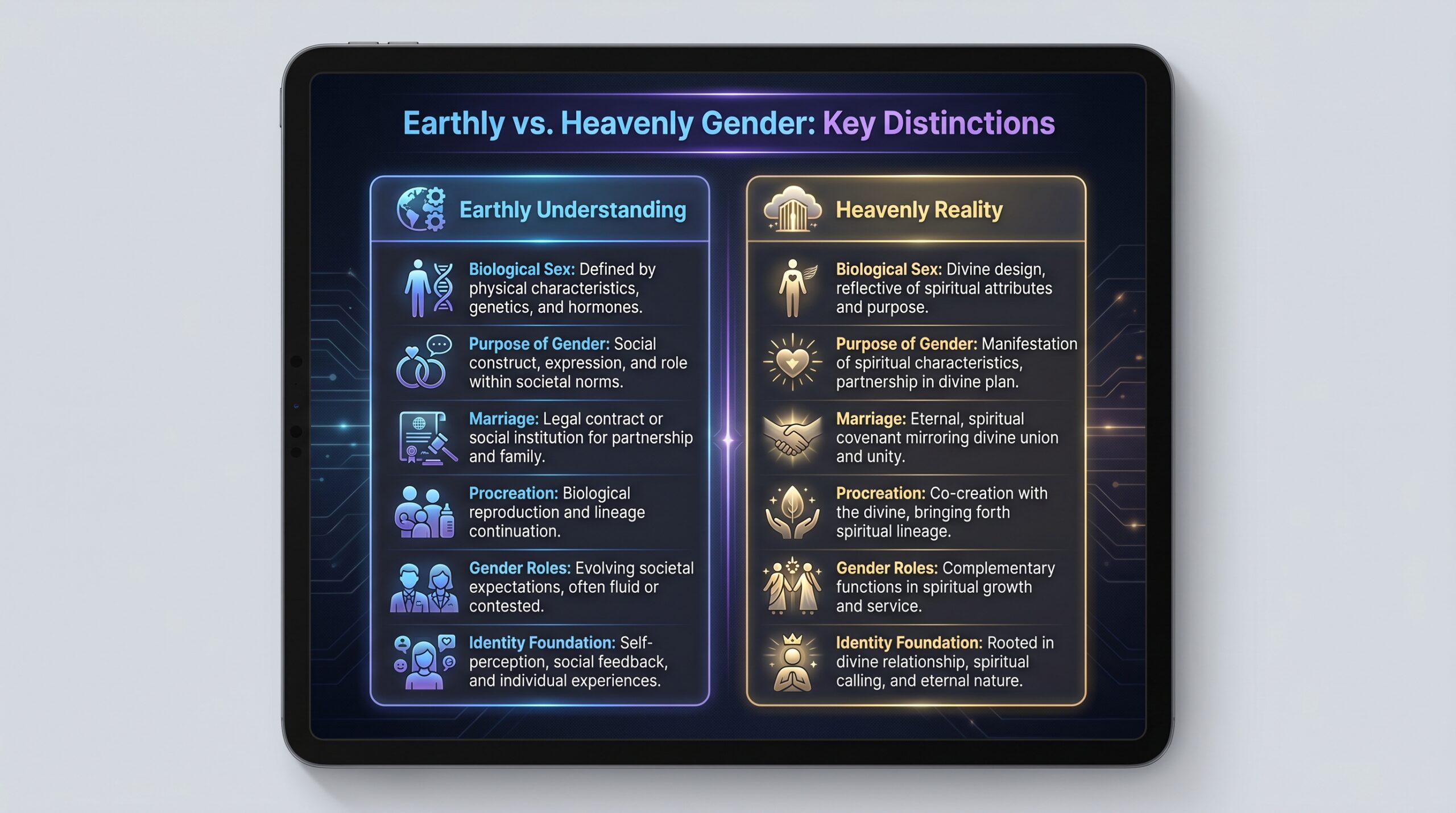
| Aspect | Earthly Understanding | Heavenly Reality (Biblical Perspective) |
|---|---|---|
| Biological Sex | Physical anatomy (male/female) for reproduction, part of the original Imago Dei (Gen. 1:27). | The essence of this created identity is retained in glorified bodies (1 Cor. 15), but reproductive systems are transformed. They will serve the perfected life of worship and communion, not procreation. |
| Purpose of Gender | To reflect God’s relational nature in complementarity, for procreation (“be fruitful”), and to prefigure Christ & Church (Eph. 5). | To reflect God’s relational nature in perfected unity/diversity within the Bride of Christ (the Church). The purpose moves from procreation to perfect, full communion. |
| Marriage | A covenantal, exclusive, one-flesh union for companionship, procreation, and sanctification. | Will not exist as an institution (Matt 22:30). The exclusive covenant is fulfilled in the universal, perfect marriage of Christ to His Church (Rev. 21:2). All relationships are perfected. |
| Procreation | The biological means of fulfilling the creation mandate and continuing humanity. | Unnecessary. The family of God is complete. The resurrection marks the final number of the redeemed. |
| Gender Roles | Social/cultural expressions and responsibilities often (but not always) tied to biological sex; many are impacted by the Fall. | All roles distorted by sin, inequality, or cultural baggage are gone. We serve according to perfected gifts, not fallen stereotypes. We are “co-heirs” in fullness (Rom. 8:17). |
| Identity Foundation | Often conflated with roles, marriage status, or societal expectations. | Rooted securely in being a glorified, redeemed Image-bearer of God. Gendered personhood is a joyful part of that, not a source of strife or limitation. |
The Nature of the Resurrection Body (1 Corinthians 15)
The quality of our heavenly existence is defined by the nature of the resurrection body. 1 Corinthians 15 is the most extensive treatment of this topic. It argues for radical continuity and radical transformation.
Key descriptors of the glorified body:
- Imperishable vs. Perishable: Our current bodies decay and die. Our resurrection bodies are immortal, immune to sickness, aging, and death (1 Cor. 15:42, 53-54). Your eternal body will never know cancer, arthritis, or fatigue.
- Glorious vs. Dishonorable: Raised in power and splendor, free from the weaknesses and dishonors of the fallen state (1 Cor. 15:43). This includes freedom from the distortions and pains associated with gender dysphoria or the consequences of the Fall on our biology.
- Spiritual vs. Natural: This does not mean “non-material.” The Greek word pneumatikos means “animated by the Spirit,” not “made of spirit.” It is a body perfectly suited for eternal life in the Spirit-led new creation, as opposed to the psychikos body suited for the present age (1 Cor. 15:44-46). It is a physical body of a new order.
- Recognizable: Jesus’ resurrected body was tangible (Thomas touched His wounds), could eat (Luke 24:41-43), yet could also appear in locked rooms (John 20:19, 26). He was recognizably Jesus. We too will be recognizably ourselves—and that includes the recognizable essence of our gendered selves.
The implication is profound: If the resurrection body retains the recognizable identity of the person who died, and if our maleness or femaleness is a core aspect of our created personhood, then it follows that this aspect is retained, albeit in its imperishable, glorious form.
What Does “Like the Angels” (Matthew 22:30) Really Mean?
Jesus’ comparison to angels is often misinterpreted to mean we become genderless spirits. A closer look at angelology and the context refutes this.
- Angels are not genderless. In Scripture, angels always appear in masculine form and use masculine pronouns (e.g., Gabriel, Michael). They do not marry or procreate, but they possess distinct, personal identities. Being “like the angels” refers specifically to the absence of marriage and procreation, not the absence of gender-identifying characteristics.
- The Focus is on Function, Not Form. The Sadducees’ question was about the function of marriage (levirate marriage laws) in the afterlife. Jesus’ answer addresses that function: it ceases. He redirects their thinking from earthly legalities to a new mode of existence.
- A Different Mode of Relating. Angels live in perfect, joyful obedience and community before God without the need for exclusive pair-bonding. Our relational capacities will be similarly expanded and perfected beyond the exclusive marital bond, fulfilling our need for intimacy in the direct presence of God and the boundless community of the saints.
Thus, “like the angels” describes a change in relational and procreational status, not a vaporization of our created, gendered humanity.
Galatians 3:28 Explained: Spiritual Equality, Not Erasure
Confusion arises because Paul’s statement, “there is no male and female,” echoes Genesis 1:27 in reverse. Is he undoing creation? Absolutely not.
- Context of Justification: Paul is fighting Judaizers who insisted Gentile converts adopt Jewish customs (like circumcision) for salvation. His list—Jew/Greek, slave/free, male/female—covers the primary societal divisions of the ancient world. He proclaims that these distinctions are irrelevant for receiving the grace of justification through faith.
- Baptismal Formula: Many scholars believe Paul is quoting an early baptismal liturgy. In the waters of baptism, earthly hierarchies and divisions are dissolved in terms of our standing before God. A slave is as much an heir as a master; a woman is as indwelt by the Spirit as a man.
- Continuity in the Church: This verse does not mandate that men and women have identical roles in the church or home (issues Paul addresses elsewhere). It mandates their equal value, dignity, and access to Christ. It is a soteriological (salvation) statement, not an anthropological (human nature) one. It tells us who is saved, not what our resurrected bodies will be like.
To apply Galatians 3:28 as proof of genderless eternity is to rip it from its context and force it to answer a question it isn’t asking.
Theological Perspectives from Key Scholars
Leading thinkers provide nuanced depth to this topic, moving beyond simplistic proof-texting.
N.T. Wright (New Testament Scholar):
Wright emphasizes the physicality of the new creation. Heaven is not a disembodied spiritual realm but the renewal of all creation. Our resurrection bodies are for this renewed earth. He argues that if in this new creation we are more truly human, and if our original humanity is gendered, then it follows that our glorified state will involve a “transposition” of our sexuality into a new key. The music (the essence) remains, but the instrument (the procreative function) is different.
Randy Alcorn (Author, Heaven):
Alcorn advocates strongly for continuity between the present and the eternal state. He writes, “We shouldn’t assume that gender is merely a physical property of our earthly bodies that will be obliterated in Heaven… To be male or female is who we are, not merely what we do or what we look like.” He suggests our gender will be more, not less, pronounced—freed from sin’s distortions and fully expressive of God’s creative intent.
Augustine (Early Church Theologian):
Augustine, in The City of God (Book 22), directly addresses the nature of resurrection bodies. He argues that all bodily parts will be present, restored to perfect integrity and harmony. While specifically discussing reproductive organs, he posits they will remain, not for use but as part of the whole perfected person, testifying to the goodness of the original creation and the completeness of God’s restoration. Their function will be transformed, praising God by their very perfected existence.
These perspectives converge: redemption perfects and restores creation; it does not annihilate it.
Common Misinterpretations & Risk Mitigation
When speculating about heaven, it’s easy to go beyond what is written. Here is a checklist to avoid common errors.
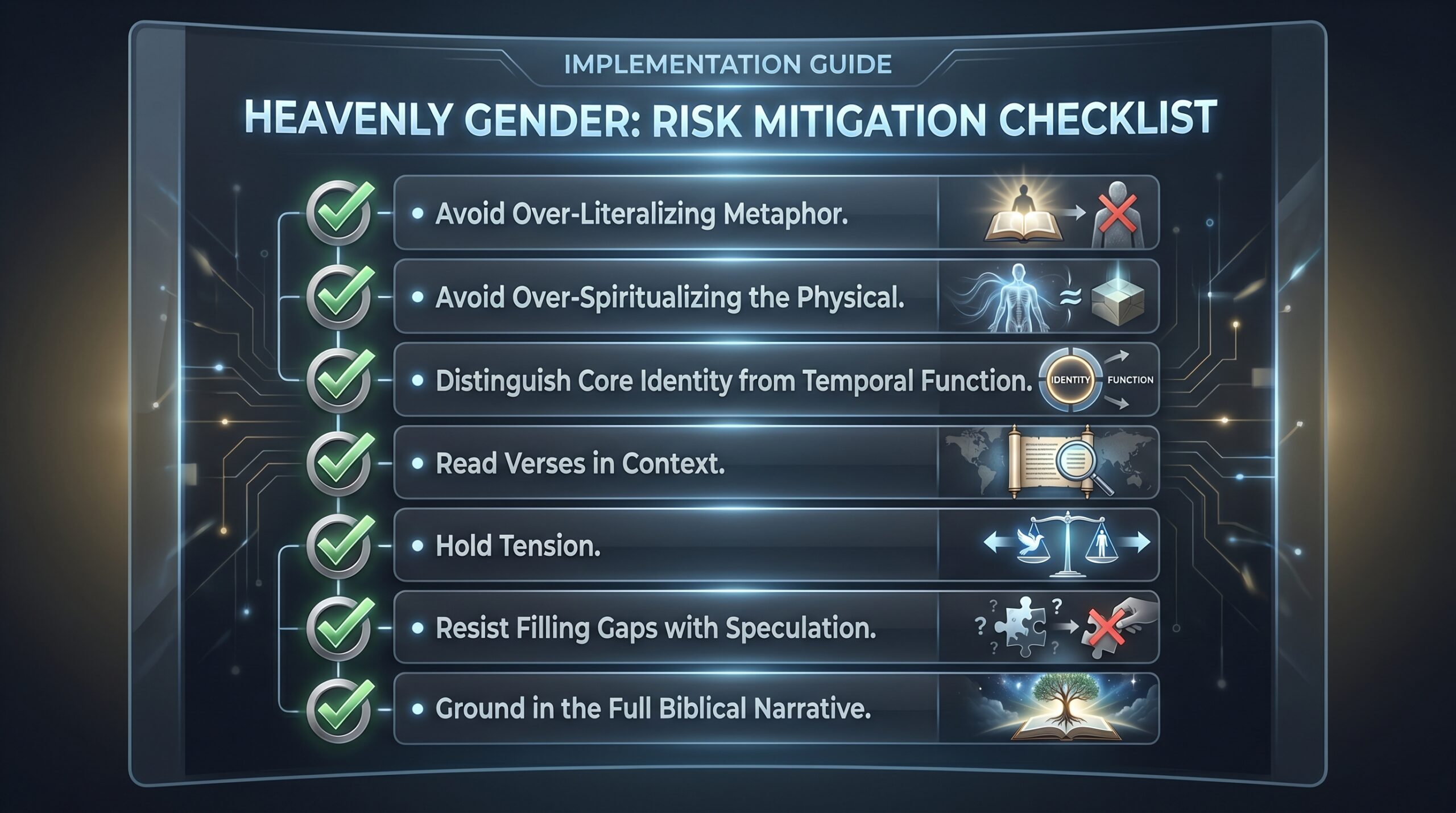
Risk Mitigation Checklist:
- Avoid Over-Literalizing Metaphor: Heaven is described with symbols (streets of gold, gates of pearl). Do not press every detail into a materialistic blueprint.
- Avoid Over-Spiritualizing the Physical: The resurrection is bodily. Do not reduce heaven to a vague, disembodied consciousness.
- Distinguish Core Identity from Temporal Function: Do not confuse the end of marriage with the end of gender.
- Read Verses in Context: Always ask, “What is the specific question this verse is answering?” (e.g., Matt. 22:30 answers about marriage, not gender biology).
- Hold Tension: We must hold the tension between “already” (spiritual equality now in Christ) and “not yet” (the full redemption of our bodies).
- Resist Filling Gaps with Speculation: Admit mystery where Scripture is silent. As Pastor Dr. Robert Jeffress noted on May 8, 2026, “The Bible provides some details about our eternal home, but not everything.”
- Ground in the Full Biblical Narrative: Any view of heavenly gender must fit within the arc of Creation, Fall, Redemption, and Restoration.
Major Risks:
- Misinterpreting Matthew 22:30 as gender abolition is the most frequent error. It’s a specific answer to a specific question.
- Confusing Galatians 3:28 with a statement on eternal physicality ignores its context of justification.
- Imposing Modern Gender Theory onto the biblical text without careful distinction between biological sex (created), gender roles (often cultural), and spiritual identity (redeemed).
Eschatology 101: Understanding Heaven & the New Earth
“Heaven” in popular imagination is often a cloudy, disembodied existence. Biblical eschatology is far richer. As of 2026, with a noted trend toward “spiritual openness” (Phil Knox, Premier Christian News), getting this right is crucial.
Key Stages:
- Intermediate State: The time between an individual’s death and the final resurrection. Believers are “with Christ” (Phil. 1:23) in a conscious, joyful, but disembodied state (“unclothed” – 2 Cor. 5:1-4).
- The Resurrection & Final Judgment: At Christ’s return, the dead are raised with glorified bodies, and all stand before God for judgment.
- The New Heaven & New Earth (Eternal State): This is the final destination. It is not an escape from creation but its renewal (Rev. 21:1-5). It is physical, embodied life on a restored planet. This is where the discussion of gendered, resurrected bodies finds its home.
In this renewed creation, the curse of Genesis 3 is reversed. This includes the relational and gendered strife that entered human experience after the Fall (“your desire will be for your husband, and he will rule over you” – Gen. 3:16). Heaven, therefore, is not the abolition of male and female but the healing of the rift between them.
Scenario Walkthrough: Recognizing Loved Ones in Heaven
Case Study: A Husband Who Lost His Wife
A grieving husband asks, “Will I know my wife in heaven? Will she still be my wife?”
- Recognition: Based on Jesus’ resurrected appearance, yes, you will know her. You will recognize her essence, her smile, her spirit—her perfected self.
- Relationship: She will not be your “wife” in the earthly, covenantal, exclusive sense. That covenant was “till death do us part.” Its earthly purpose is complete.
- New Dynamic: The love you shared will not be lost but redeemed, deepened, and expanded. It will be freed from jealousy, insecurity, and the limitations of time. You will relate as two glorified saints, with a shared history of grace, now part of the boundless love of the entire Bride of Christ for her Bridegroom. Your love for her will be greater, not less, but it will no longer be exclusive.
This scenario demonstrates the principle of transformation, not termination. The relationship is not deleted; it is upgraded and integrated into a wider, perfect community.
The Imago Dei (Image of God) and Eternal Gender
This is the ultimate foundation. Humanity is created in God’s image. Genesis 1:27 explicitly links this image to our creation as “male and female.” Therefore, our genderedness is not incidental; it is theological. It reflects something about God.
- Relational Nature: God is a Trinity—Father, Son, and Holy Spirit—in eternal, loving relationship. The male-female duality in humanity reflects this capacity for profound, complementary, other-oriented relationship.
- Creative & Generative Nature: God is the Creator. Our procreative capacity as male and female is a finite echo of His infinite creativity.
In glory, the relational aspect of the Imago Dei will be fulfilled perfectly in our communion with God and each other. The procreative aspect, having served its temporal purpose, will be transformed. We will continue to reflect God’s creativity in eternal ways we cannot now imagine—perhaps in cultivating culture, exploring creation, or worship through art in the new earth. Our gender will be part of that eternal, creative, relational expression.
Modern Cultural Questions vs. Biblical Eternity
Contemporary debates inevitably shape how we ask the question. As of 2026, the “sex–gender distinction” is a mainstay of academic literature, rightly separating biological sex from social gender roles. This distinction is helpful for our discussion.
- Gender Dysphoria & Heaven: In heaven, every tear is wiped away (Rev. 21:4). This includes the profound anguish of dysphoria. The glorified body will be a perfect fit for the glorified soul. The brokenness where one’s sense of self conflicts with one’s biology—a consequence of the Fall—will be wholly healed. A person will be fully, joyfully, and integratedly who God created them to be.
- Intersex Conditions: Conditions involving ambiguous biological sex are part of the brokenness of a fallen creation. The resurrection body will be raised in power and glory, perfected. God will resolve every individual’s identity into the fullness of His original intent, free from ambiguity or suffering.
These are pastoral, not merely academic, concerns. The biblical hope is not for a genderless void but for the resolution of all gender-related suffering in the perfection of our created identity.
It’s also worth noting cultural fixations, like the satirical “male and female delusion calculator” (Nerdbot, 2026) or video games like “Harem Heaven” (itch.io). These reflect a deep, often confused, societal obsession with gender dynamics. The biblical vision provides a stark, healing contrast: a destiny where gender is neither a source of delusion nor of harem fantasy, but of perfected, joyful personhood.
Case Study: Male-Female Duets and Heavenly Harmony
A 2026 New York Times article on country music highlighted the legendary male-female duet pairings like George Jones & Tammy Wynette or Johnny Cash & June Carter. It noted the rarity of all-female duets in the genre’s history. This earthly dynamic reflects the powerful pull of complementary male-female voices creating a unique, beautiful harmony.
In heaven, that beautiful complementarity is not lost; it is universalized. The exclusive “duet” of marriage ends, but the entire choir of the redeemed—male and female voices together—will sing the song of the Lamb in perfect, multi-part harmony (Rev. 5:9-10, 15:3-4). Our distinct “voices,” including those shaped by our gendered experiences of grace, will contribute to a worship more rich and complex than any earthly duet. The harmony is not erased; the choir is exponentially enlarged.
Implementation Checklist for a Biblical Understanding
To solidify a correct, practical understanding of heavenly gender, work through this checklist.
Biblical Understanding of Heavenly Gender: Implementation Checklist
Actionable steps to deepen and apply your understanding of gender in eternity.
- Anchor in Genesis 1:27: Affirm maleness/femaleness as good, created, and part of God’s image.
- Precision with Matthew 22:30: Remember: “No marriage in heaven,” not “no gender in heaven.”
- Contextualize Galatians 3:28: Celebrate spiritual equality without negating physical resurrection reality.
- Study 1 Corinthians 15: Internalize the hope of a transformed, glorious, and recognizable body.
- Embrace Mystery: Be comfortable with not knowing every detail, trusting your core self will be perfected.
- Live from the Future: Let perfected identity free you from earthly idols relating to gender.
- Pastoral Sensitivity: Offer hope of final integration and wholeness in Christ to those with gender identity struggles.
- Anchor in Genesis 1:27. Affirm that your maleness or femaleness is a good, created part of being in God’s image.
- Precision with Matthew 22:30. Memorize: “No marriage in heaven,” not “no gender in heaven.”
- Contextualize Galatians 3:28. Celebrate your equal standing in Christ, but don’t use this verse to negate the physical reality of the resurrection.
- Study 1 Corinthians 15. Internalize the hope of a transformed, imperishable, glorious, and recognizable body.
- Embrace Mystery. Be comfortable saying, “I don’t know exactly how it will look, but I know the core of who I am, including my gender, will be perfected, not discarded.”
- Live from the Future. Let the hope of a perfected identity free you from idolizing earthly relationships, chafing against gender roles, or fearing the loss of self in eternity.
- Pastoral Sensitivity. When comforting someone with gender identity struggles, lead with the hope of final, painless integration and wholeness in Christ, not with speculative dogma.
FAQ
Q1: Does Matthew 22:30 mean we won’t have genders in heaven?
No. Jesus is answering a specific question about the continuation of marriage laws. He states that people will not marry, comparing that aspect of life to the angels. Angels are personal beings who do not procreate but are not described as genderless. The verse addresses social/legal status, not biological-creational identity.
Q2: I’ve heard we’ll be ‘like angels’ who are sexless. Is that true?
The Bible never describes angels as sexless. They appear consistently in masculine form. The point of comparison is their mode of relating (non-marital) and their immortality, not their lack of gendered personhood. Being “like” them in one respect does not mean being identical to them in all respects.
Q3: But Galatians 3:28 says ‘no male and female.’ Doesn’t that settle it?
It settles our standing before God in Christ. This verse is about access to salvation and spiritual unity, not the composition of our resurrection bodies. To use it to argue for genderless eternity ignores its context and contradicts the clear teaching on physical resurrection found elsewhere.
Q4: What’s the point of being male/female if we don’t marry or have kids?
Earthly marriage and parenthood are temporary, albeit beautiful, metaphors for eternal realities. Our gender points to deeper truths about God’s relational nature and our capacity for “other-oriented” love. In heaven, that capacity will be fully realized in worship and community. The “point” is to be a complete, Image-bearing person in relation to God and others.
Q5: Will I be more masculine or more feminine in heaven?
You will be more fully you. All that was good, true, and beautiful in your masculinity or femininity will be purified and amplified. All that was twisted by sin, culture, or pain will be burned away. You will express your gendered personhood in ways perfectly aligned with God’s original design.
Q6: How can we be one in Christ (Gal. 3:28) and still be male/female?
Unity is not uniformity. The Trinity is one God in three distinct Persons. The Church is one body with many members (1 Cor. 12:12). Our unity in Christ is a unity of purpose, love, and redeemed identity that encompasses and celebrates our diverse, gendered personhood, not one that flattens it.
Q7: Does this mean transgender people will be ‘fixed’ to their biological sex in heaven?
It means all people will be made whole. The profound suffering of gender dysphoria is a consequence of the Fall, affecting both body and soul. The resurrection brings the redemption of the whole person. In glory, there will be no conflict, no incongruence. Each person will be seamlessly, joyfully integrated—the soul at perfect peace with the glorified body God gives them.