

The AI impact on software engineer jobs by 2026 is characterized by a reshaping of roles rather than outright replacement. While entry-level positions may see a reduction and 30-40% of current coding tasks will be automated, overall software engineering job postings are rising, with a strong demand for specialized AI skills. Engineers must adapt by mastering prompt engineering, AI output evaluation, systems thinking, and specialization in areas like agentic AI engineering to thrive.
TL;DR: AI isn’t replacing software engineers by 2026, but transforming the role. Junior positions are challenged by task automation and economic shifts, while senior engineers and AI specialists are in higher demand for their oversight, problem-solving, and AI system development skills. Adaption through prompt engineering, AI output validation, systems thinking, and specialization is crucial for career growth.
The impact of AI on software engineer jobs by 2026 is characterized by a reshaping of roles rather than outright replacement. While entry-level positions may see a reduction and 30-40% of current coding tasks will be automated, overall software engineering job postings are rising, with a strong demand for specialized AI skills. This is the definitive guide to what’s happening, why, and what engineers need to do to thrive through 2026 and beyond.
What AI Actually Does to Software Engineer Jobs in 2026
AI is not eliminating software engineering jobs but profoundly altering them. Routine coding tasks – boilerplate generation, standard API calls, simple bug fixes – are now heavily automated by AI coding agents like GitHub Copilot Enterprise, Amazon CodeWhisperer, and Cursor. This automation is forcing a role shift.
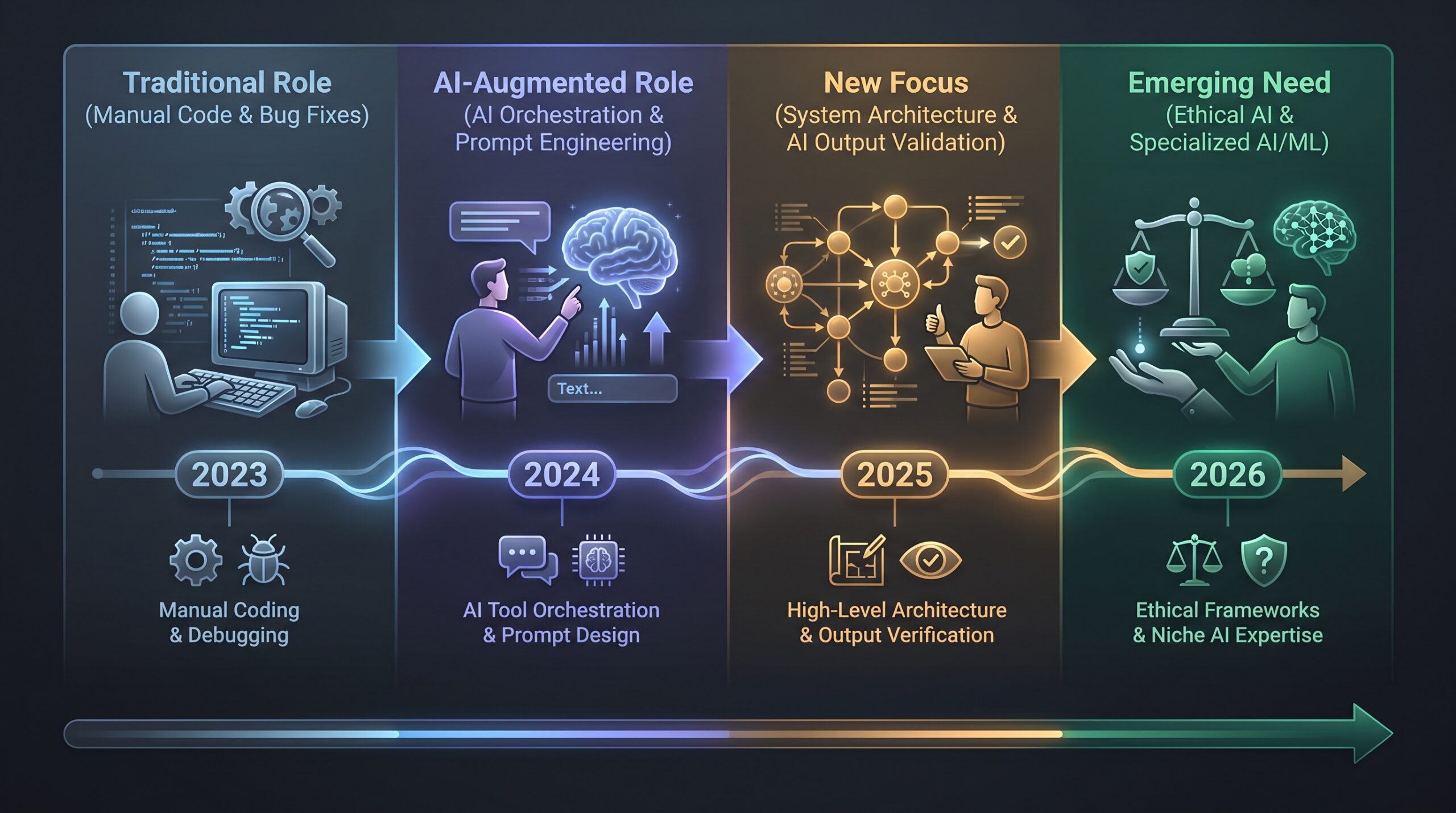
Instead of writing every line of code manually, engineers are becoming directors of intelligent systems. Their focus moves to defining problems, architecting solutions, writing precise prompts, and, most critically, rigorously evaluating and refining the code that AI agents produce. This evolution is creating a higher bar for entry-level positions while simultaneously increasing demand for senior engineers who can manage these complex, AI-augmented workflows.
The evidence for this transformation is clear. The US Bureau of Labor Statistics projects 17% employment growth for software engineers through 2033. Yet, employment for software developers aged 22 to 25 has fallen nearly 20% since 2022 (Stanford study, 2025). This contradiction highlights the core dynamic: the nature of the jobs is changing faster than the number of jobs.
Current State of AI in Software Engineering (April 2026)
As of Q2 2026, AI integration into software development lifecycles is standard practice at most mid-to-large tech companies. The conversation has decisively shifted from speculative fear (“will AI replace me?”) to practical implementation (“how do I use this to be 10x more effective?”). Tool maturity has accelerated.
GitHub Copilot, now in its enterprise phase, handles over 60% of code suggestions in supported languages like Python, JavaScript, and TypeScript for its proficient users. This significantly speeds up development and reduces the manual effort required for common coding patterns.
Gartner’s prediction that 40% of enterprise applications will include task-specific AI agents by the end of 2026 is tracking to be accurate. These aren’t just chatbots; they are autonomous agents that can perform multi-step tasks like generating a microservice from a specification, writing and running unit tests, and deploying the service to a staging environment. This has created a new layer of infrastructure that engineers must learn to manage, leading to new roles and skill requirements, particularly in AI Agent Frameworks.
Detailed Breakdown of Job Role Changes and Trends
The impact of AI is not uniform across all seniority levels or specializations. The market is bifurcating, with clear winners and those facing headwinds.
Junior/Entry-Level Software Engineer (Ages 22-25)
This group is facing the most significant challenges. Their traditional onboarding path – handling bug fixes, writing simple features, and maintaining documentation – is precisely the work that AI automates most effectively. This has led to a nearly 20% drop in employment for this demographic since 2022.
The problem is compounded by broader 2024-2025 economic factors, including interest rate hikes and widespread entry-level hiring freezes at major tech firms. Companies are now hesitant to hire junior engineers who require significant training when AI tools can immediately augment the output of their existing senior staff. This creates a difficult entry point for new graduates.
Mid-Career and Senior Software Engineers
Demand for experienced engineers has held steady or increased. Their value has shifted from raw coding output to complex problem-solving, system architecture, cross-team coordination, and, crucially, the oversight of AI-generated work. They are the “directors” who define the prompts, validate the outputs, and ensure the final product meets security, performance, and business logic standards.
Their deep contextual knowledge of existing systems and business domains is something AI cannot replicate, making them more indispensable than ever. Senior engineers are now tasked with responsibilities related to deploying AI models to production and ensuring their stability.
Generalist Software Engineers
Engineers without a deep specialization are struggling. AI excels at generalist tasks – it can quickly generate code for a common CRUD API or a standard React component. This diminishes the competitive advantage of a generalist who doesn’t bring a unique, high-value skill to the table.
The market is signaling a strong push towards T-shaped skills: broad general knowledge with one or two areas of deep, expert-level proficiency that AI cannot easily match. Without specialization, generalists risk being outcompeted by advanced AI-powered tools capable of generating efficient code.
Specialist Software Engineers (AI/ML, Agentic AI, DevOps)
This category is thriving. Specialists, particularly those focused on AI/ML, machine learning operations (MLOps), and the new field of agentic AI engineering, are in extremely high demand. The salary growth for agentic AI roles has been the steepest tracked across any AI subcategory (The AI Corner, 2025).
Companies are desperately searching for engineers who can build, train, fine-tune, deploy, and maintain the AI systems that are now core to their products. This is where the new, high-paying jobs are being created, driving demand for skills in AI model deployment tools.
| Role Type | 2022-2026 Trend | Key Impact Factors |
|---|---|---|
| Junior/Entry-Level | Decreased headcount (down ~20% for ages 22-25) | AI automation of basic tasks, economic hiring freezes, ‘AI slop’ generation. |
| Mid-Career/Senior | Held steady or increased | Demand for oversight, complex problem-solving, AI integration. |
| Generalist | Struggling | AI’s proficiency at routine generalist tasks. |
| Specialist (AI/ML, Agentic) | Thriving, significant growth | Direct creation and management of AI systems, high demand for niche skills. |
Table 1: Software Engineering Job Role Changes from 2022 to 2026.
Task Automation vs. Job Automation: A Critical Distinction
A common and critical mistake is conflating task automation with job automation. They are not the same.
Task Automation refers to using technology to perform specific, repetitive duties. By 2026, approximately 30-40% of current coding tasks are automated by AI (Markaicode). This includes writing functions, generating tests, creating documentation, and refactoring code. This is a massive productivity boost.
Job Automation implies the complete replacement of a human role. This is not happening at scale for software engineers. Instead, the job description is evolving. The 60-70% of tasks that are not automated are often more complex: understanding nebulous business requirements, designing scalable architectures, making high-stakes technical trade-offs, and ensuring ethical AI implementation. The job becomes less about typing code and more about thinking critically.
| Category | Automation Level by 2026 | Real-World Impact |
|---|---|---|
| Current Coding Tasks | 30-40% automated | Reshapes roles, reduces need for manual routine coding. |
| Software Engineer Jobs (Total) | May decrease slightly overall | Not widespread replacement. Overall job numbers projected to grow 17% through 2033 (BLS). |
Table 2: Task Automation vs. Job Role Automation by 2026.
The Exploding Demand for Agentic AI and Specialized Roles
The most significant growth area in software engineering is in AI specialization, with agentic AI roles leading the charge. An agentic AI engineer focuses on developing systems where AI agents can autonomously perform multi-step, complex tasks with minimal human intervention. This field explores Best AI Agents for Developers and how to leverage them effectively.
These roles require a hybrid skill set:
- Software Engineering Fundamentals: Strong coding skills in Python, Java, or Go.
- Machine Learning Expertise: Understanding of model training, fine-tuning (e.g., using LoRA), and evaluation metrics.
- Systems Design: Ability to architect reliable, scalable systems for agents to operate within.
- Prompt Engineering & Validation: Crafting robust prompts and creating systems to validate an agent’s outputs for safety, accuracy, and efficiency.
Companies are building teams dedicated to creating agents for tasks like automated customer support triage, internal data analysis, and continuous codebase refactoring. The “tiny supply” of engineers with these skills has led to salary premiums of 20-40% over standard software engineering roles. This is also where companies are investing in AI Agents for Decentralized Trading Platforms.
The “AI Slop” Problem: Why Human Oversight is Non-Negotiable
“AI slop” is the industry term for substandard, generic, or unoptimized code generated by AI tools, particularly when used by less experienced individuals without critical oversight. It’s a major, often overlooked side effect of widespread AI adoption. This phenomenon underscores the ongoing need for human expertise in the development lifecycle, even with advanced Python AI automation scripts.
Common manifestations of AI slop include:
- Code that is syntactically correct but logically flawed or insecure.
- Solutions that are inefficient or don’t scale, like suggesting O(n²) algorithms for problems that require O(n log n).
- Overly generic implementations that fail to account for specific business rules or edge cases.
- Introduction of subtle bugs or security vulnerabilities that are difficult to spot in a code review.
This phenomenon paradoxically increases the value of senior engineers. Their expertise is required to identify, debug, and refactor AI slop, turning a poor AI-generated draft into a production-ready solution. It creates a new responsibility: AI output quality control. This is especially critical in domains where flaws can have severe consequences, such as when AI exploits crypto exchange software flaws.
Economic Factors vs. AI: The Real Story Behind the Class of 2026’s Struggles
It is a misconception to blame AI alone for the difficult job market facing new graduates in 2026. The primary drivers are macroeconomic. The steep interest rate hikes of 2023-2024 led to a capital crunch for tech companies and venture-backed startups. This resulted in widespread hiring freezes, layoffs, and extreme caution in hiring entry-level positions, which are seen as an investment in future capacity rather than immediate productivity.
AI exacerbated this trend by giving companies a tool to do more with their existing senior staff, reducing the immediate pressure to hire juniors. However, the root cause is economic. In a stronger economy, companies would be more willing to invest in training junior talent despite the availability of AI tools. This distinction is crucial for understanding the market; it’s a temporary economic downturn layered on top of a permanent technological shift.
Key Insight: Economic Headwinds vs. AI Reshaping
The challenges faced by junior software engineers in 2026 are a blend of two forces: a natural market correction after years of over-hiring, amplified by higher interest rates, and the concurrent rise of AI. While AI fundamentally changes skill requirements, economic factors are a critical, often short-term, bottleneck for entry-level hiring.
Essential New Skills for the 2026 Software Engineer
To remain competitive, software engineers must proactively develop a new set of core competencies.
1. Prompt Engineering & AI Interaction:
This is no longer a niche skill. Engineers must master crafting precise, iterative prompts for coding agents to generate useful outputs. This includes techniques like chain-of-thought prompting and setting clear constraints. Effective prompt engineering is becoming as critical as writing clean code itself.
2. AI Output Evaluation & Validation:
The ability to critically review, test, and refine AI-generated code is paramount. This means sharpening skills in code review, static analysis, security auditing, and performance profiling specifically applied to machine-generated content. This ensures the output is not just functional but also robust and secure.
3. Systems Thinking & Architecture:
With routine coding automated, the value shifts to designing the systems that AI agents will operate within. Engineers need stronger skills in distributed systems, API design, and creating robust guardrails for autonomous agents. They must understand the broader ecosystem to integrate composable AI coding stacks effectively.
4. Specialization:
Deep expertise in a high-value domain is a shield against automation. Prioritize learning AI/ML engineering, cybersecurity, cloud infrastructure (AWS/Azure/GCP specialization), blockchain development, or embedded systems. This depth provides unique value that AI cannot easily replicate.
5. Soft Skills & Product Sense:
The ability to communicate with non-technical stakeholders, understand deep business problems, and translate them into technical directives for AI systems is a uniquely human skill that is increasingly valuable. This involves strong analytical and problem-solving capabilities.
Tools and Technologies You Must Master
The tool ecosystem has expanded far beyond basic IDEs. Proficiency in these platforms is now a baseline expectation. Mastering these tools is crucial for staying competitive and for projects like building Quantum AI Trading Bots.
- Coding Agents: GitHub Copilot Enterprise, Amazon CodeWhisperer, Cursor, Tabnine. These are your primary co-pilots for daily development, significantly boosting efficiency.
- Agentic AI Platforms: LangChain, LangGraph, LlamaIndex, CrewAI. These frameworks are essential for building multi-step autonomous AI agents, enabling advanced automation. This is related to the broader discussion on AI Decentralization vs. Bitcoin Mining Industrialization.
- Natural Language Processing (NLP) Tools: spaCy, Hugging Face Transformers, OpenAI API. Crucial for any work involving text-based AI features, from sentiment analysis to complex language generation.
- Computer Vision Systems: OpenCV, TensorFlow Object Detection API, PyTorch Vision. Key for roles in robotics, automotive, and healthcare tech, providing visual intelligence.
- Predictive Analytics Platforms: Azure Machine Learning, SageMaker, DataRobot. The backbone of building and deploying ML models, enabling data-driven decisions.
- Low-Code/No-Code Integration: Tools like Zapier and Make.com are important for orchestrating workflows between different AI services and applications, streamlining complex processes.
Case Study: Shopify’s AI-First Engineering Playbook
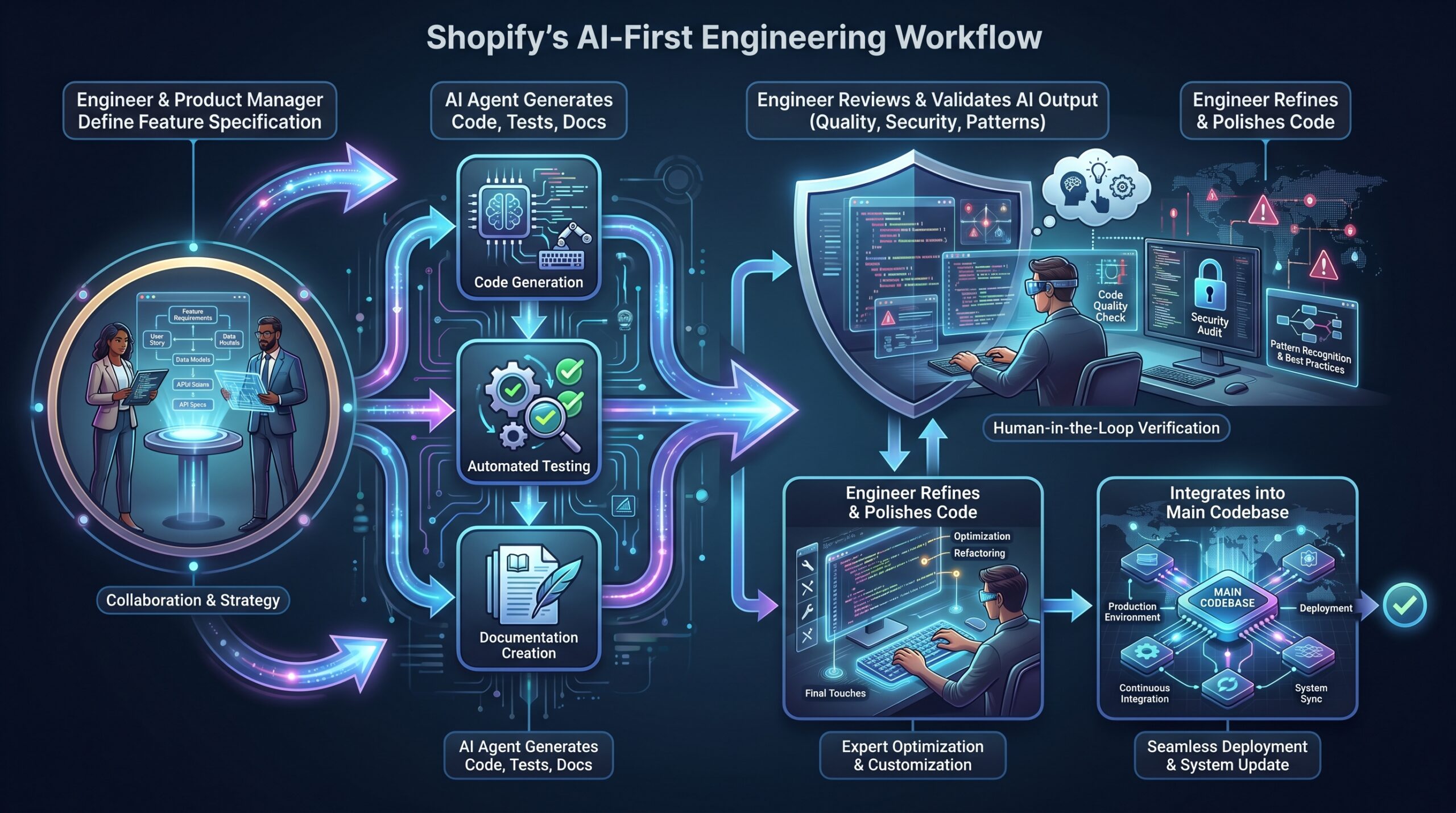
Shopify provides a canonical example of successful AI integration. As noted by Bessemer Venture Partners, the company implemented an “AI-first engineering playbook” by 2025. They didn’t replace engineers; they redefined their workflow.
The Old Way: A product manager writes a ticket. An engineer manually codes the feature, writes tests, and submits a pull request for review. This traditional method often involved more manual, repetitive tasks.
The AI-First Way: The engineer works with the PM to define the feature specification. The engineer then uses an AI agent to generate the initial code, tests, and documentation. The engineer’s primary role shifts to a) crafting the precise prompts for the agent, b) reviewing the generated code for quality, security, and adherence to Shopify’s strict patterns, and c) integrating the polished code into the main codebase.
This approach allowed Shopify’s existing engineering team to increase its output velocity by an estimated 3x without increasing headcount. It also raised the hiring bar, seeking engineers who were adept at this new “director” role rather than just prolific coders. This highlights the practical application of integrating AI tools via Python API for increased efficiency.
Case Study: A Junior Engineer’s Upskilling Path in 2026
Consider “Alex,” a 2025 computer science graduate struggling to find a traditional junior developer role. Instead of continuing to apply for stagnant positions, Alex dedicates six months to a targeted upskilling plan. This strategic approach is vital in the evolving job market for junior engineers.
1. Foundation:
Alex strengthens core data structures and algorithms knowledge on LeetCode, but now focuses on understanding the why behind efficient solutions to better evaluate AI output. This shift in focus is critical for moving beyond basic coding.
2. Specialization:
Alex chooses to specialize in backend development with a focus on AWS and Python. They complete the AWS Certified Developer – Associate certification and build several projects using API Gateway, Lambda, and DynamoDB. This specialization makes Alex more competitive in a niche area.
3. AI Tool Mastery:
Alex becomes proficient with GitHub Copilot and Cursor, practicing prompt engineering to generate complex code and then critically refactoring it. This practical application of AI tools demonstrates adaptability and efficiency.
4. Agentic AI Demo:
Alex uses LangChain and the OpenAI API to build a demo project: an AI agent that can automatically write, run, and debug unit tests for a simple codebase. This showcase of agentic AI skills is a strong differentiator. For more on this, research AI Agent Frameworks Comparison 2026.
With this new portfolio and skill set, Alex applies for “Associate AI Integration Engineer” roles. Their demonstrated ability to leverage AI tools and their specialized cloud knowledge makes them a compelling candidate, and they secure a position that would have been unavailable to a traditional junior applicant. This success story illustrates a clear path for aspiring engineers.
Risks, Myths, and What Can Go Wrong
Navigating this shift requires avoiding common pitfalls and misconceptions.
Common Myths to Ignore:
- Myth: AI will replace the majority of software engineers. Reality: Roles are reshaping, not disappearing. Demand is still growing, focusing on higher-level tasks and AI oversight.
- Myth: The job market struggle is 100% due to AI. Reality: Economic factors (rate hikes, freezes) are a major, temporary contributor, especially for entry-level positions.
- Myth: Senior engineers are safe and don’t need to adapt. Reality: All engineers must learn to work with AI tools to remain effective and lead AI-driven projects, irrespective of seniority.
What Can Go Wrong (And How to Avoid It):
- Becoming Obsolete: Failure to adapt to new workflows. Mitigation: Dedicate weekly time to learning new AI tools and paradigms. Continuously seek new skills.
- Producing AI Slop: Over-relying on AI without oversight. Mitigation: Treat AI output as a first draft. Always review, test, and refine rigorously, maintaining quality control.
- Skill Stagnation: Focusing only on writing code. Mitigation: Intentionally develop skills in architecture, prompt engineering, and evaluation. Expand beyond basic coding.
- Security Vulnerabilities: Blindly accepting AI-generated code. Mitigation: Implement mandatory security scans and peer reviews for all AI-generated code. This is crucial for preventing issues like those where AI exploits crypto exchange software flaws.
AI Impact on Software Engineering: Risks & Mitigation
- Risk: Skill Obsolescence. Mitigation: Continuous Learning & Adaptation.
- Risk: AI Slop Integration. Mitigation: Rigorous Review & Refinement.
- Risk: Lack of Specialization. Mitigation: Deep Dive into Niche Domains.
- Risk: Security Flaws. Mitigation: Automated Scans & Human Oversight.
Software Engineer AI Adaptation Checklist
Use this actionable list to guide your professional development over the next 12 months.
- Achieve proficiency in at least one mainstream AI coding assistant (e.g., achieve “highly proficient” rating in GitHub Copilot) to enhance daily productivity.
- Build a demo project using an agentic AI framework like LangChain or CrewAI to understand the architecture and practical implementation. Explore how to build AI agents for decentralized trading platforms.
- Formalize your prompt engineering skills through a course or dedicated practice, making your AI interactions more effective and precise.
- Choose one specialization area (AI/ML, Cloud, Security, DevOps) and deepen your expertise with a certification or significant project. This builds a unique market advantage.
- Revamp your resume to highlight AI-augmented productivity, system design skills, and specialization, not just languages known. Showcase your modern skill set.
- Develop a rigorous code review checklist specifically for evaluating AI-generated code to ensure quality and security.
- Network with professionals in AI-focused roles to understand emerging best practices and job opportunities, staying ahead of trends.
Key Takeaways for Software Engineers by 2026
- Adaptation, Not Replacement: AI is transforming software engineering roles, not eliminating them.
- Junior Challenges & Senior Demand: Entry-level positions face headwinds, while senior and specialized engineers are increasingly valuable.
- Macroeconomic Factors: Economic downturns significantly impact junior hiring, exacerbated by AI.
- Essential Skills: Prompt engineering, AI output validation, systems thinking, and specialization are critical.
- AI Slop Oversight: Human engineers are vital for identifying and correcting AI-generated inefficiencies and errors.
- Agentic AI Growth: Roles building autonomous AI agents are experiencing explosive demand and salary growth.
FAQ: AI Impact on Software Engineer Jobs 2026
Will AI replace software engineers?
No, AI will not replace software engineers en masse. It is automating specific tasks (30-40% of coding work), which is reshaping the role toward higher-value activities like system design, AI direction, and complex problem-solving. Overall job growth for the profession is still projected to be strong for 2026 and beyond.
Are software engineering jobs decreasing?
Overall, no. While entry-level job availability has contracted due to both AI and economic factors, the total number of software engineering jobs is still rising. The U.S. Bureau of Labor Statistics projects 17% growth through 2033. The decrease is focused on junior roles, while demand for mid-level, senior, and specialized engineers remains high.
Is it hard to get a software engineering job in 2026?
It is more challenging for new graduates applying for traditional junior developer roles due to increased competition and reduced openings. However, for engineers who have adapted their skills to include AI collaboration and specialization, the job market is excellent, with many high-demand, high-salary opportunities in areas like agentic AI. Learning about concepts like Centralized vs. Decentralized AI can provide an edge.
What is the future of software engineers after AI?
The future involves less manual coding and more “directing” intelligent systems. Software engineers will act as architects, evaluators, and integrators. They will define problems, instruct AI agents through prompts, validate outputs, and ensure the final product meets all requirements. The job becomes more strategic and less tactical, requiring skills beyond just coding.
What software jobs are AI-proof?
No job is entirely AI-proof, but roles requiring deep creativity, complex stakeholder management, high-level system architecture, and specialized domain knowledge (e.g., kernel development, quantum computing algorithms, advanced cryptography) are the most resilient. Specialized AI roles themselves, like AI/ML engineer, are also in high demand and constantly evolving. Positions in AI in Decentralized Finance (DeFi) Applications are also emerging as highly specialized and resilient.