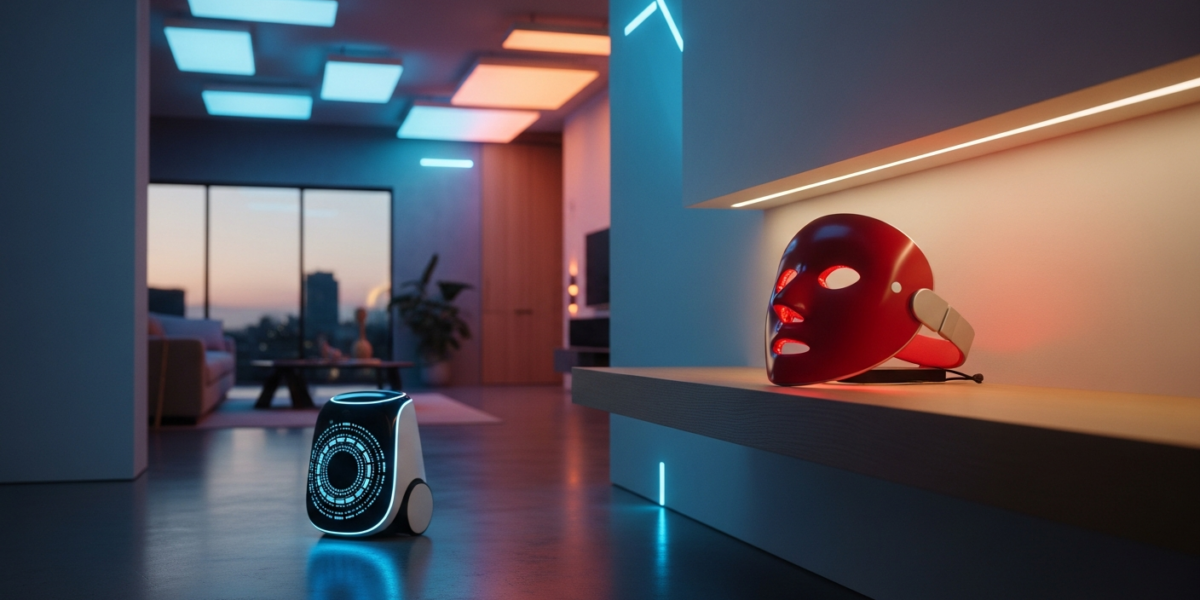
Nanoleaf, known for its modular smart lighting panels, is undergoing a significant brand evolution, shifting its focus beyond decorative illumination to encompass wellness, robotics, and artificial intelligence. This strategic pivot, teased by CEO Gimmy Chu, aims to address what the company perceives as a “boring” smart home market by integrating AI across lighting, wellness products, sensors, and robotics, with a red light therapy mask already launched in and embodied AI robotics on the horizon.
- Nanoleaf is moving beyond smart lighting, diversifying into AI, robotics, and wellness products.
- The company launched a red light therapy mask in , signaling its entry into wellness tech.
- Future plans include embodied AI robotics, though CEO Gimmy Chu notes this will take time to develop.
- This shift is a response to a perceived stagnation in the smart home market, aiming for deeper integration of technology into daily life.
What changed
Nanoleaf, which gained recognition for its smart modular light panels introduced at the Consumer Electronics Show, has historically focused on decorative and functional smart lighting [5]. However, the company has been notably quiet in product releases over the past two years compared to competitors like Govee and Philips Hue [1]. This lull was not a sign of stagnation but a deliberate “brand evolution,” according to CEO Gimmy Chu, who now prefers the company not be labeled solely as a smart lighting firm [1].
The core change is a strategic diversification into new product categories and technological domains. Nanoleaf has already launched a red light therapy mask in , which Chu states has become a successful product for the company [1, 2]. This move into wellness products, specifically red light therapy, represents a concrete step away from its lighting-centric past. Furthermore, Nanoleaf has teased upcoming products centered on embodied AI and robotics, although Chu acknowledges that the robotics aspect will require a longer development timeline [1, 3]. The vision is to integrate AI throughout the home, spanning lighting, wellness, sensors, and environmental systems, positioning Nanoleaf to leverage its existing expertise in connected devices [4].
Why it matters for operators
Nanoleaf’s pivot is a textbook example of a company recognizing market saturation in its core segment and proactively seeking new growth vectors. For operators in the smart home, consumer electronics, or even adjacent health and wellness sectors, this move carries several implications.
First, it validates the increasing convergence of consumer tech categories. The idea that a smart lighting company can credibly enter red light therapy or robotics underscores that the underlying value proposition is shifting from discrete device functions to integrated experiences. Operators should be asking: what adjacent markets can our core technological competencies unlock? Nanoleaf’s strength in connected devices and user experience is now being applied to wellness and potentially robotics, rather than just illumination. This suggests that the “smart home” is evolving into a “smart living ecosystem,” where AI acts as the connective tissue, rather than just a feature.
Second, the emphasis on “embodied AI” and robotics, even if long-term, signals a belief that the next frontier in consumer tech isn’t just about voice assistants or smart displays, but about physical agents interacting with the environment. For hardware startups and robotics engineers, this indicates a potential for significant investment and innovation in consumer-grade, task-specific robots. The challenge, as Nanoleaf implicitly acknowledges, lies in moving beyond novelty to genuinely useful, reliable, and affordable embodied AI. Operators should monitor how Nanoleaf and others define and deliver “value” in this space, as early failures could sour consumer appetite for years.
Finally, Nanoleaf’s CEO calling the smart home “boring” is a critical insight. It suggests that incremental improvements in existing smart lighting or thermostat products are no longer sufficient to capture consumer imagination or premium pricing. Operators must innovate at the experience layer, not just the feature layer. This means exploring how AI can personalize, optimize, and simplify daily routines in ways that are genuinely transformative, whether through proactive wellness interventions or intelligent assistance. The risk for operators who stick to their niche without exploring these convergences is becoming a commoditized component provider in a larger, more integrated ecosystem. The move into wellness, a high-margin sector, is particularly shrewd, as it leverages consumer demand for health optimization, which often commands higher price points than mere convenience.
Risks and open questions
- Brand Dilution: While diversification can drive growth, there’s a risk of diluting the Nanoleaf brand, which is strongly associated with smart lighting. Can consumers easily connect decorative lights with red light therapy masks and future robots?
- Execution in New Domains: Entering complex fields like robotics and advanced AI requires different expertise, supply chains, and regulatory navigation than smart lighting. Nanoleaf’s ability to execute on these new ventures remains to be seen, especially for embodied AI which is notoriously difficult to scale in consumer products.
- Market Competition: The wellness tech and robotics markets are already crowded with established players and innovative startups. Nanoleaf will face significant competition from companies specializing in these areas, such as CurrentBody in LED masks [8] or various robotics firms.
- AI Integration Challenges: The promise of AI across the home is compelling, but delivering on truly intelligent, seamless, and privacy-respecting AI integration is a massive undertaking. Will Nanoleaf’s AI be genuinely transformative or merely a marketing buzzword for existing automation?
- Long-Term Robotics Vision: While robotics is a stated future focus, the timeline is vague. Will Nanoleaf be able to sustain interest and investment in this area while delivering tangible products in the interim?
Sources
- Nanoleaf bets its future on robots, red light therapy, and AI | The Verge
- Nanoleaf bets its future on robots, red light therapy, and AI
- Nanoleaf shifts focus to robots, wellness, and AI | Let’s Data Science
- Nanoleaf’s Next Evolution Is About More Than Smart Lighting | Global Lighting Forum
- Nanoleaf – Wikipedia
- Nanoleaf LED Face Mask | Red Light Therapy | Dermatologist Approved – Nanoleaf Shop USA
- Best Red Light Therapy Masks 2026 – Forbes Vetted
- LED Red Light Therapy Face Mask: Series 2 – CurrentBody