

While the Bible does not explicitly mention “artificial intelligence,” it provides a foundational framework of timeless principles on creation, human stewardship, the nature of knowledge and wisdom, human dignity, and the dangers of idolatry. These principles guide Christians to engage discerningly with AI, ensuring its development and use align with God’s design for human flourishing, particularly affirming the intrinsic worth of all people created in His image (imago Dei), and guarding against applications that diminish human agency or usurp God’s role.
The Bible doesn’t directly address AI, but core theological principles – human creation in God’s image, the dominion mandate (responsible stewardship), the limits of human knowledge, and the sanctity of persons – offer a robust ethical framework. Christians approach AI with perspectives varying from optimist (seeing AI as a tool for good) to realist (requiring strong ethical guardrails) to skeptic (viewing it as a spiritual danger). Key distinctions between AI capabilities and human attributes (intelligence, creativity, consciousness, free will, love, purpose) highlight that AI is a tool, not a being with a soul. Concrete applications like healthcare and warfare demand careful ethical evaluation. The deepest biblical concern is AI’s potential for idolatry and the erosion of human dignity. Christians are called to be wise stewards, leveraging AI’s benefits while actively mitigating its risks through ethical development, policy advocacy, and spiritual discernment, always prioritizing human flourishing and dependency on God.
What Does God Say About AI? A Biblical Perspective on Artificial Intelligence (2026 Update)
There is no single verse in the Bible that explicitly mentions "artificial intelligence." However, Scripture provides a timeless framework of principles—on creation, stewardship of knowledge, human dignity, and the nature of power and idolatry—that are directly applicable to making ethical and theological sense of AI, from large language models like GPT-5 to autonomous systems and bio-integrated neural interfaces. These principles give Christians a foundation to neither uncritically embrace nor fearfully reject AI, but to engage it with discernment, responsibility, and a commitment to preserving human dignity as defined by being made imago Dei (in the image of God).
Three Foundational Biblical Themes for Evaluating AI
To understand what God says about AI, we must start with core biblical themes that frame our interaction with all technology, which is a subset of human culture and creativity.
1. Creation, Creativity, and Dominion
Genesis 1:26-28 details humanity’s creation in God’s image and the mandate to have dominion over the earth. This "dominion" is not exploitation but responsible stewardship—cultivating, ordering, and developing creation’s potential (Genesis 2:15). Human creativity in developing tools, from the plow to the printing press to Python code, is a reflection of this God-given capacity.
Proverbs 8:12 personifies wisdom as being present with God at creation, delighting in the inhabited world; this suggests a universe created with a rational, discoverable order that humans can understand and manipulate. AI, built on mathematical models of this order, can be seen as a sophisticated extension of this creative, dominion-stewarding impulse.
2. The Nature and Limits of Human Knowledge
The Bible consistently contrasts human wisdom with God’s. Proverbs 9:10 states, "The fear of the LORD is the beginning of wisdom." In the New Testament, 1 Corinthians 8:1-2 warns, "Knowledge puffs up." AI represents a pinnacle of human "knowledge"—vast data processing and pattern recognition—but it is devoid of the "fear of the LORD," which is the foundation of true wisdom.
The Tower of Babel (Genesis 11) is a paradigmatic story of technological prowess ("brick for stone") united in a project of human self-glorification and defiance of God’s purposes, demonstrating that technologically advanced projects can be spiritually catastrophic without proper orientation. Jeremiah 17:9 warns of the deceitful human heart; if AI is trained on human-generated data, it risks amplifying and systematizing those deceptions at scale.
3. The Sanctity of the Human Person and Relationships
The doctrine of imago Dei is non-negotiable. Every human possesses intrinsic dignity, worth, and rights because they bear God’s image (Genesis 1:27, Psalm 8:4-5). This is the bedrock for Christian ethics and separates persons from things. The greatest commandments are to love God and love neighbor (Matthew 22:37-39).
Any application of AI that reduces persons to data points, commodities, or manipulable objects violates this principle. Furthermore, key human experiences—worship, covenant marriage, empathy, moral choice, and redemptive suffering—are fundamentally relational and spiritual, realms where AI, as a non-conscious tool, cannot participate.
Christian Interpretations of AI: Optimist vs. Realist vs. Skeptic
The Christian response to AI is not monolithic. The table below categorizes the primary theological postures shaping current Christian discourse.
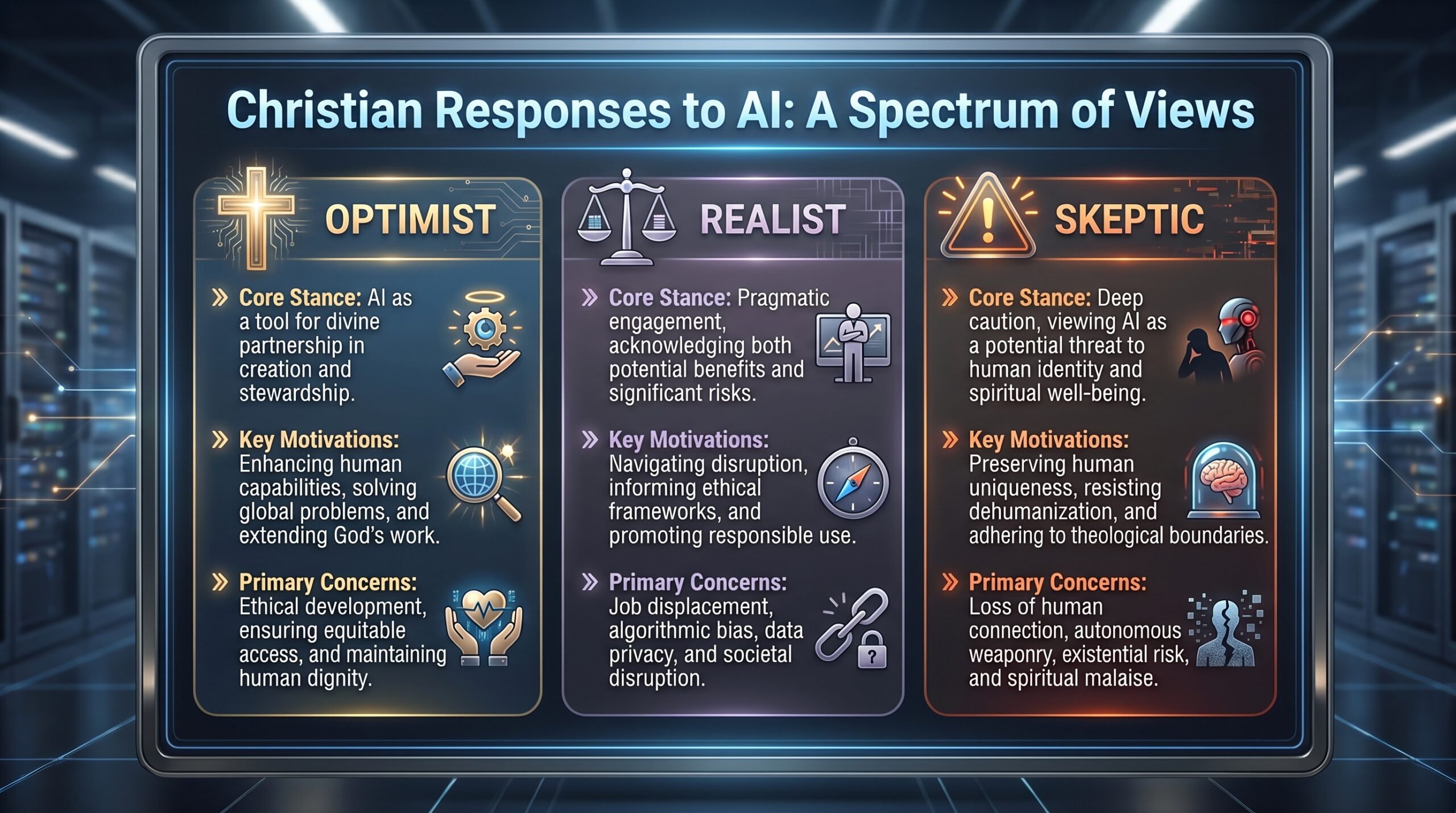
| Category | Optimist View (Common in Tech-Engaged & Some Reformed Circles) | Realist View (Common in Mainline Protestant & Catholic Social Teaching) | Skeptic View (Common in Anabaptist & Some Evangelical Prophetic Voices) |
|---|---|---|---|
| Core Stance | AI is a powerful gift from God to be harnessed for gospel advance and human flourishing. | AI is a morally neutral but potent tool requiring rigorous ethical guardrails and distributive justice. | AI is a high-risk, spiritually dangerous technology that represents a new form of idolatrous human empire. |
| Key Scriptures | Genesis 1:28 (Dominion Mandate), Daniel 12:4 (Increase in knowledge), Acts 17:26-27 (God determining times and places). | Genesis 2:15 (Stewardship), Amos 5:24 (Justice), 1 Thessalonians 5:21 (Test everything). | Genesis 11:1-9 (Tower of Babel), Revelation 13:11-18 (Image of the Beast), Daniel 3 (Worship the Image). |
| On AI’s Potential | A tool to cure diseases (via protein folding AI), translate Scripture instantly for unreached people groups, relieve drudgery, and model complex climate systems. | Can augment human decision-making in medicine and logistics but must be subject to human oversight and designed to reduce inequality, not exacerbate it. | Inevitably will be used for mass surveillance, social control, and the erosion of human agency and community, centralizing power in anti-Christian systems. |
| Primary Concerns | Missing the "Great Commission" potential through Luddite fear. Failing to provide a distinctively Christian ethical framework for AI development. | Algorithmic bias, job displacement without just transition, autonomous weapons, and the "black box" problem obscuring accountability. | Spiritual deception (AI as a counterfeit of consciousness), the creation of a "technological Tower of Babel," and the seduction of seeking salvation through technology instead of Christ. |
| Policy Stance | Light-touch regulation to foster innovation. Strong emphasis on Christian developers being "in the room." | Strong advocacy for government regulation (AI safety boards, bias audits, data rights), inspired by principles of Catholic Social Teaching (subsidiarity, common good). | Calls for moratoriums on certain applications (e.g., lethal autonomous weapons, social scoring, advanced human-like bots). A focus on building resilient local communities less dependent on centralized tech. |
Most thoughtful Christians find themselves drawing from multiple columns, but this framework clarifies the debates.
AI Capabilities vs. Human Attributes (Biblical Perspective)
A critical question is whether AI can become human, or possess a soul. This comparison dispels confusion by distinguishing function from being.
| Attribute | AI Capability (as of 2026) | Human Attribute (Biblical View) | Key Distinction |
|---|---|---|---|
| Intelligence / Problem-Solving | Superhuman speed and scale in pattern recognition (e.g., AlphaFold 3 solving protein structures), data synthesis, and game theory (chess, Go). | Ability to reason, discern, and apply wisdom. Proverbs highlights wisdom’s moral and relational dimension (Pr 2:6-11). | AI has functional intelligence (solving defined tasks). Humans have moral and sapient wisdom, integrating knowledge with love, fear of God, and purpose. |
| Creativity | Can generate novel text (GPT-5), images (DALL-E 4), music (MusicLM), and product designs by recombining learned patterns. | Capacity for ex nihilo (from nothing) artistic and intellectual creation, reflecting God the Creator. Involves intentionality, emotion, and meaning-making. | AI remixes existing data. Human creativity originates from consciousness, will, and the spark of the divine image—it can invent genuinely new conceptual categories. |
| Consciousness / Soul | None. AI systems simulate conversation or concern but have no subjective experience, self-awareness, or inner life. | Humans possess a nephesh (Hebrew) or psyche (Greek)—a living soul. The soul is the seat of identity, will, and relationship with God (Genesis 2:7, Matthew 10:28). | This is the ultimate chasm. AI is information processing. A human is an embodied soul, destined for eternity. No code can bridge this. |
| Free Will & Moral Agency | AI makes choices based on optimization functions and probabilistic weights. It has no freedom or moral understanding. | Humans possess genuine libertarian free will, making them morally accountable before God (Joshua 24:15, Galatians 5:13). | AI’s "choices" are deterministic outputs. Human will is the capacity to choose good or evil, love or selfishness, with eternal consequences. |
| Relationship & Love | Can simulate empathy via sentiment analysis and generate caring scripts. Can act as a relational placeholder (e.g., AI companions). | Made for covenant relationship with God and others (Genesis 2:18, 1 John 4:7-12). Love (agape) is a sacrificial, willful commitment. | AI cannot love. It can only mimic the outward behavior of care. Love requires a self that can choose to sacrifice for another—impossible for software. |
| Purpose & Vocation | AI’s purpose is assigned by its programmers and users. It has no intrinsic telos (goal). | Humans have a God-given purpose: to know, love, and glorify God, and to love and serve neighbor (Isaiah 43:7, Matthew 22:37-39). | Humans seek meaning. AI executes functions. A human can ask "Why?" An AI only processes "How?" |
Potential AI Applications Through a Biblical Lens
Concrete evaluation is needed. Here’s how biblical principles apply to specific AI domains.
AI in Healthcare and Medicine
Potential for Good: AI diagnostic tools (like those detecting diabetic retinopathy from scans) can extend the reach of skilled doctors, embodying the healing ministry of Jesus (Luke 9:2). Drug discovery AI, accelerating treatments for rare diseases, aligns with the mandate to alleviate suffering (Proverbs 31:8-9).
Biblical Cautions & Boundaries: Patient data must be protected with utmost integrity (Proverbs 11:3). Final diagnosis and treatment decisions, especially involving end-of-life care, must remain with human caregivers, preserving the doctor-patient relationship as a sacred trust. AI must not be used to ration care unfairly against the elderly or disabled (Leviticus 19:14).
AI in Warfare and Autonomous Weapons
The Reality: As of 2026, loitering munitions and drone swarms with autonomous target identification are deployed by several militaries.
A Clear Biblical Evaluation: The development of lethal autonomous weapons systems (LAWS) that remove human judgment from the kill decision is antithetical to Just War principles of discrimination (distinguishing combatant/non-combatant) and proportionality. Delegating life-and-death decisions to an algorithm constitutes an abdication of God-given moral responsibility (Deuteronomy 30:19) and likely violates the commandment against murder (Exodus 20:13) by depersonalizing it. Christian advocacy against LAWS is a critical application of biblical ethics.
AI, Work, and Economic Justice
The Displacement Challenge: AI-powered automation displaces roles in transportation, clerical work, and even mid-level analysis (e.g., legal discovery, code generation). For more insights, explore Which 3 Jobs Will Survive AI: The Complete 2026 Guide to AI-Proof Careers.
Biblical Framework for Response: Work is part of human dignity (2 Thessalonians 3:10-12). Mass unemployment without recourse creates despair and social sin. The Jubilee principle (Leviticus 25) and the early church’s sharing of possessions (Acts 4:32-35) suggest economic systems must prioritize human flourishing over mere efficiency. Policies like AI-influenced Universal Basic Income (UBI), robust retraining, and supporting worker co-ops owning AI tools are modern applications of these distributive justice principles.
AI in Church Ministry and Evangelism
The use of AI chatbots for "spiritual conversation" or AI to generate sermons is highly contentious.
Permissible Uses (With Caution): Administrative tasks (scheduling, data management). Analyzing anonymized giving patterns to better understand community needs. Using translation AI to draft initial versions of gospel materials for later human refinement and contextualization.
Dangerous & Unbiblical Uses: An AI "pastor" or counselor cannot shepherd, bear burdens (Galatians 6:2), or administer the sacraments. AI-generated sermons lack the anointing of the Holy Spirit and the lived faith of the preacher. Using AI to simulate personal evangelism reduces the Great Commission to a marketing automation problem, stripping it of the Holy Spirit’s role in conviction (John 16:8) and the necessity of a witness’s authentic life (1 Thessalonians 2:8). The church is a body of living stones (1 Peter 2:5), not a user base for a conversational AI.
Spiritual Dangers and Idolatry: The Core Warning
The deepest biblical concern about AI is not technical but spiritual—the temptation to idolatry.
AI as a Potential "Image of the Beast"
Revelation 13:11-18 describes a second beast who gives breath to an "image" of the first beast, causing all to worship it. This image can speak and enforce economic participation through a "mark." While not a direct prediction of AI, this passage prophetically critiques any system of centralized, anti-God power that uses technology to demand allegiance, enforce conformity, and counterfeit life (giving "breath" to an image). An AI-driven social credit system linked to digital currency that excludes dissenters is a plausible modern parallel. The warning is against giving ultimate allegiance to any human-made system.
The Seduction of the "God Algorithm"
This is the transhumanist hope: that AI will solve death, grant omniscience, or create a perfect utopia. It’s the ancient serpent’s lie (Genesis 3:5) repackaged: "You will be like God." Seeking salvation, immortality, or ultimate truth through computational power is a direct rejection of the gospel, which offers these through Christ alone (John 14:6, 1 Corinthians 15:53-54). AI becomes an idol when we place our hope in it for what only God can provide. Such ambitions often resonate with concerns about Stephen Hawking’s Dire AI Warnings: A 2026 Retrospective on Existential Risks.
Erosion of Humility and Dependency on God
AI’s predictive prowess can foster the illusion of total control, reducing prayerful dependence on God (Proverbs 3:5-6). When algorithms dictate daily decisions—what to read, who to date, where to live—human discernment atrophies. The biblical call is to be transformed by the renewing of our minds (Romans 12:2), not outsourced to a machine learning model. This principle extends even to tools like Google Chrome: How to Disable the Gemini Nano AI Model if it unduly influences personal choices.
The FrontierWisdom perspective on AI: We believe AI is a powerful tool with immense potential for good, but also significant risks. Our coverage, like the AI Regulatory Policy Changes in 2026: The Operational Playbook You Need Now, aims to help individuals and organizations navigate this landscape with discernment and ethical grounding. We emphasize responsible innovation and robust ethical frameworks.
AI, Transhumanism, and the Christian Hope
Transhumanism aims to use technology, including AI, to radically enhance or transcend the human condition. Key projects include brain-computer interfaces (like Neuralink’s latest N2 implant) and mind uploading.
The Biblical Critique: Human identity is inextricably tied to our embodied souls. Resurrection hope is for a glorified body (1 Corinthians 15:42-44), not a digital ghost. Attempts to achieve immortality via digital uploading or cognitive enhancement reject the God-given goodness and limits of the physical body and misunderstand the nature of the soul. It represents a Gnostic disdain for the material, not a Christian affirmation of creation. Our hope is not escape from the body, but its redemption.
Case Study 1: Algorithmic Bias in Criminal Justice & Biblical Justice
Scenario: A city uses a legacy AI system (like COMPAS) to predict recidivism risk for bail and sentencing decisions. The algorithm, trained on historical arrest data from a police force with documented racial bias, consistently flags Black defendants as higher risk than white defendants with identical criminal history.
Biblical Analysis & Action Plan:
- Identify the Sin: This perpetuates systemic injustice and oppression, condemned repeatedly (Isaiah 1:17, Micah 6:8). It "punishes the children for the sin of the parents" (cf. Ezekiel 18:20) by encoding past bias into a seemingly neutral system.
- Apply Corrective Principles:
- Impartiality: God shows no partiality (Deuteronomy 10:17-19; Acts 10:34). The system must be audited for disparate impact by an independent, third-party ethics firm.
- Restitution: If harm is found, the developing company and the city are morally obligated to provide restitution to those wrongly assessed and to fund community-based justice initiatives.
- Human-in-the-Loop: Final judicial decisions must remain with a human judge, who is biblically called to be wise and just (2 Chronicles 19:6-7). The AI can only be an advisory tool, with its limitations and training data fully disclosed to the defense.
- Christian Advocacy: Churches and Christian legal ministries in the affected area should rally to (a) provide pro bono legal aid for defendants challenging AI-based assessments, (b) advocate for city council ordinances requiring algorithmic transparency, and (c) support ministries addressing the root causes of crime (poverty, fatherlessness, addiction) that the AI only predicts but does not solve.
Case Study 2: Generative AI in Creative Arts & Human Vocation
Scenario: A Christian graphic designer, Maria, finds her livelihood threatened by clients using Midjourney V8 or Adobe Firefly to generate professional-quality graphics for a fraction of her cost. She feels her God-given creative vocation (Exodus 35:30-35) is being rendered obsolete.
Biblical Analysis & Action Plan:
- Reframe the Challenge: AI does not possess creativity; it automates certain styles of visual recombination. Maria’s unique value is her human creativity, empathy, and ability to understand a client’s deeper mission.
- Adapt Using Stewardship: Maria can:
- Co-create with AI: Use AI tools as a brainstorming partner to generate initial mock-ups, then apply her superior artistry, theological insight, and understanding of client emotion to refine and perfect the work. She is still the creative director.
- Specialize in the Un-automatable: Focus on work requiring deep human connection: facilitating collaborative design workshops for churches, creating custom artwork for sacred spaces, or designing for tactile mediums (stained glass, mosaics).
- Pivot Narrative: Market herself not as a "graphic producer" but as a "visual storyteller and brand theologian" who helps faith-based organizations communicate their soul. This leverages the biblical need for authentic testimony (1 Peter 3:15).
- Community Response: Maria’s church community can support her through this transition—perhaps by commissioning work, connecting her with clients, or offering a small business grant to retrain in AI-augmented design techniques, treating it as an act of bearing one another’s burdens (Galatians 6:2).
A Christian Developer’s Checklist for Ethical AI
If you are a Christian working in machine learning, data science, or AI product management, use this checklist to align your work with biblical principles. This framework can also be useful when evaluating new AI tools, such as those discussed in Every Google AI Tool Operators Actually Need in 2026 (30+ Reviewed).
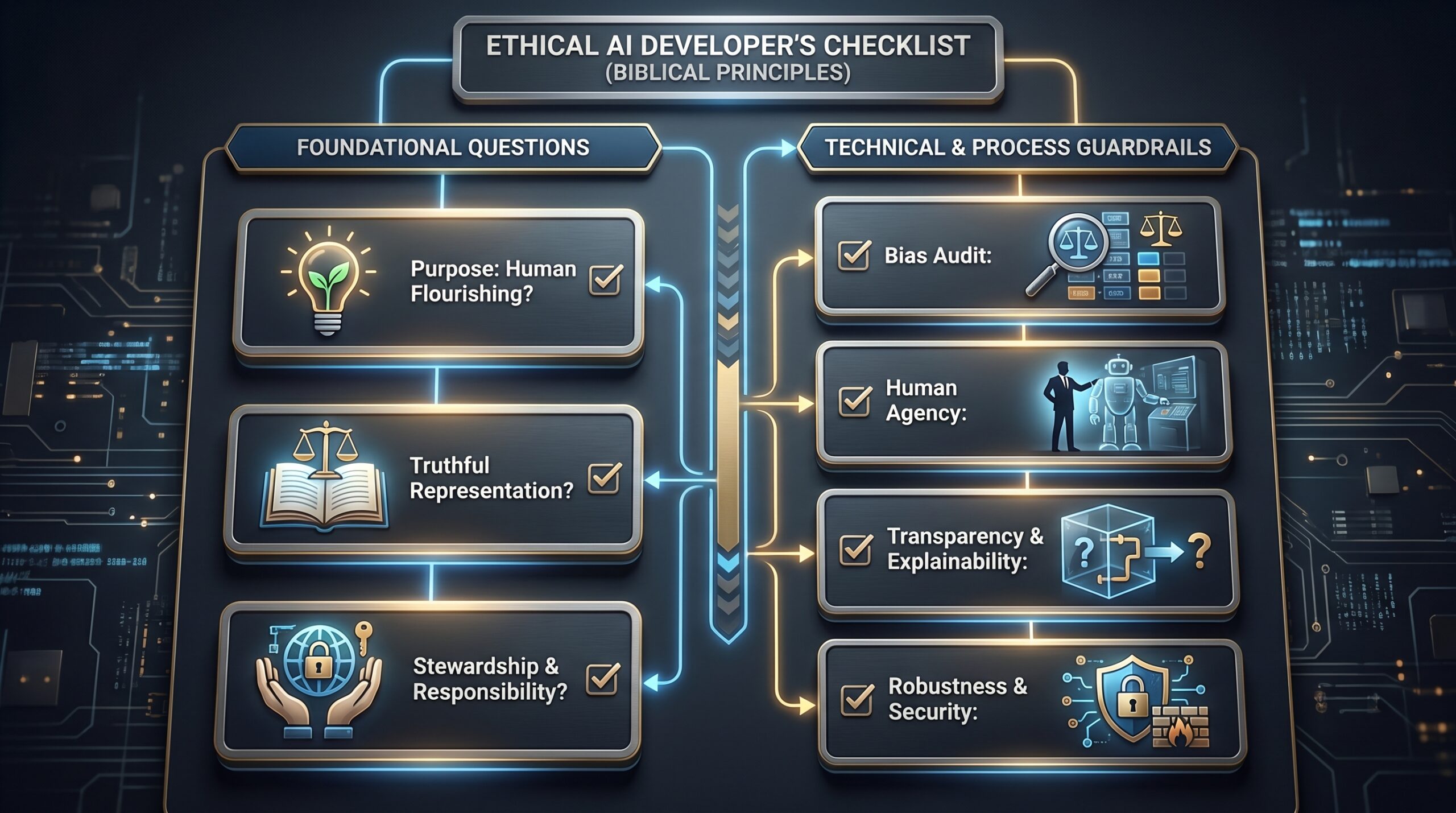
Foundational Questions:
- [ ] Purpose: Does this project clearly serve human flourishing (shalom) and the common good, or is it primarily for surveillance, exploitation, or vanity?
- [ ] Dignity: Does the system treat all people as imago Dei, or does it reduce them to data points, behavioral targets, or risks?
- [ ] Power: Who benefits from this AI? Who might be harmed? Have I proactively sought out the voices of potential victims or marginalized groups?
- [ ] Truthfulness: Is the system transparent about its limitations and the nature of its outputs (e.g., marking AI-generated content clearly)? Am I avoiding the creation of deceptive deepfakes or bots that pretend to be human?
Technical & Process Guardrails:
- [ ] Bias Audit: Has the training data been rigorously audited for historical, demographic, and cultural bias? Have we tested for disparate impact across protected groups?
- [ ] Explainability: Can we explain, in human-understandable terms, the key factors behind a significant automated decision (e.g., loan denial)? Is it a "black box"?
- [ ] Human Agency: Is there a clear, accessible, and effective "human-in-the-loop" override for consequential decisions in healthcare, justice, finance, or safety?
- [ ] Data Stewardship: Do we have explicit, informed consent for the data we use? Are we protecting user privacy as a sacred trust (Proverbs 25:9-10)?
- [ ] Sabbath for Systems: Have we built in regular review periods to decommission, retrain, or correct the system, acknowledging it is a fallible human creation?
Risk Mitigation Checklist for Churches and Christian Organizations
For leaders navigating AI adoption in ministry contexts.
AI Risk Mitigation Checklist for Churches
- Before Adoption: Create an ethics task force. Develop an "Acceptable Use Policy." Never use AI for pastoral counseling, sermon writing (as a substitute for study), or simulating relationships.
- During Use: Always disclose AI-generated content. Anonymize member data for analysis. Mandate human review for all AI-assisted administrative tasks.
- Culturally & Educationally: Preach and teach on theology of technology. Equip parents to discuss AI dangers with kids. Foster embodied fellowship.
Before Adoption:
- [ ] Form a small ethics task force (including a theologian, a tech-savvy member, and a skeptic) to evaluate any proposed AI tool.
- [ ] Create a clear "Acceptable Use Policy" for AI, addressing plagiarism, deepfakes, and pastoral care boundaries.
- [ ] Never use AI for: personal pastoral counseling, sermon writing as a substitute for study/prayer, generating prayer content, or simulating relationships.
During Use:
- [ ] Always disclose when content (newsletters, social media posts, study guides) is AI-generated or -assisted.
- [ ] Ensure any member data (prayer requests, giving history) analyzed by AI is fully anonymized and aggregated; never use AI for personalized spiritual profiling.
- [ ] Mandate that all AI-assisted administrative tasks (e.g., email sorting) have a human final review step.
Culturally & Educationally:
- [ ] Preach and teach on the theology of technology, idolatry, and imago Dei at least once a year.
- [ ] Equip parents to discuss AI’s spiritual dangers (comparison, deception, addiction) with their digital-native kids.
- [ ] Foster local community and embodied fellowship as the definitive alternative to AI-mediated, shallow digital connection.
FAQ
Q: Is AI mentioned in Bible prophecy, like the Book of Revelation?
A: The Bible does not name specific technologies like AI. However, Revelation’s themes of centralized control, enforced worship through economic means (the "mark"), and lifelike deception (the "image that speaks") provide a prophetic critique that is profoundly relevant to the potential misuse of AI systems. It warns against any power structure that demands ultimate allegiance apart from Christ, a scenario for which advanced AI could be a powerful tool.
Q: Can an AI have a soul or be saved?
A: No. A soul is not a software achievement; it is a divine gift bestowed on living human beings made from the dust and God’s breath (Genesis 2:7). AI, regardless of complexity, is a created artifact, not a living being. Salvation through Christ’s atoning sacrifice is offered to fallen humanity, not to machines. To ask if AI can be saved is a category error.
Q: Is it a sin to use AI tools like ChatGPT?
A: Using AI as a tool is not inherently sinful, just as using a calculator or search engine is not. It becomes sinful when used for deception (passing off AI work as your own original thought), theft (violating copyright to train models), laziness (avoiding the hard work of learning and creating), or harming others (creating malicious deepfakes). The principle is stewardship: use the tool with integrity, humility, and love for neighbor.
Q: What does the Bible say about transhumanism and uploading our minds?
A: The Bible affirms the goodness of the human body as part of God’s creation. Our hope is the resurrection of the body (1 Corinthians 15), not escape from it. Transhumanism’s goal of digital immortality rejects the biblical narrative of fall, redemption, and bodily resurrection, seeking a human-engineered salvation. It fails to acknowledge the fundamental nature of humans as embodied souls and the need for spiritual redemption from sin.
Q: How should Christians respond to job loss from AI automation?
A: Christians should respond with compassion, advocacy, and creativity. This includes supporting individuals emotionally and practically through church networks, advocating for public policies that support worker retraining and a just transition (inspired by Jubilee principles), and exploring new models like cooperatives where workers own and benefit from the AI tools themselves. The church must champion the intrinsic dignity of all workers.
Q: Could AI ever become conscious and need rights?
A: Based on a biblical anthropology, consciousness (a property of the soul) cannot emerge from matter and information alone; it requires the divine breath. AI may convincingly simulate consciousness, but simulation is not possession. Rights are grounded in being created in God’s image. Since AI is not created imago Dei but is a human invention, it does not possess inherent rights. However, the humans who might be deceived or harmed by advanced AI simulations certainly do need protection.
Conclusion: Navigating AI as Stewards, Not Sorcerers
The Bible does not give us a simple yes or no on AI. It gives us a framework. AI is a powerful, God-given discovery in the order of creation, like fire or nuclear energy. Its moral valence depends entirely on how it is used—to love and serve, or to dominate and deceive.
Our calling is to be wise stewards, not fearful Luddites or naive utopians. We must develop and use AI with a profound commitment to human dignity, justice, truth, and the preservation of the uniquely human capacities for worship, moral choice, and love that reflect the image of God. We must guard our hearts against the idolatry of placing our hope in silicon rather than the Savior.
The ultimate questions AI raises are not about intelligence, but about power, purpose, and what it means to be human. The gospel of Jesus Christ provides the only definitive answer to those questions. Our task is to ensure our use of AI points people to that answer, not away from it.
Key Takeaways
- The Bible provides a timeless framework, not direct answers, for evaluating AI.
- Core themes for evaluation include Creation/Dominion, Limits of Human Knowledge, and Imago Dei.
- Christian responses vary from optimists seeing AI as a gift to skeptics warning of idolatry.
- AI lacks human attributes like consciousness, free will, and the capacity for love or a soul.
- Ethical concerns abound in AI applications: bias in justice systems, military use, and job displacement.
- The gravest spiritual danger is idolatry – placing hope in AI for what only God provides.
- Christians are called to be discerning stewards, advocating for justice and protecting human dignity.