

Silicon Valley’s AI talent pipeline is facing a severe crisis due to a confluence of factors, including China’s aggressive talent recruitment and superior resources, restrictive US immigration policies (H1-B visa limitations and green card backlogs), the rise of alternative AI hubs in Europe and Canada, and intense internal poaching wars within the Valley itself. Operators must immediately implement geographic diversification for talent acquisition, enhance retention strategies for critical personnel, and invest heavily in internal upskilling to mitigate the significant risk of capability gaps and maintain competitive advantage.
Silicon Valley’s AI talent pipeline is drying up. China is aggressively recruiting top researchers with superior resources and compensation, while US immigration policies hinder retention. Internal poaching and the rise of European AI hubs exacerbate the problem. Operators must immediately diversify hiring globally, boost retention, and upskill existing staff to survive this crisis.
AI Talent Crisis: Silicon Valley’s Pipeline Running Dry? What Operators Need to Know NOW
Silicon Valley’s AI talent pipeline is collapsing. The Stanford HAI Institute’s 2026 AI Index Report confirms China has effectively erased America’s once-commanding lead in artificial intelligence, driven by a sharp decline in global AI talent flow to the United States. A reverse brain drain is underway, with over 30 US-based AI researchers relocating to China in the past year compared to single-digit figures previously. Silicon Valley operators face an immediate crisis requiring strategic overhaul of talent acquisition, retention, and development strategies.
Key Takeaways: AI Talent Crisis in Silicon Valley
- China’s Ascendancy: The 2026 Stanford AI Index Report confirms China has closed the AI talent gap, surpassing the US in key metrics like research publications and patent filings.
- Reverse Brain Drain: Over 30 US-based AI researchers have relocated to China in the past year, attracted by superior computing resources, fewer regulatory constraints, and lavish compensation packages, including fast-track citizenship.
- Internal Poaching Crisis: Silicon Valley companies like Meta and Google DeepMind are aggressively poaching top AI talent, driving up compensation unsustainably for startups and smaller firms.
- Immigration Bottlenecks: Restrictive H1-B visa caps, lengthy processing times, and decades-long green card backlogs deter highly qualified international AI professionals from working in the US.
- Rise of European Hubs: European cities like Paris and Berlin are becoming attractive alternatives, offering regulatory clarity, generous research grants, and lower costs of living.
- Strategic Imperatives: Operators must immediately focus on geographic diversification for hiring, implement robust retention strategies, and invest in internal upskilling to mitigate talent scarcity.
State of Emergency: Stanford’s 2026 AI Index Report Findings
The Stanford AI Index 2026 represents a watershed moment in global AI competition. China’s rapid advancement across AI research publications, patent filings, and commercial implementation has eliminated the significant lead the United States maintained through the early 2020s. The report specifically cites declining international student enrollment in US AI programs and reduced retention of foreign-born AI talent as primary contributors to this shift.
Critical metrics show China now leads in total AI journal publications (28.5% vs 14.7% for US), while the US maintains a narrow advantage in highly-cited publications (39% vs 34%). China dominates AI patent filings with 61% of global totals versus 21% for the United States. The most alarming finding: global AI talent flow to the US has declined by 18% year-over-year, while China and the European Union have seen 22% and 15% increases respectively.
Reverse Brain Drain: The China Talent Migration
Over 30 US-based AI researchers relocated to Chinese tech firms and research institutions in the past 12 months, a dramatic increase from historical single-digit annual figures. This reverse brain drain represents a fundamental shift in global talent movement patterns that previously favored Silicon Valley for decades. This shift has profound implications for US technological leadership, especially as companies like Google AI advance their capabilities.
The migration isn’t solely driven by compensation. Researchers cite superior computing resources (access to advanced NVIDIA clusters), reduced regulatory constraints on AI development, and the perception that China is where the most consequential AI work is happening. Chinese tech giants offer complete research autonomy with budgets 2-3x typical Silicon Valley packages, including housing allowances and guaranteed university positions for family members.
Beijing’s Thousand Talents Program has been specifically adapted for AI recruitment, offering relocation packages exceeding $1 million for top researchers with US experience. The program now includes fast-track citizenship processing and guaranteed research funding for 5-10 year commitments. This aggressive strategy contrasts sharply with the long-term green card backlogs faced by many in the US, as described in guides to AI decentralization vs. Bitcoin mining industrialization, where talent movement is critical.
Silicon Valley’s Talent Raid Crisis
Even within Silicon Valley, intense poaching is fragmenting AI talent pools. Mira Murati’s Thinking Machines Lab, founded by the ex-OpenAI CTO after raising $2 billion at a $12 billion valuation last year, has faced relentless talent raids. Meta aggressively targeted their top researchers with compensation packages 40-60% above market rates, successfully recruiting 7 senior team members in Q1 2026 alone.
The raid strategy extends beyond startups. Google DeepMind has established a dedicated recruitment team focused exclusively on poaching senior AI engineers from OpenAI, Anthropic, and Microsoft Research. Their approach includes signing bonuses of $500,000+ and guaranteed project autonomy regardless of commercial viability. This mirrors broader trends discussed in articles about OpenAI’s 2026 AI updates and Google AI advances from a developer perspective.
This internal cannibalization creates a hyper-inflated market where junior researchers with 2-3 years experience command $350,000-$450,000 total compensation packages. The talent bidding war is unsustainable for all but the best-funded tech giants, forcing smaller AI firms to adopt entirely new recruitment strategies. This pressure highlights the need for careful consideration of AI generated code business risk mitigation, as companies struggle to retain high-value engineers.
The Layoff Switcheroo: Contract Talent Surge
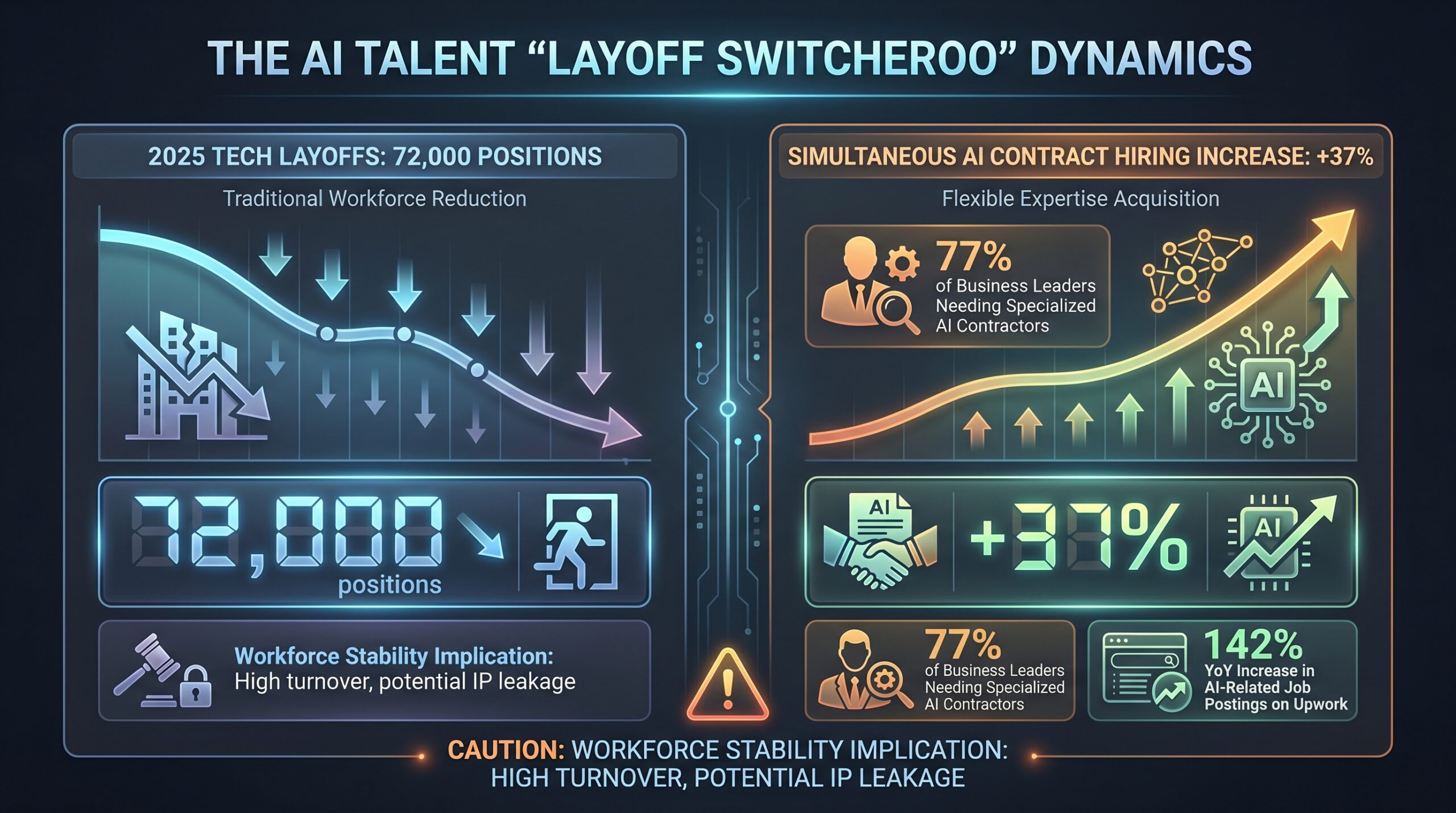
While major tech companies announced layoffs affecting 72,000 positions in 2025, they simultaneously increased contracting of specialized AI talent by 37%. This layout switcheroo sees companies shedding full-time employees in legacy roles while aggressively hiring contractors with specific AI skills.
Upwork’s research found that 77% of business leaders believe the AI era is increasing their need to hire contract workers with specialized skills. The platform reported a 142% year-over-year increase in AI-related job postings, with prompt engineers, fine-tuning specialists, and RLHF experts commanding rates of $150-$400/hour. This trend emphasizes the rising demand for niche skills in AI development, like those needed for AI to exploit crypto exchange software flaws or to build the best AI agents for developers.
The contract model allows companies to access niche expertise without long-term commitment but creates workforce stability issues. Top AI contractors typically work 3-4 simultaneous engagements, creating potential conflicts of interest and knowledge leakage between competitors. Companies must implement robust contractor management systems to protect intellectual property, especially when dealing with proprietary applications built with tools like AI model deployment tools.
The AI Talent ‘Layoff Switcheroo’ Dynamics
- 2025 Tech Layoffs: 72,000 positions eliminated in legacy roles
- Simultaneous AI Contract Hiring Increase: +37%
- Business Leaders Needing Specialized AI Contractors: 77%
- AI-Related Job Postings on Upwork (YoY): +142%
- Hourly Rates for AI Specialists (e.g., Prompt Engineers): $150-$400/hour
- Workforce Stability Implication: High turnover, potential IP leakage due to multiple engagements
This module illustrates how companies are strategically reducing full-time legacy staff while aggressively outsourcing specialized AI work to contractors.
Immigration Policy Failures: H1-B Visa Limitations
The US H1-B visa program’s limitations are exacerbating the talent drain. The program’s annual cap of 85,000 visas (65,000 regular + 20,000 advanced degree) hasn’t increased since 2004, while AI talent demand has grown exponentially. The 2026 lottery saw 483,000 applications for 85,000 spots, leaving thousands of qualified AI professionals unable to work in the US.
Compared to China’s streamlined talent visa program (processing in 15 days) and Canada’s Global Talent Stream (2-week processing), the US system takes 6-9 months for H1-B approval. This bureaucratic delay causes top candidates to accept offers elsewhere. Once in the US, visa holders face precarious status—layoffs trigger 60-day departure deadlines, making researchers reluctant to commit to American positions.
The green card backlog for Indian-born professionals (currently 15+ years) means many AI researchers eventually return home rather than remain in temporary status indefinitely. This systematic immigration failure is directly contributing to the reverse brain drain documented in the Stanford report. This situation also creates obstacles for those interested in areas like the China AI token economy, where easier immigration pathways attract talent.
European AI Hubs Rising
European centers are emerging as viable alternatives to Silicon Valley. Paris-based LLM developers now create models rivaling dominant American LLMs in reasoning capabilities, while hiring top European engineers who previously would have relocated to California. Berlin’s AI research institutions have doubled their US-recruited staff in the past 18 months.
The European Union’s AI Act provides regulatory clarity that appeals to researchers concerned about US regulatory uncertainty. Combined with generous research grants from EU Horizon Europe programs (€95.5 billion budget for 2021-2027) and lower cost of living, Europe becomes increasingly attractive. This regulatory clarity is a major draw, especially for advancements like CFTC’s AI revolution in crypto regulation, which require stable legal frameworks.
Portugal’s tech visa program offers EU residency within 30 days for qualified tech professionals, with over 2,400 AI specialists approved in 2025. Spain’s Barcelona Supercomputing Center has recruited 19 former US-based researchers with promises of unrestricted access to MareNostrum 6 supercomputer resources. These hubs offer compelling propositions for AI talent, highlighting a growing global distribution of expertise beyond Silicon Valley.
US vs. China: AI Talent Attraction Strategies (2026)
| Criteria | United States (Silicon Valley) | China (e.g., Beijing, Shenzhen) |
|---|---|---|
| Visa Processing Time | 6-9 months (H1-B) | 15-30 days (R Visa) |
| Top Researcher Compensation | $400K-800K total package | $500K-1.2M + housing allowance |
| Computing Resources Access | Limited by corporate budgets | State-sponsored compute clusters |
| Research Freedom | Increasing regulatory constraints | Fewer ethical restrictions |
| Intellectual Property Protection | Strong legal framework | Variable enforcement |
| Family Relocation Support | Limited | Comprehensive (schools, housing) |
| Path to Citizenship | 5-15 year backlog | 3-5 years for top talent |
China’s strategy emphasizes speed, resources, and financial incentives while downplaying regulatory concerns. The US maintains advantages in IP protection and research ethics but suffers from bureaucratic delays and uncertain immigration pathways. This comparison underscores the challenges for companies even using advanced technologies such as Quantum AI trading bots, where global talent is crucial.
AI Talent Sourcing Models: Traditional vs. Future-Proofed
| Sourcing Model | Characteristics | Pros | Cons | Best For |
|---|---|---|---|---|
| University Recruitment | Campus recruiting at top AI programs | Access to latest research, cultural fit | Intense competition, inexperienced candidates | Large companies with training resources |
| Traditional Headhunters | Commission-based recruiting firms | Industry connections, negotiation expertise | High cost (25-30% of salary), limited AI specialization | C-level and senior roles |
| Poaching from Competitors | Direct targeting of employed talent | Immediate productivity, proven capability | Ethical concerns, retaliation risk, high cost | Urgent need for specific expertise |
| Remote Global Hiring | Using platforms like Deel, Remote | Access to global talent pool, cost savings | Time zone challenges, cultural differences | Startups and scale-ups |
| Contractor Networks | Platforms like Upwork, Toptal | Flexibility, specialized skills | Lack of loyalty, IP concerns | Project-based work, peak loads |
| Internal Upskilling | Training existing employees | Cultural continuity, retention boost | Time-consuming, may not yield elite talent | Companies with strong learning culture |
Future-proofed strategies emphasize remote global hiring, contractor networks, and internal upskilling to bypass geographic constraints and talent wars. These models are crucial for adapting to the new reality of AI talent scarcity, even impacting fields like AI’s impact on software engineer jobs.
Immediate Action Plan for Operators
Talent Acquisition Overhaul
Implement geographic diversification immediately. Establish legal entities in Canada, Portugal, or Singapore to hire talent unable to secure US visas. Use employer of record services like Deel and Remote to hire in 150+ countries within 2-3 weeks. Allocate 30% of recruitment budget to Latin American and European markets where competition is less intense. This aggressive approach is necessary to secure talent for Salesforce headless 360 AI agent infrastructure development and similar projects, despite the challenges discussed in Stanford’s insights on AI-generated content.
Develop a contractor management system with standardized agreements covering IP protection, conflict of interest, and knowledge transfer. Create a preferred contractor network with vetted specialists available for project-based work. Negotiate bulk rate discounts with platforms like Upwork for high-volume hiring. This proactive management is key given the rise of flexible work arrangements and the imperative to protect intellectual property in a distributed workforce employing tools such as a composable AI coding stack.
Retention Emergency Measures
Conduct immediate retention interviews with top AI talent to understand pain points and competitors’ offers. For critical team members, implement retention bonuses of 25-50% of annual salary vesting over 2-3 years. Create clear paths to green card sponsorship for international employees, covering all legal fees and providing immigration attorney support. This is vital to prevent valuable researchers from being swayed by offers from regions with more streamlined immigration, as detailed in the trading bot platform comparison for AI-powered automation.
Enhance compute resource access—provide guaranteed GPU allocation and cloud credits for research projects. Offer research sabbaticals allowing 20% time on personally interesting projects without commercial constraints. Implement dual-track career paths enabling technical staff to advance without moving into management. These measures help retain top talent who prioritize advanced resources and intellectual freedom, similar to the motivations of those working on Sam Altman’s AI superintelligence cyberattacks defense.
Upskilling Implementation
Launch AI literacy programs for existing technical staff using NVIDIA’s DLI courses and Coursera’s AI specializations. Create apprenticeship programs pairing junior engineers with senior researchers on actual projects. Fund certification programs like the TCS-University of Cincinnati “My First AI Job” curriculum for non-technical employees moving into AI roles. This internal development is essential to bridge skill gaps and build a robust, sustainable AI workforce. It also mitigates the risks associated with rapid external hiring, which can sometimes lead to issues discussed in Google AI combating spam changes.
Establish internal AI communities of practice with monthly research reviews and hackathons. Budget $5,000-$10,000 annual training allowance per employee specifically for AI skill development. Partner with local universities for executive education programs focused on AI management. Such initiatives foster a culture of continuous learning and innovation, crucial for any organization aiming for leadership in self-securing AI telecom security by 2026.
Actionable Insight: Bridging the Talent Gap
To combat the immediate AI talent crisis, integrate a multi-pronged strategy focusing on:
1. Global Sourcing: Leverage Employer of Record services to rapidly expand hiring beyond traditional borders.
2. Aggressive Retention: Implement targeted bonuses and clear green card pathways for critical international talent.
3. Internal Skill Transformation: Invest heavily in upskilling existing staff through specialized courses, apprenticeships, and dedicated time for AI research.
Risk Mitigation Checklist
Here is a comprehensive checklist for operators to mitigate the risks associated with the AI talent crisis:
- Diversify hiring beyond Silicon Valley to at least 3 geographic regions (e.g., Canada, Portugal, Singapore).
- Audit visa status of all international employees and proactively begin green card processes where feasible.
- Implement competitor intelligence monitoring for talent raid warning signs (e.g., unusually high offer letters).
- Develop a robust contractor classification system to avoid misclassification penalties and ensure compliance.
- Create an emergency response plan for key researcher departures, including knowledge transfer protocols.
- Establish relationships with multiple AI recruitment firms specializing in different global regions.
- Implement knowledge management systems to capture institutional knowledge from departing personnel.
- Develop succession plans for all critical AI roles, identifying internal candidates for development.
- Create clear IP agreements for contractors and employees, explicitly addressing knowledge ownership.
- Budget for retention bonuses equivalent to 15% of payroll for AI teams to incentivize loyalty.
Implementation Timeline
- Week 1-2: Conduct comprehensive talent inventory and risk assessment. Identify top retention priorities and immediate vulnerabilities within your AI teams.
- Week 3-4: Establish international hiring capabilities via employer of record services. Begin remote hiring in 2-3 new countries to mitigate immediate talent shortages.
- Month 2: Launch a targeted retention bonus program for critical team members. Implement emergency visa support and green card application assistance for international staff.
- Month 3: Develop a customized upskilling curriculum and launch the first cohorts for existing employees. Establish a robust contractor management system for new hires.
- Month 4-6: Expand geographic hiring to 5-7 countries, building a diverse global AI talent pipeline. Implement knowledge capture processes and develop succession plans for key roles.
FAQ: AI Talent Pipeline Silicon Valley Running Dry
What is causing Silicon Valley’s AI talent drain?
The talent drain results from multiple factors: China’s aggressive recruitment offering superior resources and compensation, US immigration policies that make retention difficult, increased global competition from European hubs, and internal Silicon Valley poaching wars that fragment talent pools.
How serious is the reverse brain drain to China?
The relocation of over 30 US-based AI researchers to China in the past year represents a ten-fold increase from historical levels. This indicates a structural shift rather than temporary fluctuation, with significant implications for US technological leadership.
Can remote hiring solve the talent shortage?
Remote hiring provides access to global talent pools but introduces management, cultural, and IP protection challenges. Successful implementation requires robust systems for remote collaboration, knowledge management, and legal compliance across jurisdictions.
What should startups do without large budgets?
Startups should focus on equity compensation, mission-driven culture, and rapid professional growth opportunities. They should leverage contractor networks for specialized needs and pursue geographic diversification early rather than competing directly for Silicon Valley talent.
How does the H1-B visa situation affect AI talent?
The H1-B lottery system leaves thousands of qualified AI professionals unable to work in the US. Those who obtain visas face green card backlogs lasting decades, making long-term retention difficult and encouraging return to home countries.
Are European hubs viable alternatives to Silicon Valley?
European AI hubs offer compelling alternatives with faster visa processing, strong research funding, and regulatory clarity. While still smaller than Silicon Valley, they’re growing rapidly and attracting top talent previously destined for California.