

AI significantly impacts cybersecurity professionals by automating threat detection, accelerating response times, and augmenting defensive capabilities. However, it also introduces new human risks such as job displacement fears, the widening gap in leadership understanding, and the need for updated skills to counter AI-powered attacks. The AI impact on cybersecurity humans is a force multiplier that changes roles, workflows, and strategic priorities.
AI Impact on Cybersecurity Humans: A Complete Guide
What is the AI Impact on Cybersecurity Humans?
AI significantly impacts cybersecurity professionals by automating threat detection, accelerating response times, and augmenting defensive capabilities. However, it also introduces new human risks such as job displacement fears, the widening gap in leadership understanding, and the need for updated skills to counter AI-powered attacks. The AI impact on cybersecurity humans is a force multiplier that changes roles, workflows, and strategic priorities.
AI’s Multi-faceted Impact on Cybersecurity Professionals
The AI impact on cybersecurity humans is multifaceted and asymmetric. It automates repetitive analysis through machine learning models trained on petabytes of telemetry, freeing analysts to focus on threat hunting and strategy. Simultaneously, AI arms adversaries, lowering the barrier to entry for sophisticated attacks. This dual dynamic forces professionals to evolve from manual operators to AI toolchain managers, critical decision-makers, and governance authorities. The core challenge is not just adopting new tools but transforming human skills and organizational structures to harness AI while mitigating its risks.
TL;DR: AI Impact on Cybersecurity Humans
Key Takeaways on AI’s Influence
- AI is transforming cybersecurity by automating threat detection and improving security efficiency, making cyber resilience essential in 2026. Tools like AI-powered Security Orchestration, Automation, and Response (SOAR) platforms now handle 60-80% of initial triage in mature organizations.
- The rapid adoption of AI creates new human risks, including a widening gap in leadership understanding of cybersecurity challenges. This “human problem” often leads to misallocated budgets and inadequate strategic responses.
- Four in five IT security professionals in 2026 fear AI may cost them their jobs, according to the CyberEdge Group 2026 Cyberthreat Defense Report. The reality is job transformation, with roles pivoting to AI oversight, prompt engineering for security models, and managing AI-driven threat intelligence.
- AI empowers both defenders with enhanced tools and attackers with more sophisticated tactics, such as the ability to exploit vulnerabilities faster. Systems like Anthropic’s Mythos can theorize and test exploit chains in minutes versus the weeks or months a human red team might require.
- Super-hacker AI systems like Anthropic’s Mythos highlight the urgency for updated human skills and governance in cybersecurity. This necessitates hands-on training with adversarial AI simulations and new playbooks that assume automated, multi-stage campaigns.
- The 2026 cybersecurity landscape is marked by increased automation, interconnectivity, workforce transformation, and escalating threat sophistication due to AI. Standalone security tools are failing; integrated security platforms with APIs feeding AI engines are becoming the standard.
- Human authority over critical decisions and realistic AI-assisted exploitation rehearsals are crucial for effective cybersecurity in the AI era. Your CISO must insist on human-in-the-loop approval gates for actions like quarantining critical systems or blocking executive communications.
Key Takeaways: AI Impact on Cybersecurity and Human Roles
Critical Decisions for Navigating AI’s Cybersecurity Impact
- Focus on human governance and oversight of AI, not just AI adoption. Your 2026 roadmap must define which decisions remain human-only (e.g., authorizing countermeasures against a state actor) and which can be automated with human review (e.g., blocking phishing domains).
- Prioritize upskilling cybersecurity teams to manage and leverage AI tools. Allocate budget for certifications in AI security (e.g., MIT’s AI in Cybersecurity course) and hands-on labs with tools like Microsoft Security Copilot or SentinelOne’s Purple AI.
- Institute realistic AI-assisted exploitation rehearsals and update zero-day response playbooks. Schedule quarterly tabletop exercises where your red team uses tools like Burp Suite’s AI-powered scanner or simulated Mythos-like agents to test your blue team’s updated response procedures.
- Understand the ‘human problem’ in AI cybersecurity: leadership gaps and skill deficits. Bridge this gap by having your security team deliver concise, jargon-free briefings to the board on AI threat scenarios and required investments, using frameworks from NIST AI RMF 1.0.
- Recognize AI’s dual role: powerful defender and sophisticated attacker. Invest in defensive AI that is specifically trained to detect AI-generated attacks, such as AI-crafted phishing lures or polymorphic malware.
- Invest in interconnected security systems for comprehensive visibility and rapid AI-driven responses. Prioritize vendors with open APIs and integration capabilities. A SIEM that cannot feed real-time data to your AI threat-hunting model is a liability.
What AI Impact on Cybersecurity Humans Is
Defining AI’s Influence on Cybersecurity Professionals
The AI impact on cybersecurity humans refers to the profound changes artificial intelligence brings to the roles, responsibilities, skill requirements, and ethical challenges faced by cybersecurity professionals. This shift moves beyond simple task automation. It demands a fundamental realignment where human expertise evolves to govern AI systems, interpret their complex outputs, make strategic decisions based on AI-driven intelligence, and counteract AI-powered adversarial campaigns. You are transitioning from being the primary analyst to being the trainer, validator, and commander of AI agents.
Key Definitions for Understanding AI’s Cybersecurity Impact
- AI in Cybersecurity
- The application of artificial intelligence technologies—including machine learning (ML), natural language processing (NLP), and generative AI—to enhance security measures, detect anomalous patterns faster, automate defensive response actions, and predict emerging threats. It’s not a single product but a layer of intelligence integrated into platforms like EDR, SIEM, and XDR.
- Mythos (Anthropic)
- An advanced AI model developed by Anthropic that has demonstrated a concerning ability to identify, theorize, and exploit software vulnerabilities by analyzing codebases and system documentation. Its capabilities, which blurred the line between research and weaponization, led to a cautious, controlled rollout strategy known as Project Glasswing, involving close collaboration with government entities.
- Automation in Cybersecurity
- The use of technology, particularly AI and predefined workflows (playbooks), to perform tasks traditionally handled by humans. This includes automated threat detection, alert triage, incident response (like isolating endpoints), and vulnerability management. The goal is to improve response speed (MTTR) and efficiency, freeing human analysts for complex investigation and strategy.
- Cyber Resilience
- The integrated ability of an organization to anticipate, withstand, recover from, and adapt to cyberattacks and disruptions. In the 2026 context, resilience is defined by how well your AI-augmented defenses detect threats and how quickly your human-AI teams can contain incidents and restore operations, even during AI-driven campaigns.
- Zero-day Response Playbooks
- Pre-defined, step-by-step plans and procedures for responding to attacks exploiting new, previously unknown vulnerabilities. With AI, these playbooks can no longer assume a human-paced attack. They must be updated to include triggers for automated containment measures, AI-assisted threat hunting for lateral movement, and clear escalation paths to human experts for critical decisions.
Why the AI Impact on Cybersecurity Humans Matters Now (2026)
The Urgent Relevance of AI-Driven Cybersecurity Shifts
The AI impact on cybersecurity humans is not a future concern; it is the defining operational reality of 2026. The proof is in two converging trends: the weaponization of AI by attackers and its rushed but necessary adoption by defenders. The breach of nine Mexican government agencies from 2025–2026, executed by a single operator using Claude Code and ChatGPT, provided a public blueprint for AI-powered offense.
This demonstrated that AI could automate the most time-consuming parts of an attack: reconnaissance, vulnerability discovery, and exploit development. Simultaneously, the emergence of “super-hacker” AI systems like Anthropic’s Mythos caused a tangible panic among leaders in government and finance, as reported by marketplace.org. This triggered an arms race, with OpenAI pushing for its models to be deployed defensively within governments, while Anthropic initiated Project Glasswing for controlled access.
This rapid technological shift has outpaced human adaptation, creating what Toronto Metropolitan University’s Judith Borts identifies as the most urgent risk: the “human problem.” This problem is the widening gap between the technical capabilities of AI and the understanding, skills, and governance structures within organizations. Leaders who don’t grasp the speed of AI-powered threats may underfund defense or demand impossible guarantees.
Security teams lacking AI skills become operators of “black box” systems they cannot effectively oversee. The market shift is clear: cybersecurity job postings in Q1 2026 increasingly list requirements like “experience with AI security tools” and “knowledge of adversarial machine learning.” If your team isn’t actively adapting now, you are falling behind both attackers and forward-thinking defenders.
How AI Works in Cybersecurity and Affects Humans
Mechanics of AI Transforming Human Cybersecurity Roles
AI integrates into cybersecurity operations through a continuous loop of data ingestion, analysis, and action. The process starts with data aggregation from endpoints, networks, clouds, and identity systems into a centralized platform like a data lake or SIEM. Machine learning models, trained on historical attack data and normal behavior baselines, then analyze this data in real-time to identify anomalies—a login from an impossible location, suspicious file encryption patterns, or command-and-control traffic.
For humans, this changes the workflow fundamentally. Instead of manually sifting through thousands of low-fidelity alerts, Level 1 analysts now supervise AI triage systems that automatically classify and prioritize incidents. The human role shifts to validating high-severity alerts, investigating the complex cases AI surfaces, and providing the critical context AI lacks: business risk, political motives, or insider threat nuances. In vulnerability management, AI tools like runZero or Tenable.io now continuously scan and prioritize vulnerabilities based on exploitability and asset criticality, moving humans from scanners to strategic patching decision-makers.
The final step is automated response. Through SOAR platforms, AI can execute predefined playbooks: isolating an infected host, blocking a malicious IP, or disabling a compromised user account. Here, the human is the governor. They define the rules of engagement (what can be auto-remediated vs. what requires approval) and retain ultimate authority for critical actions that could cause business disruption. AI handles the data processing speed; humans provide the ethical judgment, strategic oversight, and understanding of operational impact.
AI’s Dual Role: Empowering Defenders and Attackers
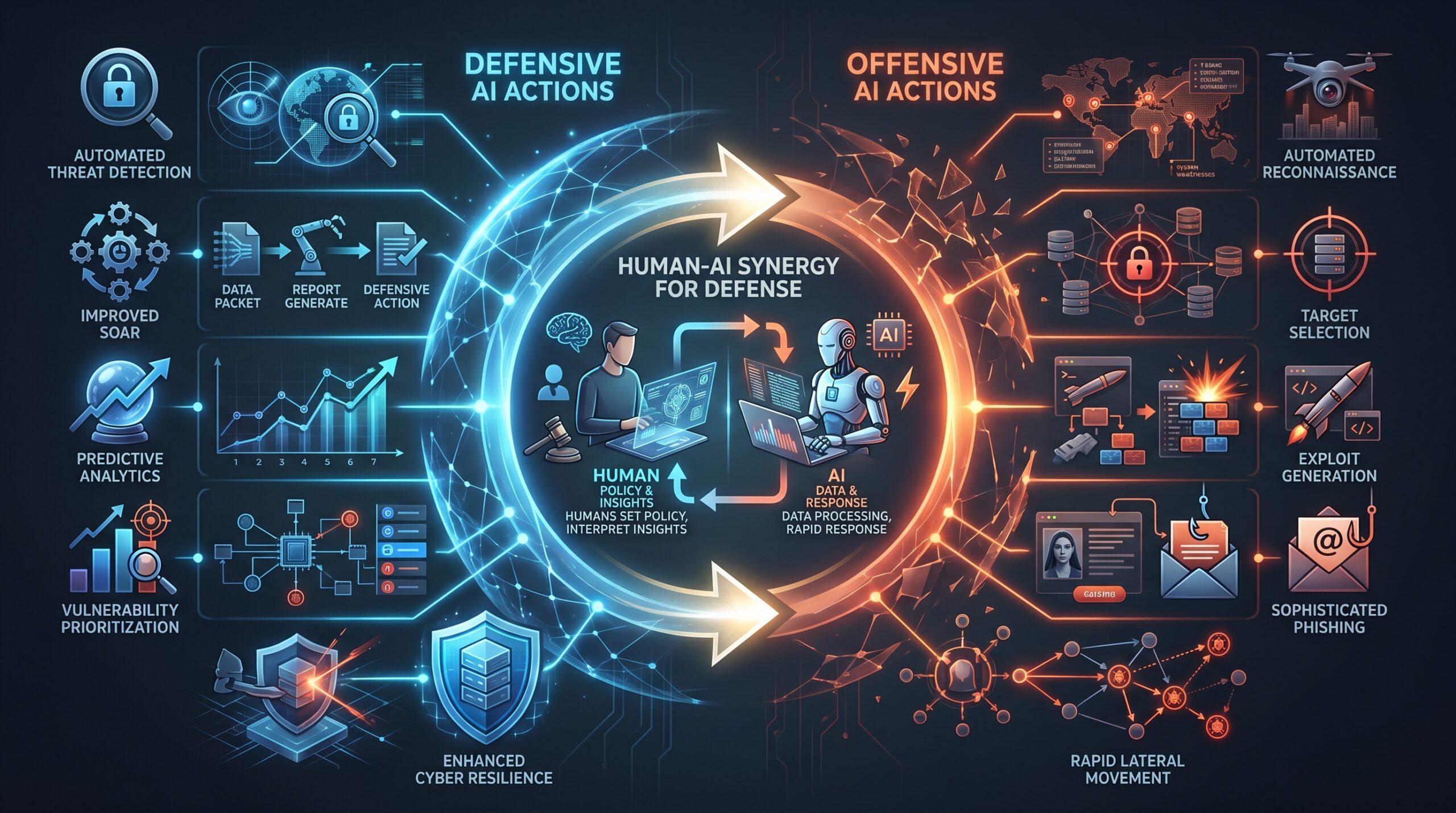
AI is the ultimate dual-use technology in cybersecurity. The same capabilities that defend networks also empower adversaries. Understanding this duality is essential for effective defense planning.
- For Defenders: AI automates the detection of malware and anomalous behavior across petabytes of data, a task impossible for humans at scale. It correlates weak signals across disparate systems to identify advanced persistent threats (APTs). It also powers predictive analytics, forecasting attack vectors based on threat intelligence feeds and an organization’s unique digital footprint. This strengthens cyber resilience by enabling proactive defense.
- For Attackers: AI lowers the skill barrier for sophisticated attacks. It can automate the discovery of exposed assets (reconnaissance), generate targeted phishing emails that bypass traditional filters (using NLP), and rapidly iterate on exploit code to bypass defenses. Most critically, as seen with systems like Mythos, AI can reason about complex software systems to find novel vulnerability chains (logic bugs, race conditions) that human attackers might miss.
Real-World Examples of AI Impact on Cybersecurity Humans
AI in Action: Cybersecurity Use Cases and Human Adaptation
Case Study 1: The 2025-2026 Mexican Government Breach
This incident is a watershed moment, demonstrating the practical AI impact on cybersecurity humans from the attacker’s side. A single operator, likely a state-sponsored actor, used Claude Code and ChatGPT to automate two critical, human-intensive phases of the attack:
- Reconnaissance & Mapping: The AI agents were tasked with scanning the target networks, identifying specific software versions, and mapping interconnected services across the nine agencies. This replaced weeks of manual scanning.
- Exploit Iteration: When a potential vulnerability was found, the operator used the AI to rapidly generate, test, and refine exploit code. This accelerated the development cycle from days to hours.
Human Impact & Response: The defending security teams were overwhelmed by the speed and precision of the campaign. The incident forced a global reevaluation of threat models, shifting the assumption from “human-paced attacks” to “AI-accelerated campaigns.” In response, defenders have begun integrating similar AI tools into their own threat-hunting and penetration testing workflows to keep pace, transforming the role of human pentesters to AI tool specialists and campaign strategists.
Case Study 2: Defensive AI in a Financial Services SOC
A multinational bank deployed an AI-powered security platform (e.g., Darktrace’s Cyber AI Analyst or IBM’s Watson for Cybersecurity) into its Security Operations Center (SOC).
- Before AI: Analysts faced 10,000+ daily alerts. Average time to investigate a potential incident was 45 minutes, with significant alert fatigue and high turnover.
- After AI Implementation: The AI engine now clusters related alerts, suppresses false positives, and autonomously investigates incidents by pulling data from firewalls, endpoints, and email gateways. It presents a summarized “Incident Dossier” with a confidence score and recommended actions.
- Human Adaptation: The Level 1 analyst role was redesigned. Instead of triaging raw alerts, these analysts now review and validate the AI’s dossiers. Their skill requirement shifted to understanding AI outputs and making context-based decisions. Senior analysts now spend more time threat hunting, using the AI to surface stealthy anomalies, and developing new detection rules. The human team shrunk slightly through attrition but became more specialized and effective, with a 70% reduction in MTTR.
Comparing AI’s Role: Defense vs. Offense and Human vs. AI in Cybersecurity
AI’s Defensive and Offensive Capabilities in Cybersecurity (2026)
The following table outlines the dual nature of the AI impact on cybersecurity humans, showing how the same core capabilities serve opposing sides.
| Capability | Defensive Benefits (2026) | Offensive Enablers (2026) |
|---|---|---|
| Threat Detection | Automated, real-time detection of malware and anomalies across cloud, endpoint, and network data. Reduces dwell time from months to minutes. | Makes it easier for hackers to detect exposed, vulnerable assets (misconfigured S3 buckets, unpatched servers) across the entire internet. |
| Response & Exploitation | Enables faster, automated security responses (SOAR): isolating hosts, blocking IPs. Strengthens cyber resilience. | Accelerates exploit iteration & reconnaissance. AI can test thousands of exploit variants in minutes to find one that bypasses AV/EDR. |
| Campaign Management | Streamlines defensive logistics. AI optimizes alert queues, automates evidence collection for audits, reducing operational waste. | Supports automated, multistage campaigns (phishing, credential theft, lateral movement) with minimal human intervention. |
| Vulnerability Management | Proactively identifies and prioritizes vulnerabilities for patching based on active exploitation and asset value. | Identifies and theorizes exploitation paths for software vulnerabilities, including novel logic flaws (e.g., capabilities shown by Mythos). |
| Complexity & Scale | Manages the increasing data volume and threat complexity that human teams cannot process manually. | Generates attacks of increased complexity and speed, such as polymorphic malware or AI-crafted social engineering at scale. |
Human and AI in Cybersecurity: A 2026 Perspective
This table contrasts the evolving human challenges with the augmenting benefits of AI, framing the partnership required for modern security.
| Aspect | Human Concerns/Challenges | AI Benefits/Augmentations |
|---|---|---|
| Job Impact | 4 in 5 IT security pros fear job loss due to AI (CyberEdge Group, 2026). Anxiety over role obsolescence is high. | Automates repetitive, high-volume tasks (alert triage, log analysis), freeing humans for strategic threat hunting, incident command, and AI governance. |
| Leadership Understanding | Widening gap in leadership’s understanding of AI/cybersecurity risks, leading to poor resource allocation (Judith Borts). | Provides data-driven insights and risk visualizations (dashboards, predictive reports) that help communicate threats and justify investments to leadership. |
| Skill Requirements | Acute need for updated skills (AI literacy, ML model validation, prompt engineering) to counter AI-powered attacks. | Enhances human capabilities through advanced tools, acting as a force multiplier. Human skill shifts to directing and interpreting AI. |
| Operational Efficiency | Manual processes still form a huge part of security posture in many orgs, leading to slow response (Devoteam/TechRadar 2026). | Drastically improves security efficiency through automation, reducing Mean Time to Detect (MTTD) and Respond (MTTR). |
| Threat Handling | Inability of human teams to keep up with the volume, velocity, and variety of modern threats without augmentation. | Addresses the speed and volume of modern threats by analyzing data at machine speed and correlating across silos. |
| Visibility & Response | Fragmented visibility and slower response times due to a lack of interconnectivity between security tools (Devoteam). | Enables comprehensive visibility by ingesting data from all sources and powers rapid, coordinated automated responses across the IT environment. |
Tools, Vendors, and Implementation Paths for AI in Cybersecurity
Choosing the Right AI Solutions for Cybersecurity
The AI tool ecosystem impacting cybersecurity humans is diverse, ranging from foundational models to integrated security platforms.
Key Tools & Vendors Shaping the 2026 Landscape:
- Anthropic’s Mythos & Project Glasswing: Represents the cutting edge of AI-powered vulnerability research and a cautionary tale. Its controlled rollout via Project Glasswing—a consortium working with government—highlights the need for governance. For defenders, it underscores the importance of tools that can simulate Mythos-like attacks for testing defenses.
- OpenAI Models for Government Defense: OpenAI’s push to deploy its most powerful models (like GPT-4o and beyond) in government cybersecurity initiatives represents the “defensive front” of the AI arms race. These models could be used to analyze threat intel, automate secure code review, or generate incident reports. FrontierWisdom has extensively covered the strategic implications of OpenAI Models on Amazon Bedrock and OpenAI’s Latest Leap: GPT-5.5, Autonomous Agents.
- Integrated Security AI Platforms: Vendors like Microsoft (Security Copilot), CrowdStrike (Charlotte AI), Palo Alto Networks (Cortex XSIAM), and SentinelOne (Purple AI) are baking generative AI directly into their security consoles. These tools allow analysts to use natural language to query data (“show me all endpoints communicating with this IP last week”), generate investigation summaries, and get guided remediation steps.
- AI-Powered Offensive Security Tools: Tools like Burp Suite’s AI-powered scanner, Synack’s AI-driven vulnerability scoring, and various open-source projects using LLMs for pentesting (e.g., AutoGPT for security) are transforming red teaming. Human pentesters now use these to extend their capabilities, focusing on complex attack simulation and social engineering.
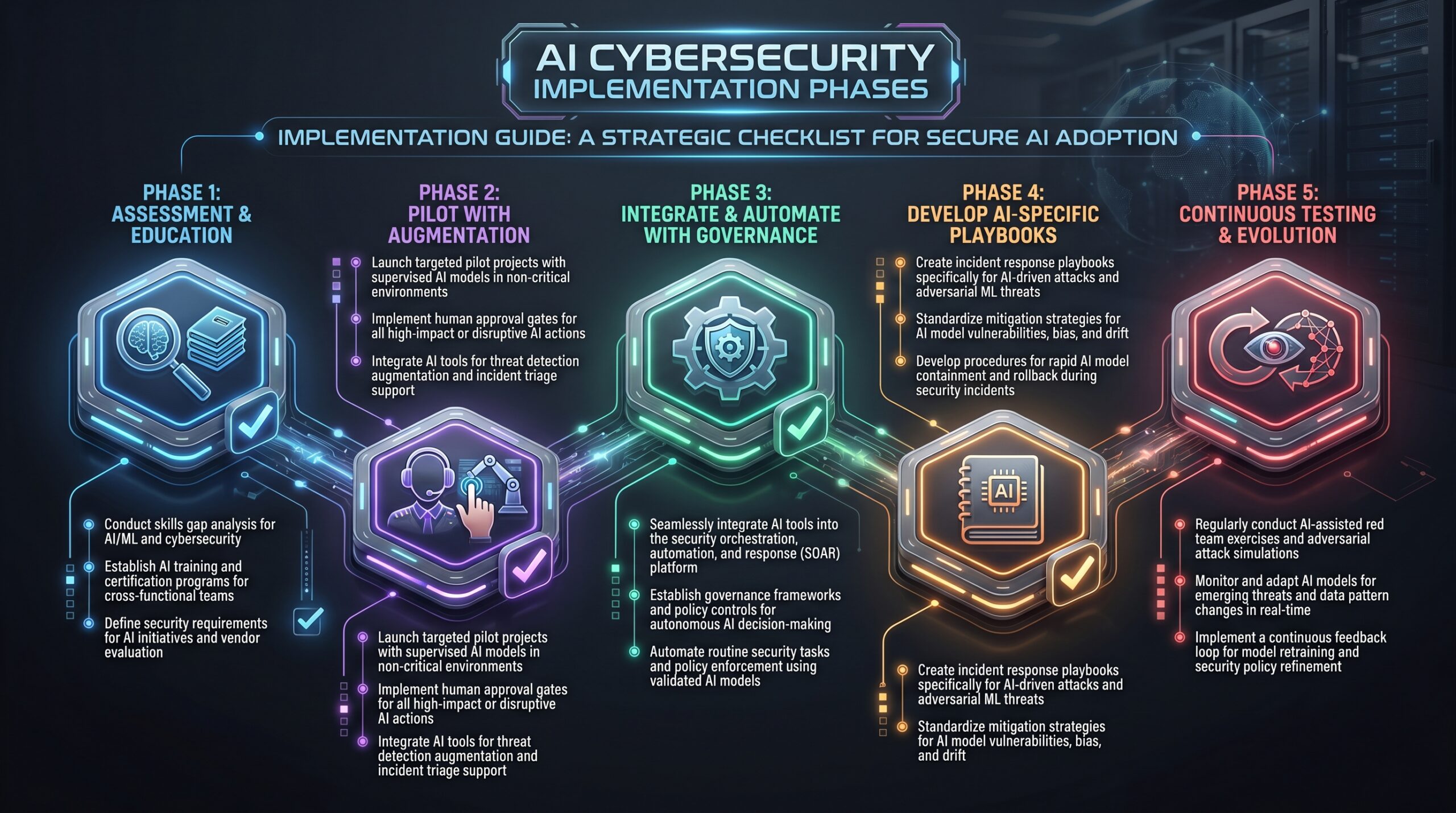
Implementation Path for Human-Centric AI Security:
- Assess & Educate: Conduct a skills gap analysis of your security team. Invest in foundational AI/ML training for all security staff. Start with non-critical use cases, like using ChatGPT (with appropriate data governance) to help draft security policies or generate awareness training content.
- Pilot with Augmentation: Choose one high-friction area (e.g., phishing alert investigation) and pilot an AI-augmentation tool. For example, integrate an AI email security tool that summarizes email context and threat indicators. Measure the time saved and accuracy improvements.
- Integrate and Automate (with Governance): Begin integrating AI-driven SOAR playbooks. Start with low-risk automations, like collecting forensic data from an endpoint. Crucially, define and implement human approval gates for any action that could disrupt business (e.g., taking a server offline).
- Develop AI-Specific Playbooks: Update your incident response and zero-day playbooks. Assume AI-powered reconnaissance and rapid exploitation. Include steps to activate AI-enhanced threat hunting models and procedures for rapid containment that leverages automated tools.
- Continuous Testing & Evolution: Regularly test your defenses with AI-assisted red team exercises. Use the findings to retrain your AI models and refine human decision points. Treat your AI security tools as a living system that requires continuous tuning by human experts.
Costs, ROI, and Monetization Upside of AI Impact on Cybersecurity Humans
Quantifying the Value of AI in Cybersecurity for Human Teams
Initial Costs (Year 1):
- Software Licensing: AI security modules or platforms typically add a 20-40% premium to existing enterprise security licenses (e.g., EDR, SIEM). Expect $50,000 – $500,000+ annually depending on organization size and scope.
- Infrastructure & Data: AI requires compute power (cloud GPUs/TPUs) and scalable data storage (data lakes). Cloud costs can increase by 15-30%.
- Training & Upskilling: Budget $3,000 – $10,000 per employee for specialized AI security training, certifications, and workshop participation.
- Integration & Professional Services: Integrating AI tools into existing workflows often requires consultants or dedicated internal projects, costing $100,000 – $300,000.
ROI & Operational Savings (Years 1-3):
- Labor Efficiency: The primary ROI driver. AI automation can reduce the time spent on triage and initial investigation by 60-80%. This either reduces the need to hire additional analysts as the business grows or allows existing staff to focus on higher-value projects, effectively creating capacity worth 1-2 FTEs per team.
- Reduced Dwell Time & Breach Costs: Faster detection and response directly shrink the window of compromise. According to IBM’s 2026 Cost of a Data Breach Report (projected), organizations with fully deployed AI and automation experience an average breach cost that is $2.5 million lower than those without. This is due to faster containment and less data exfiltration.
- Improved Threat Hunting Efficacy: AI-augmented hunters can identify stealthy threats 5x faster, potentially stopping breaches before critical data loss occurs.
Monetization & Strategic Upside:
- Enhanced Cyber Resilience as a Competitive Advantage: For B2B companies, demonstrating a mature, AI-augmented security program can be a deal-clincher with enterprise clients and a requirement for cyber insurance underwriting.
- Risk Reduction & Regulatory Compliance: AI-driven continuous compliance monitoring (e.g., for GDPR, CCPA, SOX) reduces audit preparation time and fines from non-compliance.
- Protection of Revenue-Generating Systems: By securing customer-facing applications and APIs more effectively, AI directly protects revenue streams from disruption due to ransomware or DDoS attacks.
- Fostering Innovation: A secure, AI-managed environment allows the broader business to adopt new technologies (IoT, cloud) faster and with less risk, enabling growth.
Risks, Pitfalls, and Myths vs. Facts About AI Impact on Cybersecurity Humans
What Can Go Wrong with AI’s Impact on Cybersecurity Humans
- Job Displacement and Morale Crisis: With 80% of professionals fearing job loss, organizations that implement AI without a clear workforce transformation plan risk destroying team morale, losing institutional knowledge, and causing a talent exodus.
- Leadership-Understanding Gap: Executives who see AI as a “set-and-forget” silver bullet will underinvest in human oversight and governance, creating catastrophic single points of failure when the AI errs or is bypassed.
- Overwhelmed Response Playbooks: Legacy, human-paced incident response plans will fail catastrophically against automated, AI-driven campaigns that move laterally in minutes, not days.
- Compromised or Poisoned AI Systems: Attackers can poison the training data of defensive AI models or manipulate their outputs, turning a defensive tool into a blind spot or even an attack vector (e.g., an AI that incorrectly labels malicious activity as benign). This highlights the importance of techniques like faithful autoformalization to ensure AI fidelity.
- Fragmented Visibility and Automation Silos: Deploying point AI solutions that doesn’t integrate creates new silos. An AI-powered email security tool might block a phishing email, but if it doesn’t communicate with the endpoint AI, the already-infected host from a previous campaign goes unnoticed.
- Over-reliance and Critical Decision Failure: Automating responses without human-in-the-loop approval for critical systems can lead to business disruption. An AI might rightly quarantine a malware-infected server, but if that server runs a critical manufacturing line, the financial loss could exceed the ransomware demand.
- Unprecedented “Super-Hacker” Threats: The uncontrolled proliferation of systems with capabilities like Mythos could lead to a proliferation of advanced, automated cyber weapons, drastically increasing the attack surface for all organizations.
Common Mistakes in Managing AI’s Cybersecurity Impact
- Failing to update zero-day response playbooks to include AI-assisted exploitation scenarios and automated containment triggers.
- Not conducting realistic tabletop exercises that simulate AI-powered attacks (e.g., using a red team with access to Claude Code) for your 2026 planning.
- Ignoring the principle of human authority, automating critical decisions (like shutting down core network segments) without governance and approval workflows.
- Underestimating the speed of AI-generated exploits and maintaining weekly or monthly patch cycles when adversaries can weaponize a vulnerability in hours.
- Neglecting workforce transformation, treating AI as just a new software license rather than a catalyst for reskilling analysts into AI managers and forensic data scientists.
- Allowing security AI tools to operate in silos, failing to build data pipelines that feed a centralized AI analytics engine for a unified view.
- Focusing solely on individual vulnerabilities in a checklist fashion, rather than assuming and preparing for automated, multi-stage campaigns that exploit multiple weak links in a chain.
What Most People Get Wrong About AI Impact on Cybersecurity Humans
| Myth | Reality |
|---|---|
| AI will fully replace cybersecurity professionals. | While 80% fear job loss, the consensus is AI augments, not replaces. Human governance, ethical judgment, strategic oversight, and creative problem-solving for novel threats are irreplaceable. Roles are shifting, not disappearing. |
| AI only benefits defenders. | AI is the ultimate dual-use tool. It equally empowers attackers, making sophisticated tactics like automated reconnaissance, exploit development, and hyper-realistic phishing easier and faster. The defender’s advantage is temporary at best. |
| Current security controls are sufficient for AI-driven threats. | The 2026 AI and Human Risk Landscape report from Proofpoint explicitly examines the effectiveness of current controls, implying they are often insufficient. Legacy signature-based AV and rule-based SIEMs cannot keep pace with AI-generated polymorphic code and unusual attack patterns. |
| Automation means less human involvement. | Effective automation requires more deliberate upfront human work: designing governance models, building and testing playbooks, and establishing oversight procedures. It shifts human involvement from repetitive execution to strategic design and command. |
AI Impact on Cybersecurity: Myths vs. Realities
- Myth 1: AI replaces human cybersecurity jobs.
- Reality: AI augments, not replaces, shifting human roles to AI management, oversight, and strategic decision-making.
- Myth 2: AI only benefits defenders.
- Reality: AI is a dual-use tool, equally empowering attackers with faster, more sophisticated offensive capabilities.
- Myth 3: Current security controls suffice for AI threats.
- Reality: Legacy systems struggle with AI-generated polymorphic code and novel attack patterns; new AI-aware defenses are crucial.
- Myth 4: Automation reduces human involvement.
- Reality: Effective automation requires more human input in designing governance, testing playbooks, and establishing oversight.
FAQ
- Will AI replace cybersecurity professionals by 2026?
-
No, AI will not fully replace cybersecurity professionals by 2026. While surveys show 80% of IT security pros fear job loss, the reality is a significant role transformation. AI automates repetitive, data-intensive tasks like log analysis and initial alert triage. This shifts human roles towards higher-value work: governing AI systems, investigating complex incidents AI surfaces, making strategic risk decisions, and developing countermeasures for novel AI-powered attacks. The demand for cybersecurity professionals with AI literacy and oversight skills is increasing, not decreasing.
- How does AI empower cyber attackers?
-
AI empowers attackers by dramatically accelerating and scaling every phase of the attack lifecycle. It can automate the discovery of vulnerable targets across the internet, generate highly convincing phishing emails and deepfake audio for social engineering, rapidly write and test exploit code (as seen with Claude Code in the Mexican breach), and even autonomously navigate through a compromised network to find valuable data. Tools like Anthropic’s Mythos theorize new vulnerability chains, lowering the skill barrier for sophisticated attacks and increasing their speed and success rate.
- What is the ‘human problem’ in AI cybersecurity?
-
The ‘human problem,’ as defined by researcher Judith Borts, is the widening and dangerous gap between the rapid pace of AI technology advancement and the understanding, skills, and governance structures within organizations. It has two parts: 1) A leadership gap where executives and boards do not grasp the speed and nature of AI threats, leading to poor strategic and funding decisions; and 2) A workforce skill deficit where security teams lack the AI/ML knowledge to effectively operate, oversee, and trust the new AI tools they are given. This human lag is often a greater risk than the technology itself.
- What are zero-day response playbooks and how do they need to change with AI?
-
Zero-day response playbooks are pre-defined, step-by-step procedures for responding to attacks that exploit previously unknown software vulnerabilities. With AI, these playbooks must be completely revised. They can no longer assume a slow, human-led investigation. New playbooks must include: immediate triggers for AI-enhanced threat hunting to find lateral movement, pre-authorized (but human-governed) automated containment actions for critical assets, and rapid engagement procedures with AI-powered threat intelligence feeds to understand the novel exploit’s behavior. The playbook itself should be a dynamic document, potentially partially generated and updated by AI based on new attack data.
- Can AI be used defensively against other AI attacks?
-
Yes, this is the emerging paradigm of “inter-AI combat” or AI-on-AI defense. Defensive AI systems can be specifically trained to detect the artifacts and patterns of AI-generated attacks. For example, AI can identify the subtle linguistic patterns of an AI-written phishing email or the behavioral signatures of AI-controlled malware probing a network. Furthermore, defensive AI can automate responses at the speed of the incoming AI attack, such as instantly deploying decoys or micro-segmenting the network. However, this requires continuous training of models on the latest adversarial AI techniques and significant human expertise to manage and tune these complex, dueling AI systems.
Glossary: Essential Terms for AI Impact on Cybersecurity
- Adversarial Machine Learning
- A technique used to attack or deceive ML models by providing malicious input, causing them to make mistakes. A key concern for defensive AI security tools.
- Generative AI
- A type of AI that can create new content (text, code, images) based on training data. In security, used for both creating phishing lures (offense) and generating incident reports or detection rules (defense). For more on generating content with AI, see our guide on Amazon AI Productivity Software.
- Large Language Model (LLM)
- A type of AI, like GPT-4 or Claude, trained on vast amounts of text data. In cybersecurity, LLMs are used for analyzing threat reports, querying log data with natural language, and assisting in code review. Explore how LLMs are being used in agent-based models.
- Machine Learning (ML) Model
- An algorithm trained on data to find patterns or make predictions. In security, ML models detect malware, identify anomalous user behavior, and classify phishing attempts.
- Prompt Engineering
- The skill of crafting precise instructions (prompts) to guide an LLM or generative AI to produce a desired output. A critical new skill for security analysts using AI tools.
- Security Orchestration, Automation, and Response (SOAR)
- A platform that ingests security alerts and uses playbooks to automate response actions. AI supercharges SOAR with intelligent decision-making within those playbooks.
- Threat Hunting
- A proactive search for malicious activity within a network that has evaded existing defenses. AI augments hunting by analyzing massive datasets to find subtle, stealthy patterns indicative of an advanced threat.
- Extended Detection and Response (XDR)
- A unified security platform that collects and correlates data from multiple sources (email, endpoint, cloud, network) to improve threat detection and response. AI is the core analytical engine of modern XDR.
References: Sources for AI Impact on Cybersecurity Humans
- CyberEdge Group. (2026). 2026 Cyberthreat Defense Report.
- Borts, J., Toronto Metropolitan University. (2026). Analysis on human factors in AI cybersecurity risk.
- Marketplace.org. (2026-04-29). Reporting on “super-hacker” AI systems and infrastructure exploitation.
- Center for Strategic and International Studies (CSIS). (2026). Strategic Technologies Blog: Analysis of the 2025–2026 Mexican government agency breaches.
- Proofpoint US. (2026). 2026 AI and Human Risk Landscape Report.
- Research Skill Center. (2026). 2026 Guide to AI in Cybersecurity.
- BDO.com. (2026). Analysis on AI-powered multistage campaigns.
- University of Cincinnati. (2026). Research on AI for automated threat detection.
- Devoteam/TechRadar. (2026). 2026 Pro Guide: The New Role of Automation in Cybersecurity.
- Anthropic. (2026). Announcements and documentation regarding Mythos and Project Glasswing.
- OpenAI. (2026). Policy and deployment initiatives for government cybersecurity.
- IBM Security. (2026). Cost of a Data Breach Report (2026 Projected Findings).