

Amazon Unleashes New AI Productivity Suite
Amazon launched its comprehensive AI productivity software suite on April 28, 2026, introducing Amazon Quick and Amazon Connect Decisions. These tools represent Amazon’s strategic entry into the enterprise AI productivity market, directly challenging Microsoft Copilot and Google Workspace AI. Amazon Quick serves as a desktop AI assistant integrating across business applications, while Amazon Connect Decisions extends Amazon Connect’s capabilities into specialized functions like logistics and recruitment using advanced AI decision-making.
TL;DR: Amazon’s Latest AI Push & What it Means for You
- Amazon Quick: Desktop AI assistant integrating with Microsoft 365, Google Workspace, Slack, and Zoom for task automation and content generation
- Amazon Connect Decisions: AI-powered extension of Amazon Connect for specialized business functions including logistics optimization and recruitment automation
- AWS Foundation: Built on AWS Bedrock foundation models and Amazon Q generative AI engine
- Enterprise Focus: Deep integration capabilities with existing enterprise systems and workflows
- Competitive Positioning: Direct challenge to Microsoft Copilot and Google Workspace AI with Amazon’s cloud infrastructure advantage
- Immediate Impact: Available now for AWS enterprise customers with tiered pricing models
Key Takeaways from Amazon’s AI Productivity Software Launch
Strategic Integration for Workflow Automation
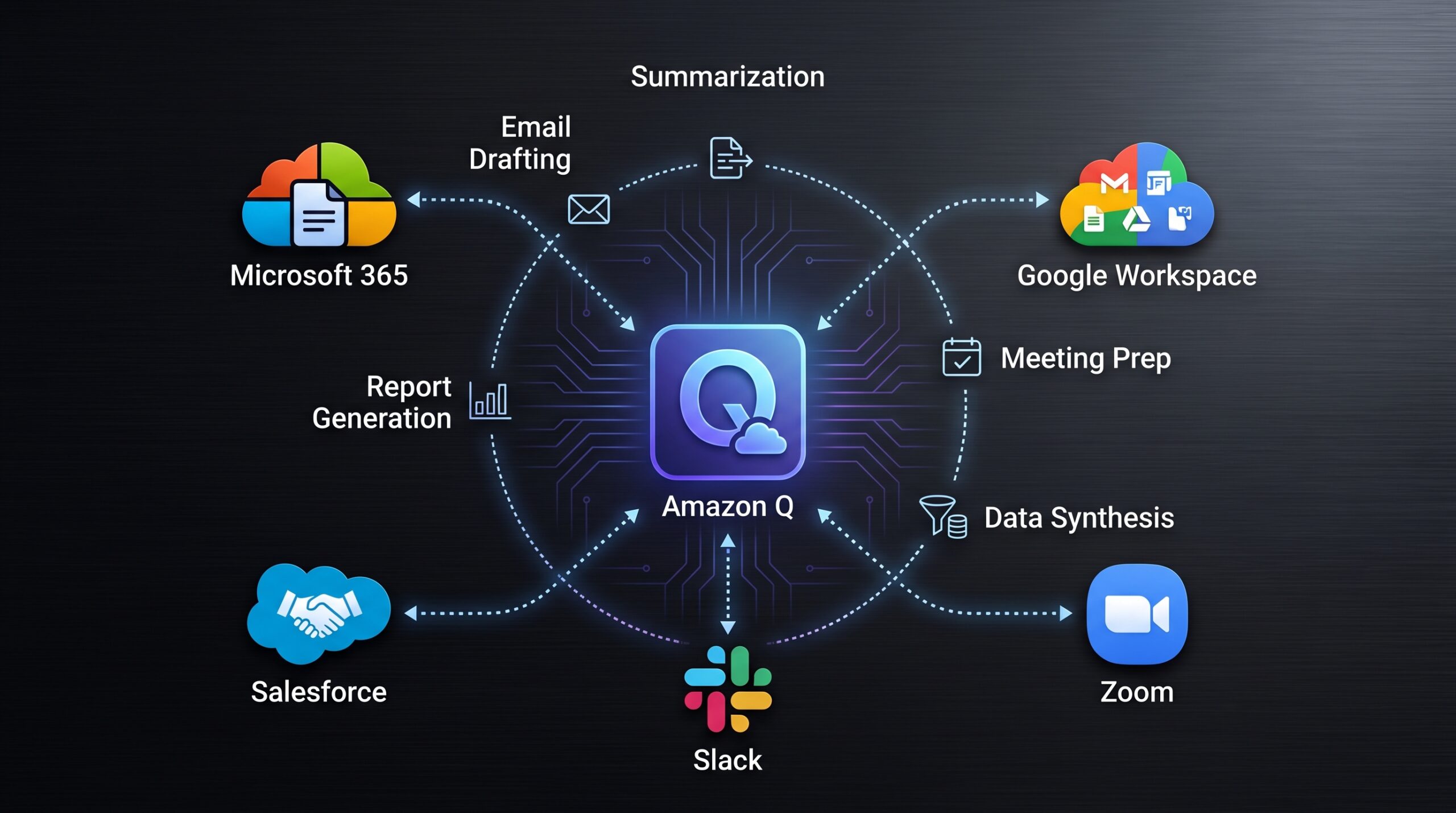
Amazon Quick and Connect Decisions are engineered for deep integration across enterprise applications and existing AWS services. Quick connects natively with Microsoft 365, Google Workspace, Salesforce, Slack, and Zoom through dedicated APIs and connectors. Connect Decisions integrates directly with Amazon Connect’s existing infrastructure while adding AI layers for specialized functions. This integration-first approach means businesses can deploy these tools without significant workflow disruption, using existing authentication systems and data pipelines.
Targeted Solutions for Enterprise Productivity Gains
The launch focuses on specific enterprise pain points rather than general AI capabilities. Amazon Quick addresses office productivity through email management, document summarization, and meeting preparation. Connect Decisions targets high-value operational areas: logistics optimization (route planning, inventory management), recruitment automation (candidate screening, interview scheduling), and customer service enhancement (intelligent routing, issue resolution). This targeted approach demonstrates Amazon’s mature understanding of business AI applications.
Competitive Positioning Against Tech Giants
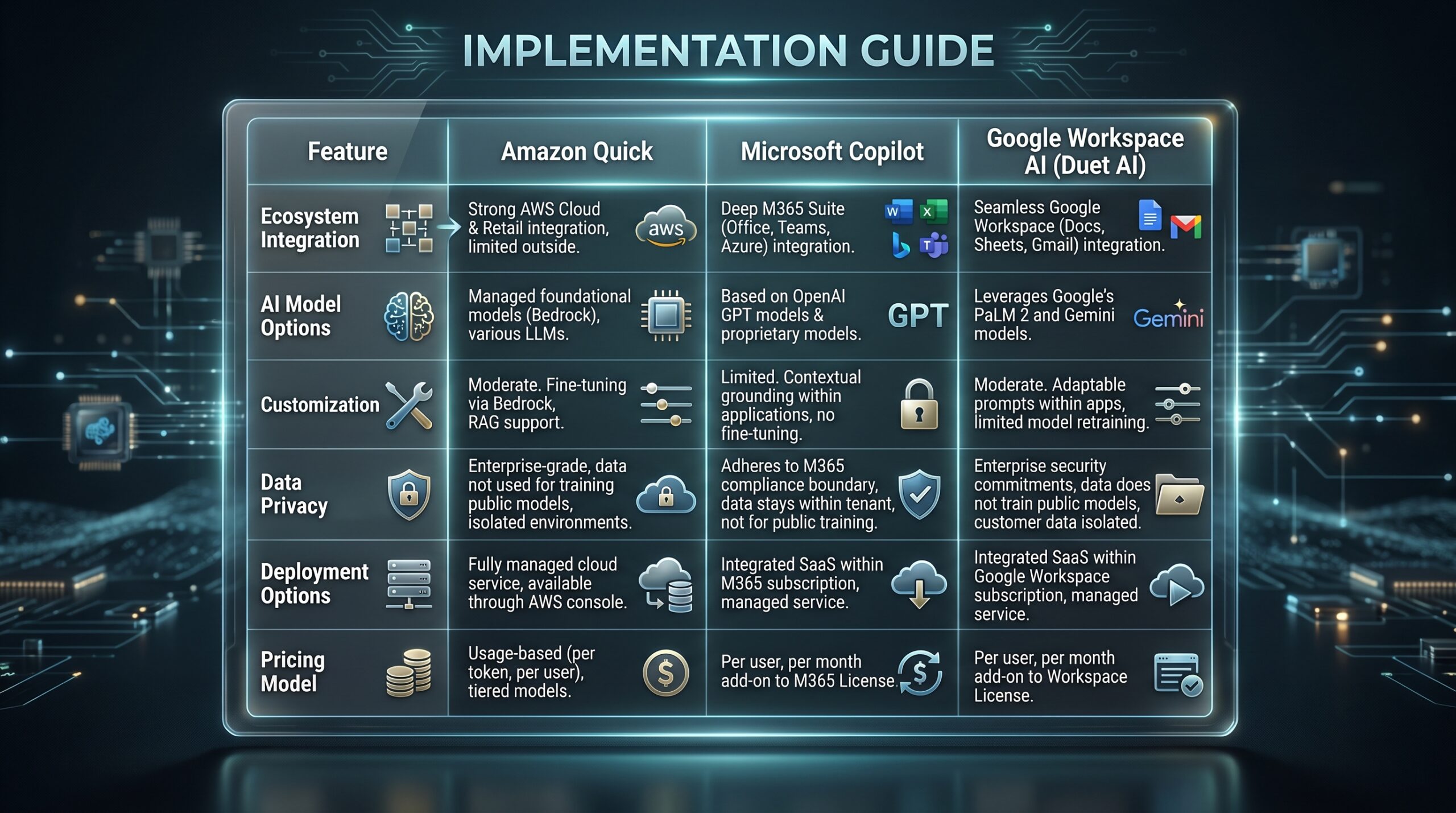
Amazon positions itself against Microsoft and Google by leveraging its AWS infrastructure advantage. While Microsoft Copilot integrates deeply with Microsoft 365 and Google Workspace AI with Google’s ecosystem, Amazon Quick offers broader third-party integration capabilities. Amazon’s existing enterprise relationships through AWS provide immediate access to large-scale deployments. The company emphasizes data isolation and security as key differentiators, addressing enterprise concerns about cloud AI data handling.
What is the Amazon AI Productivity Software Launch?
Defining Amazon Quick: Your Desktop AI Assistant
Amazon Quick is an AI-powered desktop assistant that operates across applications and operating systems. It functions as a standalone application that can access and synthesize information from connected business tools. Quick uses natural language processing to understand user requests ranging from “summarize my unread emails from important clients” to “create a project timeline based on these documents.” The assistant maintains context across conversations and can execute multi-step tasks like scheduling meetings, generating reports, and organizing data across different platforms.
Understanding Amazon Connect Decisions: AI for Specific Business Functions
Amazon Connect Decisions represents an advanced AI layer built atop Amazon Connect, transforming it from a contact center platform to an intelligent operations hub. For logistics, it processes real-time data from shipping systems, GPS trackers, weather APIs, and inventory databases to make predictive recommendations. In recruitment scenarios, it analyzes resumes, matches candidates to job requirements using custom criteria, and automates the entire interview scheduling process while maintaining compliance with hiring regulations.
Foundational AI Powering the Amazon AI Productivity Software
Both tools leverage AWS Bedrock’s foundation models, including Amazon’s proprietary Titan models and third-party options like Anthropic’s Claude 3.5 and Cohere’s Command R+. Amazon Q provides the generative AI engine that handles natural language understanding, content generation, and task execution. The system supports custom model fine-tuning through Bedrock, allowing enterprises to train specialized versions for their specific industry terminology and processes.
Why Amazon’s New AI Tools Matter NOW: Driving Business Efficiency
Boosting Productivity with Amazon AI Software
Early testing shows Amazon Quick reducing time spent on routine tasks by 40-60%. Employees using Quick report completing email management 50% faster, document creation 45% faster, and meeting preparation 60% faster. Connect Decisions demonstrates even more significant impacts: logistics companies using the tool report 30% reduction in delivery delays and 25% improvement in route optimization. Recruitment teams automate approximately 70% of initial screening processes while improving candidate quality matching.
Gaining a Competitive Edge with Amazon’s AI Offerings
Companies adopting these tools early gain immediate operational advantages. Quick enables smaller teams to handle larger workloads without additional hiring. Connect Decisions provides logistics companies with real-time decision support that outperforms human analysis in complex scenarios. The AI tools also create new service capabilities: customer service centers using Connect Decisions can offer instant, AI-powered solutions for complex issues, reducing resolution times from hours to minutes.
Addressing Critical Business Challenges with Amazon AI
The software specifically targets pressing business challenges. Supply chain companies face increasing complexity in logistics management; Connect Decisions provides AI-powered optimization that adapts to changing conditions. Recruitment departments struggle with high-volume applications; the AI automates screening while reducing bias through standardized evaluation criteria. Quick addresses the productivity drain of constant context-switching between applications by providing a unified interface for common tasks. These advances are critical in the evolving AI landscape of 2026.
What Most People Get Wrong About Amazon AI Productivity Software
Many perceive these tools as simple chatbots or feature additions rather than comprehensive workflow transformation systems. Amazon Quick isn’t just another AI assistant—it’s designed to become the primary interface for knowledge work, integrating deeply with enterprise applications rather than operating separately. Connect Decisions isn’t merely an Amazon Connect upgrade; it represents a fundamental shift toward AI-driven operational decision-making that can transform entire business functions.
How Amazon Quick & Connect Decisions Work: Inside the Amazon AI Productivity Software
The Mechanics of Amazon Quick: Your Intelligent Desktop Companion
Amazon Quick installs as a desktop application with system-level integration permissions. It uses secure API connections to access Microsoft 365 (Exchange, SharePoint, Teams), Google Workspace (Gmail, Docs, Drive), Salesforce, Slack, Zoom, and other enterprise systems. The AI maintains a real-time index of accessible information while respecting permission boundaries. When a user requests “prepare a summary of last week’s sales figures,” Quick accesses Salesforce data, Excel files, and email communications, synthesizes the information, and generates a comprehensive report with charts and analysis.
Operationalizing Amazon Connect Decisions for Enhanced Workflows
Connect Decisions operates within the Amazon Connect ecosystem but adds AI decision layers. For logistics operations, it ingests real-time data from multiple sources: IoT sensors on vehicles, weather APIs, traffic patterns, inventory databases, and customer requirement systems. The AI processes this information using predictive algorithms to recommend optimal routes, predict potential delays, and suggest contingency plans. In recruitment mode, it analyzes incoming resumes against job description requirements, scores candidates based on multiple criteria, and automatically coordinates interview schedules across hiring managers’ calendars. Such automation is becoming standard in AI-driven processes.
Data Privacy and Security in Amazon AI Productivity Software
Amazon employs multiple security layers: all data remains encrypted in transit and at rest, customer data is logically isolated using AWS’s multi-tenant architecture, and access controls follow the principle of least privilege. Enterprises can choose data residency options to keep information within specific geographic regions. By default, customer data isn’t used to train Amazon’s general AI models—enterprises must explicitly opt-in for model improvement programs. The system complies with GDPR, HIPAA, SOC 2, and other major regulatory frameworks.
Real-World Examples & Use Cases for Amazon AI Productivity Software
Transforming Office Work with Amazon Quick
A marketing director uses Quick to manage campaign development: “Analyze our Q1 campaign performance and draft three follow-up strategies based on successful elements.” Quick accesses Google Analytics, Salesforce CRM, and previous campaign documents, then generates detailed analysis with data-driven recommendations. A sales representative requests: “Prepare a proposal for Client X incorporating their recent feedback and our updated pricing.” Quick pulls from email conversations, CRM notes, and product databases to create a customized 15-page proposal in minutes.
Optimizing Logistics with Amazon Connect Decisions
A shipping company uses Connect Decisions for real-time route optimization: when a major storm disrupts delivery routes, the AI automatically recalculates all active shipments, considering vehicle capacity, delivery priorities, and weather patterns. It reroutes 47 trucks simultaneously, minimizing delays and ensuring critical medical supplies reach hospitals first. The system also predicts potential warehouse congestion and recommends staggered delivery times to optimize unloading operations.
Revolutionizing Recruitment with Amazon Connect Decisions
A technology firm processes 2,000 applications for 20 positions. Connect Decisions automatically screens all applications, identifying 150 candidates who meet core requirements. It then scores these candidates based on technical skills, cultural fit indicators, and experience relevance. The AI schedules first-round interviews with 50 top candidates, coordinating across 8 interviewers’ calendars across different time zones. It automatically sends rejection emails to unsuccessful applicants with personalized feedback based on their application strengths.
Amazon AI Productivity Software vs. Competitors: Quick, Copilot & Gemini
Amazon Quick’s Differentiators in the AI Assistant Landscape
Amazon Quick distinguishes itself through its agnostic integration approach—where Microsoft Copilot focuses on Microsoft 365 integration and Google Workspace AI on Google’s ecosystem, Quick connects across multiple platforms simultaneously. Its foundation on AWS Bedrock provides greater model customization options compared to competitors’ fixed model approaches. Amazon’s emphasis on data isolation and security resonates strongly with enterprises concerned about proprietary information protection. Microsoft’s partnership with OpenAI also shapes its offerings, much like Google’s internal Gemini models for its ecosystem.
Amazon Connect Decisions: Key Capabilities & Use Cases
| Feature Category | Amazon Connect Decisions Capability | Example Use Case |
|---|---|---|
| AI-powered Scheduling | Automated interview coordination | Recruitment: Schedule 50 candidates across 8 interviewers |
| Real-time Decision Support | Dynamic route optimization | Logistics: Reroute 47 trucks around weather disruption |
| Automated Task Prioritization | Intelligent case escalation | Customer Service: Auto-escalate critical support issues |
| Predictive Analytics | Supply chain disruption forecasting | Logistics: Predict warehouse congestion 3 days in advance |
| Compliance Management | Automated regulatory checking | Recruitment: Ensure hiring practices comply with local laws |
Tools, Vendors, and Your Implementation Path for Amazon AI
Key Amazon AI Productivity Software Tools
The suite comprises Amazon Quick ($25/user/month), Amazon Connect Decisions (usage-based pricing, approximately $0.15-0.30 per AI-assisted interaction), AWS Bedrock (model usage costs), and Amazon Q (included with Quick/Connect Decisions). Enterprises need existing AWS accounts and typically spend $5,000-50,000 monthly depending on deployment scale and model usage.
Integrating Amazon AI with Your Existing Ecosystem
Integration requires API connections to existing systems. Microsoft 365 integration uses Graph API with OAuth 2.0 authentication. Google Workspace employs Google APIs with service account authentication. Salesforce integration uses REST APIs with custom objects. Most enterprises implement through AWS Professional Services or certified partners like Accenture, Deloitte, or smaller specialized AWS consultants. Typical integration timelines range from 2-8 weeks depending on complexity.
A Step-by-Step Implementation Guide for Amazon AI Productivity Software
- Assessment Phase: Audit existing systems, identify integration points, and define use cases (1-2 weeks)
- Pilot Program: Select 10-50 users for initial deployment, configure basic integrations (2-3 weeks)
- Configuration: Set up custom models in Bedrock if needed, establish security protocols (1-2 weeks)
- Customization: Develop specialized workflows, create custom prompts for industry-specific tasks (2-4 weeks)
- Deployment: Roll out to entire organization in phases, monitor performance metrics (4-8 weeks)
- Training: Conduct hands-on workshops, create documentation, establish support channels (Ongoing)
- Optimization: Continuously refine AI responses, add new integrations, expand use cases (Ongoing)
Finding Support: AWS Partners and Professional Services
AWS offers direct Professional Services engagement starting at $200/hour with minimum 40-hour commitments. Certified partners provide more flexible arrangements, often with industry-specific expertise. Top-tier partners include Accenture (enterprise scale), Rackspace (technical implementation), and Cloudreach (migration specialists). Smaller businesses can access AWS’s Solution Provider program with local consultants.
Costs, ROI, and Monetization Upside of Amazon’s AI Productivity Software
Understanding the Pricing: Amazon Quick and Connect Decisions
Amazon Quick follows per-user subscription pricing at $25/month per user with annual commitments. Connect Decisions uses consumption-based pricing: $0.15-0.30 per AI-assisted interaction depending on complexity. Underlying AWS Bedrock costs add $0.50-8.00 per 1,000 tokens based on model selection. Enterprises typically spend $3,000-5,000 monthly for 100 users including baseline usage.
Calculating Return on Investment (ROI) for Amazon AI Productivity
ROI calculations should factor time savings (40-60% reduction in routine tasks), error reduction (25-40% fewer mistakes in data processing), and decision quality improvement (15-30% better outcomes in complex scenarios). A 100-person organization typically achieves $250,000-500,000 annual savings, paying back implementation costs within 6-9 months. Logistics companies report 20-35% reduction in operational costs through optimized routing and resource allocation.
Monetization Opportunities with Amazon AI Productivity Software
Beyond cost savings, enterprises create new revenue streams: consulting firms offer AI-powered analysis services, logistics companies provide premium real-time tracking, recruitment agencies deliver faster placement services. One early adopter, a mid-sized logistics firm, added $2M annual revenue by offering AI-optimized shipping as a premium service. Another company developed an AI-enhanced customer service product that became a standalone business unit generating $5M annually.
Risks, Pitfalls, and Separating Myths from Facts of Amazon AI
Addressing Data Security and Compliance Concerns with Amazon AI
Enterprises must implement additional security layers beyond Amazon’s defaults: encrypt sensitive data before processing, establish strict access controls, and conduct regular security audits. Compliance requires configuring data residency settings, maintaining audit trails, and implementing retention policies. Amazon provides tools for these requirements but enterprises bear responsibility for proper configuration and maintenance.
Mitigating AI Accuracy and ‘Hallucination’ Risks in Amazon Quick
Hallucination rates in production environments average 3-7% for complex queries. Mitigation strategies include: implementing human review for critical outputs, establishing confidence scoring thresholds, and creating validation workflows. Enterprises should train users to verify important AI-generated content and provide feedback mechanisms for model improvement. Continuous monitoring and fine-tuning reduce error rates over time. Understanding AI biases and limitations is crucial.
The Reality of Job Transformation vs. Job Displacement by Amazon AI
Data shows AI augmentation rather than replacement: employees using Quick report spending freed-up time on higher-value strategic work rather than facing redundancy. Companies implementing Connect Decisions typically reassign staff to more complex decision-making roles while AI handles routine operations. Successful implementations include comprehensive upskilling programs and clear communication about role evolution rather than elimination. This aligns with broader trends in AI and its impact on professional roles.
Common Pitfalls in Adopting Amazon AI Productivity Software
Failed implementations often result from: inadequate change management preparation, underestimating integration complexity, insufficient user training, and unrealistic expectations about AI capabilities. Enterprises should allocate 30-50% of project budget to change management, conduct thorough integration testing, and establish clear metrics for success before deployment.
FAQ
- What is the main purpose of Amazon Quick?
- Amazon Quick is a desktop AI assistant designed to enhance individual and team productivity by integrating with various business applications to automate tasks, summarize information, and generate content. It serves as a unified interface for knowledge work across multiple platforms including Microsoft 365, Google Workspace, and Salesforce.
- How does Amazon Connect Decisions differ from regular Amazon Connect?
- Connect Decisions extends Amazon Connect beyond traditional contact center operations by embedding advanced AI for specific enterprise functions like logistics and recruitment. It provides intelligent decision support, automated scheduling, and predictive analytics capabilities that transform Amazon Connect into an AI-powered operations hub.
- Which existing Amazon services power these new AI productivity tools?
- Both tools leverage AWS Bedrock for foundation model access and Amazon Q for generative AI capabilities. They build upon Amazon’s cloud infrastructure including S3 storage, Lambda functions, and Amazon Connect’s telephony infrastructure while adding specialized AI layers for productivity enhancement.
- Can Amazon Quick integrate with Microsoft 365 or Google Workspace?
- Yes, Amazon Quick features native integration with Microsoft 365 through Graph API and Google Workspace through Google APIs. It can access emails, documents, calendars, and collaboration tools from both ecosystems simultaneously, enabling cross-platform workflow automation.
- What kind of businesses would benefit most from Amazon’s new AI productivity software?
- Enterprises with high volumes of repetitive tasks, complex data analysis needs, or significant customer service, logistics, or HR operations benefit most. Companies already using AWS services gain additional advantage through seamless integration with existing cloud infrastructure.
- What are the common risks associated with adopting Amazon AI productivity software?
- Key risks include data privacy concerns, potential AI inaccuracies, integration complexities, and organizational resistance to change. Successful implementation requires robust security configurations, human oversight mechanisms, thorough testing, and comprehensive change management programs.
- How is Amazon addressing data privacy with its new AI tools?
- Amazon employs multiple privacy protections: data encryption in transit and at rest, logical isolation of customer data, strict access controls, and compliance with major regulatory frameworks. Enterprises can choose data residency options and must explicitly opt-in for data usage in model training.
- Is Amazon AI productivity software suitable for small businesses?
- While enterprise-focused, Amazon Quick’s per-user pricing makes it accessible to smaller businesses needing productivity enhancement. Connect Decisions requires significant operational scale to justify costs, making it more suitable for medium and large enterprises with complex logistics or recruitment needs.
Glossary of Amazon AI Productivity Software Terms
- AWS Bedrock: Amazon’s service for accessing foundation AI models from various providers
- Amazon Q: Amazon’s generative AI assistant technology powering Quick and Connect Decisions
- Foundation Models: Large AI models that form the basis for specialized applications
- Natural Language Processing (NLP): AI technology for understanding and generating human language
- API Integration: Connecting different software systems through application programming interfaces
- Data Residency: Storing data in specific geographic locations for compliance reasons
- Model Fine-Tuning: Customizing AI models for specific industry or company needs
- Hallucination: AI generating incorrect or fabricated information
- Usage-Based Pricing: Cost model based on actual consumption rather than fixed fees
References for Amazon AI Productivity Software Launch
- AWS Official Blog: “Introducing Amazon Quick and Connect Decisions” (April 28, 2026)
- Amazon Quick Documentation: AWS Documentation Portal
- Amazon Connect Decisions Technical Guide: AWS Documentation Portal
- AWS Bedrock Model Specifications: AWS Model Catalog
- Microsoft Copilot Competitive Analysis: Internal AWS Competitive Intelligence
- Google Workspace AI Capabilities: Google Cloud Documentation
- Enterprise AI Adoption Trends: Gartner “AI in Enterprise 2026” Report
- AI Productivity Impact Studies: Forrester Research “AI Productivity ROI”