

Meta Platforms has significantly increased its 2026 capital expenditure forecast to between $125 billion and $145 billion, a substantial rise from its previous prediction of $115 billion to $135 billion. This AI cost surge at Meta is primarily driven by massive investments in AI infrastructure such as compute and data centers, aimed at advancing its AI strategy despite concerns from investors leading to stock plunges.
Meta Platforms has surged its 2026 capital expenditure forecast to between $125 billion and $145 billion, largely due to massive investments in AI infrastructure like compute and data centers. This decision, following a strong Q1 2026 earnings report, led to a stock drop but reflects CEO Mark Zuckerberg’s confidence in advancing Meta’s AI strategy, even as the company reallocates resources through significant workforce reductions.
Key Takeaways from Meta’s AI Investment Strategy
- Meta’s 2026 AI-driven capital expenditure forecast has surged to $125 billion-$145 billion, up from $115 billion-$135 billion.
- This increased spending, a minimum of $10 billion more than expected, is largely for compute and data center infrastructure.
- The announcement followed Meta’s Q1 2026 earnings report and led to a stock drop of up to 10%.
- CEO Mark Zuckerberg expressed confidence in these investments, despite investor concerns over return on investment (ROI).
- Meta is also undertaking significant workforce reductions, cutting 8,000 jobs and 6,000 open roles, to reallocate resources towards AI.
- The company’s CFO, Susan Li, cited higher component pricing and additional data center costs as contributing factors to the surge.
- Competitors like Alphabet (Google) are seeing stock surges due to strong cloud revenue, a business Meta lacks, making its ROI proof more challenging.
Key Takeaways: Navigating Meta’s AI Spending Leap
Decisions, Facts, and Implications of Meta’s AI Cost Surge
- Strategic Pivot: Meta has made a definitive decision to reorient its entire company around AI, evidenced by the capex surge and concurrent large-scale layoffs. This is not an incremental increase but a fundamental shift in strategy.
- Unprecedented Scale: The facts are stark. Meta’s 2026 capex forecast of up to $145 billion represents a near doubling from its 2025 expenditure of approximately $72 billion. This scale places it at the forefront of a global industry trend.
- Immediate Market Reaction: The implication was immediate: a stock plunge of up to 10% as investors grappled with the near-term profitability hit. This contrasts sharply with hyperscalers like Alphabet, whose AI investments are buoyed by existing cloud revenue streams.
- Unique Cost Pressure: A critical insight is that the AI cost surge at Meta isn’t just about buying more hardware. CFO Susan Li explicitly cited “higher component pricing” (e.g., for memory chips) as a key driver, indicating inflationary pressure in the AI supply chain.
- High-Stakes ROI Challenge: The most significant implication is the heightened burden on Meta to prove ROI. Without a cloud business to monetize infrastructure externally, success hinges entirely on improving core products (ads, engagement) and successfully launching new AI services that users and advertisers will pay for.
What is the AI Cost Surge at Meta, and Why Now?
Defining Meta’s AI-Driven Capital Expenditure
Capital Expenditure (Capex) at Meta, in this context, refers to the massive outlay of funds dedicated to acquiring and building long-term physical assets essential for artificial intelligence. This isn’t spending on day-to-day operations (OpEx); it’s investment in the foundational bedrock of Meta’s future. Specifically, this AI cost surge is allocated to AI Infrastructure—the specialized ecosystem of hardware and facilities required to train and run sophisticated AI models. This includes procuring tens of thousands of advanced GPUs, constructing new hyperscale data centers with specialized cooling systems, and developing the proprietary software that makes it all work in concert. Hyperscalers are companies like Google Cloud, AWS, and Microsoft Azure that build and rent out such infrastructure; Meta is building its own private version to maintain competitive control.
Why the AI Cost Surge Matters Now: Market Dynamics and Strategic Imperative
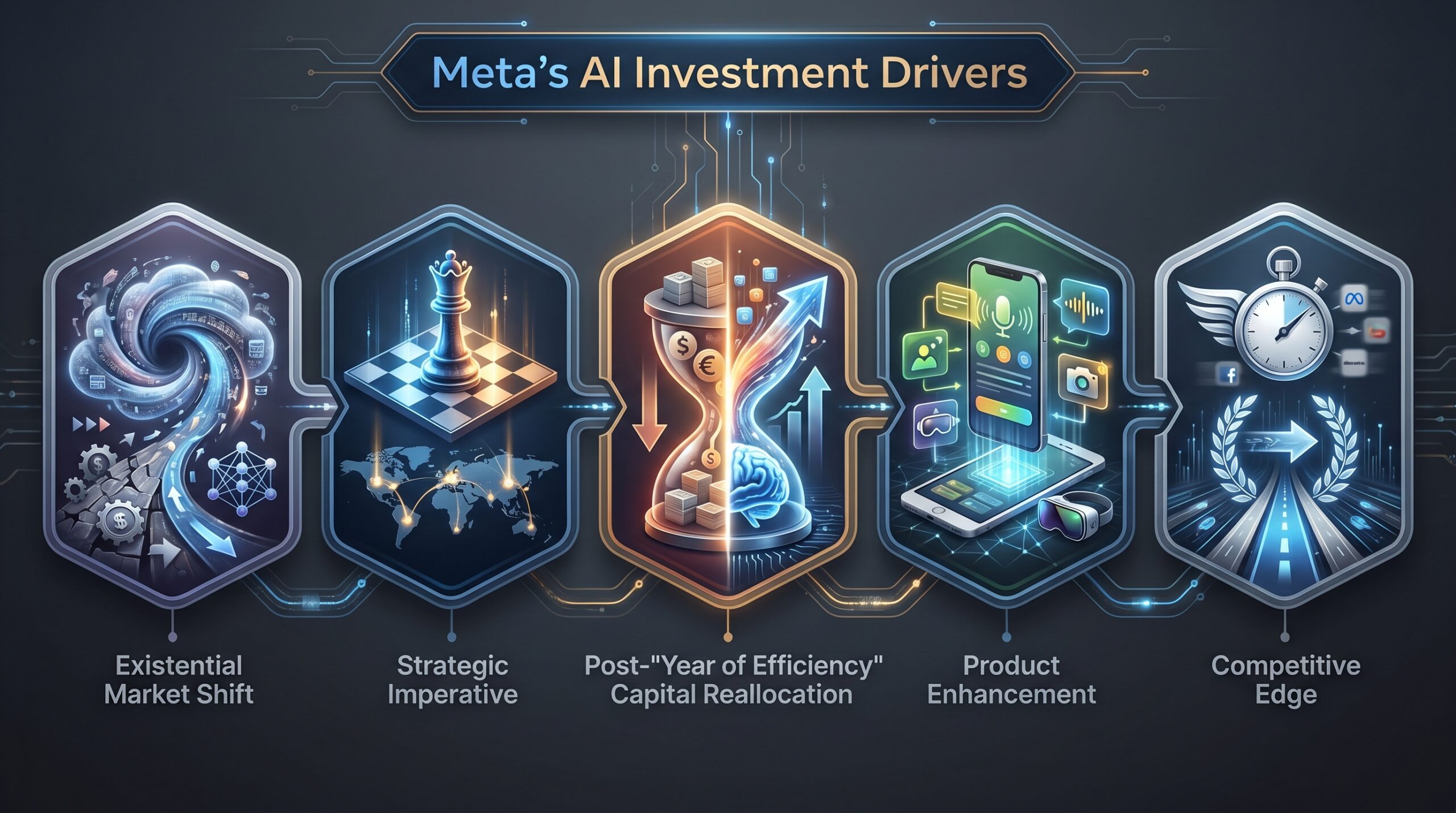
The AI cost surge at Meta is a direct response to an existential market shift. The tech industry is in a winner-take-most race for AI dominance, and falling behind is not an option. This spending follows Meta’s “Year of Efficiency,” which streamlined operations and cut costs, effectively freeing up capital for this exact moment. The strategic imperative is clear: AI is the new core of user engagement, advertising efficiency, and future platform evolution. Investors are keenly watching because this level of spending significantly depresses near-term earnings. The stock’s negative reaction on April 29th, 2026, underscores the tension between Meta’s long-term ambition and Wall Street’s quarterly expectations. This isn’t just spending; it’s a high-risk bet on Meta’s ability to define the next decade of social technology.
How Meta’s AI Cost Surge Works: The Mechanics of Massive Investment
Step-by-Step Breakdown of AI Infrastructure Investment
The allocation of Meta’s AI capex follows a concrete, multi-stage process. First, a dominant portion goes to procuring AI Compute Infrastructure. This means signing massive purchase orders for the most powerful AI accelerators available, primarily NVIDIA’s latest H200 or Blackwell GPUs, but also potentially custom-designed chips like Meta’s own MTIA (Meta Training and Inference Accelerator). Each unit can cost tens of thousands of dollars, and Meta needs them by the tens of thousands. Second, these chips must be housed. Billions are dedicated to building and commissioning new data centers from the ground up, which involves securing land, managing complex construction, and implementing advanced liquid cooling systems to handle the immense heat output. Third, CFO Susan Li’s note about “higher component pricing” points to cost inflation for essential supporting hardware, like high-bandwidth memory (HBM) chips, which are in short supply and high demand. Finally, significant investment goes into the R&D for the AI models themselves and the software stack that orchestrates training runs across thousands of interconnected chips.
The Role of Workforce Reductions in Funding AI
The 8,000 job cuts and elimination of 6,000 open roles are not a separate event; they are a core financial mechanism fueling the AI cost surge at Meta. This is a strategic reallocation of resources on a massive scale. The savings from reduced payroll, estimated to be in the billions annually, are being directly funneled into the capital budget for AI infrastructure. This trade-off highlights the company’s priorities: it is choosing to invest in physical and digital capital over certain areas of human capital. This move signals that Zuckerberg views owning and controlling a world-class AI infrastructure as more critical to Meta’s future than maintaining its previous workforce size, a stark indication of the strategic weight placed on this investment.
Real-World Implications of Meta’s AI Cost Surge
Use Cases for Meta’s AI Investments: From Ads to Assistant
The massive AI infrastructure build-out is not an abstract exercise; it powers specific, user-facing products and internal systems. The most immediate application is in advertising. More powerful AI allows for hyper-personalized ad targeting and auction dynamics, potentially increasing click-through rates and the price advertisers are willing to pay. For example, an improved model could better predict a user’s intent from a casual comment in a Facebook Group, serving a more relevant ad. Similarly, AI drives the content recommendation engine for Reels and Feed, aiming to maximize user engagement time. A key public-facing product is the Meta AI assistant, which requires immense computational power for real-time query answering and content generation. Behind the scenes, this infrastructure is also crucial for advancing their metaverse vision, enabling complex simulations and realistic avatars in virtual reality environments.
Impact on Investors and Meta’s Stock Performance
The immediate financial implication of the AI cost surge was a sharp negative reaction from investors. On April 29th, 2026, Meta’s stock fell as much as 10% in early trading following the Q1 earnings report. This drop reflects a fundamental concern: capex directly reduces free cash flow, which is a key metric for valuing a company. Investors are skeptical about the timeline and certainty of the Return on Investment (ROI). This skepticism is amplified when contrasting Meta’s situation with Alphabet’s. In April 2026, Alphabet’s stock surged 34%, its best month since 2004, fueled by strong cloud revenue that directly benefits from its own AI investments. Meta lacks this offsetting revenue stream, making its massive spend a purer, and therefore riskier, bet on future profitability from its existing apps and services.
Comparing Meta’s AI Spending to Hyperscalers
Meta’s AI Investment Strategy vs. Cloud Giants
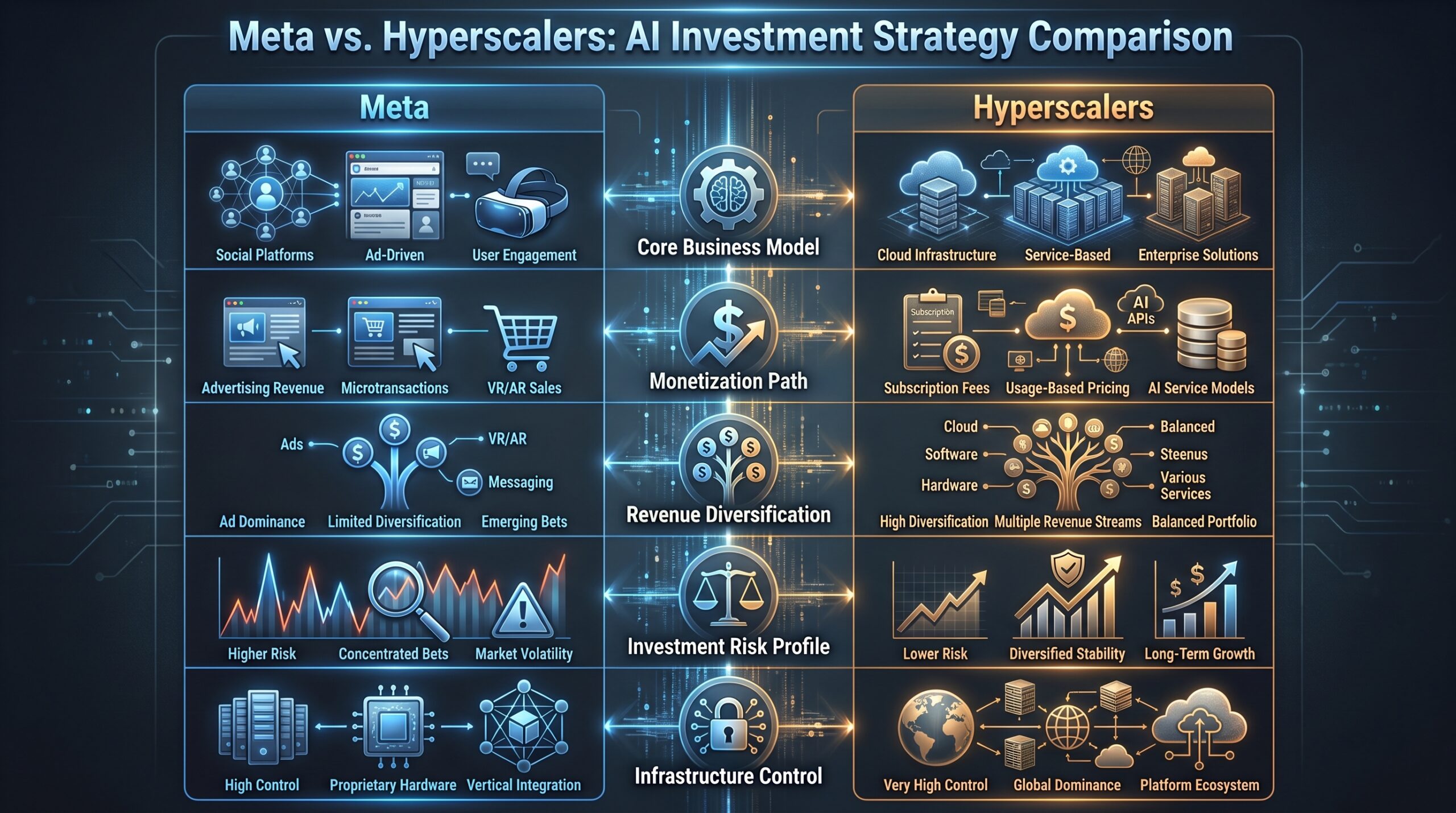
Meta’s approach to the AI cost surge is fundamentally different from that of hyperscalers like Alphabet, Microsoft, and Amazon. While all are spending heavily, the business model context is everything. Hyperscalers build AI infrastructure to serve two masters: their own internal products (like Google Search) and, crucially, external customers who rent computing power via their cloud platforms. This dual-use model means every dollar spent on AI infrastructure can potentially generate direct revenue from cloud clients, creating a more immediate and visible path to ROI. Meta, however, is building infrastructure almost exclusively for its own use. This creates a “competitive disadvantage” in the eyes of some analysts, as Meta’s ROI must be generated indirectly through improved ad performance, user engagement, and new product adoption within its family of apps. The investment is just as large, but the monetization engine is less diversified.
Meta’s AI Cost Surge: A Comparative Analysis
| Metric | Meta (2026 Forecast) | Meta (2025 Actual) | Hyperscalers (2026 AI-related Estimate) | Total AI Capex by 2030 (McKinsey Projection) |
|---|---|---|---|---|
| Capital Expenditure | $125B – $145B | ~$72B | ~$725B (across all major players) | $6.7 Trillion (worldwide) |
| Stock Movement after Q1 ’26 Earnings | Down up to 10% | N/A | Alphabet: Up 34% in April 2026 | N/A |
| Presence of Cloud Business | No | No | Yes (Primary revenue source for AI infra) | N/A |
This table illustrates the scale and context of the AI cost surge at Meta. While its forecast is colossal, it is part of a broader industry-wide investment tidal wave. The divergent stock movements highlight the market’s different risk assessment for companies with versus without a cloud business model.
Tools, Vendors, and Implementation Paths for Meta’s AI Infrastructure
Key Technologies Powering Meta’s AI Ambitions
Meta’s AI cost surge is channeled through a specific ecosystem of vendors and technologies. The cornerstone is AI Compute Infrastructure, dominated by NVIDIA’s GPU platforms. Meta is likely procuring massive quantities of the H200 and the next-generation Blackwell architecture GPUs, which offer significant performance improvements for training large language models. However, to mitigate reliance on a single vendor and control costs, Meta is aggressively developing its own custom silicon, the Meta Training and Inference Accelerator (MTIA). On the facility side, they are working with engineering firms to build state-of-the-art data centers that prioritize power efficiency and advanced cooling, such as direct-to-chip liquid cooling, to handle densities exceeding 50 kilowatts per rack. Alongside hardware, AI Talent Compensation remains a major cost, with top researchers and engineers commanding salaries and stock packages worth millions.
The Path to Scaling Meta’s AI Capabilities
Implementing this level of AI infrastructure is a monumental operational challenge. The path involves navigating a constrained global supply chain. Securing a reliable supply of high-bandwidth memory (HBM) chips, which are critical for GPU performance, is a major hurdle due to intense competition from other tech giants and automotive companies. Each new data center project faces logistical complexities, from local zoning approvals to managing construction timelines amidst shortages of key components like transformers. Furthermore, scaling isn’t just about hardware. Meta must continuously innovate in AI software and hardware co-design—creating systems where the software efficiently leverages the unique architecture of their custom chips and GPU clusters. The tradeoff is between speed (buying from NVIDIA) and long-term cost control and independence (developing custom chips); Meta is attempting both paths simultaneously, which is itself a complex implementation strategy.
Costs, ROI, and Monetization Upside of Meta’s AI Strategy
Evaluating the Financial Impact of Meta’s AI Cost Surge
The financial impact of this AI cost surge is twofold: immediate cost escalation and long-term ROI uncertainty. The specific cost drivers, as outlined by CFO Susan Li, are “higher component pricing” and “additional data center costs.” This means that even for the same number of GPUs, Meta is paying more due to market inflation for components like memory chips. Building data centers at the required scale and speed also incurs premium costs. The central question is Return on Investment. For Meta, ROI is challenging to model because it’s not selling compute hours. Instead, ROI must be measured through indirect metrics: increased advertising revenue per user, higher engagement leading to more ad impressions, and the success of new AI-powered subscription services or developer tools. The lack of a direct cloud comparison makes this a leap of faith for investors, who must trust that Zuckerberg’s vision of an AI-integrated future will translate into sufficient financial returns to justify the upfront capital destruction.
Potential Monetization Upside: The Long-Term Vision
Despite the near-term concerns, Meta’s leadership has a clear, if ambitious, monetization vision. The primary upside is supercharging its existing $140-billion-plus advertising business. More advanced AI can lead to significantly better ad targeting and measurement, allowing Meta to command higher prices from advertisers. For users, AI-driven features like more engaging Reels, a highly capable AI assistant, and better content moderation could increase daily active users and time spent on platform, expanding the overall advertising inventory. Beyond ads, Meta could introduce new revenue streams, such as a premium tier for its AI assistant with advanced capabilities, or by licensing its AI models to businesses (a nascent cloud-like business). This investment is a bet that AI will become the primary driver of value in the digital economy, a view supported by McKinsey’s projection of a $6.7 trillion global AI capex requirement by 2030. Meta is aiming to be a foundational player in that future.
Risks, Pitfalls, and Myths vs. Facts of Meta’s AI Investment
What Can Go Wrong: Risks Associated with the AI Cost Surge Meta Faces
- Investor Flight: The biggest risk is a sustained loss of investor confidence if Meta fails to articulate a clear, believable path to ROI. Another few quarters of heavy spending without demonstrable revenue acceleration could lead to further stock depreciation.
- Supply Chain Disruption: The reliance on a constrained supply chain for GPUs and memory chips poses a significant operational risk. Geopolitical issues or further supply shortages could delay projects and inflate costs beyond already high forecasts.
- Regulatory Backlash: As Meta’s AI becomes more powerful and integrated into daily life, it will attract increased scrutiny from regulators in the US, EU, and other regions concerning data privacy, market dominance, and AI ethics, potentially leading to fines and operational restrictions.
- Talent Morale and Retention: The large-scale layoffs, while freeing up capital, could damage company morale and lead to the departure of key AI talent who are in high demand, negating some of the human capital advantages Meta is trying to build.
- Technological Misstep: There is a risk that Meta’s specific AI architecture or model strategy could be surpassed by a more efficient or effective approach from a competitor, rendering portions of its massive investment less valuable.
What Most People Get Wrong About Meta’s AI Spending
Myth: AI spending will automatically translate to immediate profit for Meta.
Fact: Significant infrastructure investments have long gestation periods. ROI will be gradual, depending on the successful integration of AI into products and user acceptance. Profitability is not automatic and is likely 3-5 years away.
Myth: All tech companies are facing the exact same challenges with AI spending.
Fact: This ignores the crucial business model difference. Hyperscalers like Google and Microsoft can offset AI costs with high-margin Cloud revenue. Meta’s spending is a pure cost center until it directly improves its own product revenue, making its financial challenge unique and more acute.
Common Mistake: Overlooking the impact of component pricing.
Reality: Many analysts focus solely on the volume of spending. However, CFO Susan Li explicitly called out “higher component pricing” as a key driver. This means the AI cost surge at Meta is partially inflationary, not just a function of buying more equipment, a nuance that adds a layer of financial risk.
Truths and Misconceptions about Meta’s AI Spending
- Myth: Instant Profitability from AI. Fact: ROI has a long gestation period, 3-5 years for profitability.
- Myth: All Tech Giants Face Identical AI Challenges. Fact: Hyperscalers offset costs with Cloud revenue; Meta’s challenge is unique due to its ad-centric model.
- Misconception: Only Spending Volume Matters. Truth: High component pricing (inflationary costs) also drives the surge, adding financial risk beyond just quantity.
Frequently Asked Questions About Meta’s AI Cost Surge
Why is Meta increasing its AI spending so drastically?
Meta is increasing its AI spending drastically to build out foundational AI infrastructure, primarily compute and data centers, essential for developing advanced AI models. This investment is crucial for enhancing products like advertising, Reels, and their new AI assistant, and to remain competitive in the rapidly evolving AI landscape against other tech giants.
What specifically is Meta spending the money on for AI?
Meta is primarily spending money on acquiring high-powered AI compute infrastructure, such as advanced GPUs and specialized memory chips, and expanding its data center capacity to house these systems. The surge in capital expenditure also accounts for higher component pricing and additional costs associated with large-scale data center construction and operation.
How will Meta monetize these massive AI investments?
Meta plans to monetize these AI investments by improving existing products, leading to higher user engagement and more effective advertising, which drives revenue. They also aim to launch new AI-powered products and services, like the Meta AI assistant, potentially creating new revenue streams. The long-term goal is to make their platforms more indispensable and profitable through superior AI capabilities.
Why are investors concerned about Meta’s AI spending?
Investors are concerned because the massive capital expenditure significantly impacts Meta’s near-term profitability, leading to questions about the return on investment (ROI). Unlike hyperscalers like Google and Microsoft, Meta lacks a robust cloud business that could immediately leverage and monetize this infrastructure, placing a higher burden of proof on the company to demonstrate tangible, profitable outcomes quickly.
Is Meta’s AI spending normal for a big tech company?
While large tech companies are all investing heavily in AI, Meta’s scale and the rate of its increase are notable. Its forecast of up to $145 billion in 2026 is among the highest, and its approach is unique due to the absence of a large cloud computing division, which means the ROI must come directly from its consumer-facing applications and internal efficiencies rather than external cloud services.
Glossary of AI and Financial Terms
Key Definitions for Understanding Meta’s AI Investments
- Capital Expenditure (Capex): Funds used by a company to acquire, upgrade, and maintain physical assets such as property, plants, buildings, technology, or equipment. For Meta, this specifically refers to spending on AI infrastructure like data centers and compute resources.
- AI Infrastructure: The underlying hardware and software base required to develop, deploy, and run artificial intelligence systems, including powerful processors (GPUs), vast data storage, networking equipment, and optimized data centers.
- Hyperscalers: Large cloud providers like Alphabet (Google), Microsoft, and Amazon that offer extensive, highly scalable computing services. Meta, while a large tech company, does not operate a traditional cloud business in the same vein as these hyperscalers.
- Return on Investment (ROI): A performance measure used to evaluate the efficiency or profitability of an investment. Investors are scrutinizing Meta’s high AI spending for its potential ROI, especially without a cloud business model.
References and Further Reading
Cited Sources for Meta’s AI Investment Data
Compiled from Meta’s official Q1 2026 earnings report, subsequent investor calls, and analysis from major financial news outlets including The New York Times, Reuters, Yahoo Finance, Fortune, Business Insider, and The Mercury News. Industry projections are sourced from McKinsey & Company and market analyst reports.