

The five types of decentralization are Political, Administrative, Fiscal, Market, and Technological decentralization. This framework offers a comprehensive approach to understanding how power, responsibility, functions, and control are distributed away from a central authority. Political decentralization shifts decision-making to elected local bodies. Administrative decentralization involves delegating the delivery of public services. Fiscal decentralization grants local financial autonomy. Market decentralization transfers functions to the private sector. Lastly, Technological decentralization leverages networks and protocols like blockchain to distribute control.
Decentralization manifests in five key types: Political (power), Administrative (tasks), Fiscal (money), Market (private sector roles), and Technological (digital networks). These types are often intertwined in real-world applications, from Ghana’s national policies to the rise of Institutional DeFi platforms like Aave. Understanding their mechanisms, challenges, and interactions is critical for effective governance, market dynamics, and technological innovation in a rapidly fragmenting global landscape. The future will involve hybrid models, increased interoperability, and addressing the persistent capacity gap across all types.
The 5 Types of Decentralization: A Comprehensive Guide for 2026
The five types of decentralization are Political, Administrative, Fiscal, Market, and Technological decentralization. This framework provides a complete lens for understanding how power, responsibility, functions, and control are distributed away from a central point. Political decentralization transfers decision-making authority to elected local bodies. Administrative decentralization delegates the delivery of public services. Fiscal decentralization ensures local financial autonomy. Market decentralization shifts functions to the private sector. Technological decentralization uses networks and protocols like blockchain to distribute control. Each type operates with distinct mechanisms, goals, and real-world applications, from Ghana’s new National Decentralisation Policy to the rise of Institutional DeFi platforms like Aave and Uniswap.
Understanding these five categories is not academic; it’s practical. Governments are redesigning grants, as seen with India’s 73rd Constitutional Amendment allocating over Rs 335 trillion to rural local bodies between 2026-2031. Corporations are navigating blockchain-based ownership models. The structural shift signified by Pluto in Aquarius in 2026 is manifesting in these tangible policy and technological changes. This guide dissects each type with current examples, implementation roadblocks, and a clear view of what decentralization truly means beyond the buzzwords.
What Are the Five Types of Decentralisation?
What are the five types of decentralisation? They are Political, Administrative, Fiscal, Market, and Technological. This categorization, evolving from classic governance studies and expanded by the digital age, captures the full spectrum of dispersal.
Political decentralization focuses on power and legitimacy, moving political authority to elected sub-national governments. Administrative decentralization is about function and execution, delegating service delivery tasks. Fiscal decentralization concerns money, providing local entities with revenue-raising and spending powers. Market decentralization involves ownership and competition, transferring responsibilities from the state to private actors. Technological decentralization, the newest pillar, centers on architecture and data, using distributed networks to bypass central intermediaries.
These types are not mutually exclusive. A successful decentralization initiative, like Ghana’s 2026-2030 strategy, often combines Political, Administrative, and Fiscal elements. Conversely, a Web3 platform like GenZVerse on Polygon aims for Technological decentralization but may grapple with the political aspects of its DAO governance. The following table provides a clear, scannable overview of all five types.
The Five Types of Decentralization at a Glance
| Type | Core Focus | Key Action | Example |
|---|---|---|---|
| Political | Transfer of decision-making power and legitimacy. | Empowering elected local representatives; implementing federalism. | A state government within a federal system like the United States or Germany. |
| Administrative | Delegation of functions and public service delivery. | Devolving, delegating, or deconcentrating administrative tasks. | A municipal government managing local waste collection and primary education. |
| Fiscal | Financial autonomy and local resource management. | Allowing local tax collection and providing intergovernmental grants. | Indian rural local bodies receiving direct grants from the national Finance Commission. |
| Market | Shift of responsibilities to the private sector. | Privatizing state assets; deregulating industries; forming public-private partnerships. | A private company taking over a public water utility or telecommunications network. |
| Technological | Distributed control and data via digital networks. | Implementing blockchain protocols, DAOs, and peer-to-peer systems. | The Aave lending protocol or the Uniswap decentralized exchange operating without a central company. |
1. Political Decentralization: Power to the People
Political decentralization is the transfer of political authority, accountability, and representative power to sub-national levels of government. The core goal is to make governance more responsive and legitimate by bringing decision-making closer to citizens. This often involves constitutional or legal reforms that establish or strengthen local legislatures, executives, and judiciaries.
Federalism is the most robust form of political decentralization. In federal systems like the U.S., India, or Germany, power is constitutionally divided between a central (federal) government and constituent states or provinces. Each level has sovereignty over specific areas, such as national defense versus local education. The anarchist theorist Pierre-Joseph Proudhon framed this idea centuries ago, summing up his political philosophy as “political federation or decentralization.” This isn’t just a modern concept; it’s a long-standing response to the concentration of power.
In 2026, political decentralization is active policy. Ghana is a prime example, where the implementation of its National Decentralisation Policy and Strategy (2026–2030) is tied to broader constitutional review processes. This aims to solidify the roles of District Assemblies and enhance local democratic participation. The challenge is ensuring these local entities have real power, not just symbolic roles, and that they are held accountable by their electorates, not just by the central government.
Mechanisms of Political Decentralization
- Federalism: Constitutional division of powers. States have their own constitutions, legislatures, and tax authorities.
- Devolution of Political Power: Creating or empowering regional parliaments (e.g., Scotland in the UK, Catalonia in Spain).
- Local Elections: Instituting direct elections for mayors, city councils, and local boards, giving them a direct mandate.
- Citizen Participation Initiatives: Legal frameworks for referendums, participatory budgeting, and citizen assemblies at the local level.
The risk here is fragmentation or conflict between levels of government. Clear, legally defined jurisdictional boundaries are essential to prevent constant power struggles and ensure cohesive national policy where needed.
2. Administrative Decentralization: Getting Things Done Locally
Administrative decentralization is about who carries out the day-to-day tasks of government. It delegates responsibilities for planning, financing, and managing public functions from central ministries to local government units, field offices, or semi-autonomous agencies. The objective is to improve the efficiency and relevance of public service delivery by leveraging local knowledge.
There are three primary forms, often confused but distinct:
- Deconcentration: The weakest form. Central government redistributes administrative work to its own field offices or regional branches. Authority remains with the central ministry; the local office is merely an arm. Think of a national tax agency opening regional processing centers.
- Delegation: A stronger transfer. The central government hands responsibility for specific functions to semi-autonomous organizations, public corporations, or special project units. These bodies have more independence in management but are ultimately accountable to the center. An example is a delegated national highway authority.
- Devolution: The strongest form. The central government transfers authority for decision-making, finance, and management to legally recognized local governments that exist independently. This creates true local public administration. The 73rd Constitutional Amendment in India, which empowered Panchayati Raj (village) institutions, is a form of devolution.
A current administrative challenge is visible in Portugal, where municipalities are calling for direct funding for schools in 2026. This highlights the tension between decentralized responsibility and centralized resource control. Similarly, Vietnam’s Prime Minister in 2026 has emphasized improving the quality of grassroots-level personnel and reviewing delegated powers, recognizing that administrative decentralization fails without capable local staff. [Learn more about Centralized vs. Decentralized AI: The Ultimate 2026 Comparison, which touches on similar structural challenges of centralized control versus distributed execution.]

3. Fiscal Decentralization: Following the Money
Fiscal decentralization is the financial counterpart to political and administrative decentralization. It ensures that sub-national governments have adequate, predictable financial resources and the autonomy to spend them in line with local priorities. Without fiscal power, political and administrative decentralization is an empty shell—local governments have responsibility but no means to fulfill it.
This type involves two main sides: revenue and expenditure.
- Revenue Autonomy: Can local governments raise their own funds? This includes the power to levy property taxes, business license fees, or user charges for local services. Strong fiscal decentralization grants significant tax-setting powers.
- Expenditure Autonomy: Can local governments decide how to spend their budgets? This means local councils can allocate funds between schools, clinics, and infrastructure based on local needs, not rigid central mandates.
In practice, most local governments rely on intergovernmental fiscal transfers from the central state. The design of these transfers is critical. India’s system provides a powerful, current example. The national Finance Commission mandates direct grants to rural local bodies (Panchayats), bypassing state governments to reduce leakage. The projected allocations are substantial and escalating: Rs 55,909 crore in 2026-27, rising to Rs 113,558 crore in 2030-31. This direct, predictable funding is what empowers these local units to act as genuine “units of planning and implementation.”
The Risks of Poor Fiscal Design
- Vertical Imbalance: Central government collects most taxes, leaving localities dependent on transfers.
- Horizontal Imbalance: Wealthy localities raise more revenue than poor ones, exacerbating regional inequality.
- Unfunded Mandates: The central government imposes new responsibilities on localities without providing corresponding funding.
- Soft Budget Constraints: Local governments spend recklessly, expecting a central bailout.
The Portuguese school funding debate is a symptom of these risks—municipalities have the administrative responsibility but lack a clear, adequate fiscal mechanism from the center. Ensuring clear definitions and funding mechanisms here can prevent breakdowns, similar to how clear Trading Bot Bankroll Management Guide protocols are essential to prevent financial ruin in automated trading.
4. Market Decentralization: The Private Sector’s Role
Market decentralization shifts the provision of goods and services from the public sector to the private sector. It is based on the belief that competition, profit motives, and market discipline lead to greater efficiency, innovation, and customer responsiveness. This type is particularly relevant in industries like utilities, transportation, telecommunications, and finance.
Key mechanisms include:
- Privatization: The full or partial transfer of ownership of state-owned enterprises (SOEs) to private investors. This was widespread in the UK under Thatcher in the 1980s and in post-Soviet states in the 1990s, covering industries from steel to railroads.
- Deregulation: Removing government controls and legal barriers to entry in a particular industry to foster competition. The airline and telecommunications industries in many countries have undergone significant deregulation.
- Public-Private Partnerships (PPPs): Contracts where a private entity finances, builds, and operates a public asset (like a toll road or hospital) for a defined period, recouping costs through user fees or government payments.
- Contracting Out: Governments retain funding and oversight but hire private firms to deliver specific services, such as garbage collection or prison management.
Market decentralization is not the opposite of the other types; it can intersect with them. A municipally owned water utility (administratively decentralized) might be privatized (market decentralization). The key distinction is the shift from a public, bureaucratic logic to a private, competitive logic.
Case Study: The Rise and Scrutiny of PPPs
Consider a national government needing to expand its highway network. The centralized, traditional approach is for the Ministry of Transport to design, budget, and manage construction—a process often plagued by delays and cost overruns. A market decentralization approach would involve a PPP. The government would tender a contract to a private consortium to finance, build, and maintain the highway for 30 years. The consortium recoups its investment through tolls. This transfers financial risk and operational responsibility to the private entity, theoretically leading to on-time, on-budget delivery.
However, the 2026 landscape shows increased scrutiny. Poorly designed PPP contracts can leave governments with hidden long-term liabilities, and users can face high tolls. The debate is no longer about “privatize everything” but about smart, regulated market mechanisms where competition truly exists and public interest safeguards are robust. This is analogous to how automated trading systems need careful scrutiny; while trading bots can be profitable, their underlying algorithms and markets need robust regulation to prevent systemic risks.
5. Technological Decentralization: The Network Age
Technological decentralization uses digital networks and protocols to distribute control and data away from central intermediaries. While blockchain is the flagship technology, the concept encompasses peer-to-peer networks, federated systems, and the broader Web3 vision. The goal is to create systems that are resistant to censorship, single points of failure, and control by any single entity.
At its heart is blockchain: a distributed, immutable ledger maintained by a network of nodes. No single company or government controls it. This enables:
- Cryptocurrencies: Digital money like Bitcoin, operating without central banks.
- Decentralized Autonomous Organizations (DAOs): Entities whose rules are encoded in smart contracts, with governance decisions made by token holders. GenZVerse, a Polygon-powered Web3 platform, aims to evolve into this state.
- Decentralized Finance (DeFi): Financial services—lending, borrowing, trading—built on public blockchains.
The most significant development as of 2026 is the maturation of Institutional DeFi. Platforms like Aave (lending), Morpho (lending), Uniswap (trading), and Hyperliquid are becoming the default infrastructure for a segment of finance, analogous to what Electronic Communication Networks (ECNs) like BATS and ARCA were to US equity markets in the 2000s. They represent a profound market and technological decentralization, disintermediating traditional banks and exchanges. Such advancements also demand a strong understanding of AI skills for blockchain professionals to manage and innovate these complex systems.
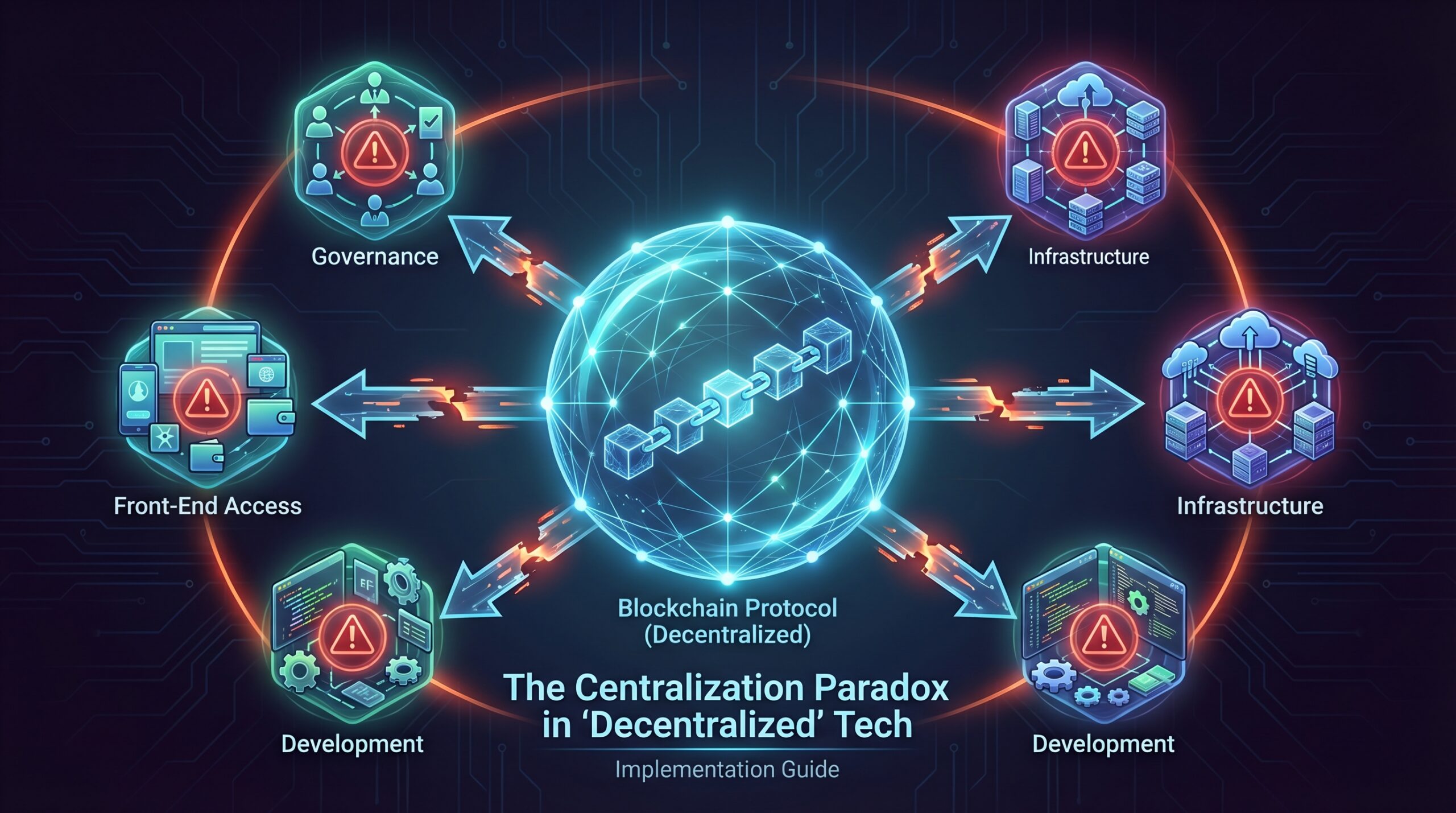
A critical nuance often missed is that technological decentralization exists on a spectrum. True technological decentralization requires vigilance across all these layers. It’s not just about the blockchain ledger; it’s about the social and infrastructural stack around it.
How the Five Types Interact and Compare
Decentralization initiatives are rarely pure. Successful reform typically involves a strategic mix of types. Understanding how they differ and overlap is crucial for design.
Decentralization vs. Related Concepts
It’s easy to confuse decentralization with similar ideas. This table clarifies the distinctions.
| Concept | Key Difference from Decentralization | Relationship |
|---|---|---|
| Distribution | A technical or spatial arrangement of parts. Lacks the intentional transfer of authority or control. | A distributed network (like a CDN) is a technical setup. Decentralization adds a governance dimension to distribution. |
| Delegation | A temporary or task-specific handing off of responsibility, usually within a hierarchy. Authority can be revoked. | Delegation is a mechanism used within administrative decentralization. It is a subset, not the whole. |
| Devolution | The specific, permanent transfer of power to a subordinate level that is politically separate. | Devolution is the strongest form of political/administrative decentralization. It implies legal autonomy. |
| Federalism | A constitutional system dividing sovereignty between central and regional governments. | Federalism is a systemic, legal framework for political decentralization. It is one way to institutionalize it. |
| Deregulation | The removal of state rules in a sector to encourage market activity. | Deregulation is a primary tool of market decentralization. It reduces state control to enable private competition. |
Synergies in Practice: The Ghana 2026-2030 Strategy
Ghana’s National Decentralisation Policy and Strategy (2026–2030) serves as a real-world case of intertwined types.
- Political: The policy aims to deepen local democracy, strengthening the mandate of District Assemblies. This is political decentralization.
- Administrative: It involves devolving more functions related to sanitation, local economic development, and basic service delivery to these assemblies. This is administrative decentralization (specifically devolution).
- Fiscal: For the above to work, the strategy must be paired with fiscal reforms—ensuring assemblies have reliable grants (intergovernmental transfers) and enhanced local revenue generation. This is fiscal decentralization.
The failure of one type undermines the others. If political power is granted without fiscal resources (a common mistake), local governments become frustrated and ineffective. If administrative tasks are devolved without building local capacity (as Vietnam’s PM highlighted), service delivery collapses. This intricate dependency also applies to areas like AI Model Deployment Tools, where successful implementation often depends on both technological infrastructure and administrative readiness within an organization.
Common Challenges, Risks, and Mistakes
Decentralization is not a panacea. It is a complex restructuring with significant potential for failure if poorly implemented. Based on global evidence up to 2026, these are the most prevalent pitfalls.
Risk Mitigation Checklist for Decentralization Projects
- Avoid Unfunded Mandates: Never legislate new local responsibilities without simultaneously legislating a clear funding mechanism (tax assignment or grant formula).
- Invest in Capacity First: Run parallel training and institutional strengthening programs for local officials before or alongside the transfer of functions. Vietnam’s 2026 focus on grassroots personnel is a direct response to this need.
- Map and Communicate Responsibilities: Create public, clear charts showing which level of government is responsible for what service to end citizen confusion.
- Build Redundancy and Oversight: In technological decentralization, audit smart contracts, promote client diversity, and avoid single points of failure in infrastructure.
- Plan for Equity: Design equalization grants (fiscal decentralization) to support poorer regions and prevent the decentralization from worsening spatial inequalities.
- Expect and Manage Resistance: Central ministries and established private monopolies will resist losing power. Plan for change management and political negotiation.
Myths vs. Facts: Grounding the Discussion
- Myth: Blockchain equals full decentralization.
Fact: Blockchain is a tool for technological decentralization, but the ecosystem around it (governance tokens, node hosting, development teams) can recentralize power. The 2026 debates around protocols like Drift highlight this ongoing tension. - Myth: Decentralization always increases efficiency.
Fact: It can lead to duplication, coordination costs, and a “race to the bottom” in regulation if not carefully designed. Efficiency gains come from competition and local knowledge, not from the act of decentralization itself. - Myth: It’s a new idea born with Bitcoin.
Fact: Political philosophers like Proudhon were advocating “federation or decentralization” in the 19th century. The early 20th century American decentralist movement responded to industrial centralization. - Myth: More decentralization is always better.
Fact: It’s a tool, not an absolute good. National defense, macroeconomic policy, and pandemic response often require strong central coordination. The key is finding the right balance for each function. This principle is vital in diverse fields, such as deciding whether to adopt AI-powered trading bot platforms with varying degrees of decentralization.
The Future of Decentralization: Trends for 2026 and Beyond
The structural shifts indicated by Pluto’s move into Aquarius (associated with networks, technology, and collective systems) and Uranus into Gemini (fast information flow) are materializing in concrete trends.
- Institutional DeFi Becomes Default: Platforms like Aave, Morpho, Uniswap, and Hyperliquid will continue to mature, moving from speculative crypto tools to integrated parts of the global financial fabric, offering transparent, programmable, and open alternatives to traditional finance.
- Hybrid Governance Models: We’ll see more experiments blending technological and political decentralization. DAOs will try to solve real-world city governance (“CityDAO” concepts), while traditional governments may pilot blockchain-based voting or asset registries.
- Focus on Interoperability: As both digital and governmental decentralized systems proliferate, the challenge will be getting them to work together. Cross-chain protocols in crypto and improved fiscal transfer mechanisms in government are two sides of the same interoperability coin. This is also a critical challenge for Composable AI Coding Stacks, where different AI modules need to communicate seamlessly.
- The Capacity Gap: The single biggest brake on administrative and fiscal decentralization will remain human capacity. Initiatives like Vietnam’s push for better grassroots personnel will become a standard pillar of any serious decentralization program.
- Regulatory Clash and Clarity: The tension between decentralized technologies and nation-state regulators will intensify. The outcome will shape whether technological decentralization grows in the open or in the shadows. Clear, smart regulation that understands the technology is the 2026 battleground.
Frequently Asked Questions (FAQs)
What is the simplest definition of decentralization?
Decentralization is the process of distributing or dispersing functions, powers, people, or things away from a central authority or location. In practical terms, it means moving control, decision-making, and service delivery closer to the end-users, whether those are citizens, consumers, or network participants.
What is the main goal of decentralization?
The main goals are to improve efficiency and responsiveness by leveraging local knowledge, to enhance democratic participation and accountability by bringing power closer to people, to foster innovation and resilience by reducing dependence on single points of failure, and in some cases, to increase competition and choice through market mechanisms.
Which type of decentralization is most important?
There is no single most important type; they are interdependent. Political decentralization without fiscal power is empty. Technological decentralization without sound governance recentralizes. For public sector reform, a balanced combination of political, administrative, and fiscal decentralization is typically necessary for success.
What is an example of decentralization in government?
A clear current example is India’s system for rural local bodies (Panchayats). The 73rd Constitutional Amendment provided political decentralization by mandating elected local councils. The national Finance Commission’s direct grants (e.g., Rs 55,909 crore in 2026-27) provide fiscal decentralization. The devolution of planning and implementation for local schemes like sanitation constitutes administrative decentralization.
How does blockchain relate to decentralization?
Blockchain is a foundational technology for technological decentralization. It is a distributed ledger that allows data to be stored and verified across a network without a central administrator. This enables decentralized applications (dApps), cryptocurrencies, and DAOs. However, blockchain is a tool—its use does not automatically guarantee full decentralization, as seen in debates over governance centralization in some crypto projects. This complexity extends to how we deploy LLM models with Docker, balancing ease of deployment with the need for distributed control.
What are the disadvantages of decentralization?
Key disadvantages include potential for increased inequality between rich and poor regions, coordination challenges and duplication of efforts, a risk of local elite capture or corruption, bureaucratic delays during transition (as seen in Portuguese municipalities), and the possibility of fragmented standards and policies that hinder national cohesion.