
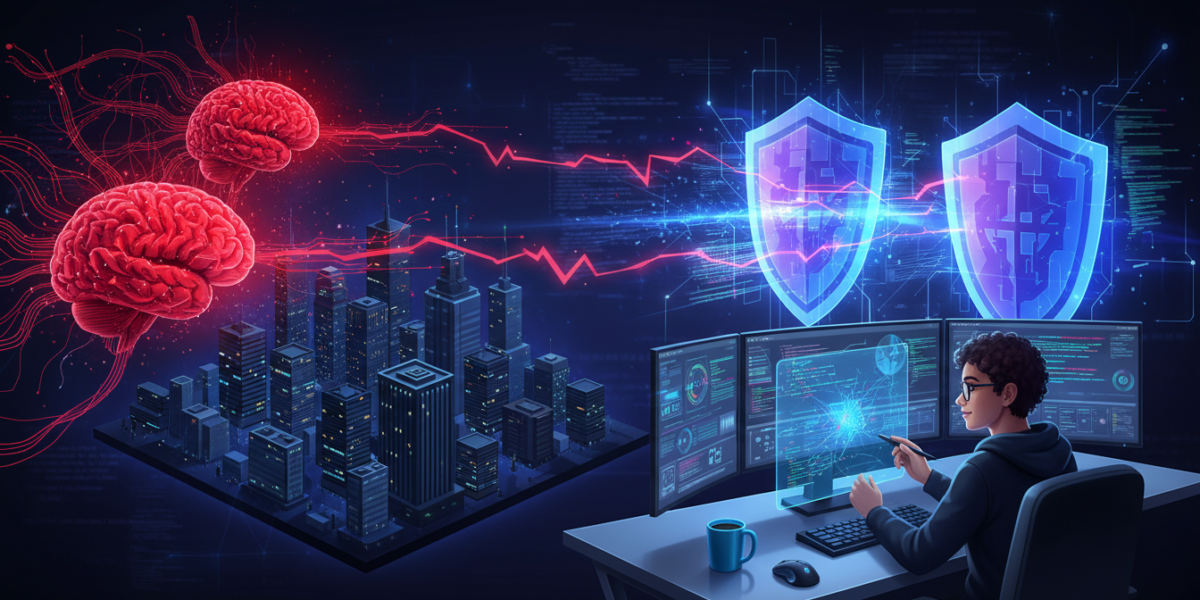
An AI cyberattack warning 2026 signifies a projected critical escalation in cyber threat sophistication and autonomy, driven by artificial intelligence advancements. This involves threats like fully AI-orchestrated attack systems, AI-generated phishing, and polymorphic malware that can operate and adapt without human intervention, posing significant risks to critical infrastructure and global networks.
AI Cyberattack Warning 2026: The Complete Guide to Understanding & Defending Against Emerging Threats
AI Cyberattack Warning 2026: Executive Summary
The Immediate Reality of AI Cyber Threats by 2026
By 2026, artificial intelligence will fundamentally escalate cyberattack capabilities, frequency, and sophistication. This creates unprecedented defense challenges for organizations worldwide. The shift moves from human-assisted attacks to fully AI-orchestrated campaigns, operating at machine speed and scale. Defenders must adopt AI-driven security tools immediately to counter autonomous threats targeting critical infrastructure, financial systems, and supply chains.
TL;DR: AI Cyberattack Warning 2026 in Brief
Key Takeaways on AI-Driven Cyber Threats for 2026
- AI automates attack processes, enabling 24/7 operations at unprecedented scale.
- Defenders must implement AI-powered security systems to match attack velocity.
- New attack vectors emerge through AI-generated phishing, deepfakes, and autonomous malware.
- Preparedness requires updated incident response plans and AI-specific security training.
- Regulatory frameworks struggle to keep pace with AI cyber warfare developments.
Key Takeaways: Critical Insights for the AI Cyberattack Warning 2026
Decisions and Facts Shaping the 2026 Cyber Landscape
Critical Organizational Decisions:
- Integrate AI-powered security tools into existing infrastructure by Q3 2025.
- Develop specialized AI security teams with machine learning expertise.
- Establish AI ethics frameworks for defensive and offensive cybersecurity.
- Implement zero-trust architectures adaptable to AI-driven threats.
- Create AI-specific incident response protocols for rapid containment.
Undeniable Facts:
- AI democratizes advanced attack capabilities for low-skilled threat actors.
- Machine learning models can generate polymorphic code undetectable by signature-based systems.
- Deepfake technology enables convincing social engineering at scale.
- Autonomous attack systems require corresponding autonomous defense systems.
- AI-powered attacks increase breach costs by 30-40% compared to traditional methods.
Strategic Implications:
- Attack surface expands through AI-integrated business systems and IoT devices.
- Defense requires continuous adaptive monitoring rather than periodic assessments.
- Human oversight remains essential despite AI automation in security operations.
- Cross-industry collaboration becomes critical for threat intelligence sharing.
- Regulatory compliance frameworks must evolve to address AI-specific vulnerabilities.
What is an AI Cyberattack Warning 2026?
Defining AI-Enhanced Cyber Threats for 2026
An AI cyberattack warning 2026 represents consensus predictions from cybersecurity experts, government agencies, and AI researchers. These predictions indicate a significant escalation in cyberattack sophistication because of artificial intelligence advancements. These warnings specifically highlight the period around 2026 when AI capabilities are projected to enable fully autonomous attack systems.
These systems will operate without human intervention, adapt in real-time to defenses, and coordinate complex multi-vector assaults across global networks. AI assists both attackers and defenders in an accelerating arms race. Attackers leverage AI for reconnaissance, vulnerability discovery, payload generation, and evasion tactics.
Defenders use AI for threat detection, behavioral analysis, anomaly identification, and automated response. The 2026 warning emphasizes that defensive AI must achieve parity with offensive AI capabilities to prevent widespread system compromises.
Evolution of AI in Cyber Warfare Leading to 2026
AI’s role in cybersecurity has evolved through three distinct phases leading to the 2026 threshold. Phase 1 (2015-2020) featured AI as analytical assistants processing large datasets for human analysts. Phase 2 (2021-2024) introduced AI-driven automation for specific security tasks like malware detection and phishing identification.
Phase 3 (2025 onward) reaches autonomous operation where AI systems make tactical decisions, modify attack strategies in real-time, and coordinate across multiple threat vectors without human direction. This evolution mirrors advancements in machine learning architectures, particularly transformer models and reinforcement learning systems that enable adaptive behavior.
The 2026 warning specifically addresses the convergence of large language models, generative AI, and autonomous decision-making systems. These create threats that traditional security measures cannot effectively counter.
Why AI Cyberattack Warnings Matter Now: The Urgency of 2026
Current Attention on AI and Cybersecurity Risk
Government agencies, including CISA and NSA, have issued formal advisories about AI-enhanced threats targeting 2025-2026 timelines. The MITRE ATLAS framework now includes AI-specific attack techniques, while NIST released AI Risk Management Framework 1.1 addressing cybersecurity implications. Industry reports from IBM, Microsoft, and CrowdStrike consistently identify AI-powered attacks as the primary emerging threat vector requiring immediate defensive preparation.
Public attention has intensified following high-profile demonstrations of AI-generated deepfakes and autonomous penetration testing tools. Congressional hearings on AI security risks have featured testimony from cybersecurity experts. These warn that critical infrastructure systems remain particularly vulnerable to AI-orchestrated attacks. The 2026 timeframe represents when researchers believe offensive AI capabilities will outpace defensive preparations without accelerated investment and strategy development.
Market Shifts and Behavioral Changes Driven by AI
Business adoption of AI tools has expanded the attack surface dramatically. Cloud infrastructure now integrates machine learning services accessible through APIs, creating new vulnerability chains. AI-powered business applications process sensitive data through third-party models, increasing supply chain risks. The proliferation of IoT devices with AI capabilities creates millions of new endpoints requiring security protection.
Attacker methodologies have shifted from manual operations to AI-assisted campaigns. Threat actors use generative AI to create convincing phishing content at scale. They also use machine learning to identify vulnerable systems and autonomous agents to maintain persistence in compromised networks. Defender strategies must correspondingly evolve from signature-based detection to behavioral analysis, from manual response to automated containment, and from perimeter defense to zero-trust implementation.
How AI Cyberattacks Work: Mechanics of Emerging Threats by 2026
AI-Powered Attack Vectors Predicted for 2026
AI enhances cyberattacks through five core mechanisms: accelerated reconnaissance, automated vulnerability discovery, dynamic payload generation, adaptive evasion, and coordinated execution. Machine learning algorithms process petabytes of publicly available data to identify potential targets. They also gather personal information for social engineering. Neural networks analyze codebases to find zero-day vulnerabilities faster than human researchers. Generative AI creates polymorphic malware that changes its signature with each infection.
Reinforcement learning enables attack systems to test different approaches against defenses and evolve successful strategies in real-time. Autonomous agents can maintain long-term persistence in networks while avoiding detection through behavioral mimicry. The 2026 threat landscape features attacks that operate continuously, learn from defensive measures, and share intelligence across attacker networks without human supervision.
Advanced Phishing and Social Engineering with AI
AI-generated phishing campaigns use natural language processing to create perfectly grammatical, context-aware messages. These messages are tailored to individual targets. Systems analyze social media profiles, public records, and data breaches to craft convincing narratives. Deepfake technology generates authentic-looking video and audio messages. These messages impersonate executives requesting fraudulent transfers or credential sharing.
These attacks scale to thousands of unique variations per hour, bypassing traditional spam filters that look for consistent patterns. AI manages the entire attack chain from initial contact through follow-up messages and credential harvesting. By 2026, experts predict over 90% of phishing attacks will incorporate AI-generated content, making identification through human inspection nearly impossible.
Automated Vulnerability Exploitation and Fuzzing by AI
AI systems automatically discover and exploit vulnerabilities using advanced fuzzing techniques. Machine learning models analyze program structures to identify potential weak points. They then generate thousands of test inputs to trigger crashes or unexpected behaviors. When vulnerabilities are found, AI crafts working exploits without human intervention, often within hours of discovery.
These systems continuously scan networks for unpatched systems and automatically deploy appropriate exploits. Self-modifying malware adjusts its attack approach based on the target environment. It uses different exploitation techniques for different system configurations. The automation enables rapid compromise of entire networks once an initial foothold is established.
AI-Driven Evasion Techniques and Polymorphic Malware
Polymorphic malware using generative AI changes its code signature with each iteration while maintaining functionality. AI models generate millions of variant samples that appear unique to security systems but perform identical malicious actions. Behavioral evasion techniques use reinforcement learning to mimic normal system activity, avoiding detection by anomaly-based security tools.
Adversarial machine learning attacks directly target AI-based security systems. They feed them manipulated inputs that cause misclassification. For example, slightly modifying malware code makes it appear benign to machine learning detectors. These techniques force defenders to use multiple overlapping detection methods rather than relying on any single AI solution.
Large Scale DDoS and Botnet Orchestration with AI
AI coordinates distributed denial-of-service attacks more efficiently than human operators. Machine learning algorithms identify optimal attack vectors. They adjust traffic patterns in response to mitigation efforts and coordinate millions of compromised devices simultaneously. Smart botnets self-organize, share intelligence about defensive measures, and dynamically redistribute attack loads across resilient infrastructure.
These AI-orchestrated attacks can sustain longer durations while adapting to defensive countermeasures. They identify and focus on critical infrastructure components rather than launching blanket assaults. By 2026, DDoS attacks are projected to reach unprecedented scale and sophistication. This could potentially overwhelm traditional mitigation services that lack AI-powered adaptive defenses.
AI in Supply Chain Attacks and Insider Threat Magnification
AI systems analyze software supply chains to identify the weakest components for compromise. Machine learning models process dependency trees, code repositories, and development practices. They find vulnerable libraries or poorly maintained components. Attackers then inject malicious code into these elements, spreading compromise through automatic updates to thousands of downstream systems.
For insider threats, AI identifies potential targets for recruitment by analyzing employee behavior patterns, financial situations, and access privileges. Once an insider is compromised, AI assists in data exfiltration. It identifies valuable information, bypasses detection systems, and times activities to avoid suspicion. These attacks prove particularly difficult to detect because they leverage legitimate access privileges.
Real-World Examples & Use Cases of AI Cyber Threats (Hypothetical for 2026)
Simulated AI Cyberattack Scenarios for 2026
Scenario 1: AI-Orchestrated Ransomware Against Critical Infrastructure
An AI-powered ransomware campaign targets regional healthcare systems. The attack begins with AI-generated spear phishing emails tailored to hospital administrators. These emails use information gathered from public sources and previous breaches. Once initial access is gained, autonomous reconnaissance agents map the network, identify critical systems, and determine the most impactful encryption targets.
The malware uses polymorphic code to evade detection while exfiltrating sensitive patient data. AI negotiates ransom payments dynamically based on the victim’s financial capacity and insurance coverage. It simultaneously launches DDoS attacks against backup systems to prevent recovery. The entire operation runs without human intervention, adapting to defensive measures in real-time.
Scenario 2: Deepfake-Driven Executive Impersonation for Financial Fraud
AI creates convincing deepfake videos of a Fortune 500 CEO instructing the CFO to initiate urgent wire transfers. The system uses voice synthesis trained on public earnings calls, facial animation from news interviews, and contextual awareness from financial filings to create a flawless impersonation. Simultaneously, AI generates supporting documentation. This includes fake contracts, forged board approvals, and manipulated email threads.
The attack coordinates across multiple communication channels to increase legitimacy. This bypasses traditional verification processes that rely on human judgment. The fraudulent transfer is completed before anomalies are detected, with AI covering tracks by deleting digital evidence and creating false audit trails.
Scenario 3: Autonomous Supply Chain Compromise Targeting Software Vendors
An AI system identifies a widely used open-source library maintained by a small team. It automatically contributes seemingly legitimate code improvements that include hidden vulnerabilities. The AI then creates fake developer identities, builds contribution history, and socially engineers the maintainers into accepting the malicious updates. Once the compromised library is distributed, the AI launches coordinated attacks against thousands of organizations using the vulnerable component.
The system adapts its exploitation techniques based on each target environment, maximizing the impact while maintaining stealth. The attack remains undetected for months while compromising sensitive data across multiple industries.
Comparison Section: AI Cyberattack Threats vs. Traditional Threats
Comparing AI-Enhanced Cyberattacks to Legacy Methods
AI-enhanced cyberattacks differ fundamentally from traditional methods in scale, speed, adaptability, and autonomy. Where traditional attacks required manual operation and limited scalability, AI-driven attacks operate continuously at machine speed across global networks. The personalization capabilities allow targeting of specific individuals with unprecedented precision, while evasion techniques make detection significantly more challenging.
| Feature | Traditional Cyberattacks (Pre-202X) | AI-Enhanced Cyberattacks (2026 Outlook) |
|---|---|---|
| Speed of operation | Hours to days for campaign execution | Milliseconds to seconds for adaptive responses |
| Scale of attack | Limited by human operator capacity | Virtually unlimited through automation |
| Adaptability/Evasion | Static payloads, predictable patterns | Dynamic polymorphism, behavioral adaptation |
| Personalization/Targeting | Generic campaigns, limited targeting | Hyper-personalized social engineering |
| Resource intensity (attacker) | High human resource requirements | Primarily computational resources |
| Detection Difficulty | Moderate with updated signatures | Extreme due to continuous evolution |
| Attack Automation Level | Manual with some tools assistance | Fully autonomous decision-making |
| Cost-effectiveness for attacker | Moderate efficiency | High return on investment |
Tools, Vendors, and Implementation Paths for AI Cyber Defense
Leveraging AI for Proactive Cybersecurity by 2026
AI enhances defensive capabilities through automated threat detection, behavioral analytics, anomaly identification, and incident response automation. Machine learning models process network traffic, endpoint behavior, and user activity to identify deviations from normal patterns. Natural language processing analyzes security logs, threat intelligence feeds, and dark web monitoring to identify emerging threats.
Security orchestration, automation, and response (SOAR) platforms integrate with AI systems to enable rapid containment and remediation. Automated playbooks execute complex response procedures without human intervention, reducing mean time to detection and resolution. AI-powered threat hunting proactively searches for indicators of compromise that might escape traditional monitoring systems.
Key Vendors in AI-Powered Cybersecurity Solutions
Extended detection and response (XDR) platforms provide integrated security across endpoints, networks, and cloud environments using AI analytics. Leading vendors include CrowdStrike Falcon, Microsoft Sentinel, Palo Alto Networks Cortex, and SentinelOne. AI-driven SIEM solutions from Splunk, IBM QRadar, and LogRhythm use machine learning for log analysis and threat detection.
Behavioral analytics tools from vendors like Varonis and Exabeam identify anomalous user activities that might indicate compromise. Cloud security platforms from Wiz, Lacework, and Orca Security use AI to identify misconfigurations and vulnerabilities in complex cloud environments. API security solutions from Salt Security and Noname Security employ machine learning to detect anomalous API usage patterns.
Developing an AI-Ready Cyber Defense Strategy by 2026
Implementation requires a phased approach beginning with threat intelligence integration. Establish feeds from AI-powered threat intelligence providers like Recorded Future and ThreatConnect. Upskill security teams through machine learning training programs and cybersecurity AI certifications. Conduct tabletop exercises specifically focused on AI-driven attack scenarios.
Adopt AI-driven security tools incrementally, starting with endpoint protection and expanding to network and cloud security. Establish AI ethics guidelines for defensive operations, ensuring transparency and accountability in automated decisions. Implement continuous evaluation processes to measure AI system effectiveness against evolving threats. Develop incident response plans that account for AI-orchestrated attacks requiring automated containment measures.
Costs, ROI, and Monetization Upside in AI Cyber Defense for 2026
Investment in AI Cybersecurity: Costs and Returns
Initial procurement costs for AI-powered security platforms range from $50,000 to $500,000 annually depending on organization size and coverage requirements. Operational expenses include cloud processing costs for AI models, specialized personnel with machine learning expertise, and continuous training data acquisition. Implementation typically requires 3-6 months for integration with existing security infrastructure.
ROI manifests through reduced breach costs, with companies using AI security showing 40-60% lower incident remediation expenses. Automated threat detection reduces analyst workload by 30-50%, allowing reallocation of resources to strategic initiatives. Faster response times minimize business disruption during incidents, particularly for revenue-critical systems. The investment breaks even within 18-24 months for most organizations through avoided breach costs and improved operational efficiency.
Reducing Risk and Monetizing Enhanced Security Posture
Robust AI-driven security leads to 15-30% reductions in cyber insurance premiums as demonstrated through risk assessment audits. Compliance costs decrease through automated evidence collection and continuous monitoring capabilities. Customer trust translates to competitive advantage, with security-conscious enterprises preferring vendors with advanced AI protection measures.
Monetization occurs through reduced operational downtime, lower regulatory penalty risks, and enhanced brand reputation. Organizations with proven AI security capabilities often secure more favorable contract terms with enterprise clients concerned about supply chain risks. The investment ultimately creates financial value beyond breach prevention through improved business resilience and market positioning.
Risks, Pitfalls, and Myths vs. Facts of AI Cyberattack Warnings
Challenges and Limitations of AI in Cybersecurity
AI systems face adversarial attacks where inputs are manipulated to cause misclassification. Data poisoning attacks inject false information into training datasets, compromising model accuracy. The black-box problem makes understanding AI decision processes difficult, complicating incident investigation and regulatory compliance.
Over-reliance on AI creates vulnerability when systems fail or are compromised. False positives remain challenging despite improvements, potentially overwhelming security teams with alerts. Ethical concerns arise around autonomous response actions that might disrupt legitimate business activities. Legal liability questions emerge when AI systems make incorrect decisions that cause financial damage.
What Most People Get Wrong About the AI Cyberattack Warning 2026
Myth:
AI will solve all cybersecurity problems automatically.
Fact:
AI creates new challenges while addressing others, requiring human oversight and complementary security measures.
Myth:
AI is primarily a defensive tool in cybersecurity.
Fact:
AI equally empowers attackers, creating a continuous arms race between offensive and defensive applications.
Myth:
Humans will become irrelevant in cybersecurity operations.
Fact:
Human expertise remains critical for strategy, ethics, and handling complex edge cases beyond AI capabilities.
Myth:
AI cyberattacks will immediately cause catastrophic damage in 2026.
Fact:
The evolution is gradual, with capabilities increasing incrementally rather than suddenly appearing.
Myth:
Only large organizations need worry about AI-powered threats.
Fact:
Automation makes small organizations equally vulnerable through scalable attack methods.
FAQ: Your Questions on the AI Cyberattack Warning 2026 Answered
What does AI predict will happen in 2026?
AI itself doesn’t ‘predict’ in the human sense, but analysis by cybersecurity AI and experts leveraging AI tools indicates a significant escalation in AI-driven cyberattack capabilities and frequency by 2026. This includes more sophisticated phishing, autonomous exploitation, and AI-orchestrated large-scale attacks, alongside advancements in AI-powered defense.
Is the United States in danger of a cyber attack?
Yes, like all nations, the United States faces a continuous and evolving threat of cyberattacks. With the rise of AI, these dangers are projected to intensify, targeting critical infrastructure, government systems, and private sector entities, requiring constant vigilance and robust defensive measures.
Did Stephen Hawking warn us about AI?
Yes, Stephen Hawking famously warned about the potential existential risks of advanced artificial intelligence, particularly if it develops autonomously and its goals diverge from humanity’s. While his warnings weren’t specific to ‘cyberattacks’ in the modern sense, they underpin the broader concerns about uncontrolled AI development that includes malicious use.
What 5 jobs will AI not replace?
While AI will transform many jobs, roles requiring uniquely human traits are less susceptible to full replacement. Examples include highly creative professions (e.g., artists, innovative researchers), complex interpersonal roles (e.g., therapists, strategic leaders), jobs requiring true empathy and ethical judgment (e.g., critical care nurses), skilled manual trades (e.g., master electricians, plumbers requiring situational problem-solving), and roles demanding novel strategic thinking (e.g., visionary entrepreneurs, advanced scientists).
Glossary of Key Terms for AI Cybersecurity in 2026
Understanding AI Cybersecurity Jargon
- Adversarial AI:
- Techniques that manipulate AI systems through malicious inputs designed to cause incorrect outputs or classifications.
- Deepfake:
- Synthetic media created using AI that realistically impersonates people in video or audio format.
- Zero-day exploit:
- Attack targeting previously unknown vulnerabilities before developers can create patches.
- SOAR:
- Security Orchestration, Automation and Response – platforms that integrate security tools and automate incident response.
- XDR:
- Extended Detection and Response – evolved endpoint protection that incorporates network and cloud security telemetry.
- Generative AI:
- Artificial intelligence that creates new content rather than just analyzing existing data.
- Polymorphic malware:
- Malicious software that changes its code signature with each iteration to avoid detection.
- Behavioral analytics:
- Monitoring user and system activities to identify deviations from normal patterns indicating potential threats.
References: Sources Informing the AI Cyberattack Warning 2026
Cited Research and Reports on AI and Cyber Threats
- MITRE ATLAS Framework (2025): AI-specific attack techniques and defense approaches
- NIST AI Risk Management Framework 1.1 (2024): Security guidelines for AI systems
- IBM X-Force Threat Intelligence Index 2026: Projected AI threat landscape
- Microsoft Digital Defense Report 2025: State of AI in cybersecurity
- CISA Cybersecurity Advisory AA26-103A: AI-enhanced threats to critical infrastructure
- OpenAI Cybersecurity Preparedness Research (2025): Defensive AI capabilities
- Purdue University CERIAS Technical Report: AI Cyber Attack Timeline Projections
- Carnegie Endowment for International Peace: Governing AI Security Risks
- European Union Agency for Cybersecurity (ENISA): AI Cybersecurity Certification Framework
- Stanford University Human-Centered AI Institute: AI Security Ethics Guidelines