

China Orders Meta to Unwind Manus AI Acquisition
China has ordered Meta Platforms, Inc. to unwind its $2 billion acquisition of AI startup Manus, a Singapore-based company with Chinese founders. This move, announced by Chinese regulators on April 27, 2026, blocks a deal intended to bolster Meta’s work on agentic AI and reflects escalating geopolitical tensions and China’s efforts to prevent technology leakage. The unwinding mandate, a direct and forceful intervention in a cross-border M&A, signals a new chapter in China’s enforcement of its national security and anti-monopoly laws.
The Manus-Meta Acquisition Unwound (Key Highlights)
- China’s National Development and Reform Commission (NDRC) has ordered Meta to unwind its $2 billion acquisition of AI startup Manus.
- Manus AI, though Singapore-based, was founded by Chinese engineers and is seen by Beijing as having ‘Chinese roots’ and ‘Chinese-founded’ technology.
- Meta acquired Manus in December 2025 to enhance its agentic AI capabilities, focused on AI tools that perform complex tasks autonomously.
- The regulatory intervention highlights China’s increasing scrutiny over foreign investments in domestic or ‘Chinese-rooted’ tech companies, especially in critical sectors like AI.
- This ‘unwind order’ signifies an aggressive stance from China, reaching beyond its direct borders to affect cross-border M&A deals.
- The decision could discourage other Chinese entrepreneurs from partnering with foreign entities, particularly from the US, due to regulatory unpredictability.
- The block underscores current geopolitical rivalries between the US and China, with technology control, specifically AI, at the forefront.
Key Takeaways: Understanding the Impact of China’s AI M&A Decision
- Geopolitics Trumps Geography: A company’s physical headquarters in a neutral jurisdiction like Singapore is no longer a shield from regulatory intervention if its founding team and core technology are viewed by Beijing as Chinese assets.
- Unwind as a New Weapon: The ability and willingness to force an unwinding of a completed or near-completed acquisition represents an escalation in China’s regulatory toolkit, moving beyond traditional pre-deal blocking to post-facto reversal.
- AI Is Now a Strategic National Resource: This case cements AI, especially emerging branches like agentic AI, as a category subject to national security-level scrutiny, similar to semiconductors.
- Meta’s Strategy Takes a Direct Hit: Meta’s plan to accelerate its agentic AI development through acquisition has been set back, forcing a return to slower internal R&D or seeking less politically sensitive targets.
- Future Investment Channels Will Freeze: Expect a sharp decline in foreign venture capital and corporate M&A interest in startups founded by Chinese nationals working in advanced technology, regardless of their registered location.
What Happened: Timeline of the Meta-Manus AI Deal and Its Collapse
This is the chronological account of the China Meta AI startup acquisition and its dramatic regulatory demise.
The Initial Meta-Manus AI Acquisition: What Was Planned?
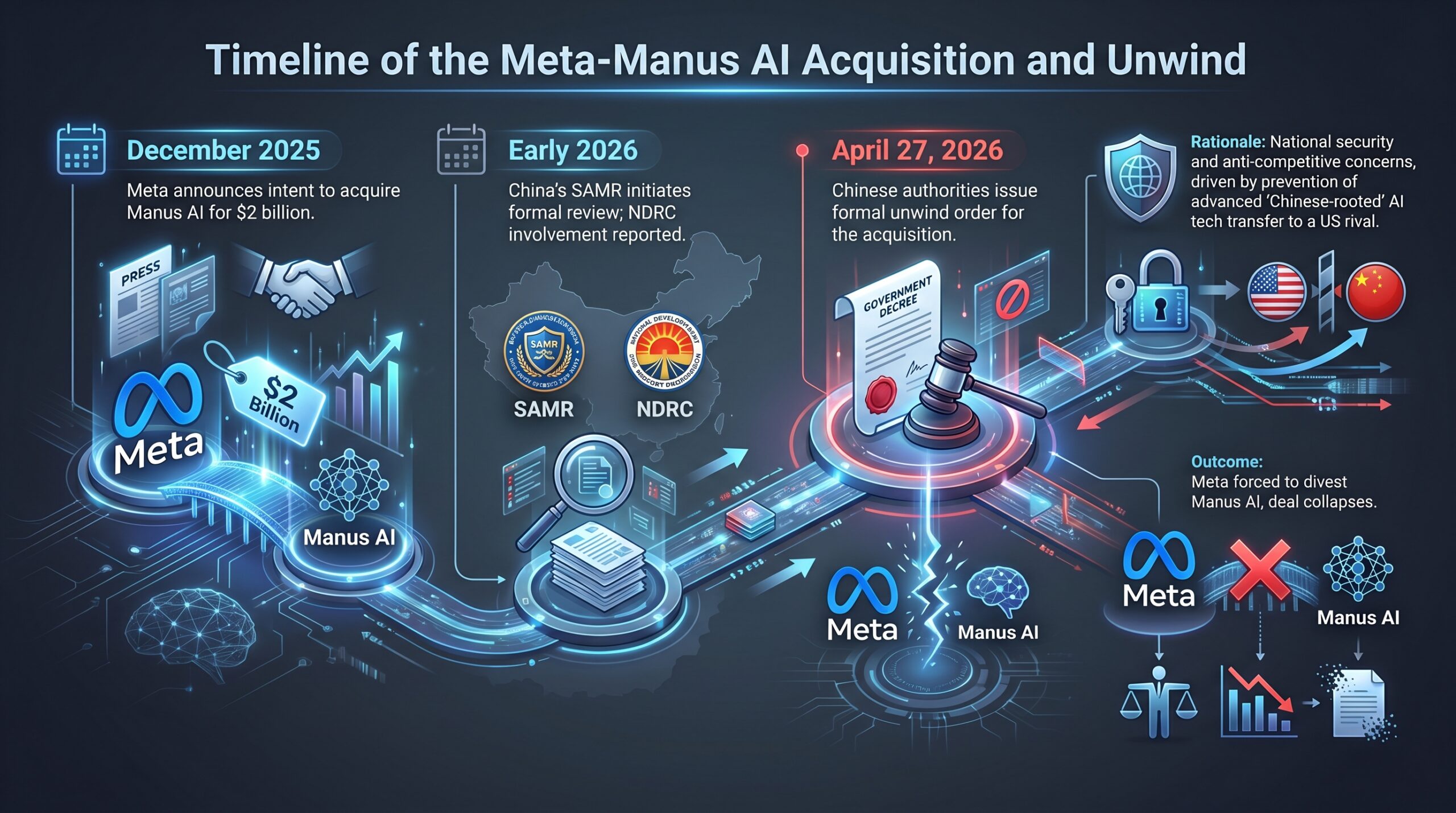
In December 2025, Meta Platforms, Inc. announced its intention to acquire Singapore-based AI startup Manus for a reported $2 billion. Meta’s primary rationale centered on securing talent and core technology in agentic AI – systems designed to act autonomously, plan, and execute complex multi-step tasks. Meta aimed to integrate these capabilities to supercharge development within its Reality Labs division and across its core social platforms, viewing agentic AI as a foundational pillar for its future metaverse and general AI ambitions. Manus AI, though legally based in Singapore, was founded by a team of top AI researchers and engineers who had previously worked at major Chinese tech firms and universities, giving it significant “Chinese roots.”
Chinese Regulatory Scrutiny: From Probe to Unwind Order
Despite the deal’s announcement, regulatory approval processes were ongoing. By early 2026, China’s State Administration for Market Regulation (SAMR), the main anti-monopoly body, initiated a formal review. Reports indicated involvement from other agencies, including the National Development and Reform Commission (NDRC), due to the deal’s strategic implications. On April 27, 2026, Chinese authorities issued a formal order mandating the unwinding of the acquisition. The primary stated grounds were risks to national security and potential anti-competitive effects, but the underlying driver was unmistakable: preventing the transfer of advanced, “Chinese-founded” AI capabilities to a major American tech rival.
Why This Matters Now: Geopolitical Chess and the AI Race for China’s Future
This news is critical because it crystallizes a shift from theoretical risk to tangible enforcement in the global AI race.
Escalating US-China Tech Rivalry and AI Control
The Manus unwind is a direct escalation in the US-China tech cold war. China’s move demonstrates it views AI not just as a commercial technology but as a sovereign capability vital to economic and military power. By blocking Meta, China is asserting control over what it deems its national AI talent pool, effectively weaponizing its regulatory framework to slow a competitor’s progress. This mirrors, but also inverts, US actions through the Committee on Foreign Investment in the United States (CFIUS), turning the tables on American tech giants.
Precedent for Cross-Border AI Acquisitions Involving Chinese Talent
This decision sets a stark precedent. Any foreign company—be it an American Big Tech firm, a European industrial giant, or a Japanese conglomerate—eyeing a startup with significant Chinese talent must now assume the deal could be blocked or unwound by Beijing. It signals China’s willingness to exert ‘long-arm’ jurisdiction, redefining corporate nationality by founder origin rather than legal registration. For Meta, it means a significant hole in its global AI acquisition strategy and a need to reassess its approach to sourcing top-tier AI talent worldwide.
The Mechanics of an ‘Unwind Order’: How China Blocks AI Mergers
Understanding the step-by-step mechanics of this regulatory action is essential for assessing future risk.
Legal Framework: China’s Anti-Monopoly and National Security Laws
The order is grounded in China’s Anti-Monopoly Law (AML) and the broadly defined National Security Law. SAMR uses the AML to review concentrations of undertakings that could eliminate or restrict competition. More powerfully, the National Security Law provides a catch-all justification for interventions in economic activities deemed to affect China’s security interests. These laws grant regulators immense discretion, especially when applied to “Critical Information Infrastructure” operators and sectors deemed strategic, a category AI now squarely inhabits.
Process of Divestiture for the Manus-Meta Deal
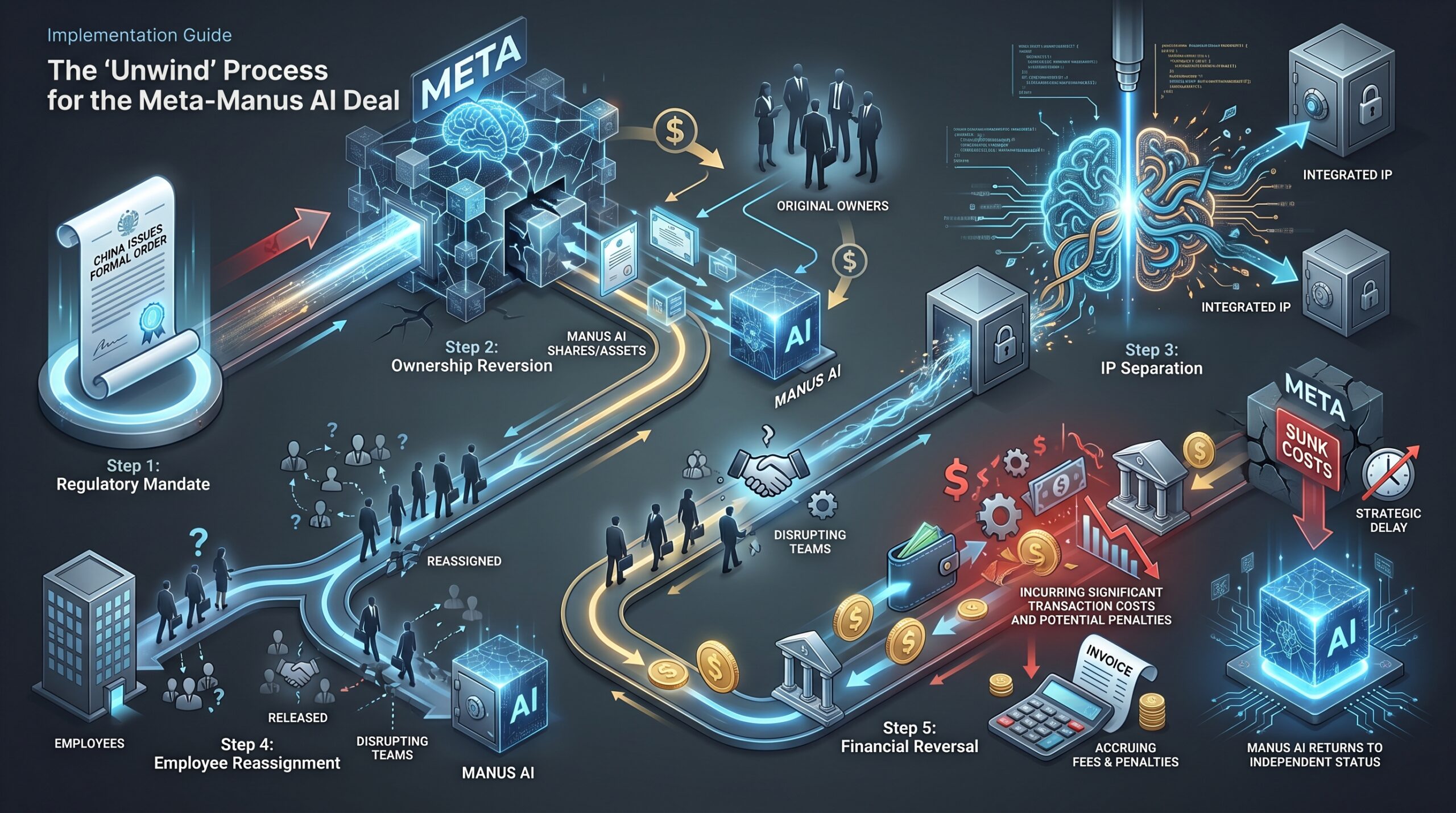
An ‘unwind’ or divestiture order is operationally complex. It requires Meta to legally and physically separate all integrated assets. This includes:
- Transferring ownership of Manus shares or assets back to the original entity.
- Separating any comingled intellectual property.
- Reassigning or releasing employees who had begun integration into Meta’s structure.
- Unwinding financial transfers and potentially paying back any acquisition funds.
For Manus AI, this means re-establishing itself as an independent company, a process that can be destabilizing and harm morale, while Meta must absorb the costs of a failed integration and lost time.
Financial Implications of Blocking a China Meta AI Acquisition
The financial fallout is multi-layered:
- Meta’s Direct Costs: All deal-making expenses (legal, advisory, due diligence) are sunk costs. There may be contractual break-up fees or fines imposed by regulators. The $2 billion in capital earmarked for the acquisition is now idle or must be redeployed.
- Meta’s Indirect Costs: The opportunity cost of delayed AI development is substantial. Reputational damage may make it harder and more expensive to pursue other strategic acquisitions.
- Manus AI’s Position: While regaining independence, Manus loses the capital infusion, global platform, and engineering resources Meta offered. Its valuation and future funding prospects are now clouded by regulatory risk.
- Investor Losses: Venture Capitalists and early investors in Manus who expected a lucrative exit face uncertainty and a likely down-round in any future fundraising.
Case Studies: Historic Precedents of China Blocking Foreign Tech Deals
This incident is not China’s first intervention in foreign M&A, but its characteristics are unique.
Notable M&A Blocks by Chinese Regulators
- Qualcomm-NXP (2018): This is the most famous parallel. US chipmaker Qualcomm’s $44 billion bid for Dutch semiconductor firm NXP Semiconductors was ultimately abandoned after failing to receive approval from Chinese regulators (SAMR) after a prolonged review. This demonstrated China’s veto power over global semiconductor consolidation.
- Applied Materials-Kokusai Electric (2021): The US semiconductor equipment maker’s $3.5 billion deal for Japan’s Kokusai was called off after failing to secure regulatory approval from China, highlighting its influence over the equipment supply chain.
- Google-Motorola Mobility (2012): While not blocked outright, China’s conditional approval of this deal (requiring Android to remain free for five years) showed early signs of using M&A review to impose business conditions on foreign tech firms.
Comparing the Manus AI Block to Previous Cases
The Manus case differs from past blocks in three key ways:
- Post-Announcement/Post-Closing Action: Previous blocks typically occurred during the extended review period before a deal formally closed. The Manus unwind order came after the acquisition was announced and likely in its early integration phase, marking a more aggressive posture.
- Target Company Jurisdiction: Qualcomm-NXP and Applied-Kokusai involved a Dutch and a Japanese company, respectively, with clear global footprints. Manus was a Singaporean startup, testing the limits of China’s jurisdictional claim based primarily on founder nationality.
- Technology Focus: While semiconductors have long been strategic, this move explicitly elevates frontier agentic AI to the same tier of sensitivity, a formal recognition of its future importance.
Impact on Global AI M&A: East vs. West Strategies Post-Manus Unwind
This single decision will fracture the global AI M&A landscape along geopolitical lines.
Regulatory Environments for AI M&A: China vs. US vs. EU
The table below outlines the divergent regulatory priorities shaping cross-border AI deals.
| Criterion | China | United States | European Union |
|---|---|---|---|
| Primary Regulatory Focus | National Security, Technology Control, Industrial Policy | Antitrust (Competition), CFIUS (National Security) | Competition, Data Privacy (GDPR), Digital Markets Act |
| Scope of Influence (Extra-territoriality) | Increasingly broad, targeting ‘Chinese roots’ regardless of HQ | Broad, through CFIUS on foreign investment impacting US national security | Broad, for mergers affecting the EU market, irrespective of company HQ |
| Intervention Post-Announcement | Demonstrated willingness to unwind deals post-announcement | Can intervene or block at various stages through DOJ/FTC/CFIUS | Can block or impose conditions post-announcement via European Commission |
| AI as ‘Strategic Sector’ | Explicitly recognized as critical for national strategy and security | Critical infrastructure/emerging tech, reviewed by CFIUS and subject to export controls | Growing focus on AI regulation (AI Act) impacts M&A indirectly via compliance |
| Data Sovereignty Concerns | High, strict data localization and transfer rules (Cybersecurity Law, DSL) | Moderate, often tied to critical infrastructure protection, sector-specific rules | High, stringent data protection and privacy regulations (GDPR) |
Shifting Investment Appetite for Chinese AI Startups
Following this block, foreign investment in companies founded by Chinese nationals will undergo a severe reassessment. Expect:
- Dual-Track Strategies: Startups may be forced to create completely separate corporate and IP structures for “China-market” and “rest-of-world” operations from day one.
- Reduced Valuations: The “China-risk discount” will become a standard factor in valuation models for any startup with Chinese founders, depressing funding rounds.
- Brain Drain vs. Regulatory Lock-In: Some top Chinese AI talent may seek to emigrate fully to sever regulatory ties, while others may be incentivized or pressured to stay within the domestic ecosystem to contribute to China’s AI sovereignty goals.
Next Steps for Operators: Navigating the New Normal in China’s Tech Space
For corporations, investors, and startups, practical adjustments are non-negotiable.
Enhanced Due Diligence for China Meta AI Acquisition Type Deals
Pre-deal assessments must expand far beyond financials and tech.
- Founder/Team Origin Analysis: Map the citizenship, education, and prior employment history of all key personnel. Assess the depth of their ongoing ties to China.
- Geopolitical Risk Assessment: Engage consultants specializing in China regulatory affairs. Model scenarios based on escalating US-China tensions.
- Regulatory Pre-consultation: For any deal with a potential “Chinese roots” angle, consider confidential, high-level consultations with Chinese regulators before any public announcement. The feedback, even if non-binding, is invaluable.
- IP Provenance Audit: Trace the development history of core algorithms and datasets to identify any potential claims of origin or dependency on China-based resources.
Strategies for Mitigating Geopolitical Risk in AI Ventures
Geopolitical Risk Mitigation Checklist for AI Ventures
- Structure for Flexibility: Utilize joint ventures or strategic partnerships instead of full acquisitions.
- Diversify Sourcing: Actively scout talent and acquisition targets in politically stable regions (e.g., Canada, EU, Israel).
- Build Regulatory Compliance Teams: Develop in-house expertise on Chinese AML, National Security Law, and export controls.
- Plan for Unwind Contingencies: Draft detailed “reverse integration” plans and include specific clauses in M&A agreements.
- Insure Against Risk: Explore political risk insurance for forced divestitures, acknowledging potential cost and coverage limitations.
Economic Implications: Costs, ROI, and Monetization Upside Revisited for AI M&A
The financial calculus for cross-border AI deals has fundamentally changed.
Financial Fallout for Meta from the Manus AI Unwind
For Meta, the costs are layered:
- Direct Expenditures: An estimated $50-$150 million in banking, legal, accounting, and integration planning fees is likely written off.
- Strategic Delay: Meta’s roadmap for deploying advanced agentic AI across WhatsApp, Instagram, and its metaverse platforms is set back by 12-24 months, creating a window for competitors like Google (Gemini), OpenAI, and Chinese firms to gain ground.
- Capital Inefficiency: The $2 billion not spent must now be redeployed, potentially into less optimal internal R&D or smaller, piecemeal acquisitions, reducing the expected ROI from a single, transformative deal.
- Market Signal: The failure weakens Meta’s position as a consolidator of top AI talent, potentially making future acquisition targets more hesitant or demanding higher premiums.
Impact on the Broader Chinese Tech Investment Climate
The long-term impact on China’s own ecosystem is paradoxical.
- Short-Term Chill: Foreign corporate venture capital (CVC) and Silicon Valley VC flows into Chinese-founded startups will slow dramatically as the perceived exit path via acquisition by a Western giant is now fraught with danger.
- Domestic Consolidation Push: This action strongly incentivizes Chinese tech giants (Baidu, Alibaba, Tencent, ByteDance) to acquire or heavily invest in promising domestic AI startups, potentially at lower valuations due to reduced foreign competition.
- Bifurcation Acceleration: The global AI ecosystem will split further into a US-led sphere and a China-led sphere, with limited cross-pollination of talent and capital at the frontier levels, potentially slowing overall global innovation.
Risks, Pitfalls, and Myths: What This Block Isn’t (and What It Is)
Clarifying misconceptions is crucial for accurate risk assessment.
What Most People Get Wrong About China Blocking AI Deals
- Myth: This is purely economic protectionism to shield Chinese companies.
Reality: While industrial policy is a factor, the primary driver is techno-national security. The goal is not just to protect a domestic competitor but to prevent a rival geopolitical power from absorbing what China views as a strategic national asset (advanced AI talent). - Myth: Relocating a company’s HQ to Singapore or another neutral country provides immunity.
Reality: The Manus case proves this strategy is now obsolete for high-stakes tech. China’s regulatory reach is defined by founder origin and IP provenance, not corporate registration. - Myth: Once a deal is publicly announced and initial work begins, it’s too late for regulators to stop it.
Reality: The ‘unwind order’ is a powerful new tool that retroactively dismantles deals, introducing catastrophic risk long after the announcement press release.
Risks and Pitfalls for Future Cross-Border AI Acquisitions
Risk Mitigation Checklist:
- Regulatory Overreach Risk: Assume Chinese (and US) regulators will define their jurisdiction as broadly as possible. Never assume a deal is “out of scope.”
- Talent Flight Risk: Key employees at the target startup may leave during the uncertainty of a prolonged review or after an unwind order, destroying the deal’s value proposition.
- IP Stagnation Risk: During regulatory limbo, the target company may be unable to aggressively develop or license its IP, causing its technology to fall behind.
- Reputational Contagion Risk: Being associated with a blocked or unwound deal can stigmatize both the acquirer and the target in the eyes of future partners and investors.
- Collaboration Reduction Risk: The overall climate for beneficial, cross-border academic and pre-competitive industrial research in AI will deteriorate, to the detriment of global scientific progress.
FAQ
- Why did China block Meta’s acquisition of Manus AI?
- China blocked the acquisition primarily citing national security concerns and potential anti-competitive effects under its Anti-Monopoly Law. The core issue is China’s desire to prevent advanced AI technology and talent, which it views as having “Chinese roots,” from being transferred to a major US technology rival, Meta Platforms, Inc. This reflects the escalating geopolitical rivalry where AI is treated as a sovereign strategic asset.
- What is Manus AI and why was Meta interested in acquiring it?
- Manus AI is a Singapore-based artificial intelligence startup founded by engineers with backgrounds at top Chinese tech firms and universities. It specialized in agentic AI, developing systems that can autonomously plan and execute complex tasks. Meta sought to acquire Manus to rapidly integrate this cutting-edge capability into its social platforms, metaverse development (Reality Labs), and overall AI portfolio, aiming to close a competitive gap with rivals like Google and OpenAI.
- What does an ‘unwind order’ mean for the Meta-Manus AI deal?
- An ‘unwind order’ is a regulatory mandate to reverse a transaction. For the Meta-Manus deal, it means Meta must legally and operationally divest itself of Manus AI. This involves transferring ownership back, separating any integrated intellectual property, reassigning employees, and unwinding financial transactions. It is a complex, costly process that effectively restores Manus to its independent pre-acquisition state and nullifies the strategic benefits Meta sought.
- How does this block compare to previous Chinese regulatory interventions in M&A?
- It is both a continuation and an escalation. Like the blocking of Qualcomm-NXP (2018), it uses regulatory review to influence global tech consolidation. However, it breaks new ground by: 1) Targeting a startup legally based outside China (Singapore), 2) Involving a forced unwind of a deal already in motion, rather than just blocking it pre-closing, and 3) Explicitly focusing on frontier AI (agentic AI) as a sector of supreme national importance.
- What are the implications for other foreign tech companies looking to acquire Chinese AI startups?
- The implications are severe. Foreign tech companies must now treat any acquisition target with significant Chinese founding talent as high-risk, regardless of the company’s legal domicile. Deals will require exhaustive geopolitical due diligence, face a high probability of lengthy reviews or blocks, and carry the novel risk of post-acquisition unwinding. This will likely deter many acquisitions, push companies toward alternative partnership models, and accelerate the bifurcation of the global AI industry.
Glossary: Key Terms for Understanding China’s AI M&A Regulation
- Meta Platforms, Inc.: A major American multinational technology conglomerate, owner of Facebook, Instagram, and WhatsApp, actively investing in AI and the Metaverse.
- Manus AI: A Singapore-based artificial intelligence startup, founded by Chinese engineers, specializing in agentic AI development. Acquired by Meta in December 2025 for $2 billion, but the acquisition was subsequently blocked by China.
- State Administration for Market Regulation (SAMR): China’s primary anti-monopoly and market regulator, responsible for reviewing mergers and acquisitions (M&A) for competitive effects.
- National Development and Reform Commission (NDRC): A macroeconomic management agency in China that formulates industrial policy and, as seen in this case, can be involved in strategic reviews of deals affecting key sectors like AI.
- Artificial Intelligence (AI): The simulation of human intelligence processes by machines, especially computer systems. In this context, agentic AI refers to AI designed to carry out complex tasks with minimal human intervention.
- Mergers & Acquisitions (M&A): Transactions in which the ownership of companies or other business organizations are transferred or combined.
- National Security Law (China): A broad legal framework in China that can be invoked to justify government interventions in economic and technological sectors under the guise of protecting national interests.
- Anti-Monopoly Law (China): China’s statute aimed at preventing monopolistic behaviors and ensuring fair competition in the market. Frequently used by SAMR to review M&A deals.
- Geopolitical Tech Rivalry: The ongoing competition between major global powers, particularly the US and China, over technological dominance, intellectual property, and supply chains.
- Metaverse: A concept of a persistent, online 3D virtual environment. Meta Platforms is a significant investor in this space, for which advanced AI is considered essential.
References: Cited Sources for the China Meta AI Acquisition Unwind
- Reuters. (2026, April 27). China orders Meta to unwind acquisition of AI startup Manus.
- The New York Times. (2026, April 27). Beijing Blocks Meta’s $2 Billion AI Deal, Citing Security.
- Bloomberg. (2026, April 27). Meta Forced to Unwind Manus AI Purchase After China Order.
- CNBC. (2026, April 27). China moves to block Meta’s acquisition of Singapore AI firm.
- The Guardian. (2026, April 28). Meta’s $2bn AI startup deal collapses after China intervention.
- TechCrunch. (2026, April 27). China’s NDRC orders Meta to reverse Manus AI acquisition.
- BBC News. (2026, April 28). Meta AI deal blocked by China in tech rivalry escalation.
- Morning Brew. (2026, April 28). Regulatory Wrap: China Throws a Wrench in Meta’s AI Plans.