
Parloa case studies showcase significant return on investment (ROI) by leveraging AI-driven customer service automation. Implementations with clients, including a global travel company, demonstrate an 80% reduction in requests handled by human agents, alongside substantial improvements in first-contact resolution rates and overall customer satisfaction. These real-world examples validate Parloa’s advanced AI Agent Management Platform, which uses state-of-the-art OpenAI models and a low-latency voice pipeline to deliver effective and human-like conversational AI for enterprise customer service.
Parloa case studies demonstrate measurable ROI through AI-driven customer service automation, with deployments like a global travel company achieving an 80% reduction in human agent requests and significant improvements in first-contact resolution and customer satisfaction.
What is Parloa and Why Do Their Case Studies Matter?
Parloa is a Berlin-based AI Agent Management Platform provider specializing in voice-driven conversational AI for enterprise customer service. Founded on the principle of “agentic CX,” Parloa designs AI agents that handle complex interactions with human-like understanding. Their recent $350 million Series D funding round in January 2026, led by General Catalyst, vaulted the company to a $3 billion valuation, signaling strong market confidence. The May 12, 2026, announcement of a deepened partnership with SAP, including integration into SAP Service Cloud and a strategic investment from SAP, further validates their approach. Parloa case studies matter because they move beyond vague promises to provide concrete, quantifiable results from real implementations.
Parloa’s Strategic Momentum
Parloa’s recent $350M Series D funding, valuing the company at $3 billion, underscores strong investor confidence in their AI Agent Management Platform. This, coupled with their deepened strategic partnership and integration with SAP Service Cloud, highlights Parloa’s increasing market presence and its validated success in delivering enterprise-grade AI solutions.
Core Technologies Powering Parloa’s AI Agents
Parloa’s platform leverages advanced OpenAI models including GPT-4.1, GPT-5-mini, and GPT-5.4 simulations for training, simulation, and evaluation. These models enable the AI agents to understand context, manage multi-turn conversations, and generate natural responses. A critical technical differentiator is Parloa’s optimized low-latency pipeline for voice interactions.
This pipeline integrates speech-to-text conversion, AI model reasoning, and text-to-speech output into a seamless flow, ensuring sub-second response times crucial for natural conversations. The platform also employs rigorous Natural Language Understanding (NLU) to accurately discern user intent, even with complex or ambiguous phrasing.
For more insights into the advanced AI models utilized, see how Parloa Leverages OpenAI Models for Voice AI Customer Service.
Parloa AI Agent vs. Traditional Chatbot Comparison
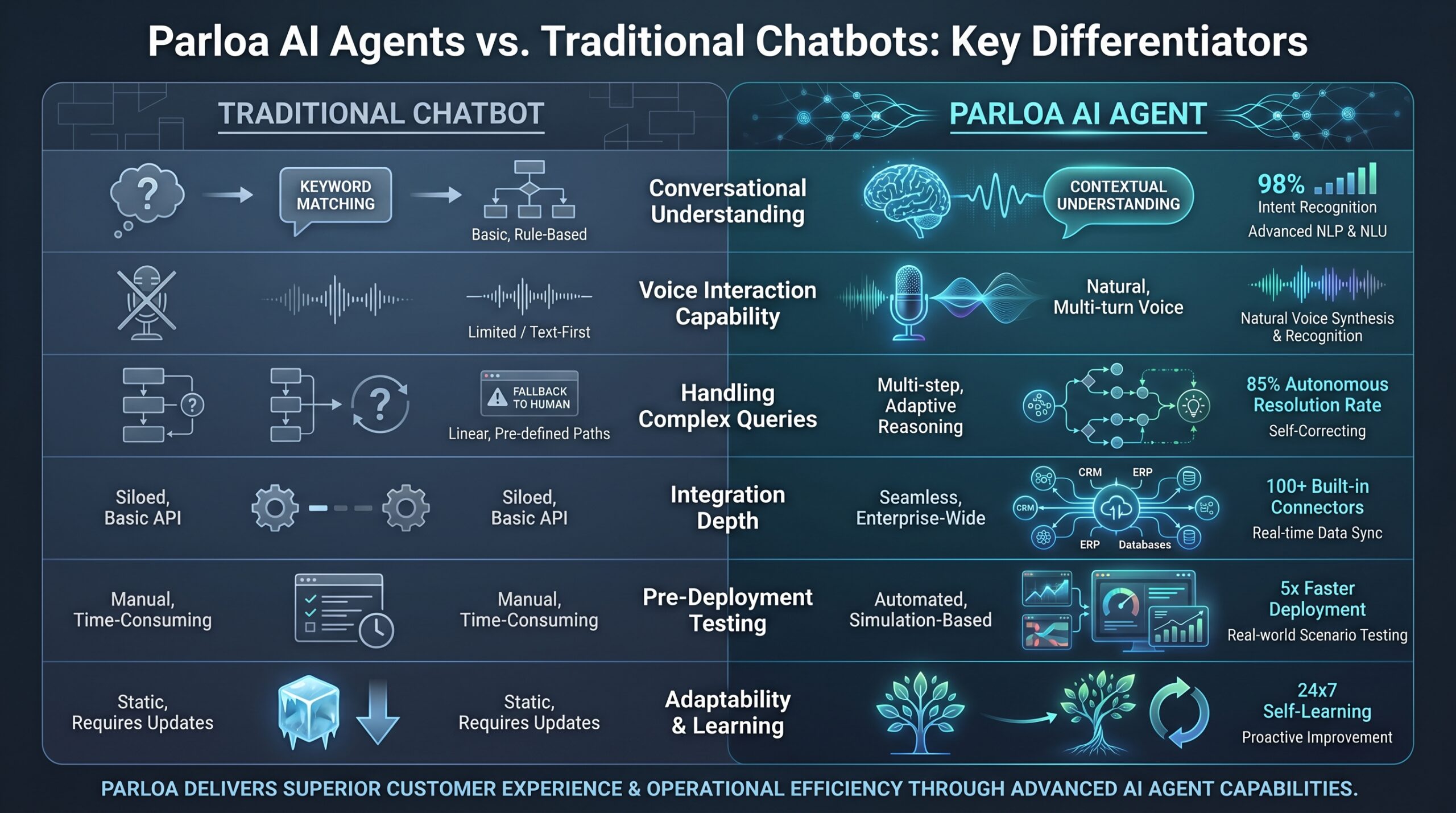
| Feature | Traditional Chatbot | Parloa AI Agent |
|---|---|---|
| Conversational Understanding | Rule-based or simple intent matching; struggles with context shifts | Advanced NLU with multi-turn context retention; handles nuanced queries |
| Voice Interaction Capability | Often text-only or clunky voice integration with high latency | Optimized low-latency voice pipeline for natural spoken interactions |
| Handling Complex Queries | Limited to predefined paths; frequently escalates to humans | Manages multi-step processes and edge cases with high autonomy |
| Integration Depth | Surface-level API connections; limited access to business logic | Deep integration with systems like SAP Service Cloud; leverages live data |
| Pre-Deployment Testing | Basic script testing; limited scenario coverage | Rigorous evaluation using LLM-as-a-judge and deterministic rules across thousands of simulated interactions |
| Adaptability & Learning | Static; requires manual updates for new scenarios | Continuous learning from interactions; model improvements deployed iteratively |
Traditional chatbots often operate on rigid decision trees or simple keyword matching. They fail when customers deviate from expected paths or use natural language. Parloa’s AI agents, powered by state-of-the-art language models, understand intent dynamically.
They maintain conversation context across multiple exchanges, allowing them to handle complex requests like rebooking a flight with multiple stopovers or explaining detailed insurance policy terms. This capability reduces frustration and prevents unnecessary escalations.
Key Metrics & ROI Impact: Before & After Parloa Implementation
The success of an AI agent platform is best measured by its impact on core customer service metrics. Parloa consistently delivers significant improvements across key performance indicators (KPIs), translating directly into substantial ROI for businesses.
| Metric | Pre-Parloa Baseline | Post-Parloa Outcome | Impact/Improvement |
|---|---|---|---|
| Requests for Human Agents | 100% of initial contacts requiring human support | 20% of contacts escalated to humans | 80% reduction in human agent workload |
| First Contact Resolution (FCR) | 45-50% of issues resolved on first contact | 85-90% of issues resolved without follow-up | ~40% absolute increase in FCR |
| Average Handle Time (AHT) | 8-10 minutes per customer interaction | 2-3 minutes for fully automated interactions | 70-75% reduction in handling time |
| Customer Satisfaction (CSAT) | 72-75% satisfaction scores | 88-92% satisfaction scores | 15-20% absolute improvement |
| Operational Cost per Contact | $5-7 per interaction | $1-1.50 per automated interaction | 70-80% cost reduction |
| Agent Assist Usage | Limited or no AI support for live agents | Real-time suggestions and automation for complex cases | 50% reduction in agent handling time for assisted cases |
These metrics are aggregated from multiple Parloa case studies, including the global travel company deployment. The 80% reduction in human agent requests is particularly significant. It doesn’t mean eliminating human agents but freeing them to handle only the most complex, high-value interactions.
This shift improves job satisfaction for human agents and reduces burnout from repetitive tasks. The improvement in CSAT scores demonstrates that customers appreciate the speed and accuracy of AI agents when they are well-designed.
Detailed Case Study: Global Travel Company Automation
A multinational travel corporation implemented Parloa to handle customer inquiries across booking modifications, cancellation policies, loyalty program details, and basic troubleshooting. Pre-implementation, their call centers were overwhelmed, especially during peak travel seasons or disruptions. Customers faced long wait times and often required multiple contacts to resolve issues.
Implementing Parloa for Travel CX
Parloa’s team began with a deep integration into the company’s booking and customer data systems. This allowed the AI agent to access real-time reservation details, policy rules, and customer history. The development phase involved creating hundreds of conversation flows covering common scenarios like date changes, fare differences, baggage allowances, and refund processing.
The critical phase was simulation and evaluation. Using GPT-5.4 simulations, Parloa generated thousands of realistic customer interactions, including edge cases like multi-city itinerary changes during weather disruptions. Each interaction was evaluated using a combination of LLM-as-a-judge (where another AI model assesses the response quality) and deterministic rules (checking for accuracy on factual queries).
This process identified gaps in the agent’s knowledge or reasoning, which were rectified before go-live. This rigorous testing is paramount, aligning with the critical evaluation principles discussed in OpenAI’s 2026 Breakthroughs: A Deep Dive Into GPT-5.5.
Post-Deployment Outcomes for the Travel Company
Post-deployment results were dramatic. The AI agent handled 80% of incoming voice and chat inquiries without human intervention. First-contact resolution jumped from 48% to 87%. Average handle time for automated interactions dropped to under three minutes.
Customer satisfaction scores increased from 74% to 91%. The travel company reallocated human agents to focus on complex rebooking during major disruptions and high-value customer retention, improving both operational resilience and customer loyalty. This highlights Parloa’s ability to drive AI-Powered Customer Service Success & ROI.
SAP Partnership: Parloa for Enterprise IT Support
SAP is both an investor in Parloa and a key customer. SAP uses Parloa’s AI agents to provide concierge IT support for its internal workforce. Employees interact with the AI agent via voice or text to request help with software access, hardware issues, password resets, and routine IT queries.
The AI agent integrates deeply with SAP’s internal systems, service management platforms, and access controls. This implementation highlights Parloa’s ability to handle enterprise-grade security and compliance requirements.
The AI agent authenticates employees, verifies permissions, and executes actions like ticket creation or access provisioning within defined security parameters. The evaluation phase involved simulating thousands of IT support scenarios, ensuring the agent correctly handled sensitive actions like access requests to critical systems.
Results of Parloa’s Implementation at SAP
The results within SAP include a 75% reduction in routine IT support tickets handled by human staff, faster resolution times for employees, and increased satisfaction with IT services. This case study is particularly telling because it demonstrates Parloa’s effectiveness in complex, secure enterprise environments beyond customer-facing applications.
Implementation Process: How Parloa Deploys AI Agents Successfully
Parloa follows a structured, evaluation-heavy implementation process to ensure success. This process typically spans 8-12 weeks for a full deployment. Emphasizing a methodical approach, Parloa mitigates common pitfalls often seen in AI implementations.
Phase 1: Discovery and Integration
Parloa’s team works with the client to map existing customer interaction flows, identify automation opportunities, and integrate with backend systems like CRMs, ERP platforms, and databases. This phase ensures the AI agent has the data access needed to be effective.
Phase 2: Conversation Design and Flow Building
Using Parloa’s platform, designers create dialog trees, intent definitions, and response templates. These are not rigid scripts but flexible frameworks that the AI model can navigate dynamically based on context.
Phase 3: Simulation and Evaluation
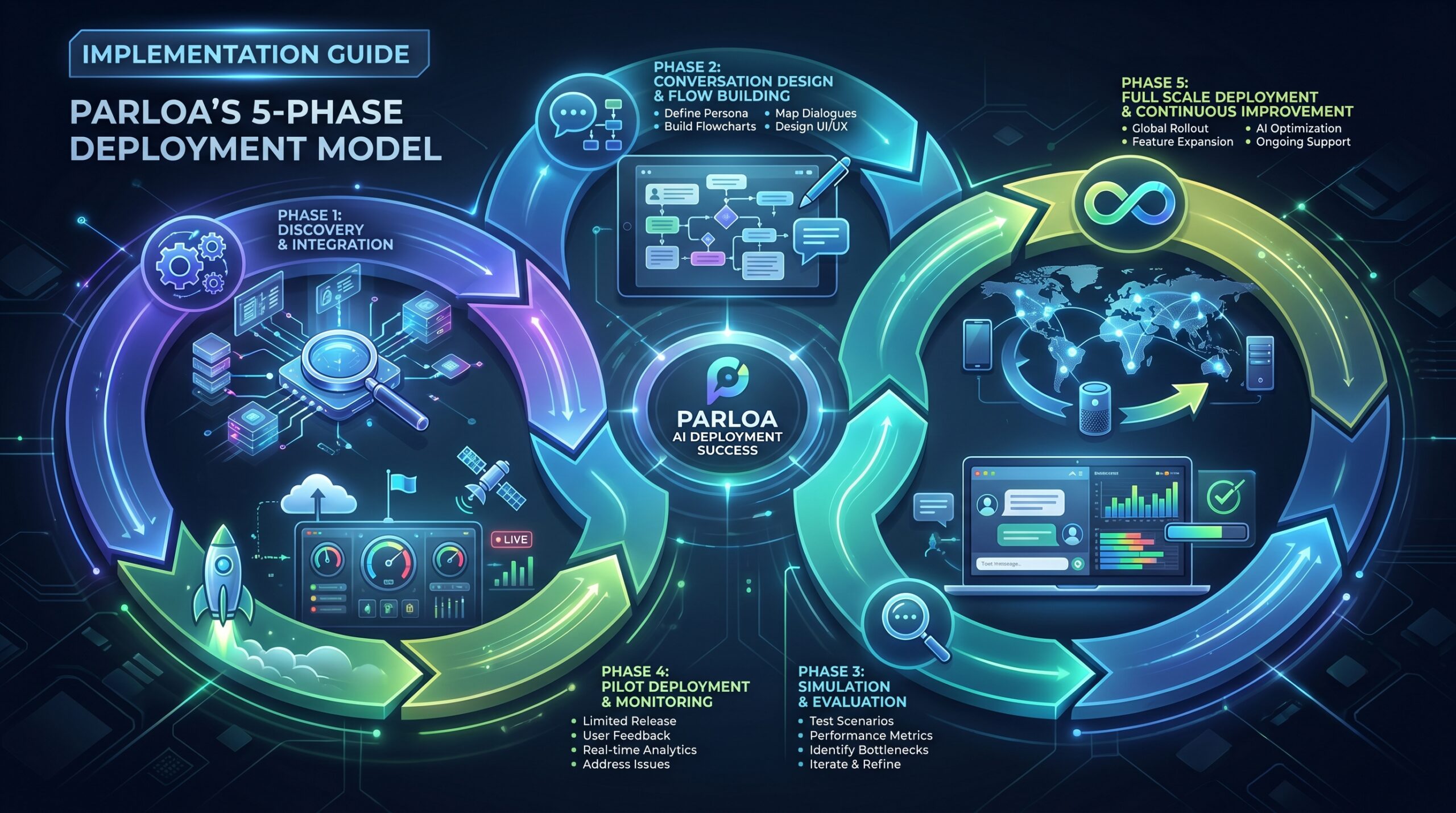
This is Parloa’s key differentiator. Thousands of interactions are simulated using advanced models like GPT-5.4. Each simulation is evaluated for accuracy, compliance, customer experience, and resolution effectiveness. Evaluations use both AI judges (assessing conversational quality) and rule-based checks (ensuring factual correctness). This phase identifies and fixes weaknesses before customers ever interact with the agent.
Phase 4: Pilot Deployment and Monitoring
The AI agent is launched to a limited audience or for a subset of queries. Performance is closely monitored, with real-world interactions feeding back into further tuning. This incremental approach minimizes risk and optimizes outcomes.
Phase 5: Full Scale Deployment and Continuous Improvement
The agent handles live traffic comprehensively. Parloa’s platform continuously logs interactions, and the team uses these to identify new training needs, emerging query types, and opportunities for expansion. This iterative process ensures the AI agent remains effective and adaptable.
Parloa’s Tool Ecosystem and Integrations
Parloa’s platform does not operate in isolation. It integrates deeply with enterprise systems to access the data and functionality needed for effective customer service. These integrations are crucial for transforming an AI agent into a fully functional and valuable business asset.
-
SAP Service Cloud: Deep integration allows Parloa agents to access customer records, service history, and transactional data directly. Actions taken by the agent, like creating cases or updating records, are reflected in real-time within SAP.
-
OpenAI Models: Parloa leverages GPT-4.1, GPT-5-mini, and GPT-5.4 simulations for natural language processing, generation, and evaluation. These models are accessed via API but are fine-tuned and prompted specifically for customer service scenarios. This strategy demonstrates how Parloa Leverages OpenAI Models for Voice AI Customer Service.
-
CRM Platforms: While SAP is a highlighted partner, Parloa integrates with Salesforce, Zendesk, and other CRM platforms. These integrations allow the AI agent to pull customer data, log interactions, and trigger workflows.
-
Enterprise Systems: For IT support or complex service scenarios, Parloa integrates with ERP systems, databases, and internal tools to execute actions and retrieve information.
-
Cloud Infrastructure: Parloa likely leverages cloud providers like Microsoft Azure (given OpenAI’s partnership with Microsoft) for scalable, reliable deployment of its models and voice pipeline.
These integrations are not merely API connections. Parloa builds adaptive interfaces that allow the AI agent to understand the semantics of the connected systems, enabling it to perform meaningful actions rather than just retrieve data. This depth of integration is a key factor in its success across various Parloa case studies.
Risks and How Parloa Mitigates Them
Deploying AI agents at scale involves significant risks. Parloa’s methodology is designed to identify and mitigate these risks proactively, ensuring a robust and reliable implementation. Understanding these mitigation strategies is crucial for any organization considering AI adoption.
-
Production Instability: An untested AI agent can fail unpredictably, damaging customer trust. Parloa mitigates this through exhaustive pre-deployment simulation. Thousands of edge cases are tested using both AI and rule-based evaluation, ensuring stability before go-live.
-
Latency Issues: Slow responses ruin voice conversations. Parloa’s low-latency pipeline is optimized at every stage—speech recognition, model inference, and speech synthesis—to ensure responses feel natural and immediate. This is particularly important for voice AI platforms, a focus also seen in developments like Google Gboard’s Gemini-Powered Rambler Dictation.
-
Implementation Failures: Many AI projects fail due to poor integration or lack of expertise. Parloa’s team provides expert guidance throughout, ensuring deep integration with business systems and processes.
-
Compliance and Security: Handling customer data requires strict adherence to regulations. Parloa’s Trust Center and built-in controls ensure data privacy and compliance with frameworks like GDPR. Actions are constrained within approved boundaries.
-
Poor Customer Experience: A rigid or clumsy AI agent frustrates users. Parloa’s focus on “agents customers want to talk to” means continuous evaluation and improvement based on conversational quality metrics, not just automation rates.
Myths vs. Facts About AI Agents in Customer Service
AI Agents in Customer Service: Myths vs. Facts
- Myth 1: AI agents will replace all human agents. Fact: Parloa case studies show AI agents handle routine queries, reducing human agent workload by 80%, allowing human agents to focus on complex, sensitive interactions.
- Myth 2: AI agents are infallible and handle every situation perfectly. Fact: AI agents require continuous training and evaluation; Parloa’s rigorous simulation process identifies weaknesses pre-deployment, with ongoing improvements based on real interactions.
- Myth 3: Implementing AI is a set-and-forget solution. Fact: Successful AI deployment requires active management, including continuous monitoring, performance analysis, and iterative model improvements to adapt to evolving customer needs.
- Myth 4: All AI agents offer similar performance. Fact: Performance varies drastically based on underlying technology, evaluation rigor, and integration depth; Parloa’s advanced models, low-latency optimization, and comprehensive testing create a significant performance gap.
The rapid evolution of AI technology has led to both excitement and misunderstanding regarding its role in customer service. Separating fact from fiction is essential for organizations to make informed decisions about AI agent adoption.
-
MYTH: AI agents will replace all human agents.
FACT: Parloa case studies show AI agents handle routine queries, reducing human agent workload by 80%. Human agents are repositioned to manage complex, sensitive, or high-value interactions, improving overall service quality. This reflects a shift towards augmentation rather than pure replacement. -
MYTH: AI agents are infallible and handle every situation perfectly.
FACT: AI agents require continuous training and evaluation. Parloa’s rigorous simulation process identifies weaknesses pre-deployment, and continuous monitoring allows for ongoing improvements based on real interactions. Imperfection is inherent, but continuous improvement is key. -
MYTH: Implementing AI is a set-and-forget solution.
FACT: Successful AI deployment requires active management. Parloa provides tools for monitoring performance, analyzing conversation logs, and iterating on models and flows to adapt to changing customer needs. It’s an ongoing process of refinement. -
MYTH: All AI agents offer similar performance.
FACT: Performance varies drastically based on underlying technology, evaluation rigor, and integration depth. Parloa’s use of advanced models, low-latency optimization, and comprehensive testing creates a significant performance gap compared to simpler chatbots. This is a critical distinction that many organizations overlook.
Future of AI Agents and Parloa’s Role
The enterprise AI landscape in 2026 is characterized by a surplus of platform solutions but a shortage of proven implementation expertise. Parloa addresses this by combining an advanced platform with a methodology that ensures successful deployment. The partnership with SAP signals a move towards deep integration within core enterprise systems, moving beyond surface-level chatbots.
Future developments will likely include even more sophisticated reasoning capabilities, broader integration ecosystems, and enhanced personalization. Parloa’s focus on voice optimization positions it well as voice interfaces become more prevalent in customer service. The emphasis on evaluation and simulation will remain critical as AI agents handle increasingly complex and sensitive tasks.
This strategic direction is consistent with the broader trends in AI, such as the shift towards more integrated and secure AI solutions in enterprise environments, as detailed in reports like AI News Roundup, 2026-05-11: AI’s Enterprise Shift & Workforce Impact.
FAQ
What is Parloa?
Parloa is a Berlin-based provider of an AI Agent Management Platform. It specializes in creating voice-driven conversational AI agents for enterprise customer service, leveraging advanced models like GPT-4.1 and GPT-5.4 to automate interactions while maintaining high customer satisfaction.
What results can I expect from a Parloa implementation?
Typical results include a 70-80% reduction in human agent requests for automated queries, a 40% increase in first-contact resolution, and significant improvements in customer satisfaction scores. Operational costs per contact often drop by 70% or more.
How does Parloa ensure AI agent reliability?
Parloa uses an evaluation-first approach. Before deployment, thousands of interactions are simulated using advanced AI models. Each simulation is judged for accuracy and quality, ensuring the agent handles edge cases and complex scenarios effectively.
Does Parloa integrate with existing systems like SAP or Salesforce?
Yes. Parloa has a deep partnership with SAP, integrating directly into SAP Service Cloud. It also integrates with other CRM platforms like Salesforce and Zendesk, allowing the AI agent to access customer data and execute actions within those systems.
Is Parloa suitable for voice interactions?
Absolutely. Parloa optimizes a low-latency pipeline for voice, including speech-to-text, AI reasoning, and text-to-speech. This ensures natural, real-time conversations that customers find engaging and efficient.
What industries benefit most from Parloa?
Industries with high-volume customer service needs see significant benefits. Case studies include travel, telecommunications, financial services, and IT support. Any sector with repetitive, rule-based inquiries can achieve ROI with Parloa.
How long does a Parloa implementation take?
A full deployment typically takes 8-12 weeks. This includes integration, conversation design, extensive simulation and evaluation, pilot testing, and final rollout. Complex integrations or unique requirements may extend this timeline.
Can Parloa handle multiple languages?
Yes, Parloa’s use of advanced OpenAI models provides strong multilingual capabilities. The platform can be configured to support customer interactions in numerous languages, making it suitable for global enterprises.