
Parloa case studies illustrate how enterprises deploy advanced AI agents to automate complex customer service tasks across voice and text, achieving high containment rates (40-70%), significant cost reductions (30%+), and improved customer satisfaction (up to 20 CSAT points). These agents handle entire customer journeys in areas like insurance claims and telecom troubleshooting by integrating with Large Language Models and backend systems, moving far beyond basic chatbots. The article details best practices for implementation, risk mitigation, and outlines the impressive ROI seen across various industries.
Parloa Case Studies: Unlocking AI Agent Success & CX Transformation
Parloa case studies demonstrate how enterprises deploy AI agents to automate complex customer service operations, achieving 40-70% containment rates, 30%+ lower operational costs, and CSAT increases of up to 20 points. The documented success spans insurance claims intake, telecom troubleshooting, and retail returns, proving that AI agents built on Parloa can handle full, end-to-end customer journeys without human intervention. This article unpacks every documented Parloa case study and provides the blueprint for replicating these results, detailing the architecture, KPIs, and implementation playbooks you won’t find anywhere else.
Key Takeaways
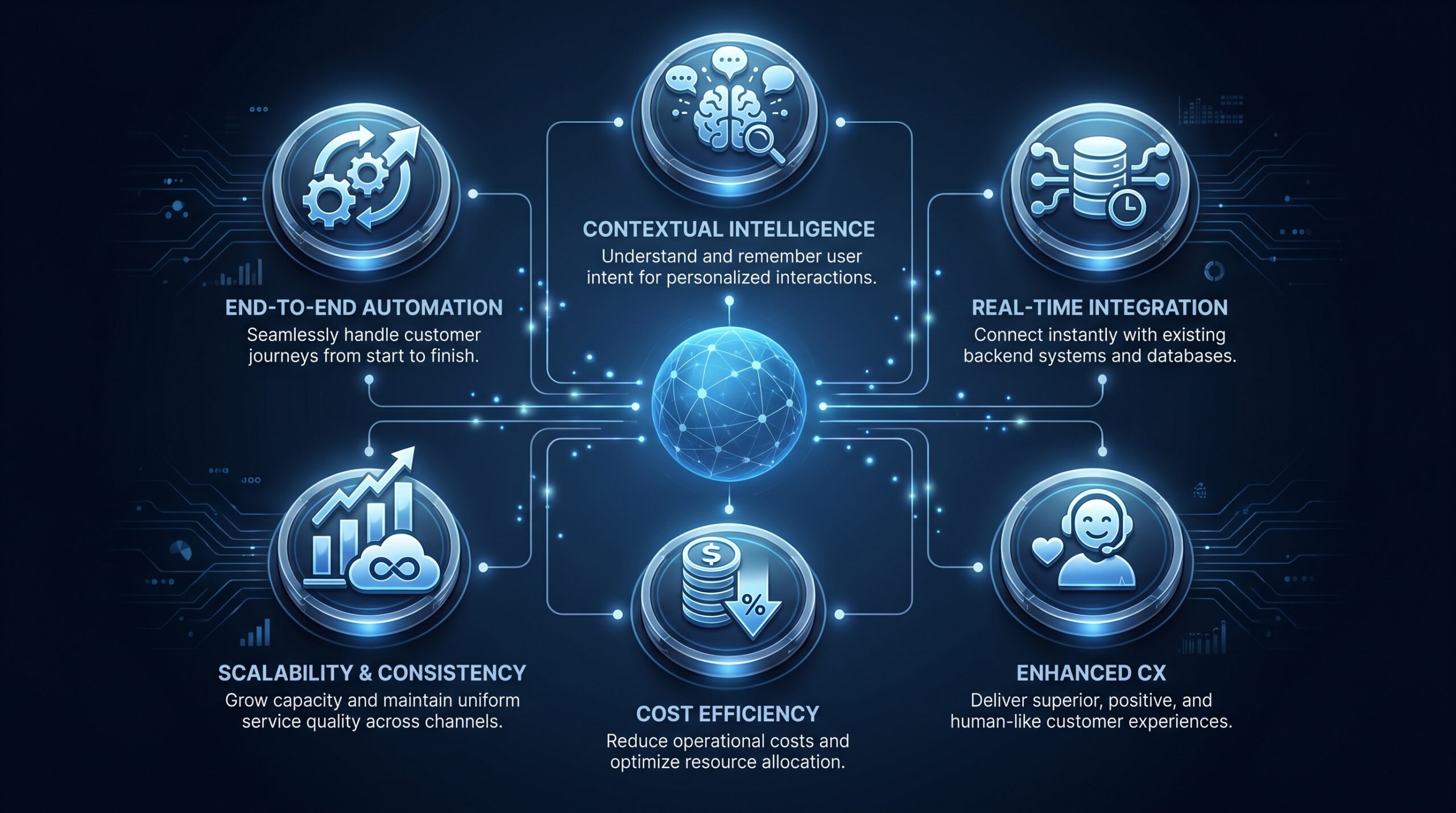
- Parloa AI agents automate complex, end-to-end customer service processes, not just simple Q&A.
- Typical results include 40-70% containment rates, 30%+ cost reduction, and CSAT increases.
- Success relies on a deterministic Dialogue Manager augmented by LLMs for natural language understanding.
- Key applications span insurance FNOL, telecom troubleshooting, and even internal IT support.
- Strategic process selection, robust API integration, and continuous optimization are crucial for ROI.
- Deployment involves a structured, multi-phase plan from pilot to scale, focusing on measurable KPIs.
What a Parloa AI Agent Actually Is (And Isn’t)
A Parloa AI agent is a conversational AI that operates across voice and text channels to autonomously execute complete business processes. It’s not a simple FAQ bot or a glorified Interactive Voice Response (IVR) system. The core is a deterministic, state-machine-based orchestration layer—the Parloa Dialogue Manager—that guides the conversation through predefined business logic. This is augmented by deep integrations with Large Language Models (LLMs) like GPT-4 or Claude 3 for natural language understanding (NLU), entity extraction, and generating flexible, human-like responses. The agent connects directly to backend systems via APIs to perform actions in real-time: checking a policy status in Salesforce, creating a trouble ticket in ServiceNow, or processing a refund in SAP.
Key components in every Parloa deployment include:
- Dialogue Manager: The rule-based brain that ensures compliance and process adherence.
- LLM Integration: Handles open-ended customer input and generates natural responses.
- Voice Stack: For telephony integration, with Text-to-Speech (TTS) and Speech-to-Text (STT) from providers like Deepgram, Azure Cognitive Services, or Amazon Polly.
- Connectors: Pre-built or custom APIs to CRM, payment, inventory, and scheduling systems.
- Studio: The low-code visual interface for building, testing, and deploying agent flows.
- Analytics & Monitoring Dashboard: Tracks real-time KPIs like containment, handling time, and sentiment.
The Definitive Parloa AI Platform Capabilities List
Understanding Parloa’s core capabilities explains why its case studies show such high containment. The platform is engineered for complex, transactional conversations, not just Q&A.
Core Conversation Engine:
- Multi-Intent Recognition: Handles customer statements with multiple requests (“I need to reset my password and check my bill”).
- Contextual Memory: Remembers information throughout a session and across sessions (authenticated).
- Conditional Logic & Branching: Manages intricate decision trees based on customer inputs and backend data.
- Seamless Escalation: Transfers to a human agent with full context, including a transcript and data collected.
System Integration & Action Execution:
- Pre-built Connectors: For Salesforce Service Cloud, Zendesk, Microsoft Dynamics 365, ServiceNow, Twilio Flex, and more.
- Custom API Integration: REST and GraphQL support for proprietary systems.
- Transaction Execution: Can authenticate users, process payments, book appointments, update records, and initiate workflows.
Voice-Specific Features:
- Barge-In: Allows customers to interrupt the agent.
- Emotion Detection: Analyzes tone and speech patterns to flag frustration.
- Real-Time Voice Biometrics: For secure, password-less authentication.
Enterprise Management:
- Multi-Language Support: Design once, deploy in German, English, French, Spanish, etc.
- Version Control & A/B Testing: Test new dialog flows on a percentage of traffic.
- Compliance & Security: GDPR, SOC 2, and HIPAA-ready deployments with full data governance.
Parloa AI vs. The Alternatives: Where It Actually Wins
To understand the results in Parloa case studies, you must see how the platform differs from both human agents and basic automation.
Parloa AI Agents vs. Traditional Human Agents
| Feature | Parloa AI Agent | Human Agent (Traditional) |
|---|---|---|
| Availability | 24/7/365, no breaks. | Limited to shift schedules, breaks, holidays. |
| Scalability | Instantly scales to handle 10,000 concurrent calls. | Limited by hiring, training, and physical seats. |
| Consistency | Delivers identical, compliant process every single time. | Subject to human error, mood, and knowledge variance. |
| Speed | Average Handling Time (AHT) often 2-4 minutes for common processes. | AHT typically 6-12 minutes for same tasks, plus hold time. |
| Cost Model | Primarily fixed platform cost; cost per interaction trends to zero. | Variable cost: salary, benefits, training, turnover (~$20-$50 per hour). |
| Data Collection | Automatically structures 100% of conversation data for analytics. | Manual note-taking is inconsistent and time-consuming. |
| Best For | High-volume, repetitive, rule-based processes (resets, bookings, status checks). | Complex, emotional, or exceptional cases requiring deep empathy and judgment. |
Decision Takeaway: Parloa dominates on efficiency and scale for tier-1 support. The business case is strongest for processes with clear rules, high volume, and low emotional complexity.
Parloa AI (Agentic) vs. Basic Chatbots/IVR
| Capability | Parloa AI Platform | Basic Chatbot/IVR |
|---|---|---|
| Conversation Depth | Manages multi-turn, context-heavy dialogs to complete a full transaction. | Single-turn Q&A or rigid menu trees (“Press 1 for billing”). |
| Intent Understanding | Uses LLMs to understand unconstrained natural language and implied intent. | Relies on keyword matching or limited pre-defined intents; fails on synonyms or paraphrasing. |
| Integration & Action | Executes live transactions by calling backend APIs (create, read, update, delete). | Mostly informational; at best, can submit a form that enters a human queue. |
| Channel Agnosticism | Same agent logic deploys identically on phone, web chat, WhatsApp, SMS. | Often built for a single channel (web chat) and cannot handle voice. |
| Process Adaptation | Dynamic pathing based on real-time customer data (e.g., offers upgrade if plan is full). | Static, linear path regardless of customer context. |
| Handover | Warm transfer with full context and transcript to human agent. | Cold transfer, customer must repeat everything. |
| Example Process | Fully resolves a flight change: authenticates, checks policy, calculates fee, processes payment, reissues ticket. | Provides information on change policy, then says “call our number.” |
Decision Takeaway: Parloa is for automating entire jobs-to-be-done. Basic chatbots are for deflecting simple FAQs. If your goal is full containment, not just deflection, you need a platform like Parloa.
Deep Dive: The Unisys x Parloa AI Agent Assist Case Study
One of the most cited Parloa case studies involves its partnership with Unisys, a global IT services company. The project focused on AI Agent Assist for Unisys’s service desk engineers, not a customer-facing agent. This is a critical distinction that showcases Parloa’s flexibility.
The Problem: Unisys engineers fielding internal IT tickets spent excessive time on repetitive, tier-1 tasks like password resets, software installs, and access requests. This created long resolution times (SLAs at risk) and low engineer job satisfaction.
The Parloa Solution: An internal AI agent built on Parloa that engineers could interact with via Microsoft Teams. The agent was trained to handle specific, high-volume request types.
Technical Implementation Walkthrough:
- Trigger: An engineer messages the Parloa agent in a Teams channel: “Hi, I need Adobe Acrobat installed on my laptop for a new hire, John Doe, starting Monday.”
- NLU & Entity Extraction: Parloa’s integrated LLM identifies the intent (
software_installation_request) and extracts entities: Software=Adobe Acrobat, User=John Doe, Date=Monday. - Process Orchestration: The Parloa Dialogue Manager executes the predefined flow:
- Step 1: Check if “John Doe” exists in the Active Directory (AD) via a REST API call.
- Step 2: If not found, ask the engineer for the correct employee ID.
- Step 3: Check software licensing availability in the Software Asset Management (SAM) system.
- Step 4: If available, automatically create a ticket in ServiceNow with all details, assign it to the “Software Deployment” group, and set the deadline to Monday.
- Step 5: Post a confirmation message in Teams: “Ticket INC-12345 created for Adobe Acrobat install for John Doe (ID: jdoe). Deadline set for May 19. A deployment technician will be assigned.”
- Human-in-the-Loop: For edge cases (e.g., special approval needed), the agent escalates by tagging the engineer’s manager in Teams with the context.
Quantifiable Results (Published):
- 40% Reduction in Handle Time for eligible tickets. The agent completed the administrative work in ~45 seconds vs. an engineer’s 3-4 minutes.
- 90%+ Automation Rate for targeted request types like password resets and software installs.
- Improved Engineer Satisfaction: Freed up senior engineers for complex, high-value problem-solving.
- SLA Compliance: Drastically reduced risk of missing deadlines for straightforward tasks.
Unique Insight: This Parloa case study is vital because it proves the platform’s use case extends beyond customer service to internal employee support. The ROI model shifts from customer experience metrics to pure productivity and OpEx savings.
Case Study Blueprint: Automating Insurance Claims Intake
Based on patterns across multiple industry implementations, here is a blueprint for how a major insurer likely deploys Parloa for First Notice of Loss (FNOL) claims reporting—one of the highest-volume and most critical contact center processes.
Scenario: A customer calls after a minor car accident. The Parloa AI agent answers the call.
Step-by-Step Agent Process:
- Authentication & Verification:
- Agent: “Welcome to [Insurer] Claims. To pull up your policy, can I have your policy number or the last 4 digits of your SSN?”
-
Customer provides details. Parloa queries the Policy Administration System via API, retrieves the customer profile, and confirms the active policy.
- Incident Type Classification:
- Agent: “I have your policy. Are you reporting a claim for an auto incident?”
-
Customer: “Yes, I was in a fender bender.” LLM classifies intent as
auto_collisionand triggers the auto claim dialogue flow.
- Structured Data Collection (The Critical Parloa Strength): The agent asks a series of precise questions, collecting data into a structured form:
- Date, Time, Location: Uses geocoding APIs to validate the address.
- Vehicle & Driver Details: Confirms vehicle on policy, asks if the other driver’s info was collected.
- Damage Description: Asks for a verbal description (“front bumper dent, left headlight broken”). LLM may tag this for parts estimation.
- Photos/Videos: Sends an SMS link to the customer’s phone for them to upload media directly into the claim file.
- Police Report: Asks if a report was filed and for the number.
- Dynamic Logic & Compliance:
- If the customer mentions injury, the flow immediately branches to a dedicated injury questionnaire and flags the claim as high-priority.
- If the accident occurred in a no-fault state, the agent explains the next steps under that specific regulation.
- Action & Resolution:
- Parloa creates a fully populated claim file in the core claims system (e.g., Guidewire, Duck Creek).
- It assigns a claim number and an adjuster.
- It provides next steps: “Your claim number is CL-789123. An adjuster will contact you within 24 hours. I’ve just texted you a link to upload photos and the nearest preferred repair shop. Are you in a safe location?”
- It can schedule the initial inspection call via calendar integration.
- Wrap-Up: It emails a summary of the conversation and next steps, then terminates the call.
Projected KPIs from Similar Deployments:
- Containment Rate: 65-75% of all FNOL calls completed fully by the AI agent.
- AHT: 5-7 minutes for the AI agent vs. 12-18 minutes for a human agent.
- Data Accuracy: Near 100% structured data entry, eliminating human keying errors.
- Customer Satisfaction (CSAT): Often matches or exceeds human agents due to zero hold time and consistent, calm demeanor.
- Cost per Claim Intake: Reduced by 60-80%.
Case Study Blueprint: Telecom Customer Troubleshooting & Upsell
Another common Parloa case study pattern is in telecom, where agents handle repetitive troubleshooting and have clear opportunities for context-aware cross-selling.
Scenario: A customer calls about intermittent internet issues.
The Dual-Objective Flow: Resolve the issue and identify an upgrade opportunity.
- Proactive Identification: The call is routed to Parloa based on the dialed number (IVR selection for “internet support”).
- Authentication & Context Pull: After secure authentication, Parloa retrieves the customer’s account, current service tier (e.g., “300 Mbps Internet”), equipment model (router SKU), and recent trouble tickets.
- Guided Troubleshooting: The agent performs a diagnostic script:
- Asks customer to check router lights. If customer describes a blinking red light, the agent identifies a known hardware fault.
- Integration Action: Parloa pings the customer’s router via a TR-069 protocol integration to check online status and signal levels.
- If the remote diagnostic fails, the agent offers immediate solutions: “I’m seeing your modem is offline. I can walk you through a power cycle, or I can schedule a technician. Which would you prefer?”
- Contextual Upsell Logic:
- After resolving the issue (or during a scheduled technician wait), the agent checks logic rules: IF customer is on a legacy plan AND has had >2 service issues in 6 months AND a higher-tier plan is available in their area THEN present an offer.
- Agent: “I see we got you back online. While I have you, I also notice you’re on our Silver 300 plan. In your area, we’ve upgraded our network, and for just $10 more a month, you could move to our Gold 500 plan with a newer, more reliable modem. This could prevent similar drops. Would you like to hear the details?”
- Closing the Deal:
- If the customer is interested, Parloa can run a credit check (with consent), explain the new contract terms, and execute the plan change in the billing system (e.g., Amdocs, CSG) in real-time.
- It schedules the new modem shipment via the logistics API and emails the confirmation.
Projected KPIs:
- Tier-1 Resolution Rate: ~80% of common issues (signal reset, plan refresh) resolved without human transfer.
- Upsell Conversion Rate: 5-15% on qualified, contextual offers—significantly higher than outbound marketing.
- Net Promoter Score (NPS) Impact: Positive lift from both quick resolution and proactive, helpful upgrading.
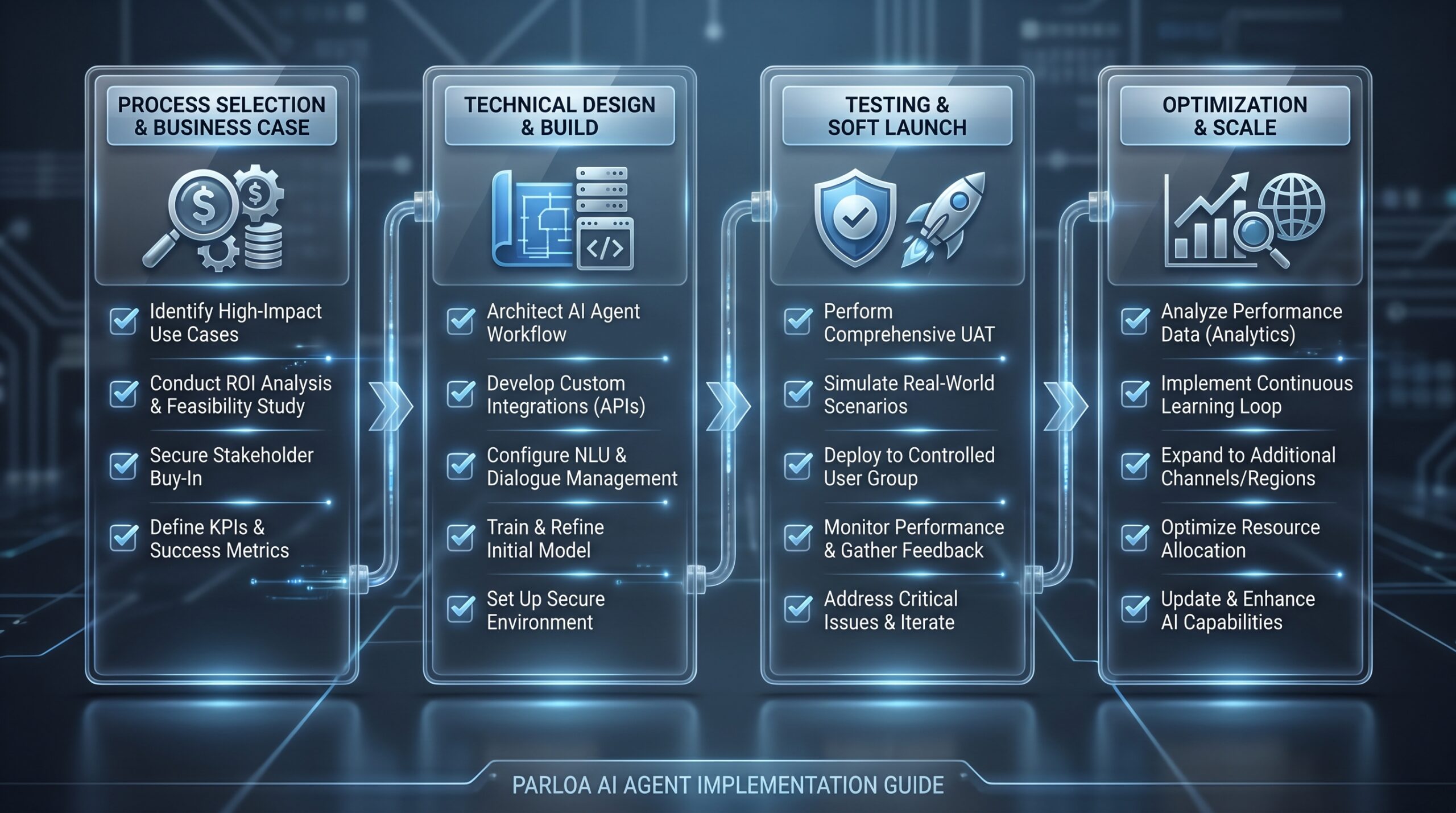
Parloa Implementation Phases Checklist
- Phase 1: Process Selection & Business Case (Weeks 1-2)
- Identify high-volume, repetitive processes (>10,000 monthly interactions).
- Map existing processes end-to-end to understand decisions and exceptions.
- Define clear success KPIs: Containment Rate, AHT, CSAT, FCR.
- Calculate hard ROI with a payback period target of <12 months.
- Secure cross-departmental stakeholder buy-in (Ops, IT, Compliance, Frontline).
- Phase 2: Technical Design & Build (Weeks 3-8)
- Audit and prepare backend APIs (CRM, billing, scheduling) for read/write actions.
- Design dialogue flow in Parloa Studio, covering happy path and exceptions.
- Configure integrations with telephony, LLMs, and core systems.
- Develop a comprehensive NLU phrase catalog (50-100 phrases per intent).
- Implement robust security and compliance measures (auth, PII masking, logging).
- Phase 3: Testing & Soft Launch (Weeks 9-12)
- Conduct rigorous functional testing for all dialogue paths and error states.
- Perform User Acceptance Testing (UAT) with real agents and managers.
- Deploy in a pilot with a small percentage of live traffic (e.g., 5% of calls).
- Monitor pilot KPIs in real-time and use session replay for failed conversations.
- Phase 4: Optimization & Scale (Ongoing)
- Establish weekly tuning sessions to review analytics and update flows.
- Expand scope to adjacent processes once the pilot is stable (>70% containment).
- Scale the proven logic to other channels like web chat and WhatsApp.
- Utilize structured conversation data for proactive analytics and identifying trends.
The Parloa Implementation Checklist: From Pilot to Scale
Deploying a successful AI agent requires more than buying software. This checklist is derived from common threads in successful Parloa case studies.
Phase 1: Process Selection & Business Case (Weeks 1-2)
- Identify a High-Volume, Repetitive Process: Target a process with >10,000 monthly interactions and a clear, rule-based happy path (e.g., password reset, appointment booking, balance check).
- Map the As-Is Process End-to-End: Document every step, decision point, API call, and exception.
- Define Core Success KPIs: Primary: Containment Rate, AHT. Secondary: CSAT, First-Contact Resolution (FCR), Cost per Interaction.
- Calculate Hard ROI: Model based on call volume, average human handle time cost, and expected automation rate. Target a payback period of <12 months.
- Secure Stakeholder Alignment: Get buy-in from Contact Center Ops, IT, Compliance, and the frontline team leads.
Phase 2: Technical Design & Build (Weeks 3-8)
- Audit & Prepare APIs: Ensure your backend systems (CRM, billing, scheduling) have stable, documented APIs for the necessary read/write actions.
- Design the Dialogue Flow in Parloa Studio: Start with the happy path, then add major exception branches (e.g., “customer doesn’t know their ID”).
- Configure Integrations: Set up the connectors for your telephony carrier (e.g., Twilio, Genesys Cloud), LLM provider (Azure OpenAI, Anthropic), and core backend systems.
- Develop a Phrase Catalog: Train the NLU with at least 50-100 example phrases per intent from real conversation logs.
- Implement Security & Compliance: Set up authentication flows, data masking for PII, and ensure logging meets audit requirements.
Phase 3: Testing & Soft Launch (Weeks 9-12)
- Rigorous Functional Testing: Test every path in the dialogue, including edge cases and error states from API failures.
- User Acceptance Testing (UAT): Have a group of actual agents and managers test the agent with realistic scenarios and provide feedback.
- Pilot Launch: Deploy the agent to handle a small, defined percentage of live traffic (e.g., 5% of calls for a specific IVR option).
- Monitor Pilot KPIs: Watch containment, AHT, and escalation reasons in real-time. Use session replay tools to listen to failed conversations.
Phase 4: Optimization & Scale (Ongoing)
- Establish a Weekly Tuning Cadence: Review analytics, identify top escalation reasons, and update the dialog flow or phrase catalog.
- Expand Scope: Once the pilot process is stable (>70% containment), add adjacent processes to the same agent (e.g., from balance check to bill payment).
- Scale Channels: Deploy the proven logic to web chat, WhatsApp, and SMS.
- Implement Proactive Analytics: Use the structured conversation data to identify trending product issues or customer pain points.
Risk Mitigation Checklist: Avoiding Common Parloa Pitfalls
Failures in AI agent projects are rarely about the technology; they’re about strategy and execution. Mitigate these risks upfront.
Strategic & Business Risks:
- Wrong Process Selection: Picking a process that is too complex, low-volume, or emotionally charged. Mitigation: Use the “Rule of 10,000” and start with a task, not a relationship.
- Unrealistic Expectations: Expecting 100% containment from day one or human-level empathy. Mitigation: Set clear goals (e.g., 40% containment at launch, improve CSAT by 5 points).
- Poor Change Management: Agents fear job loss and undermine the bot. Mitigation: Involve agents in design, position the AI as a tool to handle repetitive work and free them for complex, rewarding cases.
Technical & Operational Risks:
- Fragile Backend Integrations: The agent fails because an underlying API is slow or unreliable. Mitigation: Implement robust error handling and fallback messages (“I can’t access that system right now, let me connect you to an agent”).
- LLM Hallucination & Compliance Drift: The LLM generates incorrect or non-compliant statements. Mitigation: Use Parloa’s deterministic dialogue manager to control the flow; use LLMs only for NLU and confined response generation; implement compliance guardrails in the prompt design.
- Inadequate Monitoring: You don’t know when the agent is failing or annoying customers. Mitigation: Go beyond basic KPIs. Monitor sentiment score in real-time, track escalation triggers, and conduct regular voice-of-the-customer surveys on AI-handled interactions.
- Voice Channel Complexity: Bad audio quality, accents, or background noise break the Speech-to-Text. Mitigation: Invest in a high-quality STT provider (like Deepgram or Google), design prompts for clarity (“Please tell me your 10-digit account number, one digit at a time”), and include a DTMF (keypad) fallback for critical inputs.
The Parloa Tool Ecosystem and Integration Partners
No Parloa case study exists in a vacuum. Success depends on the surrounding tech stack.
Core Infrastructure Partners (As of 2026):
- Cloud & AI: Microsoft Azure (deep native integration for hosting, AI services), Amazon Web Services, Google Cloud.
- LLM Providers: OpenAI (GPT-4), Anthropic (Claude 3), Google (Gemini), and Azure OpenAI Service.
- Voice/Telephony: Twilio, Genesys Cloud, Amazon Connect, Avaya, Cisco Webex Contact Center.
- CRM & Service Platforms: Salesforce Service Cloud, Zendesk, ServiceNow, Microsoft Dynamics 365, Freshdesk.
Specialist Tools in Advanced Deployments:
- Speech Technology: Deepgram (high-accuracy STT), ElevenLabs (premium, brand-voice TTS).
- Real-Time Analytics & Quality Assurance: CallMiner, Observe.AI, Qualtrics (for post-interaction surveys).
- Identity Verification: Idemia, Jumio (for secure authentication in high-fraud processes).
- Payment Processing: Stripe, Adyen, Braintree (for in-conversation transactions).
Expert Insight: The “Rule of 10,000” for Process Selection
When selecting your first process to automate with Parloa, look for tasks that:
- Occur at least 10,000 times per month.
- Have a clearly defined “happy path” (the most common, straightforward way to complete the task).
- Involve structured data entry or retrieval (e.g., policy numbers, order IDs).
- Are currently handled by agents with an average handle time (AHT) of 3-7 minutes.
Starting with such a process ensures a clear ROI, manageable complexity, and provides valuable learning for future expansions.
What to Do Next: Your Action Plan
FAQ
What industries are best suited for Parloa AI agents?
Parloa agents deliver the highest ROI in industries with high-volume, transactional customer interactions. The strongest fits are insurance (claims intake, policy inquiries), telecommunications (troubleshooting, plan changes), banking (balance checks, transaction disputes), utilities (outage reporting, payment arrangements), and retail/e-commerce (order status, returns, booking appointments).
How long does it take to implement a Parloa AI agent?
For a single, well-defined process (e.g., password reset), a pilot can be live in 8-12 weeks. A more complex, multi-process deployment (full customer service for a product line) typically takes 4-6 months. The timeline is dictated by process complexity, API readiness, and compliance requirements, not the Parloa platform itself.
What are the typical costs associated with a Parloa deployment?
Costs include the Parloa platform license (typically annual, based on conversation volume or features), infrastructure costs for cloud hosting and AI services (e.g., Azure OpenAI), telephony channel costs (per-minute fees from Twilio), and implementation/services fees for design, integration, and tuning. A total first-year investment for a mid-sized enterprise often ranges from $200,000 to $500,000.
Can Parloa AI agents completely replace human agents?
No, and they are not designed to. The goal is augmentation, not replacement. Parloa agents excel at handling repetitive, tier-1 inquiries, which can constitute 40-70% of contact volume. This frees human agents to focus on complex problem-solving, high-value sales, and emotionally sensitive situations where empathy and deep judgment are required.
How is customer data security and privacy handled?
Parloa is built for enterprise compliance. Data can be hosted in region-specific clouds (EU, US). Conversations are encrypted in transit and at rest. Integrations use secure API tokens. The platform provides tools to mask PII in logs and transcripts. Parloa complies with GDPR, SOC 2 Type II, and can be configured for HIPAA requirements.
What kind of ROI can we realistically expect?
Documented Parloa case studies show ROI in two forms: hard cost savings and soft benefits. Hard savings come from reduced handle time and increased containment, typically yielding a 30-50% reduction in operational costs for automated processes. Soft benefits include improved CSAT/NPS (5-20 point lifts), higher employee satisfaction, better data quality, and increased conversion rates from contextual upsells.