
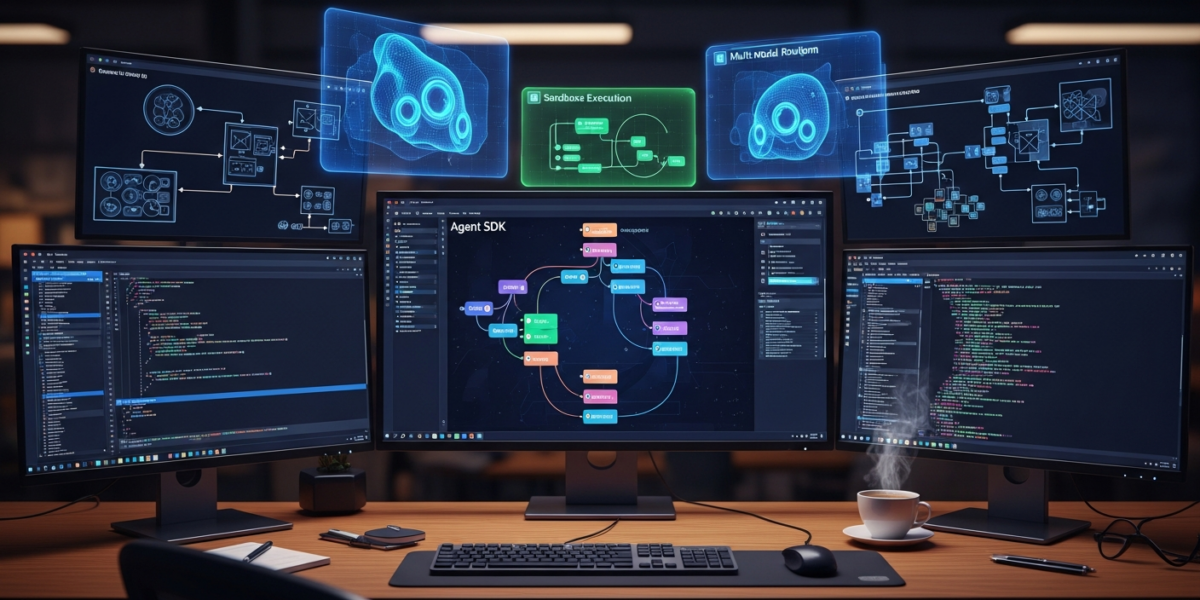
The OpenHands Software Agent SDK provides a complete toolkit for building production-ready software development agents with native sandboxed execution, multi-LLM routing, and integrated security analysis. The SDK represents a complete architectural redesign of the OpenHands framework, offering flexibility for simple implementations while supporting complex full-featured agents with custom tools and memory management.
| Released by | OpenHands |
|---|---|
| Release date | |
| What it is | SDK for building production-ready software development agents |
| Who it’s for | Developers building AI agents for software engineering |
| Where to get it | GitHub and arXiv |
| Price | Not yet disclosed |
- OpenHands Software Agent SDK offers a complete architectural redesign for building production-ready software development agents
- The SDK provides native sandboxed execution, multi-LLM routing, and integrated security analysis capabilities
- Simple interface requires only a few lines of code while supporting complex agents with custom tools
- Production deployment data shows V1 substantially reduces system-attributable failures compared to V0
- SDK connects to various interfaces including VSCode, VNC browsers, command-line interfaces, and APIs
- OpenHands SDK uniquely integrates native sandboxed execution with model-agnostic multi-LLM routing capabilities
- The toolkit provides seamless local-to-remote execution portability with integrated REST and WebSocket services
- Production deployment shows substantial reduction in system-attributable failures with negligible event-sourcing overhead
- SDK supports multiple interface types including visual workspaces, command-line interfaces, and programmatic APIs
- Architecture codifies 18 months of open-source development and production deployment lessons into validated design
What is OpenHands Software Agent SDK
The OpenHands Software Agent SDK is a comprehensive toolkit for implementing production-ready software development agents that addresses flexibility, security, and user interaction requirements. The SDK represents a complete architectural redesign of the agent components from the popular OpenHands framework for software development agents [1].
The toolkit provides a simple interface for implementing agents that requires only a few lines of code in default cases. The interface extends easily to support complex full-featured agents with custom tools, memory management, and advanced capabilities [1].
OpenHands SDK delivers seamless local-to-remote execution portability with integrated REST and WebSocket services for reliable operation. The system connects directly to various interfaces including visual workspaces like VSCode and VNC browsers, command-line interfaces, and programmatic APIs [1].
What is new vs the previous version
The OpenHands Software Agent SDK V1 represents a complete architectural redesign compared to V0, focusing on production readiness and reliability improvements.
| Feature | V0 | V1 (New SDK) |
|---|---|---|
| Architecture | Basic agent framework | Complete architectural redesign for production |
| System failures | Higher system-attributable failures | Substantially reduced system-attributable failures |
| Execution model | Limited execution options | Native sandboxed execution with local-to-remote portability |
| LLM support | Single model focus | Model-agnostic multi-LLM routing |
| Security features | Basic security measures | Built-in security analysis and integrated safeguards |
| Event sourcing | Not optimized | Negligible event-sourcing overhead |
Production deployment data demonstrates that V1 substantially reduces system-attributable failures over V0 with negligible event-sourcing overhead [1]. The new version codifies lessons from 18 months of open-source development and production deployment into an empirically validated design [3].
How does OpenHands SDK work
The OpenHands SDK operates through a modular architecture that separates concerns across execution, routing, and interface layers for maximum flexibility and reliability.
- Agent Implementation Layer: Developers implement agents using a simple interface that requires minimal code for basic functionality while supporting extensibility for complex features like custom tools and memory management [1].
- Sandboxed Execution Environment: The SDK provides native sandboxed execution capabilities that ensure secure and isolated agent operations with seamless portability between local and remote environments [1].
- Multi-LLM Routing System: Model-agnostic routing allows agents to work across different language models, providing flexibility in model selection and deployment strategies [1].
- Interface Connection Layer: The system connects to multiple interface types including visual workspaces (VSCode, VNC, browser), command-line interfaces, and programmatic APIs for diverse user interaction patterns [1].
- Security Analysis Integration: Built-in security analysis provides continuous monitoring and validation of agent operations to ensure safe execution in production environments [1].
- Service Integration: Integrated REST and WebSocket services enable reliable communication and event handling across distributed agent deployments [1].
Benchmarks and evidence
OpenHands SDK demonstrates strong performance across multiple evaluation criteria, with production deployment data validating the architectural improvements in V1.
| Metric | Result | Source |
|---|---|---|
| System-attributable failures | Substantially reduced in V1 vs V0 | [1] |
| Event-sourcing overhead | Negligible performance impact | [1] |
| Agent performance | Strong performance across multiple models and benchmarks | [1] |
| Development experience | 18 months of open-source development lessons codified | [3] |
| Production validation | Empirically validated design from real deployments | [3] |
Evaluations across multiple models and benchmarks demonstrate strong agent performance, validating the SDK’s effectiveness for production use cases [1]. The architecture represents a reference design for production agent systems based on empirical validation from real-world deployments [3].
Who should care
Builders
Software developers building AI agents for software engineering tasks benefit from OpenHands SDK’s simple implementation interface and extensibility features. The toolkit reduces development complexity while providing production-ready capabilities including sandboxed execution and security analysis [1].
Agent framework developers can leverage the SDK’s modular architecture and multi-LLM routing to build flexible systems. The seamless local-to-remote execution portability enables rapid prototyping and scaling [1].
Enterprise
Enterprise software teams require reliable agent deployment with security guarantees and operational stability. OpenHands SDK addresses these needs through built-in security analysis, substantially reduced system failures, and integrated service architecture [1].
Organizations deploying agents at scale benefit from the SDK’s production-validated architecture and negligible event-sourcing overhead. The multi-interface support enables integration with existing development workflows and tools [1].
End users
Developers using AI coding assistants gain access to more reliable and capable agents built on the OpenHands SDK foundation. The improved architecture reduces system-attributable failures that can disrupt development workflows [1].
Users working across different development environments benefit from the SDK’s support for visual workspaces, command-line interfaces, and API integrations [1].
Investors
Investment in AI agent infrastructure companies gains validation from OpenHands SDK’s production-proven architecture and substantial failure reduction. The 18-month development timeline and empirical validation demonstrate market maturity for agent technologies [3].
The SDK’s comprehensive feature set including sandboxed execution, multi-LLM routing, and security analysis represents significant technical differentiation in the agent development space [1].
How to use OpenHands SDK today
Developers can access OpenHands Software Agent SDK through GitHub repositories and begin implementation with minimal setup requirements.
- Access the SDK: Visit the OpenHands software-agent-sdk repository on GitHub to download the toolkit and review documentation [2].
- Install Dependencies: Follow the installation guide to set up the SDK environment and required dependencies for your development platform.
- Implement Basic Agent: Create a simple agent using the minimal interface that requires only a few lines of code for basic functionality [1].
- Configure Execution Environment: Set up sandboxed execution capabilities for secure agent operation with local or remote deployment options [1].
- Connect Interfaces: Integrate with preferred development interfaces such as VSCode, command-line tools, or programmatic APIs based on workflow requirements [1].
- Deploy and Monitor: Use the integrated REST and WebSocket services to deploy agents and monitor performance with built-in security analysis [1].
The OpenHands CLI provides lightweight access for terminal-based usage and integration with CI pipelines and development workflows [6].
OpenHands vs competitors
OpenHands SDK differentiates from existing agent development platforms through unique integration of production-focused features and comprehensive security capabilities.
| Feature | OpenHands SDK | OpenAI Agents SDK | Claude SDK | Google SDK |
|---|---|---|---|---|
| Sandboxed execution | Native integration | Not available | Not available | Not available |
| Multi-LLM routing | Model-agnostic support | OpenAI models only | Claude models only | Google models only |
| Security analysis | Built-in capabilities | Limited features | Limited features | Limited features |
| Lifecycle control | Comprehensive management | Basic controls | Basic controls | Basic controls |
| Interface variety | Visual, CLI, API support | API-focused | API-focused | API-focused |
| Production validation | 18 months deployment data | Limited validation | Limited validation | Limited validation |
OpenHands uniquely integrates native sandboxed execution, lifecycle control, model-agnostic multi-LLM routing, and built-in security analysis compared to existing SDKs from OpenAI, Claude, and Google [1].
Risks, limits, and myths
- Complexity Risk: While the SDK offers simple interfaces, complex agent implementations may require significant architectural understanding and development expertise.
- Resource Requirements: Sandboxed execution and multi-LLM routing may increase computational and memory requirements compared to simpler agent frameworks.
- Integration Challenges: Organizations with existing agent infrastructure may face migration complexity when adopting the new architectural patterns.
- Performance Overhead: Security analysis and comprehensive lifecycle management may introduce latency in time-critical applications despite negligible event-sourcing overhead.
- Vendor Lock-in Myth: The SDK’s model-agnostic design actually reduces vendor dependency compared to single-provider solutions, contrary to typical framework concerns.
- Production Readiness Myth: Some may assume all agent SDKs offer production capabilities, but OpenHands specifically addresses enterprise requirements that basic frameworks lack.
- Deployment Complexity: Local-to-remote portability requires proper configuration and may not be seamless in all network environments or security contexts.
FAQ
What makes OpenHands Software Agent SDK different from other agent frameworks?
OpenHands SDK uniquely integrates native sandboxed execution, model-agnostic multi-LLM routing, built-in security analysis, and comprehensive lifecycle control in a single toolkit designed for production deployment.
How much code is required to build a basic agent with OpenHands SDK?
The SDK provides a simple interface that requires only a few lines of code for basic agent functionality while supporting extensibility for complex features like custom tools and memory management.
Can OpenHands SDK work with different language models besides OpenAI?
Yes, OpenHands SDK features model-agnostic multi-LLM routing that allows agents to work across different language models, providing flexibility in model selection and deployment strategies.
What interfaces does OpenHands SDK support for user interaction?
The SDK connects to visual workspaces (VSCode, VNC, browser), command-line interfaces, and programmatic APIs, enabling diverse user interaction patterns and workflow integration.
How does OpenHands SDK ensure security in production environments?
OpenHands SDK provides built-in security analysis, native sandboxed execution for isolated operations, and integrated safeguards that continuously monitor and validate agent operations.
What evidence shows OpenHands SDK V1 improves over the previous version?
Production deployment data demonstrates that V1 substantially reduces system-attributable failures compared to V0 while maintaining negligible event-sourcing overhead for improved reliability.
How can developers access and start using OpenHands SDK today?
Developers can access the OpenHands Software Agent SDK through GitHub repositories, with documentation and installation guides available for immediate implementation and testing.
What type of applications can be built with OpenHands SDK?
The SDK enables building software development agents for tasks like code generation, testing, debugging, and workflow automation, with support for custom applications and production-scale deployments.
Does OpenHands SDK require specific infrastructure for deployment?
The SDK provides seamless local-to-remote execution portability with integrated REST and WebSocket services, supporting deployment across various infrastructure configurations and environments.
How does OpenHands SDK handle agent lifecycle management?
OpenHands SDK provides comprehensive lifecycle control capabilities that manage agent creation, execution, monitoring, and termination with built-in reliability and security features.
What performance overhead does OpenHands SDK introduce?
Production data shows negligible event-sourcing overhead, though security analysis and comprehensive features may introduce some latency depending on application requirements and configuration.
Can existing agent applications migrate to OpenHands SDK?
While the SDK represents a complete architectural redesign, its flexible interface and extensibility features can accommodate migration from existing agent frameworks, though integration complexity may vary.
Glossary
- Agent SDK
- Software Development Kit that provides tools, libraries, and frameworks for building AI agents that can perform automated tasks and interact with software systems.
- Sandboxed Execution
- Secure execution environment that isolates agent operations from the host system, preventing unauthorized access to system resources and ensuring safe operation.
- Multi-LLM Routing
- Architecture that enables agents to work with multiple different large language models, providing flexibility in model selection and avoiding vendor lock-in.
- Event-sourcing Overhead
- Performance impact from storing and processing event streams that track system state changes, used for reliability and debugging in distributed systems.
- Lifecycle Control
- Management of agent creation, initialization, execution, monitoring, and termination processes throughout the complete operational lifespan.
- Model-agnostic
- Design approach that works independently of specific AI models, allowing systems to function with different language models without requiring architectural changes.
- Production-ready
- Software that meets enterprise requirements for reliability, security, scalability, and maintainability suitable for real-world deployment.
- System-attributable Failures
- Errors or malfunctions caused by the underlying system architecture or infrastructure rather than user actions or external factors.
Sources
- Wang, Xingyao, et al. “The OpenHands Software Agent SDK: A Composable and Extensible Foundation for Production Agents.” arXiv:2511.03690, 2024. https://arxiv.org/abs/2511.03690
- OpenHands. “software-agent-sdk: A clean, modular SDK for building AI agents with OpenHands V1.” GitHub. https://github.com/OpenHands/software-agent-sdk/
- Wang, Xingyao, et al. “The OpenHands Software Agent SDK: A Composable and Extensible Foundation for Production Agents.” arXiv HTML. https://arxiv.org/html/2511.03690
- BrightCoding. “OpenHands: The AI Developer Agent That Actually Works.” BrightCoding Blog, April 17, 2026. https://www.blog.brightcoding.dev/2026/04/17/openhands-the-ai-developer-agent-that-actually-works
- OpenHands. “extensions: Public registry for OpenHands extensions.” GitHub. https://github.com/OpenHands/extensions
- OpenHands. “OpenHands-CLI: Lightweight OpenHands CLI in a binary executable.” GitHub. https://github.com/OpenHands/OpenHands-CLI
- bradAGI. “awesome-cli-coding-agents: Curated directory of terminal-native AI coding agents.” GitHub. https://github.com/bradAGI/awesome-cli-coding-agents
- OpenAI. “Agents SDK | OpenAI API.” OpenAI Developer Documentation. https://developers.openai.com/api/docs/guides/agents