
The U.S. Commodity Futures Trading Commission (CFTC) has dramatically increased its regulatory reach and efficiency by deploying Microsoft AI tools, primarily Microsoft 365 Copilot, to surveil cryptocurrency, prediction markets, and commodity derivatives. This strategic adoption, necessitated by a 20-25% staff reduction since FY2024, allows the agency to maintain and enhance oversight of rapidly evolving digital markets. Concurrently, the CFTC established an Innovation Task Force (ITF) in March-April 2026 to develop clear regulatory frameworks for crypto assets, AI, and prediction markets, aiming to provide legal certainty and foster responsible innovation.
The CFTC is actively using Microsoft AI tools, specifically Microsoft 365 Copilot and other specialized AI surveillance systems, to surveil cryptocurrency, prediction markets, and commodity derivatives. This initiative, confirmed by Chairman Michael Selig in April 2026, compensates for significant staff reductions (20-25% since FY2024) by augmenting analysts’ capabilities in data analysis, anomaly detection, and workflow efficiency. The agency also formed an Innovation Task Force (ITF) to develop future regulatory frameworks for these emerging technologies.
The U.S. Commodity Futures Trading Commission (CFTC) is actively using Microsoft AI tools, specifically Microsoft 365 Copilot, to surveil cryptocurrency, prediction markets, and commodity derivatives. This adoption is a strategic move to compensate for significant staff reductions (ranging from 20-25% since FY2024), allowing the agency to maintain and enhance its regulatory oversight capabilities in rapidly evolving digital markets.
CFTC Chairman Michael Selig confirmed the agency’s deployment on April 16, 2026. The implementation is part of a broader strategy that includes the formation of a new Innovation Task Force (ITF) in March-April 2026. This guide provides the most comprehensive analysis available on this pivotal shift in U.S. financial regulation.
Understanding the CFTC’s Mandate and Regulatory Scope
The CFTC is the U.S. federal agency responsible for regulating the derivatives markets. Its jurisdiction covers futures, swaps, and options contracts. In recent years, its authority has increasingly intersected with digital assets.
The CFTC classifies Bitcoin and Ethereum as commodities, not securities, placing many spot crypto exchanges and derivatives products firmly within its purview. This classification is critical for determining which regulatory body has oversight.
Its core mission is to promote the integrity, resilience, and vibrancy of the U.S. derivatives markets through sound regulation. This involves detecting and preventing market manipulation, fraud, and abusive practices. Market surveillance is a cornerstone of this mission, requiring the analysis of vast amounts of trading data to identify suspicious patterns.
The Staffing Crisis: Why the CFTC Turned to AI
Between FY2024 and early 2026, the CFTC experienced a dramatic workforce reduction. Public records and Chairman Selig’s statements confirm a staff cut of 20% to 25%.
This equates to a loss of several hundred employees from a body that already operated with a lean budget compared to other financial regulators like the SEC. The exodus created an urgent need for technological solutions.
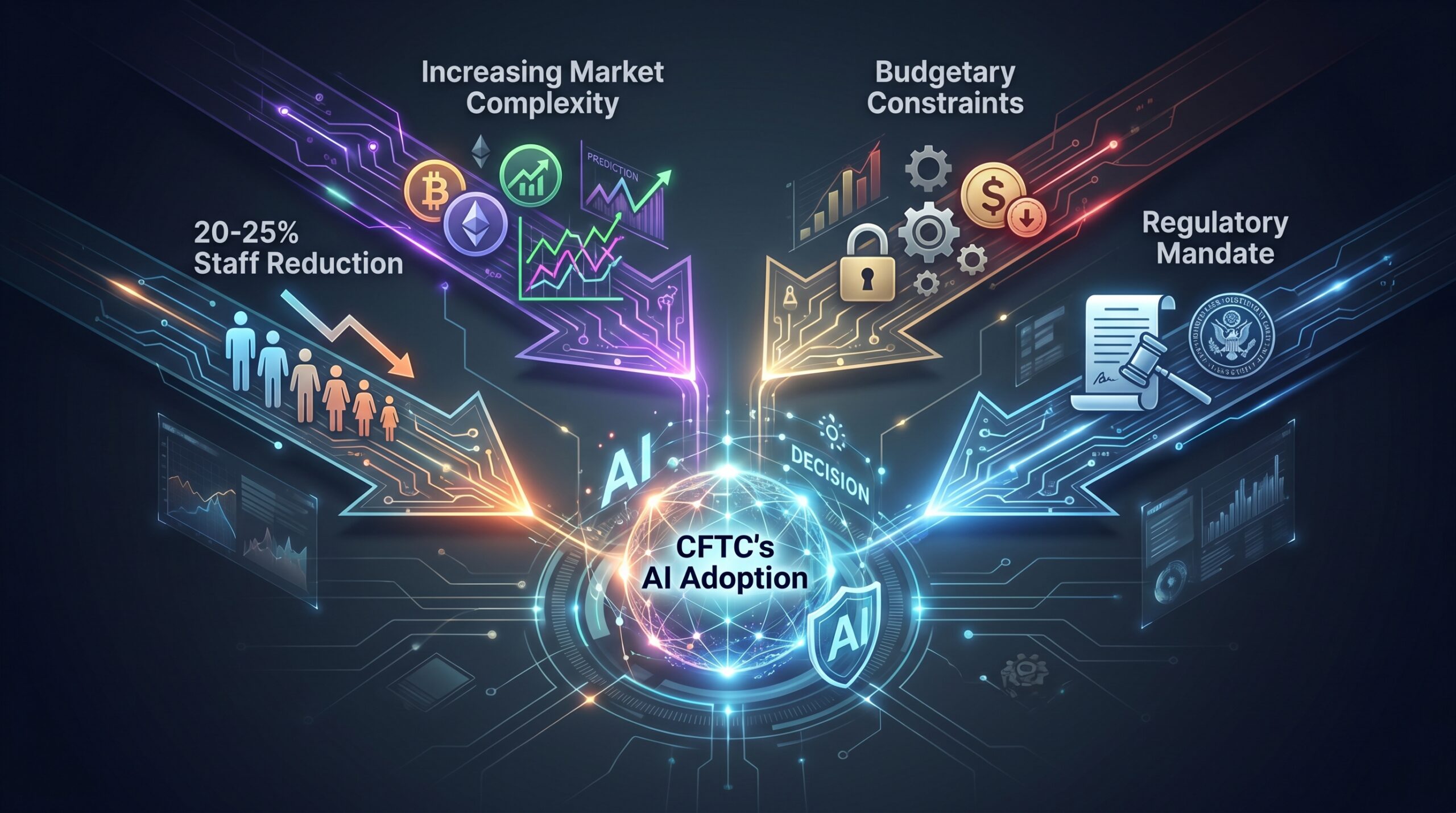
| Factor | Impact on CFTC Operations |
|---|---|
| 20-25% Staff Reduction | Reduced capacity for manual market monitoring, investigation, and enforcement. |
| Increasing Market Complexity | Crypto and prediction markets generate exponentially more data than traditional derivatives. |
| Budgetary Constraints | Limits ability to hire and train new specialists at the required scale. |
This staffing shortfall created a critical gap in the CFTC’s ability to oversee markets that are growing in both volume and complexity. Relying solely on traditional, manual review methods became untenable.
The adoption of AI was not merely an upgrade; it was a necessary step to maintain baseline regulatory function. It allowed the agency to preserve its core mission objectives with fewer resources.
The AI Arsenal: Microsoft 365 Copilot and Beyond
The CFTC’s primary AI tool is Microsoft 365 Copilot. This is an AI-powered productivity assistant integrated into the Microsoft 365 suite (Word, Excel, Outlook, Teams, etc.).
It leverages large language models (LLMs) to understand and generate language, analyze data, and automate workflows. This integration allows for seamless augmentation of existing administrative processes.
How the CFTC Uses Microsoft 365 Copilot
For the CFTC, Copilot is not a singular “surveillance bot” but a multifaceted tool that augments analysts’ capabilities in several key areas.
- Document Analysis and Summarization: Analysts can use Copilot in Word or the Copilot sidebar to quickly summarize lengthy regulatory filings, exchange reports, or internal investigation memos. This drastically reduces the time spent on preliminary research, enhancing efficiency.
- Data Synthesis in Excel: Copilot in Excel can identify trends, highlight outliers, and create pivot tables from massive datasets of trading data. An analyst can ask, “Show me all trading pairs on this exchange with a volume spike of over 500% in the last 24 hours,” and receive a formatted table, accelerating data-driven insights.
- Communication and Workflow Efficiency: In Outlook and Teams, Copilot can draft responses, summarize email threads about specific cases, and schedule follow-ups. This streamlines communication within the agency and with external entities like exchanges, fostering quicker regulatory responses.
Other AI Surveillance Tools
While Microsoft Copilot handles productivity and data synthesis, the CFTC is also deploying specialized AI surveillance tools. These are likely custom or third-party systems built with machine learning algorithms designed for financial markets.
Their functions include more granular and sophisticated detection capabilities critical for market integrity.
-
Anomaly Detection: These tools identify trading patterns that deviate significantly from established norms, such as wash trading or spoofing, which are hallmarks of manipulative behavior.
-
Network Analysis: AI can map relationships between wallet addresses and trading accounts across various platforms to uncover coordinated manipulation schemes, revealing hidden connections.
-
Pattern Recognition: Advanced algorithms flag complex manipulative strategies that are difficult for humans to spot in real-time across multiple asset classes, allowing for proactive intervention.
The Innovation Task Force (ITF): Building the Future Regulatory Framework
In parallel with deploying AI tools, the CFTC established the Innovation Task Force (ITF). Announced in Press Release 9201-26 on March 24, 2026, and staffed on April 10, 2026 (Press Release 9210-26), the ITF represents the strategic, forward-looking component of the agency’s tech pivot.
The ITF’s official mandate is to develop clear regulatory frameworks for three key areas. This marks a proactive approach to evolving market dynamics.
- Crypto Assets and Blockchain Technologies
- Artificial Intelligence and Autonomous Systems
- Prediction Markets and Event Contracts
This is significant because it moves beyond mere surveillance. The ITF is tasked with creating the “rules of the road” for innovators. This proactive stance aims to provide legal certainty, which is crucial for responsible technological development in the U.S. financial system.
Case Study: AI-Powered Surveillance in a Crypto Market Manipulation Scenario
Scenario: The CFTC’s AI systems detect a potential pump-and-dump scheme on a decentralized prediction market for a political event.
- Data Ingestion: AI surveillance tools continuously ingest order book data, trade executions, and on-chain transaction data from the prediction market platform and associated blockchain. This creates a comprehensive dataset for analysis.
- Initial Flagging: An anomaly detection algorithm flags a cluster of new wallets that simultaneously place large buy orders for “YES” contracts on a specific outcome, causing a sharp price increase. This immediate detection is crucial for timely intervention.
- Copilot-Assisted Analysis: An analyst receives the alert. They use Microsoft 365 Copilot to:
- Summarize: Quickly get a summary of the trading activity of the flagged wallets over the past 48 hours.
- Cross-Reference: Instruct Copilot in Excel to cross-reference these wallet addresses with a database of known entities from previous investigations. This helps identify repeat offenders. An analyst might also use advanced Python AI automation scripts for deeper cross-referencing.
- Draft Communications: Use Copilot in Outlook to draft a preliminary notification to the prediction market platform, requesting more information. This accelerates the inquiry process.
- Network Mapping: The specialized AI tool performs a network analysis, revealing that the seemingly independent wallets are funded from a common source and controlled by a single entity—a classic hallmark of manipulation. This provides a clear visual of the manipulation scheme.
- Human Decision: Armed with this AI-generated intelligence, human investigators at the CFTC decide to open a formal investigation, leveraging the compiled evidence to issue subpoenas. This demonstrates that human oversight remains paramount.
This workflow demonstrates how AI handles the heavy lifting of data processing and pattern recognition, freeing human experts to focus on strategic decision-making and legal action. This hybrid approach optimizes both efficiency and accuracy. Financial institutions might also leverage AI-powered trading bot platforms for their own compliance monitoring.
Comparing Traditional vs. AI-Augmented CFTC Oversight
The CFTC’s approach has shifted from a purely traditional model to a hybrid, AI-augmented one. This evolution addresses the challenges of modern, data-rich markets.
| Oversight Aspect | Traditional Method | AI-Augmented Method (Current CFTC) |
|---|---|---|
| Data Processing | Manual review of samples; time-intensive. | Automated, continuous analysis of 100% of available data. |
| Pattern Recognition | Relies on analyst experience; may miss novel or complex schemes. | Machine learning identifies subtle, cross-market patterns and new manipulation tactics. |
| Investigation Speed | Weeks or months to correlate evidence from different sources. | Hours or days to synthesize data and identify connections. |
| Scalability | Limited by human analyst headcount. | Highly scalable with computing power; can handle market growth. |
| Cost | High personnel costs. | Higher initial tech investment, but lower marginal cost per analysis. |
Risks and Challenges of the CFTC’s AI Implementation
Deploying AI in a regulatory context is not without significant risks. Acknowledging these is critical for understanding the limitations of the current strategy and ensuring robust, fair oversight.
These challenges highlight the need for continuous vigilance and adaptation in the CFTC’s AI strategy. Regulators must be proactive in addressing potential pitfalls.
What Can Go Wrong: A Risk Mitigation Checklist
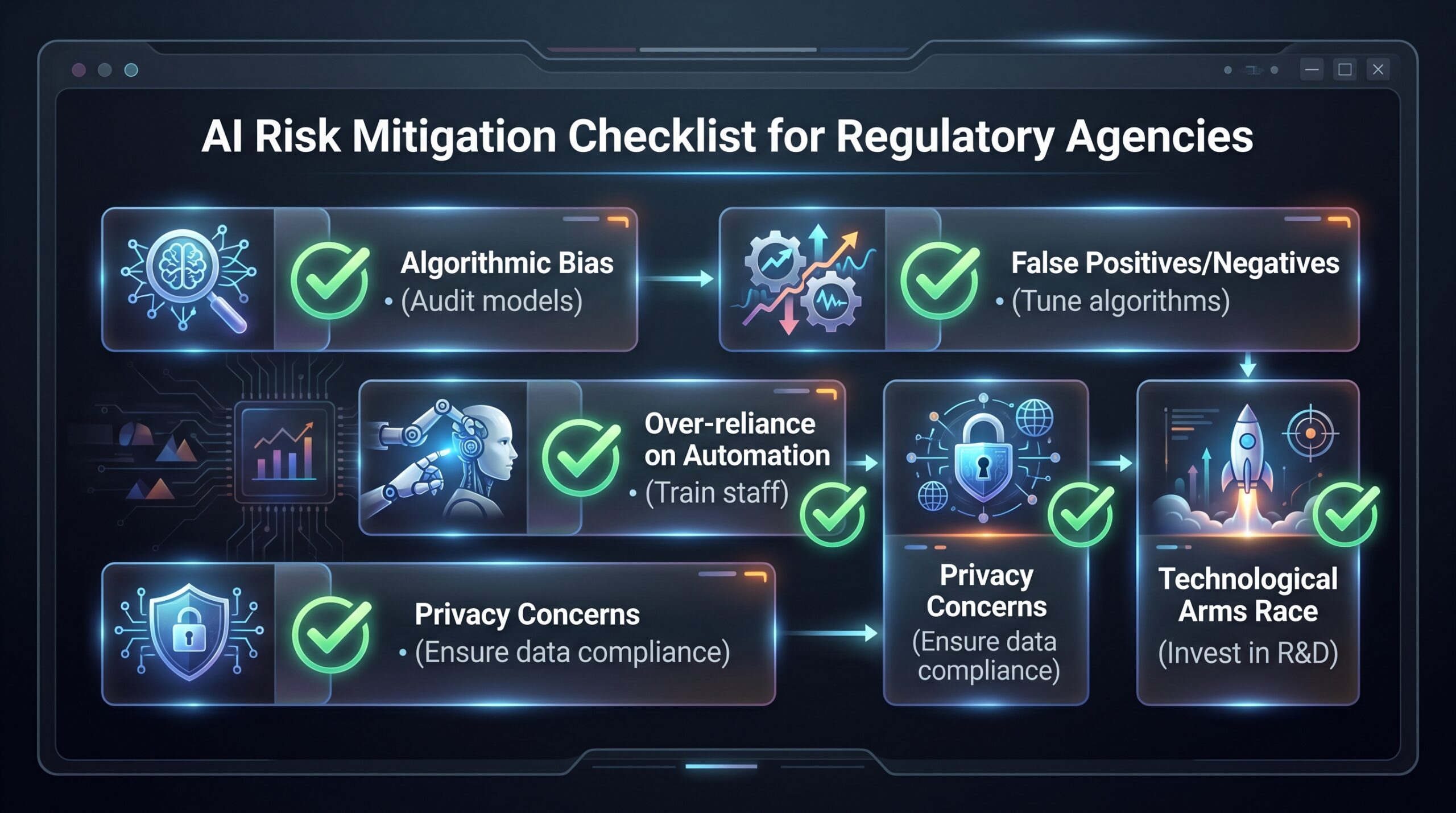
AI Risk Mitigation Checklist for Regulatory Agencies
- Algorithmic Bias: Regularly audit AI models with diverse datasets; implement human oversight for decisions.
- False Positives/Negatives: Continuously tune algorithm sensitivity; maintain analyst feedback loops to improve models.
- Over-reliance on Automation: Frame AI as an ‘assistant’, not a replacement; train staff to question and validate AI findings rigorously.
- Privacy Concerns: Ensure data compliance with laws; focus analysis on illicit activities only.
- Technological Arms Race: Invest in R&D for AI surveillance; foster info sharing with other regulators.
- Algorithmic Bias: AI models trained on historical data may inherit biases, potentially leading to disproportionate scrutiny of certain market participants. This could undermine fairness and equity in enforcement.
- Mitigation: Regularly audit AI models for bias using diverse datasets. Implement human oversight for all enforcement decisions to double-check AI-generated findings.
- False Positives/Negatives: Over-sensitive algorithms could flood analysts with false alerts, wasting valuable resources, while under-sensitive ones could miss real malfeasance. Balancing sensitivity is a constant challenge.
- Mitigation: Continuously tune algorithm sensitivity based on feedback from human analysts. Maintain a feedback loop where analyst corrections improve the model’s accuracy over time.
- Over-reliance on Automation: Critical thinking and contextual understanding could be diminished if analysts become passive recipients of AI conclusions, potentially missing nuanced market dynamics.
- Mitigation: Frame AI as an “assistant” not a “replacement.” Train staff to question and validate AI findings comprehensively, ensuring human expertise remains central.
- Privacy Concerns: Mass surveillance of blockchain and market data raises significant privacy issues for legitimate market participants, requiring careful navigation of data ethics.
- Mitigation: Ensure all data collection and analysis complies with existing privacy laws and is focused on detecting specific illicit activities, respecting individual rights.
- Technological Arms Race: Bad actors will use AI themselves to develop more sophisticated manipulation techniques that can evade detection, creating an ongoing cat-and-mouse game. This impacts areas such as AI for detecting crypto insider trading.
- Mitigation: Invest in ongoing R&D for AI surveillance tools. Foster information sharing with other regulators and academic institutions to stay ahead of evolving threats.
Debunking Common Myths
Misconceptions about AI in regulation can lead to unnecessary fear or unrealistic expectations. It’s important to clarify the reality of the CFTC’s current approach.
- Myth: AI will fully replace human regulators.
- Reality: Chairman Selig’s statements and the ITF’s mission emphasize AI as a tool to augment a reduced staff. Final enforcement decisions and complex legal judgments require human expertise and critical human intelligence.
- Myth: AI surveillance is infallible.
- Reality: All AI systems have error rates. They are probabilistic, not deterministic. Their output must be interpreted and validated by skilled professionals, especially when detecting sophisticated threats like software flaws in crypto exchanges.
- Myth: The CFTC now has clear rules for crypto and AI.
- Reality: The very existence of the ITF confirms that clear frameworks are still under development. The AI tools are for enforcement within existing authorities, while the ITF works on future regulations to provide much-needed clarity for innovative firms.
Implications for Crypto Exchanges, Traders, and Developers
The CFTC’s AI adoption has immediate and profound implications for anyone operating in its jurisdictional space. Understanding these implications is crucial for proactive adaptation.
For Crypto Exchanges and Platforms
Crypto exchanges face heightened scrutiny in this new regulatory environment. Adapting their operational strategies is paramount for continued compliance.
- Increased Scrutiny: Expect more sophisticated and frequent surveillance. AI can correlate activity across spot and derivatives markets more effectively, making it harder to hide manipulative actions. Platforms might need to improve their telecom security to avoid data breaches that could be exploited by AI.
- Compliance Requirements: The bar for market surveillance and reporting is now de facto higher. Exchanges may need to invest in their own AI-driven compliance tools to meet regulatory expectations and avoid enforcement actions.
- Proactive Engagement: Engaging with the CFTC’s ITF could provide valuable insights into the evolving regulatory landscape and help shape future rules, creating a more favorable operating environment.
For Traders and Funds
Traders and funds must adjust their strategies, acknowledging the increased sophistication of regulatory oversight. Transparency and legitimate practices become even more critical.
- Detection Certainty: Assume that manipulative practices like spoofing or wash trading will be detected faster and with greater certainty. Algorithms will quickly flag anomalous behavior. Investors might also want to explore AI agents for crypto investment opportunities that prioritize compliance.
- Documentation: Maintain clear, thorough records of trading strategies. If flagged by AI, the ability to quickly provide a legitimate explanation will be crucial for avoiding penalties.
- Novel Strategies: Be cautious with highly novel or complex algorithmic trading strategies, as they may be initially misinterpreted by AI surveillance systems. Consider internal stress tests for compliance.
For Developers in Prediction Markets and DeFi
Developers in these innovative sectors have a unique opportunity to build compliant systems from the ground up, aligning with future regulatory expectations. This is crucial for long-term viability.
- Regulatory Clarity (Forthcoming): The ITF’s work is a key signal to watch. Its output will define the legal parameters for building and launching prediction markets and DeFi protocols in the U.S.
- Compliance by Design: Consider regulatory considerations during the design phase of new protocols, potentially incorporating features that make compliance and surveillance easier. This proactive approach can reduce future legal risks.
A Second Case Study: The ITF’s Potential Impact on a Prediction Market Startup
This case study illustrates how regulatory innovation can foster responsible development, rather than stifle it entirely. The ITF plays a critical role in providing necessary guidance.
Scenario: A U.S.-based startup plans to launch a decentralized prediction market for weather derivatives in 2027.
- Regulatory Uncertainty (Pre-ITF): The startup would face significant ambiguity. Are their event contracts legal? How should they handle KYC/AML? The lack of clear rules would likely force them to operate in a legal gray area or move offshore, hindering domestic innovation.
- Engagement with the ITF (Post-Formation): The startup’s legal team monitors publications and attends public meetings held by the CFTC’s Innovation Task Force. This engagement helps them understand the evolving landscape and contribute to discussions.
- Framework Development: The ITF issues a report or proposed rule defining the conditions under which certain event contracts are permissible and outlining compliance expectations for decentralized platforms. This provides much-needed legal clarity for the industry.
- Informed Launch: Armed with this clarity, the startup can design its platform to be compliant from day one—for example, by building in specific data reporting feeds for regulators or implementing identity verification thresholds. This reduces legal risk and fosters legitimate innovation within the U.S. economy, aligning with the goals of best crypto AI trading apps.
This case highlights how the ITF’s work could directly enable, rather than stifle, responsible technological advancement. It shows a forward-thinking approach to regulation.
The Future of CFTC Regulation with AI
The current implementation is likely just the beginning of a larger transformation. Future developments could see even more sophisticated uses of AI across the CFTC’s operations.
- Advanced Natural Language Processing (NLP): AI that can scan social media, news, and regulatory filings in real-time to correlate public sentiment with market movements and identify potential manipulation campaigns. This would provide an even broader surveillance net.
- Autonomous Enforcement Actions: For clear-cut, repetitive violations, AI systems might eventually automate initial steps like issuing warning letters or freezing accounts on regulated exchanges. This would significantly speed up the enforcement process, complementing human-driven Google AI spam defense playbooks.
- Generative AI for Rulemaking: The ITF could use generative AI to simulate the market impact of proposed regulations, helping to draft more effective and efficient rules by forecasting various outcomes and potential loopholes.
- Inter-Agency AI Networks: The CFTC’s AI systems may share data and alerts with those of the SEC, FinCEN, and international regulators to create a cohesive, global surveillance network. This collaboration would enhance cross-border regulatory efforts. Ultimately, this leads to a more robust, composable AI coding stack for regulatory oversight.
What Market Participants Should Do Next: An Actionable Checklist
Based on the CFTC’s current trajectory, here is a practical checklist for affected entities. Proactive engagement and adaptation are key to navigating this evolving regulatory landscape.
Key Takeaways for Market Participants
- For All Participants: Audit operations for manipulative practices, stay informed via CFTC channels, and rigorously document all activities.
- For Exchanges/Platforms: Upgrade surveillance with AI tools, designate a CFTC liaison, and consider proactive engagement with the ITF to shape regulations.
- For Traders/Funds: Review algorithms for compliant patterns, keep meticulous records, and approach novel strategies with caution, seeking legal counsel when necessary.
- For All Participants:
- Audit Your Operations: Review your trading, lending, or platform activities for any practices that could be construed as manipulative under existing CFTC guidance. Proactive internal audits can prevent future issues.
- Stay Informed: Monitor the CFTC website, specifically the Innovation Task Force section, for new reports, speeches, and proposed rules. Subscribing to official updates is highly recommended.
- Document Everything: Ensure robust record-keeping of all transactions and business decisions. Clear documentation is your best defense against an AI-generated alert or regulatory inquiry. This includes historical data for quantum AI trading bots.
- For Exchanges and Large Platforms:
- Upgrade Surveillance: Assess your current market surveillance capabilities. Investing in AI-driven tools is becoming a competitive necessity, not just a regulatory obligation, to detect and prevent manipulation effectively.
- Appoint a Liaison: Designate a team or individual to track CFTC AI and ITF developments specifically. This ensures a centralized point of contact and expertise within the organization.
- Consider Proactive Engagement: Explore opportunities to provide commentary to the ITF through public comment processes to help shape pragmatic regulations. Your input can be valuable in creating fair and effective rules.
- For Traders and Funds:
- Review Algorithms: If you use algorithmic trading, ensure your code does not inadvertently create patterns that mimic spoofing or layering. Conduct internal compliance checks regularly, considering the potential impact from Google AI advances.
- Seek Legal Counsel: Consult with attorneys who specialize in CFTC regulation and understand the implications of AI-driven enforcement. Expert legal advice can guide your operational changes and compliance efforts.
Frequently Asked Questions (FAQ)
- What specific Microsoft AI tools is the CFTC using?
- The CFTC has confirmed the widespread use of Microsoft 365 Copilot, an AI assistant integrated into applications like Word, Excel, and Outlook. This is used for productivity and data analysis. They are also deploying broader, unnamed AI surveillance tools for pattern recognition and anomaly detection in market data.
- Why did the CFTC start using AI?
- The primary driver was a severe staff reduction of 20-25% since FY2024. AI tools are being used to maintain and even enhance regulatory oversight capabilities despite having fewer human analysts. This allows the agency to keep pace with the data-intensive nature of crypto and prediction markets.
- What is the CFTC’s Innovation Task Force (ITF)?
- The Innovation Task Force is a specialized working group launched by the CFTC in March-April 2026. Its mission is to develop clear regulatory frameworks for emerging technologies, specifically crypto assets and blockchain, artificial intelligence and autonomous systems, and prediction markets and event contracts.
- Is the CFTC only monitoring cryptocurrency?
- No. While cryptocurrency is a major focus, the CFTC’s AI surveillance and the ITF’s mandate also explicitly include prediction markets and commodity derivatives. The agency oversees the entire U.S. derivatives market, which intersects with these digital areas.
- Does this mean AI is now making enforcement decisions at the CFTC?
- No. AI is used as an assistive tool for surveillance and data analysis. It flags potential issues and synthesizes information. All final decisions regarding investigations, charges, and enforcement actions are made by human staff and commissioners, applying legal judgment.
- How can a crypto exchange prepare for AI-driven regulation?
- Exchanges should invest in their own sophisticated market surveillance systems, ensure robust compliance and record-keeping practices, and actively monitor the CFTC’s ITF for emerging regulatory guidance. Proactive engagement with regulators is also advisable.
Last Updated: April 17, 2026. This article is based on public statements from CFTC Chairman Michael Selig and CFTC press releases from March-April 2026.