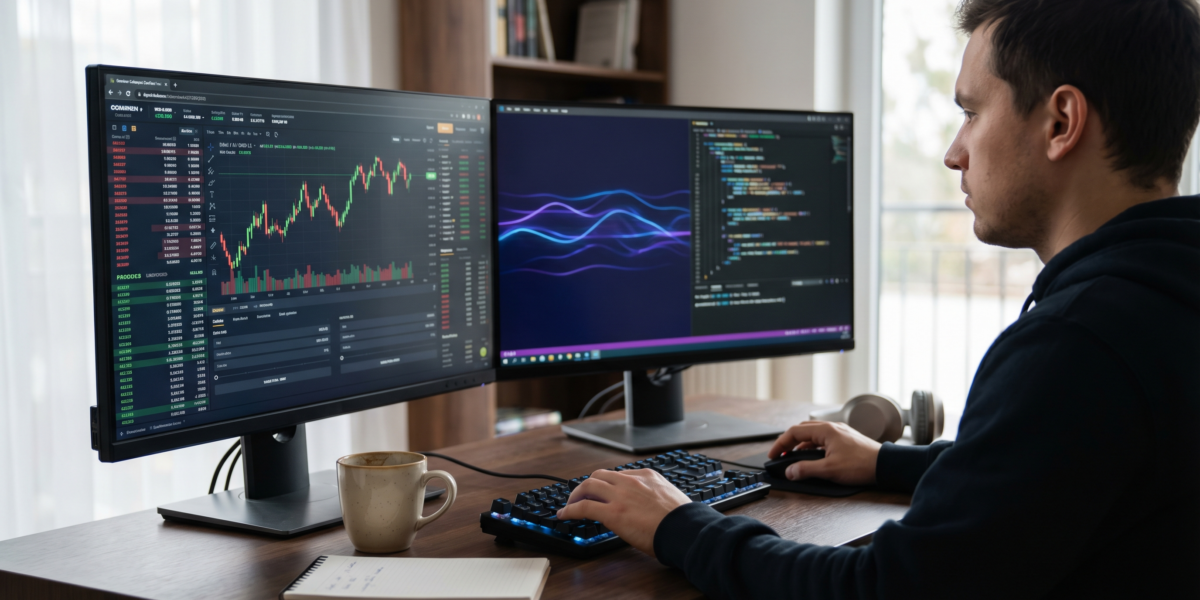
Yes, trading bots can be profitable in 2026, but their success hinges on sophisticated algorithms, robust risk management, and constant adaptation to evolving market conditions. While they offer speed and efficiency, profitability is not guaranteed and requires significant user expertise in strategy development and parameter tuning. Advanced AI and machine learning are enhancing their capabilities, yet continuous oversight remains crucial.
Trading bots can be profitable in 2026 for those who combine advanced algorithmic strategies with rigorous risk management and continuous adaptation to market changes. They are not a set-and-forget solution; success demands deep market understanding, technical proficiency, and ongoing optimization.
The financial markets of 2026 are more complex and fast-paced than ever before. With the rapid evolution of technology, particularly in artificial intelligence, the question “are trading bots actually profitable?” becomes increasingly relevant for both seasoned investors and novice traders.
Trading bots, automated software programs designed to execute trades based on pre-defined criteria, have been a subject of intense debate. While some portray them as a guaranteed path to riches, others view them with skepticism. This article delves into the current landscape of trading bot profitability in 2026, offering a definitive guide to understanding their potential, limitations, and the critical factors for success.
Key Takeaways
- Trading bots can be profitable in 2026, but success is not guaranteed and requires significant user strategy and oversight.
- AI and machine learning integrations are enhancing bot capabilities, offering more adaptive and predictive trading strategies.
- Key profitability drivers include sophisticated algorithms, robust risk management, and continuous adaptation to market dynamics.
- Challenges include market volatility, over-optimization, and technical infrastructure demands.
- Users need to understand different bot types, conduct thorough backtesting and paper trading, and maintain realistic profit expectations.
A New Era for Trading Bots in 2026
In 2026, the capabilities of trading bots have expanded significantly beyond simple algorithmic execution. Advances in artificial intelligence, machine learning, and high-performance computing have ushered in an era where bots can analyze vast datasets, identify complex patterns, and execute trades with unprecedented speed and precision.
This technological leap has democratized access to sophisticated trading strategies once exclusive to institutional investors. However, with greater power comes greater responsibility; the profitability of these bots remains deeply tied to the expertise and diligence of their operators.
Why Trading Bots Can Be Profitable
The core advantages that make trading bots potentially profitable in 2026 stem from their inherent design:
- Speed and Efficiency: Bots can execute trades in milliseconds, capitalizing on fleeting market opportunities that human traders would miss. This is crucial for high-frequency trading and arbitrage strategies.
- Emotionless Trading: Unlike humans, bots are immune to emotions like fear and greed, adhering strictly to their programmed strategies without impulsive deviations. This eliminates a significant source of trading losses.
- 24/7 Operation: Trading bots can monitor markets and execute trades around the clock, ideal for volatile markets like cryptocurrency that never close.
- Backtesting Capabilities: Before deployment, strategies can be rigorously backtested against historical data to assess their potential profitability and identify flaws, though this has its own limitations.
- Diversification: A single trader can manage multiple bots running different strategies across various assets, diversifying risk and increasing potential profit streams.
The Reality of Bot Profitability: Challenges and Limitations
While the advantages are compelling, operating a profitable trading bot is not without its significant challenges.
Market Volatility and Black Swan Events
Even the most sophisticated bots can struggle with unforeseen market anomalies. Sudden, dramatic market shifts (black swan events) or extreme volatility can render pre-programmed strategies obsolete or even lead to substantial losses if not properly accounted for with robust risk parameters. Building an Agentic AI Trading Infrastructure can help bots adapt more dynamically.
Over-optimization and Backtesting Bias
A common pitfall is over-optimization, where a bot’s strategy is fine-tuned to perform exceptionally well on historical data but fails in live market conditions. This leads to a false sense of security regarding its future profitability.
Technical Glitches and Infrastructure Demands
Bots rely on stable internet connections, reliable servers (often VPS deployment), and error-free code. Technical failures can lead to missed opportunities or unintended trades, underscoring the importance of robust infrastructure and continuous monitoring. For specific platforms like Freqtrade, dedicated setup guides exist to mitigate these issues, such as the Freqtrade Docker Deployment Guide.
Regulatory Changes
The regulatory landscape for automated trading, especially in cryptocurrencies, is constantly evolving. New regulations can impact strategy effectiveness or even force bot operators to adapt their approaches rapidly.
Key Factors for Trading Bot Success
Profitability in 2026 is less about simply having a bot and more about how that bot is designed, managed, and adapted.
Sophisticated Strategy Development
Successful bots employ complex algorithms that can identify patterns, predict price movements, and manage orders efficiently. This often involves combining technical indicators, fundamental analysis, and, increasingly, machine learning models. The depth and originality of the strategy are paramount.
Robust Risk Management
Perhaps the most critical factor is a comprehensive risk management strategy. This includes setting appropriate stop-loss limits, defining position sizing, and preventing over-leveraging. Proper bankroll management for trading bots protects capital and ensures longevity. Concepts like The 3-5-7 Rule in Trading can also be adapted for bot strategies.
Continuous Monitoring and Adaptation
Markets are dynamic. What works today might not work tomorrow. Profitable bot operators continuously monitor their bots’ performance, analyze market conditions, and adapt their strategies or parameters accordingly. This often requires understanding how to set up, fine-tune, and secure these systems, as outlined in guides like the Hyperliquid API Wallet Security Guide.
Choosing the Right Platform and Infrastructure
The choice of trading platform and underlying infrastructure greatly impacts a bot’s performance. Factors like execution speed, API reliability, and available indicators are crucial. A trading bot platform comparison for 2026 can help traders make informed decisions.
AI and Machine Learning Transforming Bot Profitability
Artificial intelligence and machine learning are game-changers for trading bots in 2026. AI-powered bots can:
- Learn from Data: Adapt to new market conditions by learning from vast historical and real-time data, identifying subtle correlations that traditional algorithms might miss.
- Predictive Analytics: Utilize advanced models to predict future price movements with a higher degree of accuracy, incorporating sentiment analysis from news and social media.
- Dynamic Strategy Adjustment: Automatically modify trading parameters or even switch strategies based on changing market regimes without human intervention.
- Risk Optimization: More intelligently manage risk by predicting potential drawdowns and adjusting position sizes or exposure.
For example, new platforms offer free AI stock trading bots in 2026, making sophisticated tools accessible to a wider audience, while advanced users might explore Hyperliquid API Automation for cutting-edge algorithmic trading.
Understanding the Types of Profitable Trading Bots
Different types of trading bots employ distinct strategies, each with its own profit potential and risk profile.
Arbitrage Bots
These bots exploit small price differences for the same asset across different exchanges. Their profitability relies on speed and low latency, as these opportunities are typically fleeting.
Market-Making Bots
Market-making bots profit from the bid-ask spread by placing both buy and sell orders simultaneously, aiming to capture the spread on high-volume assets. This strategy requires significant capital and robust infrastructure.
Trend-Following Bots
As the name suggests, these bots identify and follow market trends, buying during uptrends and selling during downtrends. They generally perform well in trending markets but can struggle in choppy, sideways markets.
Mean Reversion Bots
These bots operate on the principle that prices will eventually return to their historical averages. They buy when prices deviate significantly below the mean and sell when they rise significantly above it. They thrive in range-bound or oscillating markets.
AI-Driven Predictive Bots
Leveraging machine learning, these bots analyze vast data to predict future price movements, often combining elements of trend following, mean reversion, and sentiment analysis for more adaptive strategies. For instance, an AI crypto trading bot setup focuses on these advanced capabilities.
Evaluating a Trading Bot’s Potential
Before deploying any capital, thorough evaluation is paramount.
Start with Backtesting
Rigorous backtesting against diverse historical data (including different market regimes) is the first step. This helps identify if a strategy has had historical edge, but always be wary of over-optimization.
Paper Trading and Simulation
After backtesting, deploy the bot in a paper trading or simulation environment. This allows for real-time testing with virtual money, identifying how the bot performs under current market conditions without risking actual capital.
Realistic Expectations and Risk Assessment
No bot offers guaranteed returns. Understand the potential drawdowns, win rates, and risk-reward ratios. Align expectations with the bot’s historical and simulated performance, and always consider your personal risk tolerance.
How to Start Developing a Profitable Trading Bot in 2026
Embarking on the journey of creating a profitable trading bot requires a structured approach:
- Educate Yourself: Learn about financial markets, technical analysis, programming (often Python), and algorithmic strategies.
- Define Your Strategy: Based on your market understanding and risk tolerance, clearly outline the rules your bot will follow.
- Choose Your Tools: Select a suitable programming language, trading platform with robust API access, and development environment.
- Develop and Backtest: Code your strategy, then rigorously backtest it using historical data.
- Paper Trade: Deploy your bot in a simulated environment to test its real-time performance without financial risk.
- Optimize and Refine: Based on paper trading results, make necessary adjustments to your strategy and parameters.
- Deploy with Caution: Start with a small amount of capital and gradually scale up as you gain confidence in its live performance, maintaining Freqtrade bankroll management if using that platform.
Conclusion: The Future of Trading Bot Profitability
In 2026, trading bots are undeniably powerful tools that can be profitable. However, they are not magic bullets. Their success is a direct function of the intelligence behind their programming, the robustness of their risk management, and the continuous oversight and adaptation by their human operators. As AI continues to advance, the potential for ever more sophisticated and adaptive bots will grow, but the fundamentals of market understanding and risk control will always remain paramount.
FAQs About Trading Bot Profitability
Are trading bots consistently profitable in 2026?
Not consistently for everyone. While advanced bots with sophisticated strategies and robust risk management can be profitable, their success is highly dependent on the user’s expertise, continuous monitoring, and adaptability to evolving market conditions. They are not a “set-it-and-forget-it” solution.
What makes a trading bot profitable?
Key factors include a well-researched and backtested strategy, robust risk management (e.g., stop-losses, position sizing), the ability to adapt to changing market conditions, efficient execution, and low latency infrastructure. AI and machine learning integration also plays a crucial role in enhancing profitability.
Can I lose money using trading bots?
Yes, it is possible to lose money, often significantly. Bots are tools that execute strategies; if the strategy is flawed, poorly configured, or not adapted to current market realities, losses can occur. Market volatility, technical glitches, and over-optimization are common reasons for bot-related losses.
Do I need programming skills to use a trading bot?
While many platforms offer pre-built bots or drag-and-drop interfaces that don’t require coding, advanced users who want to develop custom, highly optimized, and unique strategies will benefit greatly from programming skills (e.g., Python). Understanding the logic behind the code is always beneficial.
What’s the role of AI in trading bot profitability in 2026?
AI and machine learning significantly enhance bot profitability by enabling them to learn from vast datasets, perform predictive analytics, dynamically adjust strategies to market conditions, and optimize risk management with greater intelligence than traditional algorithms. This allows for more adaptive and nuanced trading decisions.