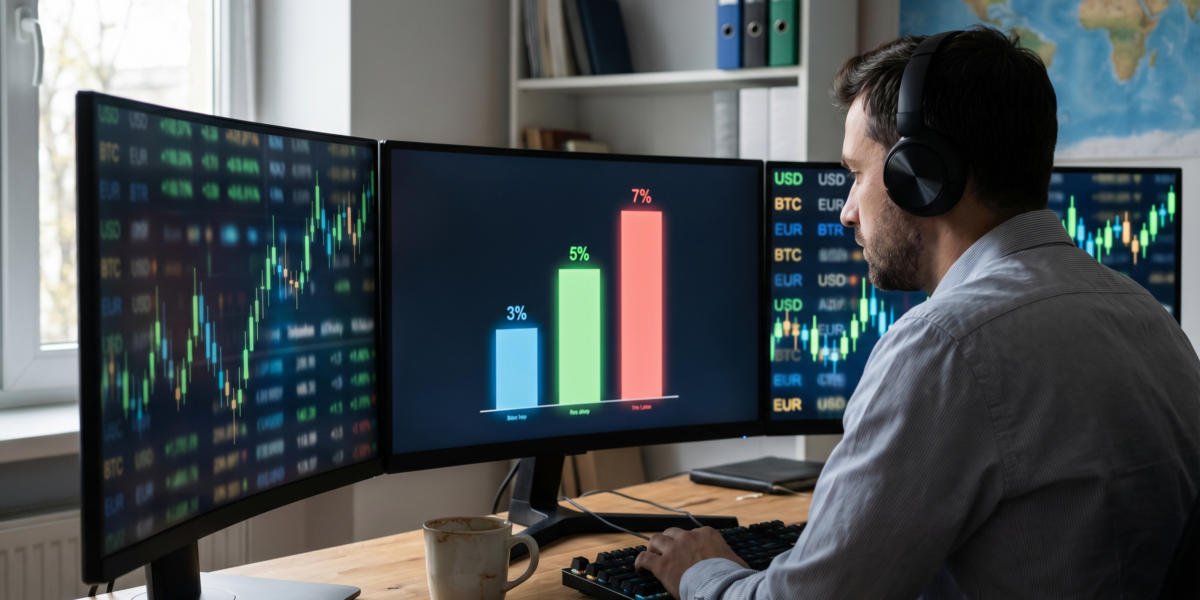
The 3-5-7 rule in trading is a comprehensive risk management strategy that limits losses per trade to
, caps open trade exposure across all positions at
, and sets a maximum portfolio drawdown threshold of
. This rule aims to prevent catastrophic losses, enforce trading discipline, and provide a mathematical edge over emotional decision-making, particularly for swing and position traders.
The 3-5-7 rule is a trading risk management framework: 3% maximum loss per trade, 5% maximum total exposure across open positions, and 7% maximum account drawdown before pausing. It promotes discipline, scales with account size, and protects against ruin across various asset classes.
The 3-5-7 rule in trading is a risk management strategy that limits losses per trade to 3% of account equity, caps open trade exposure at 5%, and sets a maximum portfolio drawdown threshold of 7%. Designed for swing and position traders, it prevents catastrophic losses while maintaining growth potential. This systematic approach forces discipline and provides a mathematical edge over emotional trading.
What Is the 3-5-7 Rule?
The 3-5-7 rule is a conservative risk management framework designed to protect trading capital. It consists of three components:
- The
3% rule
limits the capital risked on any single trade.
- The
5% rule
restricts total open exposure across all positions.
- The
7% rule
acts as a circuit breaker for overall account drawdown.
This hierarchical structure ensures that losses remain controlled at multiple levels—trade, portfolio, and account-wide.
The 3% rule prevents any single bad trade from severely damaging your account. If you risk 3% on a trade and lose, you still have 97% remaining. The 5% rule ensures you aren’t overexposed to market moves—especially important during correlated downturns. The 7% rule forces a trading pause or strategy review if your total losses hit this threshold, preventing death-by-a-thousand-cuts scenarios.
Unlike fixed-dollar risk models, the 3-5-7 rule scales with account size. A $10,000 account risks $300 per trade, while a $100,000 account risks $3,000. This percentage-based approach maintains consistency whether you’re trading micro lots or standard contracts. The rule works best for traders holding positions for days to weeks, not scalpers or high-frequency strategies.
Why the 3-5-7 Rule Works
Mathematically, the 3-5-7 rule protects against ruin. Risking 3% per trade requires 33 consecutive losses to blow up an account—statistically improbable with even modest win rates. The 5% exposure cap prevents overconcentration in one sector or asset class. Market crashes often see correlations converge; without this limit, a diversified portfolio can still suffer simultaneous losses.
The 7% drawdown rule is based on recovery math. A 7% loss requires a 7.5% gain to break even. A 20% loss needs 25% to recover. Beyond 7%, recovery becomes exponentially harder. This rule stops small losses from compounding into catastrophic ones. It forces objectivity—emotional traders often double down after losses, violating sound risk principles.
Psychologically, the rule builds discipline. Predefined risk parameters remove hesitation and second-guessing. You enter trades knowing exactly how much you can lose. This reduces fear and greed-driven decisions. The structure also makes performance tracking easier—you can quickly see if you’re adhering to rules or deviating.
How to Calculate Your 3-5-7 Rule Parameters
Start with your total account equity. This includes cash and open positions marked to market. For a $20,000 account, your 3% risk per trade is $600. Your 5% open exposure limit is $1,000—meaning the total value of all positions (adjusted for leverage) shouldn’t exceed this during market hours. The 7% max drawdown is $1,400—if your account drops to $18,600, you pause trading.
Calculate position size using stop-loss distance. If you buy a stock at $50 with a stop at $48, you’re risking $2 per share. With a $600 risk cap, you can buy 300 shares ($600 / $2). This controls loss amount regardless of position size. For leveraged instruments like futures, calculate risk based on tick value and stop distance.
Monitor open exposure in real time. If you have two trades open—one risking $400 and another $300—your total exposure is $700, under the $1,000 cap. If you want to add a third trade, it must risk $300 or less to stay under 5%. Broker platforms like Thinkorswim or TradingView can display real-time exposure percentages.
Rebalance parameters monthly. As your account grows, adjust your risk amounts. If your account increases to $22,000, your new 3% risk becomes $660. If it drops below $20,000, reduce risk accordingly. Never increase position size after losses—this violates the 7% rule’s intent.
Applying the 3-5-7 Rule in Different Markets
Stocks
For stock trading, the 3% rule determines share quantity. If AAPL is at $150 and your stop is $145, you risk $5 per share. With a $600 risk limit, buy 120 shares. The 5% rule limits how many positions you hold simultaneously—typically 2-3 stocks for most accounts. Avoid overconcentration in one sector like tech or energy.
Stock gaps can violate risk parameters. A stock might open 10% lower after earnings, blowing past your 3% stop. To mitigate, avoid holding earnings announcements or use options for defined risk. The 7% rule protects against these black swan events—if gap losses push your drawdown past 7%, you stop trading until reassessing.
Forex
Forex traders use pip risk for calculations. If you trade EUR/USD with a 50-pip stop, and each pip is worth $10 per lot, one lot risks $500. For a $20,000 account, you can trade one lot since $500 < $600 (3%). The 5% rule means you shouldn’t have open positions risking more than $1,000 total across all currency pairs.
Forex correlations matter. EUR/USD and GBP/USD often move together. If you’re long both, your effective exposure might be higher than 5%. Use correlation matrices from tools like MyFxBook to adjust position sizes. The 7% rule is critical here—forex volatility can trigger multiple stops quickly during news events.
Cryptocurrencies
Crypto’s volatility requires tighter stops. A 3% risk on Bitcoin might mean a 2% price move due to high volatility. Use percentage stops instead of fixed dollar amounts. If BTC is at $60,000, a 3% stop is $1,800—so set your stop at $58,200. The 5% exposure limit is crucial—crypto correlations are extreme, with most altcoins moving with Bitcoin. For more insights on managing risk in crypto, read our guide on Bankroll Management for Trading Bots.
Avoid trading during major events like Fed announcements or Bitcoin halvings. Slippage can make actual losses exceed planned 3% risks. The 7% drawdown rule forces a cooling-off period after large moves—essential in crypto’s 20% daily swing environments. For traders looking to automate their crypto strategies, understanding how this rule applies can be crucial. Check out our guide on Self-Hosted Freqtrade VPS Setup.
Futures
Futures contracts have fixed tick values. For ES (S&P 500 futures), each point is $50. If you risk 10 points, you risk $500 per contract. With a $600 limit, you can trade one contract. The 5% rule limits how many contracts you have open across markets—e.g., one ES contract and one NQ (Nasdaq) contract might risk $900 total, under the $1,000 cap.
Futures margins can confuse exposure calculations. Focus on risk amount, not margin used. A contract might require $10,000 margin but only risk $500—your exposure is $500, not $10,000. The 7% rule protects against rapid moves like flash crashes, where stops might not fill at desired prices.
3-5-7 Rule vs. Other Risk Management Strategies
| Strategy | Key Principle | Pros | Cons | Best For |
|---|---|---|---|---|
| 3-5-7 Rule | 3% per trade, 5% exposure, 7% drawdown caps | Hierarchical protection, scalable, emotional discipline | Requires position sizing math, conservative for small accounts | Swing traders, position traders |
| Fixed Fractional | Risk fixed % per trade, no exposure cap | Simple, no complex calculations | No portfolio-level protection, can overexpose | Beginners, small accounts |
| Fixed Ratio | Increase size after gains, decrease after losses | Accelerates growth during wins | Complex math, large drawdowns possible | Experienced traders with volatility tolerance |
| Kelly Criterion | Optimize bet size based on edge | Maximizes long-term growth | Requires accurate win rate/edge estimation, aggressive | Quantitative traders, high-edge strategies |
| Martingale | Double down after losses | Can recover losses quickly | Risk of ruin high, requires large capital | Not recommended—casino strategy |
Applying the 3-5-7 Rule Across Asset Classes
| Asset Class | 3% Risk Example | 5% Exposure Example | 7% Target Consideration | Unique Challenges |
|---|---|---|---|---|
| Stocks | $600 risk on $20k account, 120 shares of AAPL | Hold max 2-3 stocks risking $300-$400 each | Pause if account drops to $18,600 | Gap risk, low liquidity stocks |
| Forex | $600 risk, 50 pip stop on EUR/USD ($10/pip) | Max $1,000 risk across all pairs | Stop trading if 7% drawdown reached | High leverage, correlation between pairs |
| Crypto | 3% price stop on BTC, e.g., $58,200 stop from $60,000 | Limit altcoin exposure—most correlate with BTC | 7% drop triggers strategy review | Extreme volatility, exchange risk |
| Futures | $500 risk on ES contract (10 points) | One ES and one CL contract might exceed 5% | Account-wide pause at 7% drawdown | Margin calls, overnight gaps |
| Options | Premium paid is max risk, e.g., $600 debit spread | Total premium across positions <5% of account | 7% loss includes all open positions | Illiquid strikes, wide spreads |
Tools to Implement the 3-5-7 Rule
Use trading journals like Tradervue or Tradetomato. They automatically calculate risk percentages, drawdowns, and exposure across trades. Input your account size, and the software tracks compliance in real time. Most connect directly to brokers via API for automatic trade importing.
Broker platforms with advanced order types help. Conditional orders on Thinkorswim or Interactive Brokers let you set percentage-based stops. You can enter "close position if loss exceeds 3%" orders automatically. Portfolio margin tools show real-time exposure percentages.
Excel or Google Sheets templates work for manual tracking. Create a sheet with columns for entry price, stop loss, position size, and risk amount. Use formulas to calculate total exposure and drawdown. Update after each trade or daily. Though manual, it reinforces discipline through active engagement. Interested in how automation can help with these calculations? Explore the benefits of AI-Powered Trading Bot Platforms.
Risk management plugins for MetaTrader 4/5 exist. Tools like Position Size Calculator automatically compute lot sizes based on stop distance and risk percentage. They alert you if you’re about to exceed 5% exposure. Some even block trades that violate parameters.
Common Mistakes When Using the 3-5-7 Rule
Ignoring correlations is a top error. Trading three tech stocks might seem like three separate 3% risks, but if tech crashes, they all drop together. Your effective exposure could be 9%, violating the 5% rule. Use sector ETFs or correlation matrices to measure true exposure.
After a 7% drawdown, traders often jump back in too soon. The rule says pause and reassess—not just wait a day. Analyze why losses occurred: Were stops too tight? Market regime changed? Take at least a week to review trades and adjust strategies before resuming.
Traders sometimes "hide" losses by not marking positions to market. If you have a losing trade down 8% but don’t close it, it doesn’t count toward your 7% drawdown? Wrong. The rule uses current equity, including open positions. Mark-to-market daily to get accurate numbers.
Increasing risk after a losing streak breaks the rule. If your account drops to $18,000, your new 3% risk is $540—not $600. Don’t try to "make back" losses by risking more. This is how accounts blow up. Stick to the percentages religiously.
Adapting the 3-5-7 Rule for Your Strategy
Scalpers might use a 1-3-5 variant. Since they trade frequently, 3% per trade is too high. Risk 1% per trade, 3% exposure, and 5% drawdown. This adjusts for higher trade frequency while keeping ruin risk low.
Large accounts ($500k+) can use smaller percentages. Risk 1.5% per trade, 3% exposure, and 5% drawdown. Large absolute dollar amounts make smaller percentages still meaningful. A 1.5% risk on $500k is $7,500—plenty for most positions.
Combine with profit-taking rules. When a trade hits 2:1 reward, take off half or move stop to breakeven. This locks in gains and reduces open exposure. If you have two trades open and one hits target, your exposure drops from 5% to 2.5%, allowing new entries.
Use the rule in phases. If you’re new, start with paper trading using 3-5-7. Then move to live with 2-4-6 until proven. Graduate to full 3-5-7 after six months of profitability. This builds discipline without initial large losses.
FAQs About the 3-5-7 Rule
Is the 3-5-7 rule suitable for day trading?
The 3-5-7 rule is designed for swing and position traders holding trades for days to weeks. For day trading, the 5% exposure cap might be too restrictive if you trade frequently. Day traders often use a modified 1-3-5 rule or fixed dollar risk per trade instead. For more context on specific asset classes like crypto, you can find insights in articles such as Day Trading Crypto: Do You Need $25,000?
How do I calculate risk if my stop loss is hit?
Risk is calculated at trade entry based on your stop loss price. If you buy a stock at $100 with a stop at $95, you risk $5 per share. Multiply by the number of shares to get total risk. If the stop is hit, you lose that predetermined amount—assuming no slippage.
Can I use the 3-5-7 rule for options trading?
Yes, but define risk as premium paid plus commissions. If you buy a call option for $300, that’s your max risk. Your 3% rule limits option premiums to 3% of account size. The 5% rule caps total premium across all options positions.
What should I do during a 7% drawdown?
Stop trading immediately. Analyze all recent trades to identify why losses occurred. Common causes include stops being too wide or too narrow, trading during high volatility, or overriding signals. Only resume trading after at least one week and implementing strategy adjustments.
Does the 3-5-7 rule work for small accounts under $5,000?
It works but can be restrictive. 3% of $5,000 is $150—commissions might eat into that. Consider a 5% per trade rule instead, with 7% exposure and 10% drawdown until your account grows significantly. Alternatively, trade micro futures or fractional shares to fit within size limits. For those looking to grow smaller accounts, balancing risk is crucial, perhaps with help from AI Trading Apps for Passive Income.