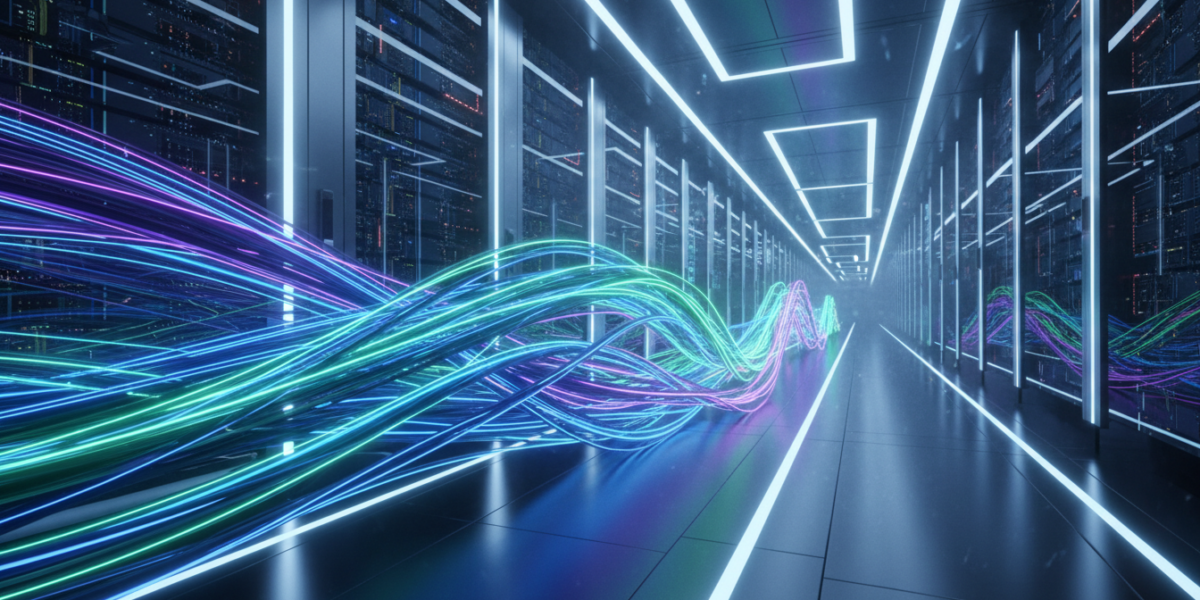
Corning and Meta have begun construction on a significant expansion of Corning’s optical cable manufacturing facility in Hickory, North Carolina. This multi-year, up to $6 billion investment aims to create the world’s largest optical cable plant, specifically designed to meet the skyrocketing bandwidth demands of next-generation AI data centers.
TL;DR
- What happened: Construction began April 1, 2026, on what will become the world’s largest optical cable plant.
- Why it’s happening: AI data centers need unprecedented bandwidth—optical cables are the backbone.
- Who’s involved: Corning (manufacturing) and Meta (use-case and funding) are leading the effort.
- Scale: Multi-year investment of up to $6 billion.
- Impact: More jobs, faster AI infrastructure rollout, and a reshaped U.S. supply chain.
- What you should do: Position yourself in high-demand roles related to fiber optics, AI infrastructure, or advanced manufacturing.
Key takeaways
- Optical cables are critical for AI at scale.
- Corning and Meta are betting $6B on it.
- This will create jobs, stabilize supply, and accelerate AI rollout.
- Act now: skill up, audit your infrastructure, and engage with vendors.
What Are Optical Cables and Why Do They Matter for AI?
Optical cables (often called fiber optic cables) transmit data using light. They offer vastly higher speeds and bandwidth compared to traditional copper wiring. For AI data centers—which process immense volumes of data in real-time—this isn’t a luxury. It’s a necessity.
Why this matters to you: If you work in tech, data, telecom, or hardware, your systems will increasingly depend on this kind of infrastructure. Slower speeds could bottleneck entire AI workflows.
Who should care most:
- Network engineers
- Data center operators
- AI/ML developers
- Investors in tech and infrastructure
Why Now? The AI Infrastructure Gold Rush
AI model sizes and data requirements are doubling faster than Moore’s Law can keep up. Training advanced models requires data centers with ultra-low-latency, high-throughput connections. Existing infrastructure is already straining.
This expansion signals that tech giants are moving from experimental AI to industrial-scale deployment. Delays in data transfer could mean slower inference, higher costs, and failed real-time applications.
Why it matters to you: Supply chain delays in critical components like optical cables could slow down your company’s AI projects. Understanding where bottlenecks might occur helps you plan around them.
Who should act first:
- Tech procurement teams
- Cloud infrastructure planners
- AI startup founders
How Optical Cabling Powers AI Data Centers
AI data centers aren’t just buildings with servers—they’re complex networks where data must move seamlessly between storage, compute, and cooling systems. Optical cables make this possible by:
- Enabling terabit-level transfer speeds
- Reducing latency to microseconds
- Supporting longer distances without signal loss
Without these, training large AI models would take longer, inference would be slower, and real-time applications would be unreliable.
Real-World Impact: More Than Just Meta
While Meta is the named partner, this expansion will supply the broader market. Companies like Google, Amazon, and Microsoft are also racing to build AI-optimized data centers. This plant will help mitigate a looming optical cable shortage.
Example: When OpenAI trained its latest model, delays in data transfer between GPU clusters added weeks to the training timeline. Faster optical links could prevent that.
Key Players & Technologies
- Corning: World leader in fiber optics and advanced glass technologies.
- Meta: Driving demand and co-investing in supply.
- Other vendors: Companies like CommScope, Prysmian, and II-VI are also scaling, but Corning’s move is the largest single expansion.
| Company | Role | Investment Scale |
|---|---|---|
| Corning | Manufacturing & R&D | Multi-billion $ |
| Meta | Funding & Deployment | Co-investor |
| Other Vendors | Competing or supplying | Varied |
Implementation Timeline and Expectations
- Construction began: April 1, 2026
- Estimated completion: 2028–2029
- Initial production scaling: Late 2027
This isn’t an overnight change—but planning now ensures you’re ahead of the curve.
How to Leverage This Shift for Your Career or Business
For Job Seekers and Tech Professionals
Roles in fiber optics, network architecture, and data center design are about to become even more valuable.
For Businesses and Teams
If you rely on AI, assess your data transport layers. Delays here will delay everything.
For Investors
The optical hardware market is entering a growth phase. Companies like Corning, Lumentum, and Ciena are well-positioned.
Risks and Myths
Myth: “Only hyperscalers like Meta benefit.”
Fact: This expansion will ease supply for everyone—smaller enterprises can also access better cables sooner.
Myth: “Copper and wireless can replace fiber.”
Fact: For AI-level throughput and latency, nothing beats fiber optics today.
Risk: Construction or supply chain delays could push timelines back. Have contingency plans.
FAQ
Q: Will this lower the cost of optical cables?
A: Initially, maybe not—but increased supply should stabilize prices long-term.
Q: How does this affect 5G and telecom?
A: Better fiber supply helps everyone—AI data centers, telecom, smart cities.
Q: Should I learn about optical networking?
A: Yes. It’s becoming a foundational skill in tech infrastructure.
Glossary
- Optical cables: Cables that use light to transmit data.
- AI data centers: Facilities built to handle intensive AI workloads.
- Latency: Delay in data transmission—critical for real-time AI.
- Bandwidth: The amount of data that can be transferred at once.
Key Takeaways
- Optical cables are critical for AI at scale.
- Corning and Meta are betting $6B to expand manufacturing capacity in Hickory, NC.
- This will create jobs, stabilize supply, and accelerate AI rollout.
- Act now: skill up, audit your infrastructure, and engage with vendors.
References
- Business Wire: Corning and Meta Begin Construction on Hickory Expansion
- WCNC: World’s Largest Optical Cable Plant Breaks Ground in Hickory
- Light Reading: Optical Cables Critical for AI Data Centers
- Charlotte Observer: $6B Investment in NC Optical Cable Plant
- Yahoo! Finance: Corning and Meta Multi-Year Investment
- WHKY: Expansion Reshapes AI Infrastructure Future
This analysis is based on breaking news and industry trends as of April 2026. Follow official Corning and Meta channels for ongoing updates.