The best dry run trading bot workflow involves defining a quantifiable strategy, configuring a secure environment, rigorously backtesting with historical data, simulating live execution in paper trading mode, and iterating based on performance analysis before deploying any real capital. This disciplined process validates algorithmic logic, exposes real-world execution issues, and mitigates risk in automated trading systems.
Current as of: 2026-03-26. FrontierWisdom checked recent web sources and official vendor pages for recency-sensitive claims in this article.
TL;DR
- Define a concrete, falsifiable trading strategy with precise entry/exit rules
- Backtest rigorously using historical data while modeling fees and slippage
- Execute dry-run simulations against live market data to validate real-time performance
- Analyze results and iterate before deploying with small capital allocations
- Maintain continuous monitoring even after going live
Key takeaways
- Dry run workflows prevent catastrophic losses by validating strategies before capital deployment
- AI-powered trading requires even more rigorous testing due to model overfitting risks
- Hardware configuration significantly impacts trading bot performance and must be tested
- Secure API key management is non-negotiable for operational security
- The iterative testing process never truly ends—live trading is just another validation phase
What is a Dry Run Trading Bot Workflow?
A dry run trading bot workflow is a multi-stage process for developing and validating an automated trading strategy without risking real capital. It transforms a theoretical idea into an executable, tested system.
Dry Run / Paper Trading: The core execution phase where the trading bot connects to live exchange data feeds and generates orders that are not sent to the marketplace. The bot’s internal ledger tracks simulated PnL, allowing observation of behavior in real-time market conditions.
Backtesting: The foundational analysis phase that involves running your strategy’s logic against historical market data to evaluate how it would have performed. This provides a first-pass sanity check for profitability and risk.
The Workflow Sequence: Strategy Definition → Backtesting → Dry-Run Simulation → Analysis → Iteration → Live Deployment. This systematic approach identifies and eliminates failure points before capital deployment.
Why the distinction matters: A strategy can have a phenomenal backtest but fail in a dry run. Backtests often assume perfect order execution, while dry runs expose real-world issues: API rate limits, network latency, order book liquidity, and logical errors in time-sensitive code.
Why a Rigorous Dry Run Workflow Matters
The urgency for disciplined testing has intensified in 2026 for several critical reasons:
AI Model Proliferation
AI and machine learning models are now embedded in many trading platforms. While powerful, they are not magical—models that overfit to historical data will fail in live markets. Dry run workflows detect overfitting and validate that model signals remain robust in dynamic environments.
Increased Market Complexity
Liquidity fragmentation across centralized and decentralized exchanges, combined with faster news cycles, creates more edge cases. Strategies that worked in bull markets may behave erratically in volatile conditions. Extended dry-running across different market regimes is essential.
Hardware as a Differentiator
The trading advantage has shifted from software alone to the hardware powering it. Access to specialized processors (GPUs, TPUs) reduces model inference time significantly. Your dry run environment must mirror your live hardware setup to avoid latency-related failures.
Operational Security Demands
The value locked in trading wallets represents prime targets for exploitation. Dry running allows testing security setups—firewalls, key permissions, withdrawal whitelists—without the existential risk of misconfiguration.
How the Best Dry Run Trading Bot Workflow Works
This step-by-step breakdown covers the entire process from idea to live trading.
Step 1: Defining a Quantifiable Trading Strategy
You cannot test a vague idea. Your strategy must be a set of unambiguous, code-able rules:
- Hypothesis: What market inefficiency are you exploiting?
- Entry Rules: Precisely when does the bot enter a trade?
- Exit Rules: Precisely when does the bot exit (both profit-taking and stop-loss)?
- Risk Management Rules: Hard limits that override everything else
Actionable Tip: Write your strategy in plain English first. If you can’t explain it clearly, you can’t code it effectively.
Step 2: Configuring the Bot and Secure Environment
This involves infrastructure setup, not just software installation:
- Choosing a Platform: Select a bot framework that supports full dry-run mode with accurate fee and slippage modeling
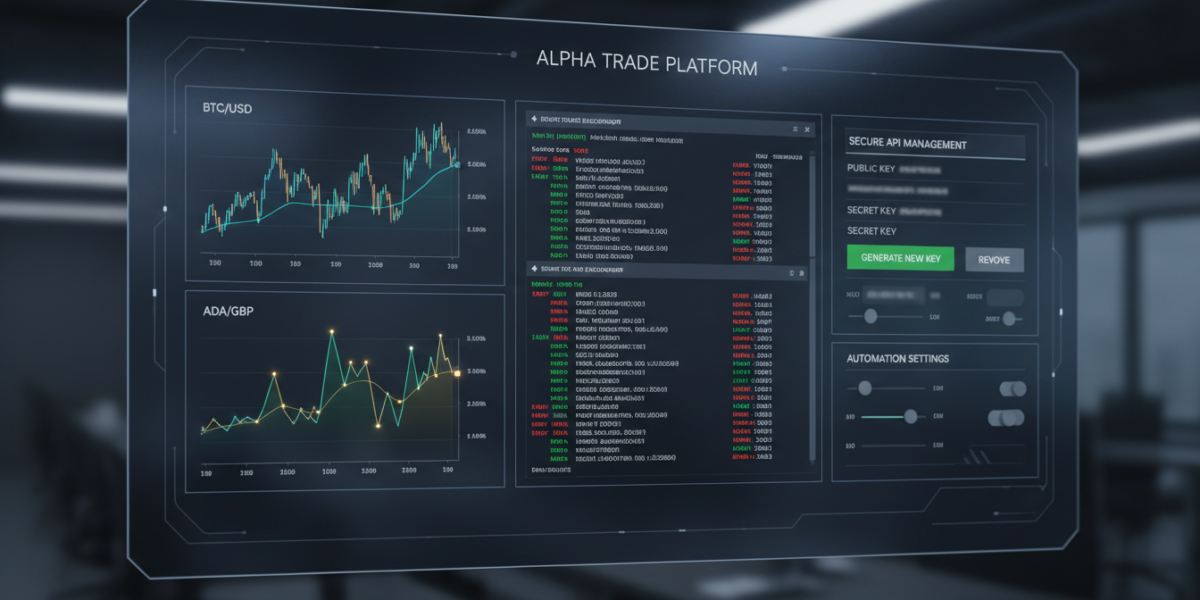
- Secure API Key Setup: Create exchange API keys with only “Read Info” and “Trade” permissions—never enable “Withdraw”
- Environment Isolation: Run your bot on a dedicated VPS for 24/7 uptime, low latency, and isolation from local machine instability
Step 3: Rigorous Backtesting
Backtesting provides your strategy’s first reality check:
- Data Quality: Use high-quality historical OHLCV data with maximum granularity
- Model Realism: Include exact exchange fees, slippage assumptions, and market impact for larger positions
- Key Metrics: Evaluate Total Return, Sharpe Ratio, Maximum Drawdown, Win Rate, and Profit Factor
Pitfall Alert: Do not over-optimize. Finding perfect parameters for past data (curve-fitting) guarantees future failure. Test your strategy’s core logic, not its ability to memorize history.
Step 4: Dry-Run Simulation
This is where theory meets reality. A successful backtest only grants a ticket to dry running:
- Goal: Observe the bot’s behavior in the live market ecosystem
- What to Watch: Order execution quality, API error handling, latency issues, and unexpected logic behaviors
- Duration: Run for at least two weeks across different market conditions to gather significant sample size
Step 5: Analysis, Iteration, and Live Deployment
The final phase before capital deployment:
- Analysis: Compare dry-run results to backtest—discrepancies reveal real-world market mechanics
- Iteration: Make small, logical adjustments and repeat the dry run until performance stabilizes
- Live Deployment: Start with small capital allocation you’re prepared to lose and maintain strict monitoring
Comparing Top Tools for Backtesting and Dry-Run Trading
| Tool / Platform | Type | Backtesting | Dry-Run Mode | Best For | Key Consideration |
|---|---|---|---|---|---|
| Freqtrade | Open-Source Framework | Excellent, customizable | Full paper trading | Developers, custom strategy builders | Requires Python knowledge |
| Hummingbot | Open-Source Framework | Good for market-making | Full paper trading | Market makers, arbitrageurs | Steeper learning curve |
| Gunbot | Commercial Bot | Built-in | Paper Trading mode | Non-coders, beginners | Less flexibility than open-source |
| 3Commas | Web-Based Platform | Good visual backtester | Paper trading portfolio | Traders wanting GUI | Vendor lock-in, subscription cost |
| Exchange Native Bots | (e.g., Binance, Coinbase) | Limited or none | Often available | Simplicity, convenience | Limited strategy options |
Trade-off: Open-source frameworks offer maximum control and transparency but demand technical skill. Commercial bots and platforms offer ease of use but limit customization and can become expensive.
Implementation Path: Your First Dry Run in 7 Days
A concrete plan to get started:
- Day 1: Choose your tool based on technical capability
- Day 2: Define one simple strategy—avoid complex AI models initially
- Day 3: Set up environment with VPS and restricted API keys
- Day 4: Conduct basic backtest on 3 months of historical data
- Day 5-6: Initiate dry-run mode for 48 hours continuous operation
- Day 7: Analyze results and document findings for iteration
This approach establishes the iterative loop that characterizes professional trading bot development.
Costs, ROI, and How to Gain Leverage
Costs
- VPS: $5-$20/month
- Trading Bot Software: Freqtrade (Free) or Commercial Bots ($20-$100/month)
- Data Feeds: Usually free from exchanges for historical data
- Your Time: The most significant investment
ROI and Earning Potential
The ROI comes from capital protection and edge validation, not the tools themselves. Preventing a single 10% loss pays for years of tooling. The goal is systematic, risk-adjusted returns, not lottery tickets.
Building Career Leverage
Mastery of this workflow represents a high-value skill:
- For Employment: Quant funds hire people who understand systematic validation
- For Consulting: Offer services to build, test, and deploy bots using rigorous workflows
- For Your Own Capital: The ultimate leverage is compounding returns without catastrophic risks
Risks, Pitfalls, and Myths vs. Facts
Pitfalls to Avoid
- Overfitting (Curve-Fitting): Creating complex strategies that fit historical data perfectly but have no predictive power
- Ignoring Fees and Slippage: Assuming perfect execution rather than modeling worst-case scenarios
- Underestimating Psychological Factors: Dry running is emotionally easy; live trading is not
- Inadequate Sample Size: Making conclusions after too few dry-run trades
Myths vs. Facts
- Myth: A great backtest means guaranteed live profits
Fact: A great backtest is necessary but insufficient—it only proves past performance - Myth: AI trading bots are “set and forget”
Fact: They require constant monitoring and maintenance as market regimes change - Myth: Paper trading is pointless without real emotions
Fact: The primary goal is technical execution validation, not emotion simulation
Frequently Asked Questions (FAQ)
What are the key metrics to evaluate during backtesting?
Focus on Maximum Drawdown (worst loss tolerance), Profit Factor (profitability after costs), and number of trades (statistical significance). The Sharpe Ratio helps compare risk-adjusted returns across strategies.
How do I securely configure API keys?
Always create keys with “Read” and “Trade” permissions only—never enable “Withdraw.” Use IP whitelisting to restrict API access to your VPS’s IP address when supported.
My backtest and dry-run results are very different. Why?
This is common and informative. Dry runs expose real-world friction: API latency, order book depth affecting fills, and bid-ask spreads. Analyze discrepancies to improve model realism.
How long should I dry run before going live?
There’s no fixed time. You need statistically significant trades across varying market conditions. Two weeks is minimum; a month or more is wiser.
Can I use AI models in my dry run workflow?
Absolutely. The workflow is identical. Dry running is even more critical for AI strategies to ensure models generalize to live data rather than memorizing past patterns.
Key Takeaways and Actionable Next Steps
The dry run workflow forms the backbone of professional automated trading, replacing hope with evidence and recklessness with discipline.
Your next steps:
- Stop planning, start doing. Pick one tool and one simple strategy today
- Build testing infrastructure. Set up a VPS and secure API keys—this one-time investment pays perpetual dividends
- Embrace the iterative loop. Your first strategy will likely be flawed; the goal is building a process that systematically eliminates wrong approaches
- Prioritize risk management over returns. A strategy with 5% return and 2% max drawdown beats 20% return with 50% drawdown
The market rewards rigor. Your dry run workflow is where that rigor is forged.
Glossary of Key Terms
- Backtesting: Simulating a trading strategy’s performance on historical data
- Dry Run / Paper Trading: Executing a strategy against live market data without placing real orders
- Maximum Drawdown (Max DD): The largest peak-to-trough decline in portfolio value
- Overfitting: Creating a strategy that models noise in historical data rather than underlying signal
- Profit Factor: Gross profits divided by gross losses (values above 1.0 indicate profitability)
- Slippage: Difference between expected trade price and actual execution price
References
- Freqtrade Official Documentation – Open-source trading bot platform
- Hummingbot Official Site – Open-source market making bot
- Gunbot Official Documentation – Commercial trading bot platform
- 3Commas Trading Platform – Web-based trading terminal
- Binance Exchange – Major cryptocurrency exchange with native bot support
- Coinbase Exchange – Regulated cryptocurrency exchange platform