
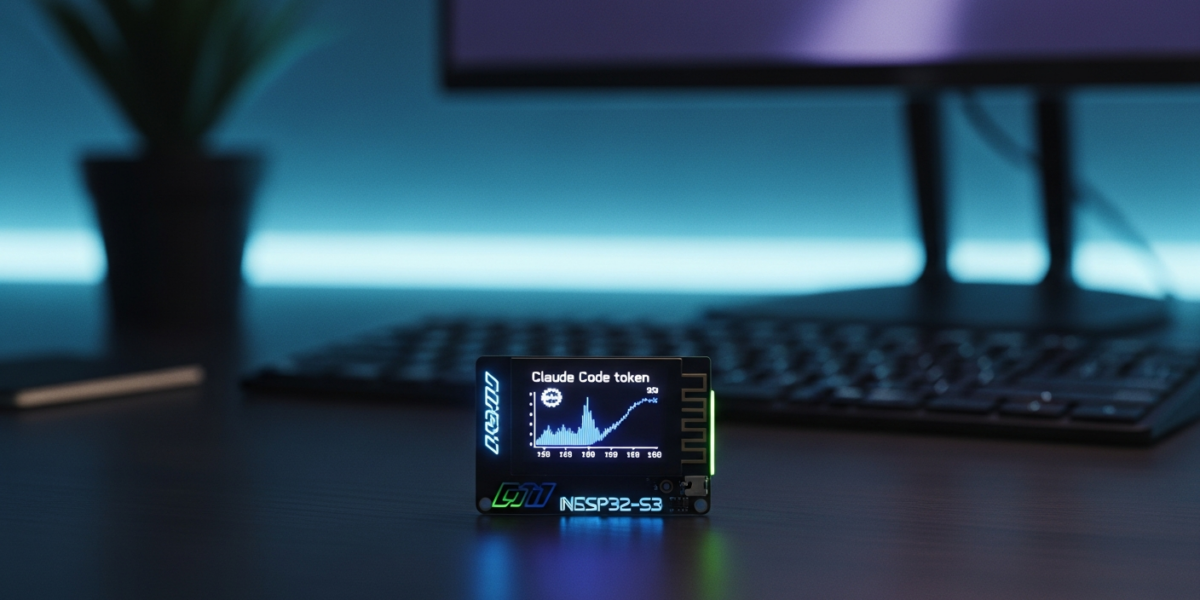
Clawdmeter, an open-source ESP32-S3 dashboard, signals a shift towards tangible, real-time AI resource monitoring for developers, highlighting the increasing cost-sensitivity and operational visibility needed for LLM-driven workflows.
Clawdmeter, an open-source ESP32-S3-powered desktop dashboard, signifies a critical shift in how developers and operators manage AI resource consumption. Far from a mere novelty, this physical device highlights the growing need for immediate, tangible feedback on LLM token usage, especially as AI integration moves beyond experimentation into production. It underscores the increasing cost-sensitivity and operational visibility required for sustainable, efficient LLM-driven workflows, signaling a future where real-time, physical indicators become standard for managing complex AI deployments.
What actually happened
Hermann Bjorgvin released Clawdmeter, an open-source project that transforms an ESP32-S3 microcontroller into a dedicated desktop dashboard for monitoring Claude Code token usage [1, 2]. This DIY device, typically built on platforms like the Waveshare ESP32-S3-Touch-AMOLED-2.16, displays real-time token consumption on a 2.16-inch AMOLED screen [3, 4, 8]. The interface leverages the LVGL library for its high-resolution UI, featuring expressive pixel-art animations and data-rich screens to visually represent token usage [4, 8]. The primary function is to provide AI coding power users with a constant, at-a-glance awareness of their Claude Code usage limits, helping them manage costs and avoid unexpected cut-offs [1, 7]. The project’s source code is available on GitHub, encouraging community contributions and customization [2, 6]. Adafruit and Hackster.io both covered the project, emphasizing its utility for developers [4, 5].
The signal most coverage missed
The immediate appeal of Clawdmeter is its “cute” and “animated” pixel-art display, making it seem like a charming desktop accessory [5]. However, this superficial framing misses the deeper operational signal: the emergence of dedicated, physical monitoring hardware for AI resource consumption. While software dashboards and API calls have always provided usage data, Clawdmeter’s existence points to a critical threshold where LLM token usage has become so central, so costly, and so operationally sensitive that developers are building bespoke hardware to track it. This isn’t just about curiosity; it’s about cost control and workflow interruption. When a developer hits a rate limit or exhausts their tokens, it directly impacts their productivity and potentially project timelines. The fact that an engineer felt compelled to build a physical device for this specific purpose indicates that existing software-only solutions are insufficient for certain high-intensity AI development scenarios. It suggests that the “invisible” cost of LLM inference is becoming tangibly felt, driving a demand for more immediate, ambient awareness beyond what a browser tab or terminal window can provide. This is a precursor to more sophisticated, integrated hardware-software solutions for LLMOps resource management.
Evidence and counterarguments
One might argue that Clawdmeter is merely a niche, hobbyist project, and that existing software-based monitoring tools, such as API dashboards or custom scripts, are perfectly adequate for tracking Claude Code usage. Indeed, many developers already rely on these methods, and a Reddit user even mentioned using a re-terminal for a similar purpose, indicating that software solutions can be robust [6]. The argument is that adding dedicated hardware introduces unnecessary complexity, cost, and a potential point of failure compared to purely digital solutions. Furthermore, the “cute pixel-art” aspect might be seen as prioritizing aesthetics over pure utility, suggesting it’s more of a novelty than a serious operational tool [5].
However, this counterargument overlooks the fundamental difference in cognitive load and immediacy. Software dashboards require context switching – opening a new tab, running a command, or navigating an interface. This introduces friction, however minor, that can disrupt a developer’s flow. Clawdmeter, by contrast, provides ambient, persistent feedback. It’s always there, in the developer’s peripheral vision, offering a glanceable status update without requiring any active interaction [1, 7]. This continuous, low-effort monitoring is crucial for managing burstable resources like LLM tokens, where usage can spike unexpectedly and quickly lead to rate limits or cost overruns. The “cute” animations are not just aesthetic; they are a highly efficient, non-intrusive way to convey information quickly, leveraging visual cues to indicate status without demanding full attention [5, 8]. The fact that it’s open-source and DIY further supports its operational intent, allowing developers to tailor it precisely to their needs and integrate it into their physical workspace as a dedicated tool, much like a specialized oscilliscope or network monitor. This physical presence transforms an abstract cost into a concrete, always-visible metric, which is a powerful psychological and operational advantage.
Operator playbook
-
Within 7 days: Assess current LLM usage visibility
Operators should conduct an immediate audit of their current LLM usage monitoring practices. Identify which teams or projects are heavily reliant on models like Claude Code and how they track token consumption and associated costs. Determine if current methods (e.g., API dashboards, custom scripts, billing alerts) provide sufficient real-time, glanceable feedback. Look for areas where developers are frequently hitting rate limits or expressing concerns about unexpected costs. This assessment will highlight the immediate pain points that solutions like Clawdmeter aim to address.
-
Within 30 days: Prototype ambient monitoring solutions
For teams with identified visibility gaps, prototype simple ambient monitoring solutions. This could involve setting up a basic Clawdmeter (or similar ESP32-based device) for a key developer or team, or even exploring existing software widgets that provide always-on desktop notifications for LLM usage. The goal is not necessarily to deploy Clawdmeter specifically, but to experiment with how persistent, low-friction visual feedback on token consumption impacts developer behavior and cost awareness. Evaluate the cognitive load reduction and the speed at which developers can react to usage spikes or approaching limits.
-
Within 90 days: Integrate real-time resource awareness into LLMOps strategy
Based on prototyping results, integrate real-time, ambient resource awareness into your broader LLMOps strategy. This might involve standardizing on a physical dashboard for high-usage teams, developing internal tools that push critical usage metrics to team dashboards, or even exploring commercial solutions that offer similar real-time, glanceable insights. The objective is to move beyond reactive cost management to proactive resource optimization by making LLM token consumption an ever-present, easily digestible metric for every developer. Consider how this real-time feedback can inform prompt engineering, model selection, and overall architectural decisions to optimize for cost and performance.
Sources
- Clawdmeter turns your Claude Code usage stats into a tiny desktop dashboard | TechCrunch
- GitHub – HermannBjorgvin/Clawdmeter: ESP32 desk dashboard that shows Claude Code usage · GitHub
- Clawdmeter – A DIY ESP32-S3 desk dashboard for Claude Code token usage monitoring – CNX Software
- Making a Claude usage display with Clawdmeter – Adafruit Blog
- Keep Tabs on Claude with the Cute, Animated Clawdmeter – Hackster.io
- r/ClaudeCode on Reddit: Clawdmeter – a small ESP32 usage limit monitor (source code in description)
- Клавдметер: Claude Коде фойдаланиш статистикаси учун ихчам иш столи қурилмаси
- Clawdmeter – Open Source Embedded Project