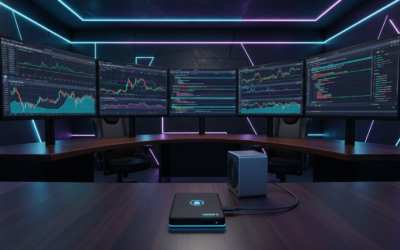

AI crypto and stock trading apps leverage artificial intelligence to automate and simplify investing across multiple markets. These platforms offer data-driven execution, real-time analytics, and user-friendly designs, making sophisticated trading strategies accessible to both novice and experienced investors in 2026.
Current as of: 2026-05-13. FrontierWisdom checked recent web sources and official vendor pages for recency-sensitive claims in this article.
TL;DR
- AI trading apps execute predefined strategies 24/7, removing emotion and latency from trading decisions
- Professional operation requires secure API management, reliable hosting, and robust risk controls
- Success depends on strategy quality, not just automation technology
- Self-custody is critical for cryptocurrency trading security
- Real-world testing with small capital is essential before full deployment
- Platform downtime and technical risks require operational planning
- Accessibility has improved through user-friendly platforms and modular bots
Key takeaways
- AI trading apps automate strategy execution but require quality underlying strategies
- Infrastructure reliability separates hobbyist setups from professional operations
- Self-custody solutions reduce counterparty risk in cryptocurrency trading
- Thorough testing and small initial deployment mitigate operational risks
- The shift from trader to operator requires different skills and mindset
What Are AI Crypto and Stock Trading Apps?
AI trading apps are software programs that automate buying and selling assets based on predefined rules or algorithms. The “AI” component typically refers to machine learning models or statistical algorithms that analyze market data to make predictions or execute decisions without constant human intervention.
These applications focus on three core capabilities:
- Pattern Recognition: Identifying technical indicators or chart patterns from historical and real-time data
- Predictive Modeling: Using statistical models to forecast short-term price movements
- Execution Optimization: Determining optimal entry and exit points to minimize slippage
Unlike traditional manual trading, these systems are systematic, emotionless, and operational 24/7. They represent tools for applying quantifiable edges with machine-like consistency rather than guaranteed profit generators.
Why AI Trading Matters Right Now
Several converging factors make mid-2026 a pivotal moment for automated trading adoption. The maturity of decentralized finance infrastructures has created viable, self-custodial environments for sophisticated bots. Open-source frameworks have democratized the underlying technology, allowing users to focus on strategy rather than infrastructure.
Proven strategies have been battle-tested and integrated into commercial and open-source bots, providing solid foundations beyond experimental models. Increased market volatility across both crypto and traditional markets positions automated systems to capitalize on opportunities while managing risk around the clock.
The tools for building serious automated trading operations are now commercially available and technically accessible. The primary barrier has shifted from capital requirements to operational knowledge.
How AI Trading Apps Work: The Operator’s View
Understanding the professional-grade workflow is essential for managing expectations and troubleshooting issues. The core feedback loop involves data ingestion, strategy analysis, signal generation, order execution, and continuous portfolio management.
Critical infrastructure components separate hobbyist setups from professional operations:
- Hosting Environment: Virtual Private Servers (VPS) provide 99.9% uptime versus unreliable local computer operation
- API Key Security: Strict permission controls and secure storage prevent unauthorized access
- Logging and Monitoring: Detailed logs and alert systems enable remote operation oversight
For example, a simple momentum bot might buy when a 20-period moving average crosses above a 50-period moving average, simultaneously setting stop-loss and take-profit orders. This demonstrates how bot performance depends entirely on strategy logic quality.
Real-World Examples of AI Trading Platforms
The current market splits between all-in-one platforms and modular, exchange-specific solutions. Recent launches include AriseAlpha and MoneyFlare AI Bot, which emphasize user-friendly interfaces and full automation for broader accessibility.
ZyAlpha combines AI with quantitative strategies for 24/7 cryptocurrency market operation. Established players like Trade Ideas continue providing AI-assisted scanning and alerting for equity markets.
A distinct category exists for bots built specifically for next-generation exchanges. The FrontierWisdom Hyperliquid Trading Bot exemplifies this approach, engineered for Hyperliquid’s architecture with advantages in execution speed, fee efficiency, and self-custody security.
Comparing AI Trading Platforms: Key Differentiators
| Feature | All-in-One Platforms | Modular/Exchange-Specific Bots | Advanced Frameworks |
|---|---|---|---|
| Ease of Use | High. GUI-based, minimal setup | Medium. Requires configuration | Low. Code-based |
| Customization | Low. Limited to provided strategies | Medium. Adjustable parameters | High. Build from scratch |
| Control & Transparency | Low. Black box operations | Medium-High. Transparent logic | Highest. Full control |
| Infrastructure Management | Vendor handled | Varies by platform | Your responsibility |
| Best For | Beginners wanting simplicity | Operators seeking balance | Developers needing flexibility |
The fundamental trade-off balances ease of use against control. All-in-one platforms enable faster deployment but lock users into specific ecosystems. Modular solutions and frameworks offer greater ownership and portability at the cost of increased technical requirements.
Implementation Path: From Zero to Live Trading
Successful deployment requires methodical progression from education to live operation. Rushing this process represents the most common failure point for new automated trading operators.
Backtesting provides historical performance context but cannot guarantee future results. The transition from simulated to live trading should begin with minimal capital allocation to validate real-world performance before scaling deployment.
Costs, ROI, and Realistic Monetization
Understanding the complete cost structure is essential for realistic return expectations. Expenses include software subscriptions ($0-$499 monthly), hosting ($5-$20 monthly), exchange fees, and hidden costs like slippage.
Realistic targets focus on risk-adjusted outperformance of buy-and-hold strategies rather than exponential returns. The primary value often comes from time savings and operational freedom rather than纯粹 trading profits.
Beyond direct trading, mastering automated systems builds valuable skills in Python, statistics, and risk management that have career applications in fintech and quantitative finance sectors.
Risks, Pitfalls, and Myths vs. Facts
Effective risk management separates sustainable operations from account blow-ups. Essential controls include proper bankroll sizing (1-2% per trade risk), circuit breakers for maximum drawdown limits, and preference for self-custodial solutions where possible.
Myth vs. Fact: AI trading bots do not guarantee profits—they automate strategy execution, including flawed strategies. Fully automated does not mean fully hands-off; professional oversight remains essential. Complex AI is not inherently better than simple, transparent strategies.
Strategy decay presents an ongoing challenge as market conditions change. Technical failures require contingency planning for downtime and disconnections through health checks and alert systems.
FAQ
How do AI trading apps compare to traditional trading?
AI apps provide systematic, fast, emotionless execution but require technical setup and lack human discretion. Traditional trading offers intuitive flexibility but suffers from emotional decision-making and time constraints.
What’s the most important feature in an AI trading platform?
Control and transparency outweigh ease of use for serious operators. Understanding strategy logic, managing risk parameters, and maintaining self-custody where possible are critical considerations.
Can I run a bot without any coding knowledge?
Yes, all-in-one platforms designed for beginners require minimal technical knowledge. However, customization and deep system understanding will be limited compared to coded solutions.
Is my money safe with an AI trading bot?
Safety depends on setup quality. Flawed strategy logic and insecure technical practices present greater risks than the automation technology itself. Self-custody solutions significantly reduce counterparty risk.
How much money do I need to start?
While possible to start with minimal capital, proper position sizing and risk management work better with larger bankrolls. Fixed costs of software and hosting may disproportionately impact very small accounts.
Key Takeaways and Actionable Next Steps
The accessible automated trading era has arrived, emphasizing consistent discipline over magical algorithms. The journey transforms traders into operators managing systems rather than executing trades manually.
Automated trading represents powerful technology that rewards meticulous operation and punishes impulsiveness. The opportunity is real but demands respect for risk, commitment to learning, and rigorous operational discipline.
Glossary
Algorithmic Trading
The use of algorithms and AI to execute trades automatically based on predefined criteria.
Data-Driven Execution
The process of making trading decisions based on real-time data analysis and AI insights.
Multi-Market Support
The ability of a trading platform to operate across different markets, such as cryptocurrencies and stocks.
Self-Custody
Maintaining control of private keys and funds rather than storing assets with third-party exchanges or platforms.
Backtesting
Testing trading strategies against historical data to evaluate potential performance before live deployment.