

AI decentralization aims to distribute AI processing, data ownership, and governance across a network, contrasting with the centralized, industrial-scale infrastructure characteristic of Bitcoin mining. While both leverage distributed ledger technologies and seek to democratize access, AI decentralization focuses on preventing single points of control in AI development and deployment, promoting ethical AI, and fostering innovation. Bitcoin mining, conversely, has trended towards large, capital-intensive operations, driven by economies of scale and specialized hardware, leading to significant industrialization and centralization of hash power.
AI decentralization seeks to spread AI power across many participants, preventing monopolies and fostering open access, often using blockchain. In contrast, Bitcoin mining, despite its decentralized goal, has evolved into a highly industrialized, centralized activity dominated by large farms with specialized hardware. While both are built on distributed ledger principles, their current trajectories diverge significantly: one strives for distributed control over computational intelligence, while the other has centralized its computational power for network security and reward.
AI Decentralization vs. Bitcoin Mining Industrialization: A Deep Dive
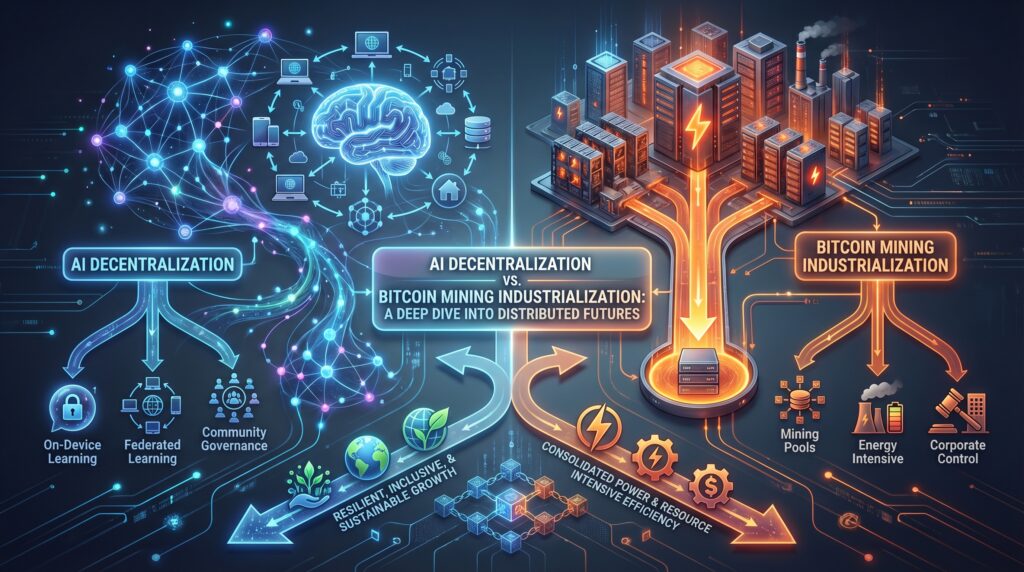
AI Decentralization vs. Bitcoin Mining Industrialization: A Deep Dive into Distributed Futures Framework 1
- Signal: What changed and why this matters now.
- Decision framework: Compare options by cost, risk, and implementation effort.
- Execution checklist: Concrete next step and measurable outcome.
The realms of artificial intelligence (AI) and blockchain technology are converging in profound ways. This convergence brings forth concepts like AI decentralization and the ongoing industrialization of Bitcoin mining. Understanding the dynamics of these two phenomena is crucial for grasping the future landscape of digital infrastructure, economic models, and technological governance.
While both AI and Bitcoin operate on principles that can be distributed, their real-world manifestations often diverge. AI decentralization is an ambitious vision to democratize access and control over AI. Bitcoin mining, despite its origins as a peer-to-peer system, has largely succumbed to the efficiency gains of centralized, industrial-scale operations.
This article will delve into the core tenets of AI decentralization and the industrialization of Bitcoin mining. We will explore their foundational principles, technologies, economic drivers, and societal implications. By comparing their trajectories, we can better anticipate the challenges and opportunities each presents for a truly decentralized and equitable digital future.
Understanding AI Decentralization: Principles and Goals
AI decentralization refers to the movement towards distributing the components of artificial intelligence systems across a network of participants rather than centralizing them in the hands of a few entities. This includes decentralizing data ownership, computational power, algorithm development, and critical decision-making processes. The core goal is to foster greater transparency, resilience, and equitable access to AI technologies, mitigating the power imbalances observed in conventional AI development.
The concept directly challenges the current paradigm where large tech corporations dominate AI research and deployment. These corporations control vast datasets, powerful computing resources, and proprietary algorithms. Decentralization seeks to break down these silos and create a more open, collaborative, and censorship-resistant AI ecosystem.
The Foundational Pillars of Decentralized AI
Several key pillars underpin the vision of decentralized AI. These pillars address different aspects of the AI lifecycle, from data generation to model deployment. Understanding them is essential for grasping the holistic nature of this movement.
First, decentralized data ownership and access are paramount. Instead of data aggregation by a few, decentralized AI promotes individuals and smaller entities owning and controlling their data. This often involves privacy-preserving techniques like federated learning and homomorphic encryption, ensuring data utility without compromising privacy.
Second, distributed computing power is crucial. This pillar aims to democratize access to the intensive computational resources required for AI training and inference. Projects are emerging that allow individuals to contribute their idle GPU power to a network, earning rewards in return. This creates a global supercomputer for AI development, much like early distributed computing initiatives.
Third, transparent and open-source algorithms form another vital component. Decentralized AI advocates for open development and auditing of AI models. This approach reduces bias, enhances trustworthiness, and prevents the creation of \”black box\” AI systems that are difficult to scrutinize or understand. This contrasts with proprietary models where internal workings are often hidden.
Key Technologies Enabling Decentralized AI
The realization of decentralized AI relies on a suite of cutting-edge technologies. These technologies provide the infrastructure and mechanisms necessary to distribute AI components effectively. Blockchain, specifically, plays a critical role in many of these initiatives.
Blockchain and Distributed Ledger Technologies (DLT) are fundamental. They provide immutable records for data provenance, incentivize participation through token economies, and enable transparent governance structures. Smart contracts automate agreements and reward distribution, facilitating complex interactions in a trustless environment.
Federated Learning is a critical privacy-preserving technique. It allows AI models to be trained on decentralized datasets without the data ever leaving its source. Instead of sending raw data to a central server, only model updates or gradients are shared, protecting individual privacy while still enabling collective intelligence.
Homomorphic Encryption augments data privacy by allowing computations to be performed on encrypted data without decrypting it first. This means sensitive information can remain encrypted even during AI processing, providing a robust layer of security. Combining this with federated learning offers powerful privacy guarantees.
Decentralized AI marketplaces and protocols are also emerging. These platforms facilitate the sharing of datasets, computational resources, and pre-trained AI models in a peer-to-peer fashion. They often leverage token incentives to reward contributors and ensure the quality of shared resources.
Framework for Decentralized AI
- Data Layer: Federated Learning, Homomorphic Encryption, Privacy-Preserving AI
- Compute Layer: Distributed GPU Networks, Peer-to-Peer Computing, Edge AI
- Model Layer: Open-Source Models, Collaborative Training, Model Watermarking
- Incentive Layer: Blockchain-based Tokenomics, Proof-of-Contribution, Reputation Systems
- Governance Layer: Decentralized Autonomous Organizations (DAOs), Community Voting, Algorithmic Governance
Benefits and Challenges of Decentralized AI
The promise of decentralized AI is significant, but it also faces considerable hurdles. Understanding both sides is key to assessing its potential trajectory. The composable AI coding stack could benefit greatly from decentralized components.
Benefits include:
- Increased Resilience: A distributed network is less susceptible to single points of failure, censorship, or malicious attacks. If one node goes down, the system can continue operating.
- Enhanced Privacy and Security: Data remains in the control of its owners, and privacy-preserving techniques reduce the risk of data breaches and misuse.
- Democratized Access: Lowers the barrier to entry for AI development and deployment, enabling smaller teams and individuals to contribute and utilize powerful AI tools.
- Reduced Bias: Diverse data sources and open-source models can help mitigate algorithmic bias, leading to more equitable and fair AI systems.
- New Economic Models: Token economies create novel ways to incentivize contributions, reward innovation, and foster collaborative development. Developers can explore AI agents crypto investment opportunities within these new models.
Challenges, however, are substantial:
- Scalability and Efficiency: Decentralized networks can be slower and less efficient than centralized counterparts, particularly for bandwidth-intensive AI workloads.
- Coordination and Governance: Managing and coordinating a vast, distributed network of participants for complex AI projects is inherently difficult and requires robust governance mechanisms.
- Technical Complexity: Integrating various blockchain technologies, privacy-preserving techniques, and AI models presents significant technical challenges for developers.
- Regulatory Uncertainty: The decentralized nature of these systems often exists in a regulatory grey area, posing compliance challenges and hindering mainstream adoption.
- Cost: While aiming to democratize, the energy and computational costs for complex DLTs combined with AI can paradoxically be high, especially in early stages.
The Industrialization of Bitcoin Mining: A Centralized Evolution
Bitcoin mining, the process by which new Bitcoin transactions are verified and added to the blockchain, began as a distributed activity. Early miners used standard personal computers to solve cryptographic puzzles. However, driven by economic incentives and technological advancements, the landscape has dramatically shifted towards large-scale, industrial operations. This trend, often termed the industrialization of Bitcoin mining, contrasts sharply with the original vision of decentralized participation.
This industrialization has profound implications for the network’s security, energy consumption, and the distribution of power within the Bitcoin ecosystem. It has transformed a hobbyist pursuit into a multi-billion dollar industry characterized by specialized hardware, massive data centers, and advanced energy management strategies.
From Home PCs to Mining Farms: The Journey of Bitcoin Mining
The evolution of Bitcoin mining capacity highlights a relentless pursuit of efficiency. Initially, Satoshi Nakamoto and early adopters mined Bitcoin using CPU power. As the network grew and difficulty increased, GPU mining became prevalent, offering significantly higher hash rates. This was the first step towards specialization.
The real shift towards industrialization began with the advent of Application-Specific Integrated Circuits (ASICs). These specialized chips are designed solely for Bitcoin mining, offering orders of magnitude greater efficiency and hash power compared to GPUs. This innovation immediately rendered CPU and GPU mining unprofitable for the vast majority of participants. This specialized hardware led to a significant barriers to entry previously absent.
Today, Bitcoin mining is dominated by massive data centers, often referred to as mining farms. These facilities house tens of thousands of ASICs, require enormous amounts of electricity, and are typically located in regions with cheap energy resources and cool climates. The operational scale of these farms resembles that of traditional industrial enterprises, complete with dedicated infrastructure and complex logistics.
Evolutionary Stages of Bitcoin Mining
- CPU Mining (2009-2010): Early days, personal computers, low difficulty, hobbyist-driven.
- GPU Mining (2010-2011): Graphics cards introduced, increased hash power, rise of smaller enthusiasts.
- FPGA Mining (2011-2012): Field-Programmable Gate Arrays, further specialized hardware, increased efficiency.
- ASIC Mining (2013-Present): Application-Specific Integrated Circuits, purpose-built hardware, huge leap in efficiency, led to industrialization.
- Mining Farms/Pools (2014-Present): Large-scale data centers, pooling of hash power, centralization of operations.
Economic Drivers Behind Industrialization
The industrialization of Bitcoin mining is primarily an economic phenomenon, driven by fierce competition for block rewards. Several factors have pushed mining operations towards larger scales and greater specialization. Mining profitability heavily relies on the Bitcoin price, network difficulty, and electricity costs. These factors dictate the viability of operations, leading miners to continuously optimize their setups.
Economies of Scale: Large-scale operations can procure ASICs in bulk, often securing better prices and priority access to the latest models. They can also negotiate lower electricity rates with power providers due to their massive consumption. Furthermore, the operational overhead per unit of hash power decreases with scale, making it significantly more profitable than small-scale mining.
Access to Cheap Energy: Electricity is the largest operational cost for Bitcoin miners. Industrial miners actively seek out regions with abundant, cheap, and often underutilized energy sources, such as hydroelectric power or natural gas flare sites. This global search for inexpensive power has led to the concentration of mining operations in specific geographic locations.
Specialized Infrastructure: Running thousands of ASICs requires sophisticated infrastructure for cooling, power distribution, and network connectivity. This includes industrial-grade HVAC systems, high-capacity transformers, and dedicated internet connections. Smaller miners cannot afford or efficiently manage such infrastructure, creating a significant barrier to entry.
Financialization of Mining: The mining industry has attracted substantial institutional capital. Investment firms and publicly traded companies now operate mining facilities, further professionalizing the sector. This influx of capital enables further expansion and acquisition of cutting-edge hardware, solidifying the industrial trend.
Environmental and Geopolitical Implications of Industrialized Mining
The industrialization of Bitcoin mining has drawn considerable scrutiny regarding its environmental footprint and geopolitical implications. The massive energy consumption associated with proof-of-work consensus has become a contentious issue, raising concerns about sustainability and climate change. Furthermore, the concentration of mining power in certain regions introduces new geopolitical risks.
Energy Consumption and Carbon Footprint: The sheer scale of electricity required to power industrial mining farms is a major environmental concern. While a significant portion of this energy comes from renewable sources, fossil fuels still contribute substantially. The debate continues on accurate energy consumption figures and the proportion of clean energy utilized. Efforts to make this energy use more transparent are often complicated by the dynamic nature of the industry and challenges in data collection.
The FrontierWisdom perspective: While Bitcoin mining’s energy consumption is undeniable, the focus should shift to the *source* of that energy. Industrial miners are increasingly incentivized to tap into stranded or renewable energy supplies, which might otherwise go unused. This could paradoxically accelerate renewable energy infrastructure development. However, the sheer scale still demands careful ecological consideration.
E-Waste Generation: The rapid obsolescence of mining hardware (ASICs) due to continuous technological advancements results in significant electronic waste. As newer, more efficient models are released, older ASICs become unprofitable and are discarded, contributing to a growing e-waste problem. This cycle of technological refresh is an inherent feature of the competitive mining landscape.
Centralization of Hash Power: Despite Bitcoin’s decentralized ethos, the concentration of mining farms and pools has led to a de facto centralization of hash power. If a small number of entities control a majority of the network’s hash rate, it theoretically poses a risk to the network’s security, potentially enabling a 51% attack. This is a topic of ongoing debate and concern within the cryptocurrency community.
Geopolitical Influence: The geographic concentration of mining operations can create geopolitical vulnerabilities. Governments in regions with high mining activity could exert influence or impose regulations that affect the entire Bitcoin network. This can lead to concerns about governmental control over what is intended to be a global, permissionless currency. Examples like China’s past crypto mining ban illustrate this risk.
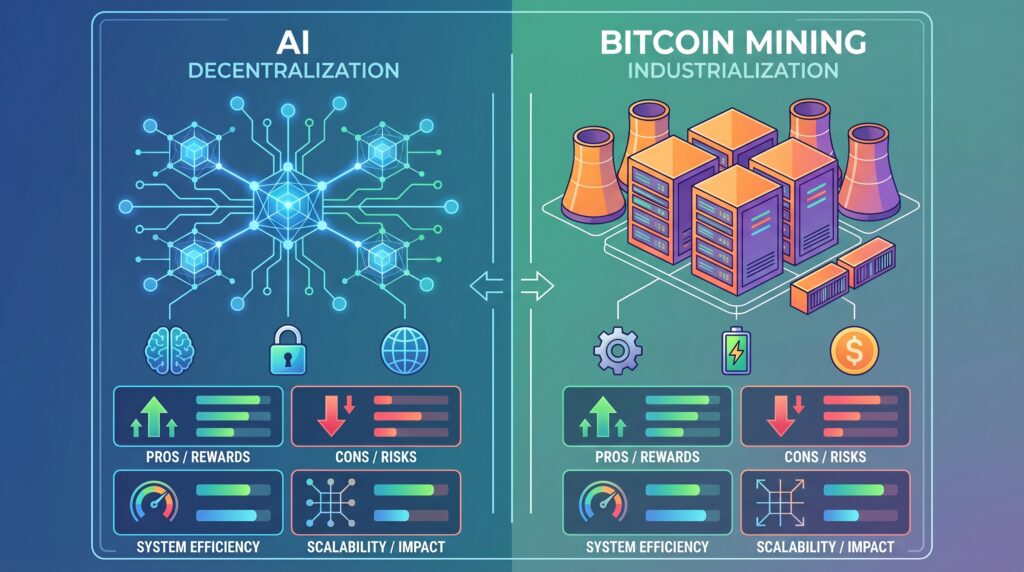
Comparing the Paradigms: AI Decentralization vs. Bitcoin Industrialization
While both AI decentralization and Bitcoin mining industrialization engage with distributed networks and computational power, their fundamental trajectories and underlying philosophies diverge significantly. One actively seeks to distribute control, while the other has converged towards efficiency through centralization. This section will explore these key differences across various dimensions, providing a comprehensive contrast.
Understanding these distinctions is crucial for assessing their respective roles in shaping the future of technology and society. Both processes offer valuable lessons and highlight different aspects of how distributed systems evolve under various economic and technological pressures.
Decentralization of Power, Computation, and Data
The core difference lies in their approach to decentralization itself. AI decentralization is a proactive effort to prevent power concentration, whereas Bitcoin mining, while starting decentralized, has seen power gravitate to fewer, larger entities.
- AI Decentralization:
- Power: Actively seeks to prevent monopolistic control over AI development, deployment, and access. Aims to distribute governance and decision-making through DAOs and community participation. This aligns with the principles of AI in Decentralized Finance (DeFi) applications.
- Computation: Focuses on distributed computing, allowing individuals and smaller centers to contribute GPU/CPU power. The goal is to create a globally distributed AI supercomputer.
- Data: Emphasizes individual data sovereignty and privacy-preserving methods (e.g., federated learning). Data remains localized and under user control, preventing massive central data pools.
- Bitcoin Mining Industrialization:
- Power: While Bitcoin’s protocol is decentralized, the economic realities of mining have led to a concentration of hash power in large mining pools and farms. This creates potential points of control, though the protocol is designed to resist direct censorship by a single actor.
- Computation: Highly centralized in massive, specialized data centers using ASICs. Home mining is largely unprofitable, pushing computational power towards industrial operations.
- Data: Transactions are transparent on the public blockchain, but the “data” being processed (transaction verification) is not subject to individual ownership in the same way as AI training data.
The philosophical underpinning of AI decentralization is to empower the periphery, while Bitcoin mining industrialization demonstrates how powerful economic incentives can centralize even inherently decentralized systems.
Economic Incentives and Market Structures
The economic models and market structures driving each phenomenon are distinct, shaping their respective growth and development trajectories. AI decentralization often relies on token-based economies to align incentives, while Bitcoin mining’s market is driven by direct competition for a finite block reward.
- AI Decentralization:
- Incentives: Token economies reward participants for contributing data, computational power, or developing algorithms. This creates a multi-sided market where various actors can monetize their resources and expertise. For instance, developers of AI agents for decentralized trading platforms could be incentivized through such models.
- Market Structure: Aims for open, permissionless marketplaces for AI services and resources. Competition is fostered by a broader base of contributors, reducing vendor lock-in and promoting innovation.
- Capitalization: Often funded through decentralized venture capital (DAO-governed funds) and token sales, allowing for community ownership and distributed investment.
- Bitcoin Mining Industrialization:
- Incentives: The primary incentive is the block reward (newly minted bitcoins) and transaction fees. This creates a direct, highly competitive “race to solve” the cryptographic puzzle, rewarding the most efficient miner.
- Market Structure: Characterized by an oligopolistic market where a few large mining conglomerates and pools dominate. Economies of scale and access to capital are critical entry barriers, leading to consolidation.
- Capitalization: Heavily reliant on traditional venture capital, private equity, and public market listings for mining companies, reflecting a more conventional corporate structure.
The contrast highlights how different incentive mechanisms lead to varied market outcomes. AI decentralization hopes to distribute economic benefits more broadly, whereas Bitcoin mining has concentrated them.
Governance and Ethical Considerations
Both areas grapple with critical governance and ethical questions, but from different perspectives. AI decentralization explicitly addresses ethical AI from its core design, while Bitcoin mining’s ethical considerations largely revolve around its environmental impact and hash power distribution.
- AI Decentralization:
- Governance: Emphasizes transparent, community-driven governance through DAOs, allowing token holders to vote on protocol upgrades, resource allocation, and ethical guidelines. AI agent frameworks benefit from clear, verifiable governance structures.
- Ethical Focus: Prioritizes bias mitigation, privacy protection, and preventing the misuse of powerful AI. The open-source nature and distributed auditing aim to create more responsible AI systems.
- Accountability: Aims for distributed accountability, making it harder for a single entity to escape responsibility for AI system failures or ethical breaches, but potentially more complex to attribute blame.
- Bitcoin Mining Industrialization:
- Governance: While Bitcoin’s protocol governance is decentralized (via BIPs and client implementations), the concentration of mining power gives large miners significant influence over network upgrades and consensus.
- Ethical Focus: Primarily concerned with its significant energy consumption and carbon footprint, as well as the environmental impact of e-waste. Debates also surround the geopolitical implications of concentrated hash power.
- Accountability: Accountability for environmental impact often rests with the individual mining operations, though the broader Bitcoin community faces collective pressure to address sustainability.
The deliberate design for ethical AI and distributed governance is a hallmark of the decentralized AI movement. Bitcoin’s governance, while robust at the protocol level, faces ethical questions arising from its industrial development.
Comparison: AI Decentralization vs. Bitcoin Mining Industrialization
| Feature | AI Decentralization | Bitcoin Mining Industrialization |
|---|---|---|
| Primary Goal | Distribute AI control, data, compute; foster open, ethical AI. | Secure Bitcoin network, verify transactions; earn block rewards. |
| Computational Model | Distributed peer-to-peer compute, federated learning, edge AI. | Centralized data centers, specialized ASICs, massive scale. |
| Data Model | Decentralized data ownership, privacy-preserving techniques. | Public blockchain for transactions, no individual data ownership focus. |
| Economic Incentives | Token rewards for data, compute, algo contribution. Multi-sided markets. | Block rewards & transaction fees. Oligopolistic competition for efficiency. |
| Governance | DAOs, community voting, transparent protocol upgrades. | Protocol governance via client impl., hash power concentration implies influence. |
| Key Technologies | Blockchain, Federated Learning, Homomorphic Encryption. | ASICs, large-scale power infrastructure, mining pools. |
| Barriers to Entry | Technical complexity, network effects for adoption. | High capital investment (ASICs, infrastructure), access to cheap energy. |
| Environmental Impact | Potentially lower due to efficient resource sharing; however, DLT overhead can be high. | Significant energy consumption (carbon footprint) & e-waste; efforts towards renewables. |
| Societal Impact | Democratizes AI access, mitigates bias, enhances privacy. | Secures global financial network, but raises centralization & environmental concerns. |
Shared Challenges and Potential Synergies
Despite their divergent paths, both AI decentralization and industrialized Bitcoin mining face common challenges and present opportunities for synergistic collaboration. These areas of overlap highlight broader issues within the decentralized technology landscape and suggest potential avenues for future innovation. The growth of China’s AI token economy could also be affected by these challenges.
Scalability and Efficiency Hurdles
Both decentralized systems grapple with the fundamental trade-off between decentralization, security, and scalability. This ‘blockchain trilemma’ is not exclusive to cryptocurrencies but impacts any distributed ledger technology. The computational demands of AI further exacerbate these issues for decentralized AI initiatives.
For decentralized AI, executing complex AI model training or inference across a distributed network can be significantly slower and more resource-intensive than on centralized supercomputers. The overhead of blockchain transactions, cryptographic operations, and network latency poses major scalability hurdles. Efficient data routing, optimized consensus mechanisms, and off-chain computation are critical research areas. Large datasets for training generative AI models, for example, are still typically processed in huge centralized server farms due to infrastructure bottlenecks.
For Bitcoin mining, while efficiency in terms of hash rate per watt has dramatically improved with ASICs, the overall network’s energy consumption is a direct consequence of its proof-of-work security model. Scaling the network (e.g., higher transaction throughput) without compromising decentralization or security remains an ongoing challenge. Solutions like the Lightning Network attempt to address transaction scaling off-chain, but the core mining operation remains energy-intensive at its base layer. Both sectors are seeking radical improvements in throughput, latency, and resource utilization to fulfill their long-term visions.
Regulatory Landscapes and Adoption
Both domains operate within nascent and often uncertain regulatory environments, which significantly impacts their mainstream adoption and institutional integration. As technology outpaces legislation, pioneers in both fields navigate a complex and evolving legal maze. Businesses building trading bot platforms or crypto AI trading apps need to be acutely aware of these regulatory shifts.
Decentralized AI projects face challenges related to data privacy regulations (e.g., GDPR, CCPA), intellectual property rights for collaboratively trained models, and the legal status of decentralized autonomous organizations (DAOs). Defining legal responsibility and liability in a permissionless, distributed system is exceptionally complex. Clear regulatory frameworks are essential for enterprises and institutional investors to confidently engage with decentralized AI solutions, which could unlock significant capital and talent.
Bitcoin mining industrialization grapples with regulations concerning energy consumption, environmental impact, and financial oversight. Governments worldwide are increasingly scrutinizing Bitcoin’s carbon footprint, leading to policy shifts that can drastically impact mining operations (e.g., bans, incentives for renewable energy). Additionally, the financial regulatory landscape for cryptocurrencies continues to evolve, affecting how mining businesses operate, raise capital, and manage their assets. The global nature of both makes coordination among different jurisdictions particularly difficult.
The Role of AI in Optimizing Decentralized Systems
A significant synergy lies in the potential for AI to optimize and enhance decentralized systems, including Bitcoin mining. AI can be a powerful tool for addressing some of the intrinsic challenges faced by distributed technologies, leading to more efficient, secure, and scalable solutions. Developers are integrating AI into systems today for maximum effect, as detailed in guides like Integrate AI Tool via API Python.
AI for Network Optimization: AI algorithms can be employed to optimize routing, load balancing, and resource allocation in decentralized networks, improving their overall efficiency and reducing latency. This is particularly relevant for distributed AI computation, where efficient management of diverse computational resources is crucial. For instance, AI could intelligently distribute federated learning tasks to available compute nodes based on their capacities and network conditions.
Enhanced Security and Anomaly Detection: AI can significantly bolster the security of decentralized systems by detecting anomalous behavior, identifying potential Sybil attacks, and flagging malicious actors. Machine learning models can analyze network traffic patterns and transaction histories to identify deviations from normal behavior, offering an additional layer of protection against cyber threats. Detecting and preventing AI security threats is a burgeoning field.
Energy Efficiency in Mining: For industrial Bitcoin mining, AI can optimize energy consumption by intelligently managing ASIC operations, predicting energy price fluctuations, and dynamically switching between power sources. AI-powered algorithms can determine the most profitable times to mine, integrate with smart grids, and even identify opportunities to utilize excess or curtailed renewable energy. This could significantly reduce the environmental impact of large-scale mining operations and move from brute-force tactics.
The FrontierWisdom Takeaway: The convergence of AI and decentralized technology isn’t just about decentralizing AI. It’s also about using advanced AI to make existing decentralized systems, like Bitcoin, more robust, efficient, and sustainable. This symbiotic relationship could unlock new levels of performance for both fields, allowing them to overcome their respective scaling and resource optimization challenges.
Future Outlook: The Evolving Relationship
The trajectories of AI decentralization and Bitcoin mining industrialization are likely to continue diverging in some aspects while converging in others. The coming years will be critical in shaping their impact on global technology, economics, and governance. Predicting the exact future is challenging, but trends suggest a complex interplay between these powerful forces.
The growth of AI-powered financial tools and platforms, as seen in trading bot platform comparisons and guides to best performing AI stocks, will rely on the underlying infrastructure developed in both decentralized and centralized AI contexts.
Hybrid Models and Emerging Architectures
Purely decentralized systems face significant challenges, just as purely centralized systems pose risks. The future is likely to see the emergence of hybrid models that combine the strengths of both approaches. This means leveraging centralized efficiencies for specific tasks while maintaining decentralized control over critical aspects like data ownership and governance. This shift is already evident in many projects building solutions for AI model deployment tools.
- For AI: Hybrid architectures could involve centralized cloud providers for computationally intensive AI tasks, with blockchain-based layers ensuring data integrity, model provenance, and transparent governance. Federated learning allows models to be trained on distributed data while only aggregated insights are shared, representing a form of hybrid decentralization. Platforms for AI ad performance optimization might use such hybrid platforms.
- For Bitcoin: Mining pools are already a form of semi-centralization, aggregating hash power while individuals still contribute. The ongoing debate around layer-2 solutions like the Lightning Network also represents a hybrid approach, aiming to scale transactions off-chain while settling on the more secure, albeit slower, main chain. This provides greater flexibility without compromising the core tenets of security.
These hybrid models seek a pragmatic balance, recognizing that absolute decentralization might not always be the most efficient or practical solution for all components of a complex system. They are crucial for moving beyond theoretical ideals to real-world applications. The design of AI automation workflows will increasingly incorporate these hybrid paradigms.
Impact on Global Innovation and Access to Technology
The long-term impact of these trends will be felt globally, influencing who controls and benefits from cutting-edge technologies. The choices made today in designing these systems will have profound implications for future equity and innovation. The rise of agentic AI trading infrastructure, for example, highlights how these technologies directly influence economic access.
Decentralized AI holds the promise of democratizing access to powerful AI tools, enabling innovators in developing regions or smaller organizations to compete with tech giants. By lowering costs and providing open access to models and computing, it could foster a more diverse and globally distributed innovation ecosystem. This could lead to a proliferation of culturally nuanced and region-specific AI applications that might not emerge from centralized development pipelines. The Python AI automation script community and other open-source initiatives will be pivotal in this regard.
Conversely, the industrialization of Bitcoin mining, while securing the network, could also exacerbate existing inequalities. If access to mining resources becomes highly concentrated, it could create a global digital divide where only well-capitalized entities can participate in securing and benefiting from the network’s foundational layer. However, by seeking out cheap, underutilized energy sources globally, industrial mining could also indirectly spur infrastructure development in remote areas, although this benefit is incidental rather than a core design goal. The question of universal and equitable access to computational power remains central to both narratives.
Ultimately, the ongoing interplay between AI decentralization and Bitcoin mining industrialization underscores a fundamental tension in the digital age: the pull towards efficiency and scale versus the push for decentralization and equitable distribution of power. How this tension resolves will profoundly shape the technological landscape for decades to come.
Key Takeaways
- AI Decentralization aims to distribute AI processing, data ownership, and governance to prevent concentration of power, enhance privacy, and democratize access.
- Bitcoin Mining Industrialization describes the shift from individual mining to large, centralized data centers using specialized hardware (ASICs), driven by economies of scale and the pursuit of efficiency.
- Key Divergence: Decentralized AI actively seeks to prevent centralization and empower the periphery, while Bitcoin mining, despite its decentralized protocol, has seen a de facto centralization of hash power due to economic forces.
- Technological Pillars: Decentralized AI relies on blockchain, federated learning, and homomorphic encryption; industrial Bitcoin mining relies on ASICs, massive power infrastructure, and mining pools.
- Economic Models: Decentralized AI uses token economies for broad participation; Bitcoin mining is driven by fierce competition for block rewards, favoring large, efficient operations.
- Shared Challenges: Both face hurdles in scalability, efficiency, and navigating complex regulatory landscapes.
- Synergies: AI can optimize decentralized systems, including more efficient, secure, and environmentally friendly Bitcoin mining operations.
- Future Outlook: Hybrid models combining centralized efficiency with decentralized control are likely to emerge, impacting global innovation and access to technology.
Frequently Asked Questions (FAQ)
What is AI decentralization?
AI decentralization is an approach to building and deploying AI systems where data ownership, computational power, and algorithmic control are distributed across a network of participants, rather than being concentrated in a few central entities. It often leverages blockchain and privacy-preserving technologies to promote transparency, resilience, and equitable access to AI.
How has Bitcoin mining become industrialized?
Bitcoin mining industrialized as the profitability of mining shifted from general-purpose CPUs/GPUs to specialized, high-efficiency Application-Specific Integrated Circuits (ASICs). The need for cheap electricity, large-scale infrastructure, and capital investment led to the formation of massive mining farms and pools, effectively centralizing hash power and turning mining into a large-scale industrial operation.
What are the main differences between AI decentralization and Bitcoin mining industrialization?
The main difference lies in their current trajectories and goals. AI decentralization actively seeks to prevent and reverse centralization, aiming to distribute control over AI resources and governance. Bitcoin mining, despite its decentralized protocol design, has seen an industrial trend that concentrates hash power in fewer, larger entities driven by economic incentives for efficiency. One pursues distributed control, the other has converged power for optimization.
Can AI help make Bitcoin mining more environmentally friendly?
Yes, AI can play a significant role in making Bitcoin mining more environmentally friendly. AI algorithms can optimize energy consumption by intelligently managing ASIC operations, predicting optimal mining times based on energy prices, and enabling better integration with renewable or otherwise curtailed energy sources. This can lead to more efficient and sustainable mining practices.
What are the benefits of decentralized AI?
The benefits of decentralized AI include increased system resilience against censorship and failure, enhanced data privacy and security through techniques like federated learning, democratized access to AI tools for a wider range of participants, reduced algorithmic bias through diverse development, and the creation of new, fairer economic models for AI contributions.