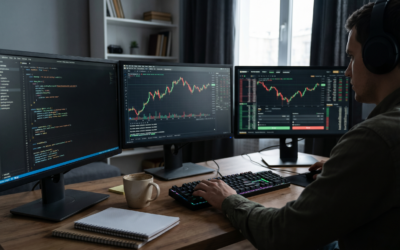
Free AI stock trading bots automate buy-sell decisions with algorithms, backtest strategies, and execute trades—often with zero cost entry using freemium platforms, community tools, or broker integrations as of 2026. Risks include data dependency, overfitting, and limited customization without paid upgrades.
Free AI stock trading bots offer automated trading capabilities, primarily using machine learning to analyze market data and execute trades. While beneficial for education and basic strategy testing, they often come with limitations like delayed data, restricted features, and a steeper learning curve for open-source solutions. Key options for 2026 include AlpacaML, QuantConnect, Trade Ideas (free plan), MT5 with EA Studio, Kryll.io, and self-hosted Freqtrade.
Key Takeaways
- Free AI trading bots automate stock buy/sell decisions using algorithms, often available through freemium models, community tools, or broker integrations.
- Top options for 2026 include AlpacaML Free Tier, QuantConnect LEAN Engine, Trade Ideas Free Plan, MetaTrader 5 with Free EA Studio, Kryll.io Starter Plan, and self-hosted Freqtrade.
- These bots leverage machine learning, NLP, and predictive analytics, but free versions typically have limitations like data delays or restricted features.
- Key features to evaluate are the backtesting engine, strategy customization options, data quality, broker integration, and risk management tools.
- Risks include data latency, overfitting, broker reliability issues, and security concerns, making paper trading essential before live deployment.
What Are Free AI Stock Trading Bots?
AI stock trading bots use machine learning, natural language processing, and predictive analytics to automate trading. Free versions typically offer basic strategy automation, paper trading, and limited access to market data.
They rely on historical and real-time data to identify patterns, execute orders, and manage portfolios with minimal human intervention. This automation can help traders react faster to market changes.
Key components include data ingestion APIs, strategy backtesting modules, risk management rules, and exchange connectors. Most free bots operate on cloud servers, eliminating complex local setup needs. Open-source options like Freqtrade or Jesse, though requiring self-hosting, offer full control over strategy development.
Top Free AI Stock Trading Bots in 2026
1. AlpacaML Free Tier
AlpacaML provides commission-free API trading integrated with ML backtesting. Free users gain access to Polygon.io market data, albeit with call limits, and can effectively deploy Python-based strategies. It currently supports US equities only, with no minimum balance required to start.
2. QuantConnect LEAN Engine
QuantConnect offers an open-source platform with free cloud backtesting across more than 50 global markets. Its features include Sharpe ratio optimization, portfolio replay, and direct integration with Interactive Brokers. Users need to code in Python or C#, but a vibrant community supports strategy development.
3. Trade Ideas Free Plan
The free version of Trade Ideas provides a real-time scanner equipped with basic AI pattern recognition. It includes three active alerts, delayed data, and limited backtesting capabilities. The platform uses its proprietary Holly AI engine to identify momentum and gap play opportunities.
4. MetaTrader 5 with Free EA Studio
MetaTrader 5 (MT5) allows users to build expert advisors (EAs) for free via EA Studio’s web version. This tool generates code-free strategies using genetic algorithms and is compatible with over 100 brokers. The free tier is limited to three strategies and basic indicators.
5. Kryll.io Starter Plan
Kryll.io features a user-friendly drag-and-drop strategy builder, offering free crypto and stock trading through broker APIs. The starter plan includes five strategy executions per month, various technical indicators, and paper trading. No credit card is required to begin.
6. Freqtrade (Self-Hosted)
Freqtrade is an entirely free, open-source Python bot that supports over 100 exchanges. It requires self-hosting on platforms like AWS/Azure or local deployment. Features include comprehensive backtesting, hyperparameter tuning, and dynamic positioning, though it has a steeper learning curve.
How Free AI Trading Bots Work
AI bots ingest market data, including price, volume, and news, using APIs from sources like Alpha Vantage or Twelve Data. Machine learning models, often LSTM networks or gradient boosting, predict short-term price movements. Reinforcement learning continuously adjusts strategies based on performance feedback.
Natural language processing (NLP) is employed to scan SEC filings, earnings calls, and financial news for sentiment signals that can influence market behavior. Execution APIs from brokers such as Alpaca or TD Ameritrade then place orders automatically. Risk layers are also built in, providing essential features like stop-loss triggers and position sizing rules.
Free versions of these bots typically throttle data speed, often with 1-minute delays, or limit the depth of historical data. Some may also restrict live trading hours, which can affect rapid market response. Open-source bots, while bypassing these limitations, demand more extensive infrastructure management and technical expertise from the user.
Key Features to Look For
- Backtesting Engine: A robust engine should support Walk-Forward Analysis and Monte Carlo simulations. Look for crucial metrics like Compound Annual Growth Rate (CAGR), Sharpe ratio, and maximum drawdown to evaluate strategy performance.
- Strategy Customization: Options range from code-based development, typically in Python, to visual builders. Free tools often impose restrictions on developing complex conditional logic.
- Data Quality: Assess whether the bot provides real-time or delayed data. Many free tiers, like those from Polygon.io and IEX Cloud, come with rate limits on data access.
- Broker Integration: Ensure compatibility with zero-commission brokers such as Alpaca, Webull, or TradeStation to minimize trading costs.
- Risk Management: Essential features include automated stop-loss, take-profit orders, and trailing stops. Free plans might lack dynamic risk adjustment capabilities, which are crucial for minimizing potential losses. For more insights on securing your trading capital, check out our guide on Bankroll Management for Trading Bots.
Choosing the Right Free AI Bot
When selecting a free AI trading bot, prioritize platforms that offer extensive paper trading capabilities. This allows you to test and refine your strategies in a risk-free environment without immediate financial exposure. Consider the learning curve associated with open-source options versus the ease of use of freemium models.
Comparison of Free AI Trading Bots
| Feature | AlpacaML Free | QuantConnect | Trade Ideas Free | Freqtrade (Self-Hosted) |
|---|---|---|---|---|
| Cost | $0 | $0 | $0 | $0 (hosting costs) |
| Markets | US Equities | Global Equities/Futures | US Equities | Crypto + Stocks |
| Backtesting | ✅ Limited Data | ✅ Full Historical | ✅ Basic | ✅ Extensive |
| Live Trading | ✅ API Only | ✅ Broker-linked | ❌ Alerts Only | ✅ Multi-exchange |
| Data Delay | 15-min Delay | Real-time (limited) | 15-min Delay | Real-time (self-sourced) |
| Strategy Language | Python | C#/Python | Visual | Python |
| Support | Community | Documentation | GitHub |
Risks and Limitations of Free Bots
Free AI trading bots, while accessible, come with several critical constraints that users must acknowledge:
- Data Latency: Delayed data, often 15 minutes or more, can lead to missed entry and exit points during volatile market periods. This can significantly impact trade profitability and execution quality.
- Overfitting: Strategies developed with limited backtesting data may perform well on historical data but fail dramatically in live market conditions. This is a common pitfall of insufficient testing across diverse market regimes.
- Broker Reliability: Free API connections to brokers can be subject to rate limiting or unexpected downtime. This can disrupt automated trading strategies and prevent timely order execution, leading to potential losses
- Security Risks: Open-source bots, while offering flexibility, require users to configure secure server environments. Without proper security measures, these setups can be vulnerable to cyberattacks. For more on protecting your digital assets, consider our guide on AI Cyberattack Warnings.
- No Guarantees: A 2025 FINRA report indicated that 72% of retail algorithmic traders experienced losses within 12 months. Free bots are primarily educational tools and do not guarantee profits.
It is always advisable to paper trade for 3-6 months before deploying any strategy with real capital. Validating strategies across multiple market conditions—bull, bear, and sideways markets—is crucial for understanding their robustness and reliability.
Building Your First Free AI Trading Strategy
A good starting point is a mean-reversion strategy on large-cap stocks. Here’s a basic plan:
- Data Source: Utilize the Alpha Vantage free API, which allows for 5 calls per minute, to gather necessary market data.
- Indicator: Implement the Relative Strength Index (RSI) with a 14-period setting. Trigger an entry when RSI(14) is below 30, indicating an oversold condition, and an exit when it rises above 70, signaling an overbought state.
- Backtest: Conduct thorough backtesting on QuantConnect, using data from 2020-2025 to cover varied market conditions.
- Execution: Deploy the strategy via AlpacaML, applying a 2% position sizing rule per trade to manage risk effectively.
- Monitor: Regularly check for drawdowns on a weekly basis, possibly integrating with TradingView for visual analysis and alerts.
It is important to avoid overtrading with free bots, as they can incur hidden costs through spread slippage or unfavorable fill prices. Always evaluate the cost-effectiveness of your strategy.
FAQ
Are free AI trading bots profitable?
Most free AI trading bots are not consistently profitable; they serve primarily as educational tools. Profitability requires highly customized strategies, access to quality real-time data, and continuous optimization. Free versions typically lack the advanced features necessary for generating consistent gains.
Do free bots work with Robinhood or Webull?
Free bots do not directly integrate with platforms like Robinhood or Webull. Users often resort to unofficial API wrappers, such as Robin-Stocks, or third-party solutions (used at your own risk). Official and more stable API support is typically found with brokers like Alpaca, TD Ameritrade, and Interactive Brokers.
What’s the catch with free trading bots?
The “catch” with free trading bots often involves vendors upselling premium features, advanced data feeds, or faster execution speeds for a fee. Open-source bots necessitate a significant level of technical expertise for setup and maintenance. All free options demand a considerable investment of time for strategy development and refinement.
Can I use multiple free bots simultaneously?
Yes, you can use multiple free bots simultaneously, but it’s crucial to avoid deploying correlated strategies that might expose you to excessive risk. Diversify your approach across different asset classes, such as stocks and crypto, and various timeframes. It’s also important to monitor for conflicting orders across different platforms to prevent unintended consequences.
How much money do I need to start?
You typically need a minimum of $100–500 to begin testing free AI trading bots with real capital. Smaller amounts can significantly amplify the impact of slippage and trading fees. It is critically important to never risk capital that is needed for your living expenses.