
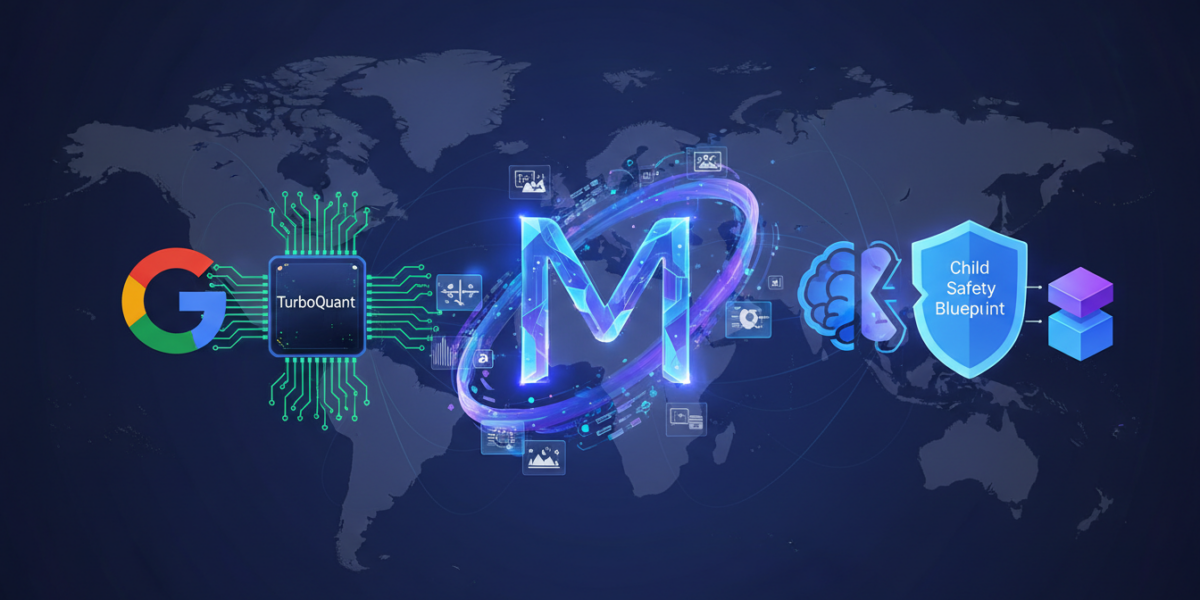
On April 9, 2026, the AI market saw significant developments: Meta launched its first major AI model post-Alexandr Wang, Google unveiled TurboQuant to boost LLM efficiency, and OpenAI balanced commercial growth with a Child Safety Blueprint. These moves intensify competition, enhance practical AI efficiency, and spotlight ethical deployment. Operators must swiftly evaluate new models, regulatory shifts, and infrastructure investments to stay competitive.
Breaking AI news today, April 9, 2026, includes Meta’s new multimodal and agentic AI model debut, Google’s TurboQuant algorithm for significant KV cache memory reduction in Large Language Models (LLMs), and OpenAI’s simultaneous release of a Child Safety Blueprint and expanded enterprise AI solutions. These developments highlight a surge in competitive AI model innovation, a strong focus on operational efficiency in LLM inference, and a strategic balancing act between rapid commercial expansion and responsible AI deployment.
The AI market experienced three major shifts on April 8th, 2026, signaling a new phase of intense competition and practical application. Meta, under Alexandr Wang’s leadership, launched its first significant AI model, poised to challenge existing leaders.
Simultaneously, Google introduced the groundbreaking TurboQuant algorithm at ICLR 2026, targeting crucial efficiency gains in LLM operations. OpenAI made a dual announcement, releasing a comprehensive Child Safety Blueprint alongside expanded enterprise solutions, indicating a strategic focus on both ethical governance and market capture.
Beyond these headline events, Aria.AI (ARIA) saw a notable 24.1% surge, new hardware breakthroughs emerged, and Anthropic strategically recruited a key Microsoft infrastructure executive. These combined movements underscore increasingly fierce competition, a drive for practical efficiency, and a necessary dual focus on commercial expansion and responsible ethical deployment. For operators, the immediate imperatives are clear: assess new model upgrades, adapt to evolving regulatory landscapes, and strategically plan infrastructure investments.
What Happened and Why It Matters
Meta’s new AI model marks its first major release since the high-profile recruitment of Alexandr Wang from Scale AI in mid-2025. This launch is not merely an incremental update; it represents Meta’s direct challenge to the dominance of OpenAI’s GPT series and Google’s Gemini models. Early intel suggests a strong emphasis on multimodal capabilities and agentic behavior, positioning it for diverse applications from consumer-facing apps to complex business integrations. The rapid nine-month development cycle highlights aggressive resource allocation, strategic talent acquisition, and an accelerated development strategy within Meta.
Google’s TurboQuant algorithm directly addresses a critical bottleneck in Large Language Models (LLMs): the KV cache memory overhead. In transformer-based architectures, the Key-Value (KV) cache stores previous token computations to prevent redundant processing, but this consumes vast amounts of memory, particularly with longer context windows. TurboQuant employs a novel quantization technique that drastically compresses this cache without significant degradation in performance. This innovation promises to substantially reduce operating costs for LLM inference and enables the use of longer context windows on existing hardware infrastructure.
OpenAI’s dual announcement of a Child Safety Blueprint and new enterprise AI solutions on the same day reveals a strategic balancing act. The Child Safety Blueprint meticulously outlines both technical safeguards and policy measures designed to prevent misuse, encompassing advanced content filters, robust age verification tools, and clear developer guidelines. Concurrently, their enterprise solutions likely include sophisticated fine-tuning APIs, secure private deployment options, and specialized industry-specific modules. This integrated approach aims to build public trust and address regulatory concerns while simultaneously capturing a larger share of the burgeoning business demand for advanced AI.
Secondary developments further underscore these prevailing trends. The Aria.AI token surge reflects a speculative interest in AI-crypto projects, though operators are advised to critically distinguish genuine utility from mere hype. An April 7th report on high-temperature memory devices paves the way for AI operations in extreme environments, such as industrial furnaces or critical space missions. Lastly, Anthropic’s strategic hire of a Microsoft infrastructure executive clearly indicates that successful AI scaling demands profound expertise in cloud architecture and data center management, not just advanced algorithmic development. This move is crucial for long-term growth and reliability, as explored in Project Glasswing: Anthropic’s $100 Million Bet on AI-Powered Cybersecurity.
Breaking AI Model Capabilities: April 2026
| AI Model/Platform | Key New Feature/Update | Primary Application | Operator Impact |
|---|---|---|---|
| Meta’s New AI Model | First major release post-Alexandr Wang hire; multimodal, agentic focus | Consumer apps, business automation | Evaluate for cost vs. OpenAI/Google; test API access |
| Google TurboQuant | KV cache memory reduction via quantization | LLM inference efficiency | Lower cloud costs; enable longer contexts on current GPUs |
| OpenAI Enterprise Solutions | Custom deployment, fine-tuning APIs, security modules | Business process automation | Integrate with existing workflows; assess data governance |
| Anthropic Infrastructure | Hiring Microsoft exec for scaling | Model training and deployment | Monitor for improved reliability and lower latency |
Regulatory Landscape: Global AI Initiatives (April 2026)
| Region/Country | Key AI Regulatory Update | Focus Area | Impact on Global Operators |
|---|---|---|---|
| EU | EU AI Act enforcement phase | Risk-based compliance | Strict rules for high-risk AI; mandatory audits |
| US | Draft federal AI legislation | Safety and accountability | Potential reporting requirements; align with NIST framework |
| China | Updated generative AI rules | Content control | Data localization; censorship filters required |
| UK | Pro-innovation approach | Light-touch regulation | Faster deployment but watch for future changes |
Top AI Investment & Acquisition News (April 2026)
| Acquirer/Investor | Target/Recipient | Industry/Focus | Strategic Implication |
|---|---|---|---|
| Anthropic | Microsoft infrastructure executive | Cloud/Scaling | Boost operational capacity for model training |
| Venture Funds | Aria.AI and similar tokens | AI-Crypto | Speculative bets on decentralized AI networks |
| Meta | AI talent (e.g., Alexandr Wang) | Core R&D | Accelerate model development against competitors |
| Hardware Firms | High-temperature memory tech | Physical AI | Enable AI in extreme environments (e.g., manufacturing) |
Key Terms: Breaking AI News Today
- Generative AI: Artificial intelligence that produces new content such as text, images, or audio from prompts. This technology is critical for creative and automated content generation tasks.
- Large Language Models (LLMs): Deep learning models designed to process and generate human-like text. They power applications like chatbots, code assistants, and advanced natural language interfaces.
- KV Cache: A memory storage mechanism used in transformer architectures to store the ‘Key’ and ‘Value’ representations of previously processed tokens. It is a critical component whose memory consumption is addressed by new innovations like TurboQuant.
- AI Governance: The set of rules, policies, and frameworks developed for the responsible and ethical development, deployment, and use of artificial intelligence. OpenAI’s Child Safety Blueprint is an example of an AI governance initiative.
- AI Regulation: Government laws and directives designed to guide and control the use of artificial intelligence. The EU AI Act, currently the most stringent, exemplifies increasing global efforts in AI regulation.
- Physical AI: AI systems designed to interact with and operate within the physical world, often through robotics and advanced sensor technologies. These systems are crucial for automation in industries like manufacturing and logistics.
- Enterprise AI: Artificial intelligence solutions specifically tailored for business environments to enhance efficiency, automate processes, and support data-driven decision-making. These solutions often integrate with existing corporate workflows.
Risks and Realities
The risks of AI misinformation are growing, particularly with new, advanced models like Meta’s latest release and OpenAI’s Sora. While platforms like Facebook are innovating in content moderation, operators must implement their own verification tools to combat false narratives. Data privacy concerns also remain paramount; ensuring compliance with GDPR and upcoming US regulations is critical. Despite safety blueprints, ethical gaps persist, necessitating regular internal audits. Fears about job displacement are frequently overstated; the focus should shift to upskilling teams for AI-augmented roles rather than outright replacement. Furthermore, the hype surrounding AI crypto tokens, such as Aria.AI, often exceeds their actual utility; operators should rigorously evaluate such tokens based on their proven use cases rather than speculative interest.
What to Do Next
FAQ: Breaking AI News Today
What is the most significant AI news today?
Meta’s new AI model debut, Google’s TurboQuant release, and OpenAI’s simultaneous safety and enterprise moves are the top stories. These developments collectively highlight intensified competition, significant efficiency gains in AI operations, and a strategic balance between ethical considerations and commercial expansion.
How does TurboQuant help AI operators?
TurboQuant substantially reduces KV cache memory usage in Large Language Models (LLMs). This innovation directly translates to lower cloud computing costs and enables the processing of longer contexts without requiring immediate hardware upgrades. Operators can implement it through Google’s AI platforms.
Why did Aria.AI token surge 24%?
The surge in Aria.AI’s token price is primarily attributed to speculative interest within the AI-linked cryptocurrency market. It is crucial for operators to evaluate such tokens based on their actual project utility and technical fundamentals, rather than solely on market hype.
What is OpenAI’s Child Safety Blueprint?
OpenAI’s Child Safety Blueprint is a comprehensive framework designed to prevent the misuse of AI technologies, particularly concerning minors. It includes provisions for advanced content filtering tools, robust age verification mechanisms, and clear guidelines for developers to ensure responsible AI deployment.
How does the high-temperature memory device affect AI?
The development of high-temperature memory devices significantly expands the operational environments for AI hardware. This breakthrough enables AI systems to function reliably in extreme heat conditions, opening new applications in sectors like advanced manufacturing, energy production, and critical aerospace missions.
Is AI regulation increasing in 2026?
Yes, AI regulation is notably increasing in 2026, especially within the European Union with the enforcement phase of the EU AI Act. The United States is also actively drafting federal-level AI legislation. Staying compliant with these evolving regulations is essential for all operators to avoid potential penalties and legal challenges.
Should businesses adopt enterprise AI solutions now?
Businesses should proactively consider adopting enterprise AI solutions, particularly if these tools offer clear pathways to improved efficiency, enhanced decision-making, or automated processes. Starting with strategic pilot projects in areas like customer service or data analysis can demonstrate immediate value and facilitate broader integration.
What risks does AI misinformation pose?
AI misinformation, amplified by advanced generative models, poses significant risks, including the creation of deepfakes and the rapid spread of false content. Such misinformation can severely damage trust and undermine decision-making. Implementing robust detection tools and rigorously verifying information sources are critical countermeasures.
Will AI eliminate jobs?
While AI is poised to automate many routine tasks, it is generally not expected to eliminate most jobs entirely. Instead, AI will transform existing roles and create new ones. The strategic focus for businesses should be on upskilling their employees to work collaboratively with AI systems, transitioning towards AI-augmented roles.
Why did Anthropic hire a Microsoft executive?
Anthropic hired a key Microsoft infrastructure executive to strategically bolster its capabilities in scaling AI models. This move underscores the critical importance of deep cloud computing and data center expertise for advanced AI development, highlighting that robust infrastructure is as vital as sophisticated algorithms for long-term growth and operational efficiency.