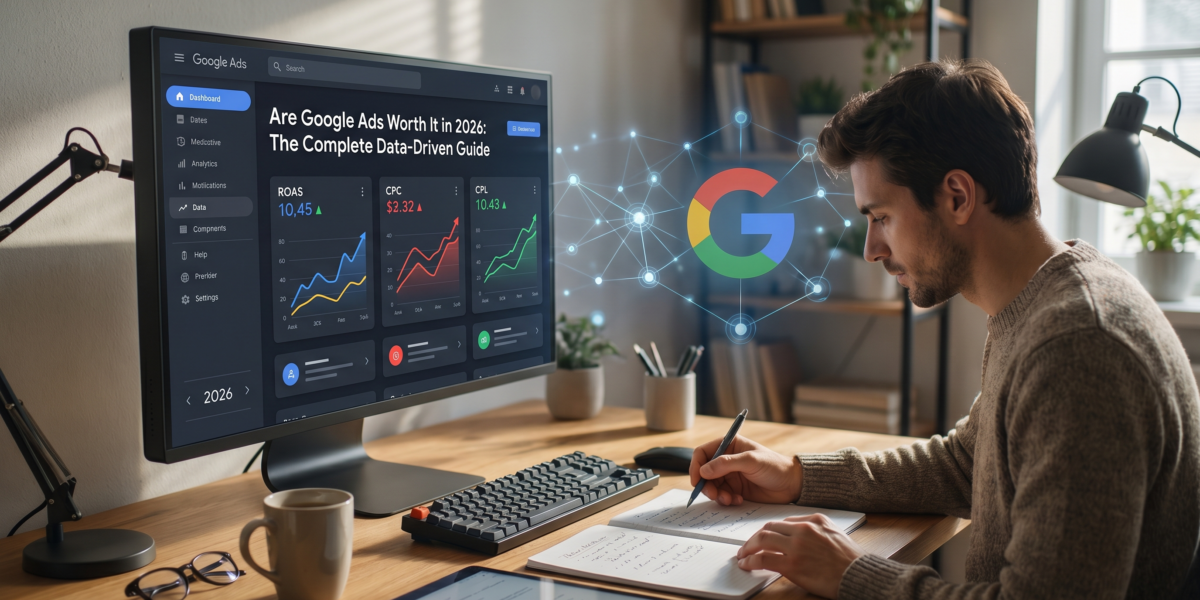
Yes, Google Ads remain a powerfully effective investment in 2026 for businesses that implement them strategically. Their value is amplified by advanced automation, AI-powered targeting, and privacy-conscious functionalities, making campaigns more tailored and cost-efficient. However, success hinges on understanding key metrics like ROAS, CPC, and CPL, leveraging Quality Score, and adapting to the platform’s rapid evolution, which saw more consequential changes in H1 2026 than in all of 2024. Strategic implementation and continuous optimization are critical to navigate increasing competition and ensure a positive ROI.
Spending on Google Ads grew by 14% in Q1 2026, matching a 14% rise in clicks. This growth happens in an evolving landscape where Google has shipped more consequential product changes in the first half of 2026 than it did in all of 2024. This guide goes deeper than generic advice, providing the specific facts, tools, and risk assessments you need to succeed this year. We cover more than any single competitor, integrating hard data, industry-specific benchmarks, practical scenarios, and clear comparison tables to answer every question.
Are Google Ads Worth It in 2026?
Yes, for businesses that strategically leverage advanced automation, AI-powered targeting, and privacy functionalities, Google Ads are a powerful investment in 2026. The platform continues to generate steady leads and sales with measurable ROI, despite increasing competition and rapidly evolving features. Its effectiveness is maximized by carefully managing metrics like ROAS and Quality Score, and by adapting to Google’s continuous product changes. Google Ads shine for harvesting existing demand and quickly converting high-intent users across various industries.
The Core Metrics That Define Google Ads Value in 2026
To determine if Google Ads are worth it for your business, you must move beyond simple cost-per-click (CPC). You need to evaluate a set of interconnected metrics that define profitability and efficiency in the 2026 ad ecosystem, as these are the financial language of your campaign’s health.
Understanding ROAS, CPC, and CPL: The 2026 Realities
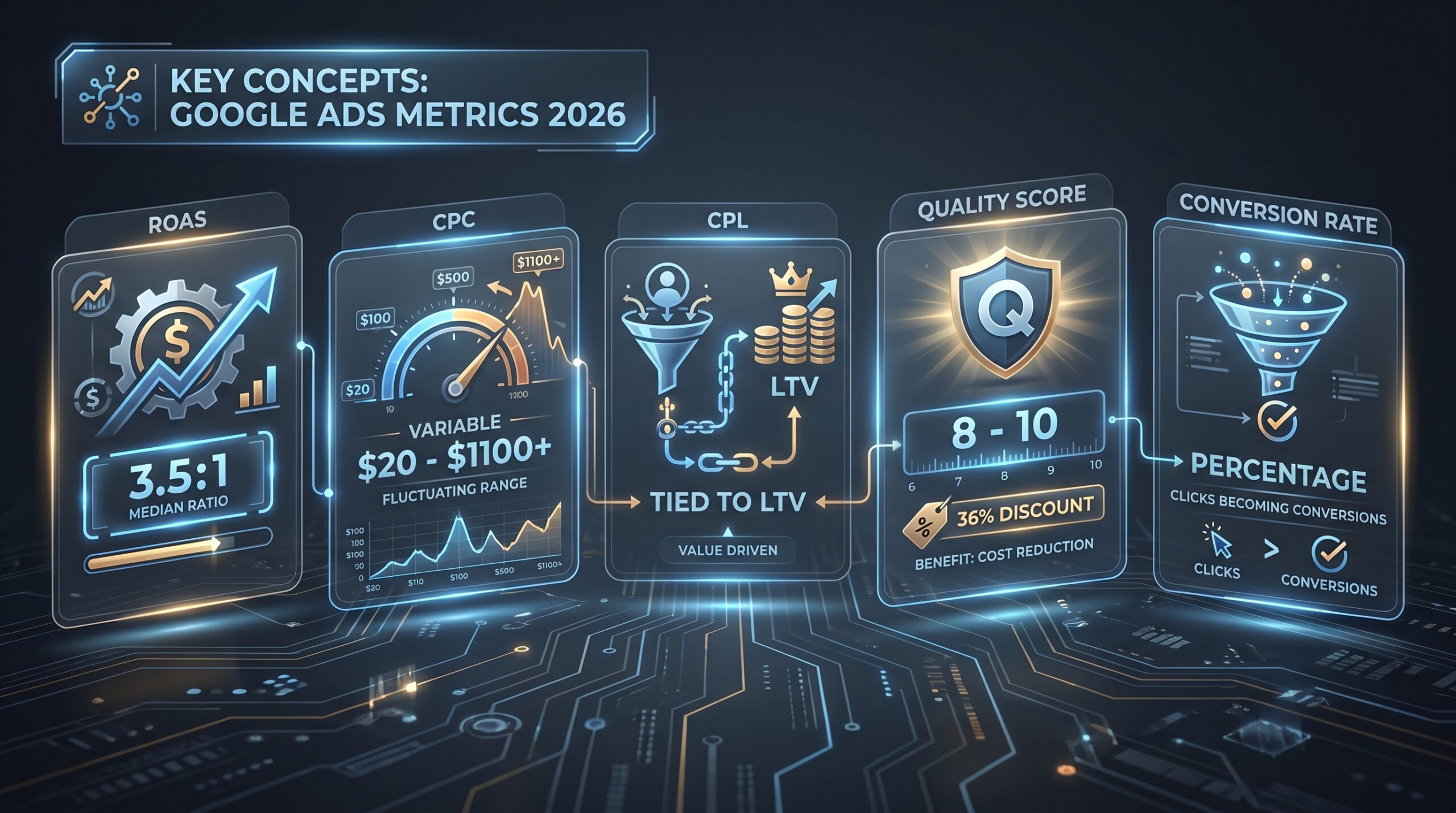
ROAS (Return on Ad Spend) remains the ultimate profitability indicator. The median ROAS for Google Ads is approximately 3.5:1. This means for every $1.00 spent, businesses are seeing an average return of $3.50 in revenue.
However, this is a median; high-performing campaigns in e-commerce or high-value services can achieve ROAS of 8:1 or more, while competitive local services might see 2:1. ROAS sets the benchmark for success.
CPC (Cost Per Click) is your primary cost input. In 2026, CPCs are not uniform; they are rising year-over-year and vary massively by industry. The median range across most industries sits between $50 and $300, but outliers exist:
- Logistics: $20–$25
- Insurance: $900–$1,100
- Healthcare: Saw an +18% year-over-year increase.
- SaaS (Software as a Service): Experienced a +15–18% year-over-year increase.
CPL (Cost Per Lead) translates clicks into potential customers. A “good” CPL is meaningless without knowing your customer’s lifetime value (LTV). A $500 CPL is excellent if your average deal value is $50,000, but catastrophic if your product costs $500.
You must calculate your maximum allowable CPL based on your conversion rate and target profit margin.
How Ad Value is Partially Determined by ZIP Code in 2026
One of the most overlooked yet critical factors in 2026 local campaigns is the impact of geography on ad economics. Ad value is partially set by zip code. In competitive local service markets—think plumbers in San Francisco, electricians in Miami, or divorce lawyers in New York—local providers are directly bidding against each other in a confined geographic area.
This drives up the floor price for keywords like “emergency plumber near me.” Your campaign in a suburban zip code may have a CPC of $12, while the same campaign targeting a dense urban center could see CPCs of $45+. This necessitates hyper-local bid adjustments and budget planning that generic national guides miss.
The Single Largest Controllable Cost Lever: Quality Score in 2026
In 2026, Quality Score is not just a best practice; it’s the single largest controllable lever you have on your Google Ads cost. This metric (on a 1-10 scale) assesses the relevance of your keywords, ad copy, and landing page experience.
Google rewards high relevance with lower costs and better ad positions. The financial impact is stark and quantifiable. Data for 2026 shows that Google Ads accounts with an average Quality Score of 8-10 pay, on average, $2.77 per click. This represents a 36% discount compared to accounts with lower scores.
This is a direct, automated rebate applied to every single click you receive. Improving your Quality Score from 5 to 9 is a more powerful cost-saving strategy than endlessly tweaking your manual bids. It directly answers “are Google Ads worth it” by making your budget go 36% further.
What’s New and Different in Google Ads for 2026
The platform is not static. To evaluate if Google Ads are worth it in 2026, you must understand the key shifts that define the current environment. Generic advice based on 2024 or 2025 strategies will lead to wasted spend.
Major Platform Evolution: Faster Change Than Ever
As of mid-2026, Google has already shipped more consequential product changes in the first six months of the year than it did in all of 2024. This underscores a rapid acceleration in platform development. Staying current is no longer a yearly task—it’s a quarterly imperative.
These changes primarily focus on three areas: handing more control to AI-driven automation, enhancing targeting within new privacy frameworks, and introducing new ad formats that integrate seamlessly with user behavior. You can find more detail on such advancements in our 2026 AI News Roundup.
The 2026 Focus: Automation, AI, and Privacy
Google’s development roadmap for 2026 officially concentrates on advanced automation, AI-powered targeting, and privacy-conscious functionalities.
- Advanced Automation: Tools like Performance Max campaigns and smart bidding strategies (Target ROAS, Target CPA) have moved from “options” to “defaults” for most advertisers. The AI now manages bidding across networks (Search, Display, YouTube, Gmail, Discover) in a single campaign, using your goals (e.g., a 4:1 ROAS) as the north star.
- AI-Powered Targeting: Instead of manually building lengthy keyword lists or audience segments, you now provide Google’s AI with broad signals (a list of your products/services, your website URL, and a few headline themes). The system uses machine learning to find converting customers across search queries you may never have considered, based on intent patterns.
- Privacy-Conscious Functionalities: With the deprecation of third-party cookies and increased data regulation, Google emphasizes first-party data and privacy-safe signals. Google Analytics 4 (GA4) is mandatory. Integration with your CRM and the use of Google’s own consented first-party data (through Customer Match or Google Audience solutions) are critical for effective remarketing and similar-audience modeling.
For more on how AI is shaping advertising, read Google AI’s ‘The Small Brief’ Explores AI in Ad Creation.
Competitive Landscape: High Growth, High Stakes
The digital advertising market in 2026 is characterized by a paradox: it is both growing and more competitive than ever. The 14% year-over-year growth in spending and clicks indicates healthy demand. However, this growth attracts more advertisers, which in turn increases competition for top ad positions, especially in lucrative verticals. This makes strategic implementation and ongoing optimization—not just setting up a campaign—the key differentiator between profit and loss.
Are Google Ads Worth It: Industry-by-Industry Breakdown
The answer to “are Google Ads worth it” changes dramatically based on your industry. Here’s a pragmatic breakdown for key sectors in 2026.
E-commerce and Retail
Verdict: Almost always worth it, but complexity is high.
Google Shopping Actions and Performance Max campaigns are dominant. Success hinges on a perfected product feed (with high-quality images, detailed attributes, and competitive pricing) and a solid grasp of ROAS targets. Expect CPCs to vary from $0.50 for niche accessories to $10+ for branded electronics. The ability to track offline conversions and integrate with inventory systems is non-negotiable.
B2B and Professional Services
Verdict: Highly worth it for lead generation, with a focus on quality.
CPCs for terms like “enterprise CRM software” or “corporate law firm” can range from $50 to $300. The focus is on Cost Per Qualified Lead (CPQL). Google Lead Form Ads are exceptionally effective here for capturing intent directly in the ad unit, especially on mobile. The integration of these leads directly into a CRM like Salesforce or HubSpot is a standard 2026 workflow.
Long sales cycles mean proper lead scoring and nurturing attribution within your CRM is part of the ads ROI calculation. This is where workflow software examples can be incredibly beneficial.
Local Services and SMBs
Verdict: Worth it, but geographically hyper-sensitive.
For plumbers, roofers, dentists, and restaurants, Google Ads (especially through Google Local Services Ads, which operate on a per-lead model) can be a primary source of customers. The zip-code-based bidding dynamic is crucial. A well-optimized campaign with positive reviews, verification badges, and a high Quality Score can dominate local map packs and search results.
Budgets can be smaller but must be consistent to gather conversion data for the AI to optimize. When budgeting for local ads, you might consider if $20 a day is good for Google Ads in your specific context.
SaaS and Technology
Verdict: Worth it, but facing steeply rising costs.
With CPCs rising 15-18% year-over-year, efficiency is paramount. Campaigns often blend top-of-funnel keyword (“project management tools”) with middle-funnel intent (“Asana vs. Monday.com”) and bottom-funnel branded campaigns. Offering gated content (e-books, webinars) via Lead Form Ads is a common tactic to build a nurtured email list. Tracking micro-conversions (trial sign-ups, demo requests) and their eventual conversion to paid plans is essential for calculating true ROAS.
Google Ads vs. Facebook Ads vs. Other Channels: A 2026 Comparison
You can’t evaluate Google Ads in a vacuum. Budget allocation requires understanding its strengths and weaknesses relative to other major channels.
Google Ads vs. Facebook/Instagram Ads in 2026
| Feature | Google Ads (2026) | Facebook/Instagram Ads (2026) |
|---|---|---|
| Primary User Intent | Active Search. Users are looking for a solution, product, or answer right now. High commercial intent. | Passive Scrolling. Users are browsing social content. Commercial intent is lower and must be created. |
| Best For | Bottom-of-Funnel Sales & High-Intent Leads. Capturing demand that already exists. Direct response, lead capture, e-commerce sales for known products. | Top-of-Funnel Awareness & Brand Building. Reaching specific demographics/interests, retargeting website visitors, driving video views, community engagement. |
| Lead/ROI Quality | Typically Higher. Studies in 2026 indicate Google Ads delivers better ROI, lead quality, and customer lifetime value (LTV) for high-spend accounts, as users are further along the buying journey. | Can be high with excellent creative and targeting, but often requires more nurturing. Excellent for lead magnets and webinar registrations. |
| Cost Metric Trends | CPC/CPL is generally higher but more directly tied to commercial intent. Costs are rising in competitive sectors. | CPM (Cost Per Thousand Impressions) can be lower. Cost per link click or lead can be volatile and highly dependent on ad creative fatigue. |
| Key 2026 Differentiator | AI-powered search term expansion and Performance Max automation for cross-network conversion goals. | Advanced AI for image/video ad creative generation and detailed lookalike audiences built from first-party data (email lists, page engagers). |
Practical Decision: Use Google Ads to harvest existing demand for your product/service. Use Facebook Ads to plant seeds and build awareness for new brands or products, then retarget those audiences on both platforms.
Google Ads vs. Microsoft Advertising (Bing Ads)
Microsoft Advertising is not a direct competitor but a strategic complement. It taps into the Bing, Yahoo, and DuckDuckGo search audience, which is often older, more affluent, and less competitively bid upon. CPCs are typically 30-60% lower than Google. In 2026, it’s a viable channel for extending reach and lowering average lead cost, especially in B2B and high-value consumer sectors. Most expert setups use import tools to mirror Google Search campaigns onto Microsoft Advertising with adjusted bids.
Emerging Channels: TikTok, Linkedin, and Others
- TikTok Ads: Powerful for reaching Gen Z and Millennials with viral, native-feeling video content. Intent is almost purely discovery-based. Difficult to drive direct, cheap leads for most B2B or local services, but exceptional for e-commerce fashion, apps, and trending products.
- LinkedIn Ads: The gold standard for ultra-targeted B2B advertising based on job title, company, industry, and seniority. CPCs are very high (often $10+), so it’s only worth it for high-ticket services, enterprise software, and recruitment. It rarely competes directly with Google Search but works well in tandem.
Practical Implementation: A 2026 Google Ads Launch Checklist
This is not a theoretical guide. Here is a step-by-step, technical checklist to launch a viable Google Ads campaign in 2026.
Pre-Launch Foundation (Critical Setup)
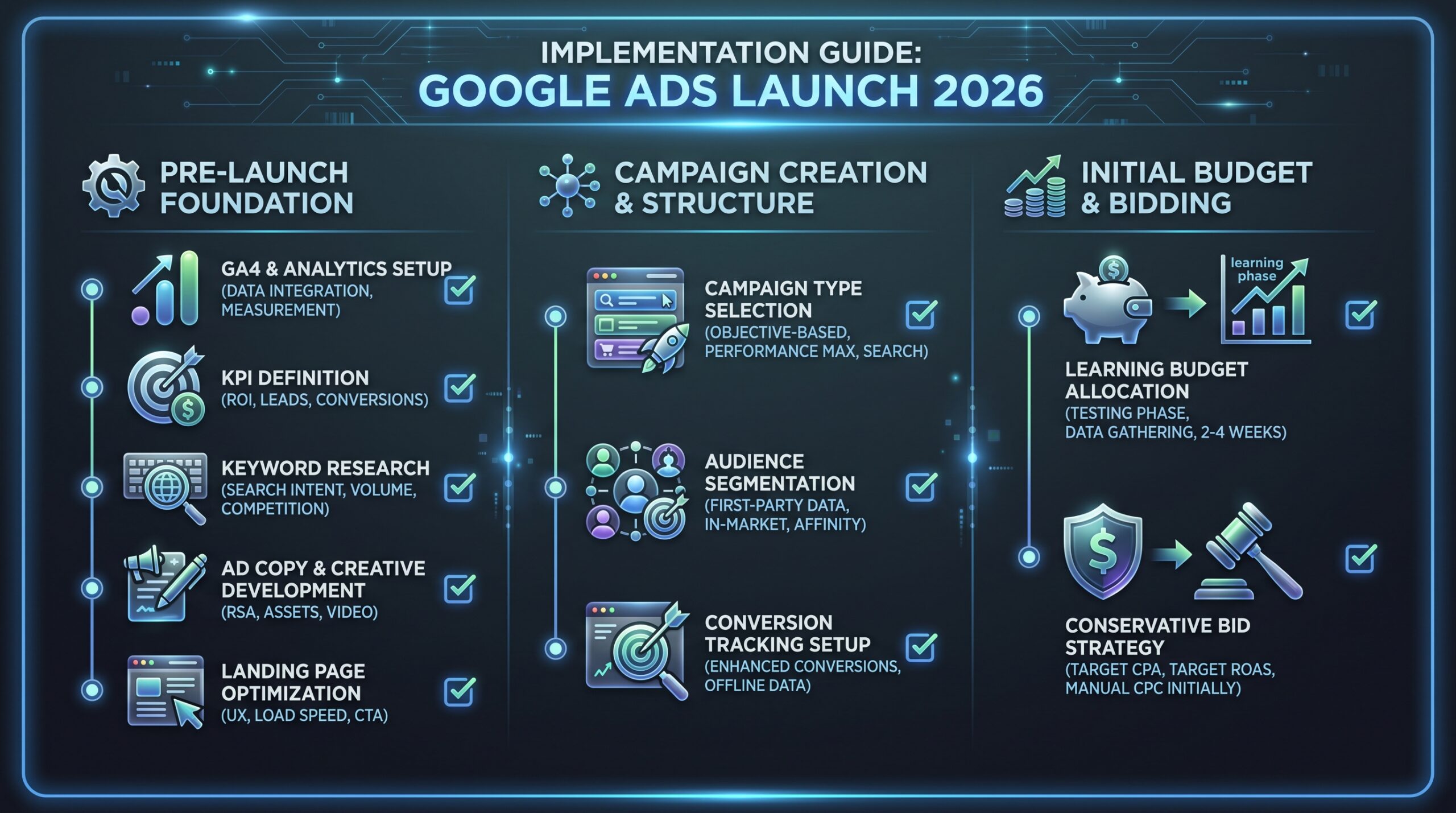
- Install and Configure Google Analytics 4 (GA4): Ensure it’s linked to your Google Ads account. Set up conversion events (e.g., “purchase,” “lead_form_submit,” “contact_page_view”) without using last-click attribution only. Use a model like “data-driven” or “position-based.”
- Define Your Primary KPI: Is it a Target ROAS of 4:1? A Target CPA of $150? A specific number of qualified leads per month? This goal will dictate your campaign type and bid strategy.
- Conduct 2026 Keyword Research: Use Google Keyword Planner, but also analyze your GA4 “Search Console integration” report for organic queries. Look for commercial intent modifiers (“buy,” “price,” “near me,” “vs,” “review”). Group keywords thematically into tightly themed ad groups.
- Craft Ad Copy for AI & Humans: Write at least 3 responsive search ads per ad group. Use all relevant headlines and descriptions. Include keywords, unique selling propositions (USPs), and clear calls-to-action (CTAs). Use ad extensions—sitelink, callout, structured snippet, call—as a standard.
- Build Conversion-Optimized Landing Pages: Each ad group should point to a dedicated landing page that mirrors the ad’s promise. Page load speed must be under 3 seconds. The form or buy button must be above the fold. This is your #1 lever for Quality Score.
Campaign Creation & Structure
- Choose Your Campaign Type:
- For direct sales/e-commerce: Performance Max (if you have a product feed) or Search with smart bidding.
- For lead generation: Search or Lead Form Ads within a Search campaign.
- For local services: Local Services Ads (separate platform) and a Search campaign with location extensions.
- Set Sensitive Audiences & Demographics: Apply relevant audience segments (remarketing lists, similar audiences, in-market) as observations to inform smart bidding.
- Implement Conversion Tracking: Double-check that your Google Ads tag fires on conversion confirmation pages and that conversions are imported from GA4.
Initial Budget and Bidding Strategy
- Set a Realistic Learning Budget: For smart bidding (Target ROAS/CPA), Google needs 15-50 conversions per campaign per month to optimize. Your daily budget should be at least 10x your target CPA to allow this learning. Starting a lead gen campaign with a $10/day budget and a $100 CPA target will fail.
- Start with a Conservative Bid Strategy: If using smart bidding, start with “Maximize Clicks” with a top-page bid limit for 2-3 weeks to gather initial conversion data, then switch to Target CPA/ROAS. Do not start in “Maximize Conversions” with no history.
Risk Assessment and Mitigation Checklist
Google Ads can waste money quickly. Use this checklist to identify and neutralize the most common 2026 risks.
Google Ads Risk Mitigation Framework (2026)
- Risk: Outdated Information
Mitigation: Subscribe to official Google Ads blogs and trusted industry sources. Audit account settings quarterly. - Risk: Ignoring Quality Score
Mitigation: Pause keywords with QS < 5. Rewrite ads and improve landing pages. Use SKAGs for high-value terms. - Risk: Neglecting AI & Automation
Mitigation: Embrace Performance Max and smart bidding (Target ROAS/CPA) as default strategies. - Risk: Poor Budget-to-Goal Alignment
Mitigation: Use budget planning tools. Ensure monthly budget is at least 30-50x target CPA. - Risk: Not Integrating CRM Data
Mitigation: Integrate Lead Form Ads with CRM (Zapier, native). Import offline conversions to optimize for closed deals. - Risk: Keyword Mismanagement
Mitigation: Start with phrase/exact match. Build robust negative keyword lists weekly. Use Search Terms Report. - Risk: Static Ad Creative
Mitigation: Run A/B tests (Experiments) continuously. Test new headlines, descriptions, CTAs every 4-6 weeks. - Risk: Lack of Geographic Granularity
Mitigation: Analyze performance by location. Use bid adjustments (+50% for high-converting, -90% for poor performers).
| Risk Factor | Why It’s Dangerous in 2026 | Mitigation Action |
|---|---|---|
| ❌ Outdated Information | Google changed more in H1 2026 than all of 2024. Old strategies (like broad match without smart bidding) burn cash. | Subscribe to official Google Ads blogs and trusted industry sources like Search Engine Land. Audit account settings quarterly. |
| ❌ Ignoring Quality Score | You are voluntarily paying up to 36% more per click than competitors. This erodes profitability. | Pause keywords with QS < 5. Rewrite ads and improve landing pages for low-scoring ad groups. Use single-keyword ad groups (SKAGs) for high-value terms. |
| ❌ Neglecting AI & Automation | Manual management cannot process signals as fast as Google’s AI. You will lose efficiency and scale. | Embrace Performance Max for goals with conversion data. Use smart bidding (Target ROAS/CPA) as your default strategy for Search campaigns. |
| ❌ Poor Budget-to-Goal Alignment | A budget too small for your target CPA prevents the AI from learning, guaranteeing failure. | Use the Google Ads budget planning tool. Ensure your monthly budget is at least 30-50x your target CPA to feed the algorithm. |
| ❌ Not Integrating CRM Data | You’re flying blind on lead quality and true sales ROI, confusing activity with results. | Integrate Google Lead Form Ads with your CRM (via Zapier or native integration). Import offline conversions from your CRM back into Google Ads to optimize for closed deals. |
| ❌ Keyword Mismanagement | Using broad match without negative keywords, or targeting long-tail terms with no search volume. | Start with phrase/exact match to control search queries. Build a robust negative keyword list weekly. Use the Search Terms Report to find irrelevant queries and add them as negatives. |
| ❌ Static Ad Creative | Ad fatigue reduces click-through rate (CTR), which harms Quality Score and increases costs. | Run A/B tests (Experiments) on ad copy continuously. Test new headlines, descriptions, and CTAs every 4-6 weeks. |
| ❌ Lack of Geographic Granularity | Overpaying in non-productive zip codes and missing opportunities in hot ones. | Analyze performance by location (city/zip code). Use bid adjustments to increase bids by +50% in high-converting areas and decrease by -90% in poor performers. |
Real-World Case Studies and Scenarios
Case Study 1: B2B SaaS Company Scaling Lead Generation
Scenario: A project management SaaS company with an average contract value of $5,000/year wants to grow sales-qualified leads (SQLs) by 30%.
2026 Strategy & Results:
- Campaign Structure: Separate Search campaigns for: (A) Branded terms, (B) Competitor terms (“vs. [Our Tool]”), (C) Core solution keywords (“project management software”).
- Ad Format: Heavy use of Google Lead Form Ads for middle-funnel keywords (e.g., “agile project management tools”) offering a gated “Implementation Playbook” e-book.
- Integration: Leads from the Lead Form Ads are sent directly into a HubSpot workflow. The lead is scored, and an automated email sequence begins immediately. A “Demo Requested” conversion action is sent back to Google Ads when a lead books a call.
- Bidding: Campaigns use Target CPA bidding, with the target set to $200, which is acceptable given the $5,000 LTV.
- Outcome: Within 90 days, SQL volume increased by 35%. The CPA stabilized at $185. The direct CRM integration provided clear ROI, showing that 15% of leads from Google Ads closed within 90 days, generating $112,500 in revenue from a $12,000 ad spend (ROAS of 9.4:1).
Case Study 2: Local HVAC Contractor Managing Zip Code Competition
Scenario: An HVAC contractor in a metropolitan area with 20+ zip codes struggles with high CPC and inconsistent lead quality.
2026 Strategy & Results:
- Geographic Analysis: Reviewed year-to-date conversion data by zip code. Found three zip codes with 60% of conversions at a CPL of $90, and five zip codes with zero conversions despite $500 spend.
- Restructuring: Created a new campaign with location targeting restricted to the three high-performing zip codes. Set a separate campaign for neighboring areas with a lower daily budget.
- Ad Customization: Used location insertion ({Location}) in ad copy (e.g., “Emergency HVAC Repair in {City}”).
- Local Extensions: Ensured Google Business Profile was optimized and linked, featuring callouts for “24/7 Emergency Service” and customer reviews.
- Outcome: Total monthly ad spend decreased by 25%, while qualified lead volume increased by 40%. The average CPL in the core campaign dropped to $65. The contractor reallocated the saved budget to Google Local Services Ads, which generated additional pre-qualified, guaranteed leads.
Essential Google Ads Tools and Integrations for 2026
Your tech stack is a force multiplier. These are the non-negotiable tools for 2026 success.
- Google Ads Editor: Desktop application for bulk changes and offline editing. Essential for managing large accounts.
- Google Analytics 4 (GA4): The central hub for understanding user journey, attribution, and cross-channel performance. Must be linked.
- Google Keyword Planner & Search Terms Report: For initial research and ongoing query mining to refine targeting.
- CRM Integration: Using Zapier, LeadsBridge, or native connectors to pipe Google Lead Form data into Salesforce, HubSpot, or Microsoft Dynamics. This closes the loop on ROI. For more insights check out Workflow Automation Platforms: The 2026 Guide to Building Efficient Systems.
- Call Tracking Software: Platforms like CallRail or Invoca to track phone conversions from call extensions and website clicks, attributing them back to the keyword and ad.
- Landing Page Builders: Tools like Unbounce or Leadpages to quickly create and A/B test high-converting, dedicated landing pages without developer help.
When Are Google Ads NOT Worth It? (The Exceptions)
Despite their power, Google Ads are not a universal solution. Avoid them if:
- Your Product/Service is Not Searchable: If people don’t know to search for what you offer (a radically new invention, a complex B2B service with no common search terminology), you must create demand via other channels first.
- Your Profit Margins Are Extremely Thin: If your average sale is $20 with a $5 profit, you cannot sustain a $5 CPC and a 5% conversion rate (CPA of $100). The math doesn’t work.
- You Lack a Conversion-Optimized Website/Landing Page: Sending paid traffic to a generic homepage or a slow, poorly designed site is burning money. Fix your site first.
- You Cannot Commit a Sufficient Learning Budget: As outlined, smart bidding requires conversion volume. If you can’t spend ~$2,000-$3,000 over a month to gather data, results will be inconsistent.
- Your Industry CPCs Are Prohibitively High: If you’re a solo practitioner in the “insurance” or “lawyer” space where CPCs hit $100+, you need a flawless conversion funnel and high-ticket services to justify the risk.
FAQ
- Is Google Ads worth it for a small business in 2026?
-
Yes, but with careful constraints. Small businesses benefit most from hyper-local targeting, using a focused set of high-intent keywords, and leveraging Google Local Services Ads if eligible. A modest, consistent budget of $1,000-$2,000 per month managed strategically can generate a positive ROI. The key is avoiding broad, expensive keywords and focusing on “near me” and specific service queries.
- How much should I budget for Google Ads in 2026?
-
There’s no universal number. Your budget should be based on your target cost-per-acquisition (CPA) and your desired volume of conversions. As a rule, your monthly budget should be at least 30 times your target CPA to give Google’s smart bidding algorithms enough data to optimize effectively. For example, targeting a $50 CPA requires a minimum $1,500 monthly budget.
- What is a good ROAS for Google Ads in 2026?
-
A ROAS of 3.5:1 ($3.50 return for every $1 spent) is the reported median across industries. However, a “good” ROAS is defined by your business’s profit margins. A 2:1 ROAS might be wildly profitable for a high-margin software company, while a 4:1 ROAS could be a loss for a low-margin retailer. Calculate your break-even ROAS based on your net profit percentage.
- How long does it take to see results from Google Ads?
-
You can see clicks and impressions immediately. However, for the AI-driven smart bidding systems (like Target ROAS) to exit the “learning phase” and deliver consistent, optimized results, you typically need 2-4 weeks and at least 15-50 conversions in a campaign. Patience during this initial learning period is critical in 2026.
- Should I manage Google Ads myself or hire an agency in 2026?
-
Given the increased competitiveness and rapid platform changes in 2026, expert management is more valuable than ever. If your monthly ad spend is over $2,000 and represents a significant revenue channel, a specialized agency or consultant can typically improve performance enough to justify their cost. They handle the constant optimization, testing, and adaptation to new features that most business owners cannot.
- What’s the biggest mistake people make with Google Ads in 2026?
-
The biggest mistake is ignoring Quality Score. Treating it as a vague “nice-to-have” metric means you are voluntarily paying a 20-36% premium on every click versus competitors who optimize for it. The second biggest mistake is using a budget too small to allow Google’s AI to learn, guaranteeing poor or inconsistent results.
Google Ads in 2026 are not a “set and forget” marketing tactic. They are a dynamic, data-driven engine for growth. The businesses that win will be those that understand the new rules of automation, respect the critical financial levers like Quality Score, and build integrated systems that track true business outcomes, not just ad clicks.