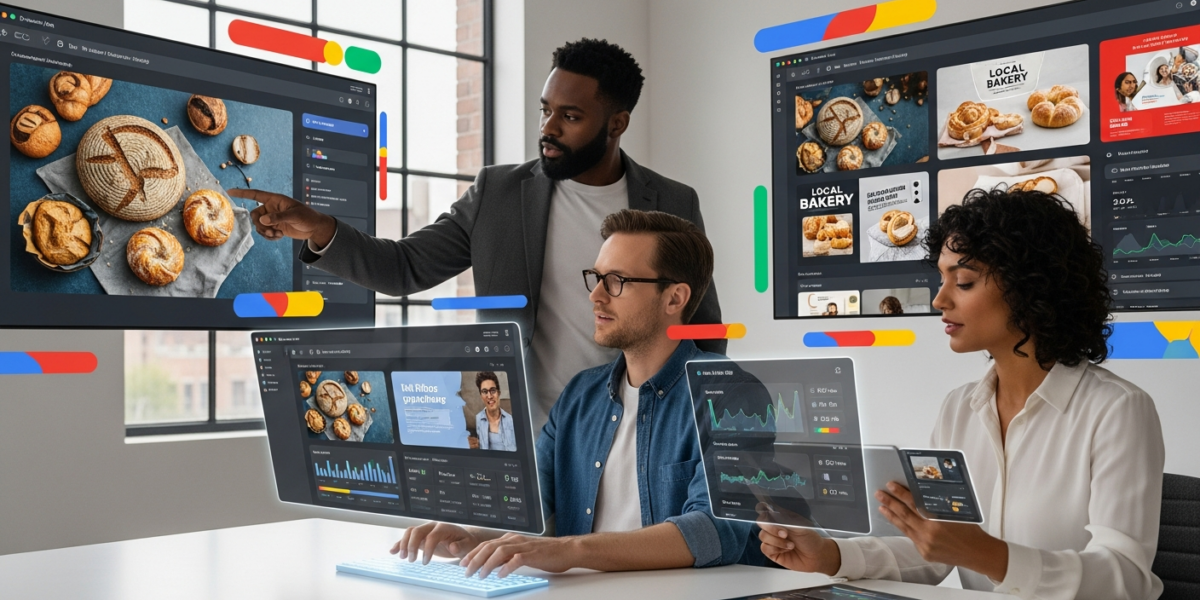
Google AI has launched “The Small Brief” initiative, bringing together prominent advertising industry figures to create studio-quality ad campaigns for local businesses using AI tools. This program aims to demonstrate AI’s capacity for storytelling and efficient content generation, inspiring broader adoption among creatives and small enterprises by showcasing how technology can simplify brand building and reduce marketing costs.
- Google’s “The Small Brief” initiative features ad industry legends leveraging AI to produce high-quality campaigns for small businesses.
- The program emphasizes AI’s role in streamlining ad creation, reducing costs, and enabling small businesses to compete with larger brands.
- AI tools can automate repetitive tasks, extract key information from product pages, and generate varied ad creatives at scale.
- The initiative highlights a broader industry shift towards more efficient, AI-powered marketing strategies.
What changed
On , Google AI announced “The Small Brief,” an initiative designed to showcase the practical application of AI in advertising by having established creative professionals develop campaigns for small businesses. This move signals a more public and direct endorsement by Google of generative AI’s role in mainstream advertising production, moving beyond theoretical discussions to demonstrable case studies [1].
Historically, creating high-quality, studio-grade advertising campaigns was a resource-intensive endeavor, often requiring significant budgets and a full agency setup, making it largely inaccessible for many small and local businesses [5]. The advent of AI-powered tools has begun to democratize these capabilities. What has changed with “The Small Brief” is Google’s active participation in illustrating how AI can bridge this gap, enabling “breakthrough, studio-quality campaigns” for smaller entities [1]. This initiative directly addresses the challenge of small teams competing on volume with larger brands, as AI tools can now generate content faster and at lower costs per piece [8].
The emphasis on AI in this program reflects a broader industry shift towards smarter, more efficient marketing, where AI can analyze product information to generate descriptions, features, and even initial ad images [2, 4]. This evolution allows for capabilities that previously demanded extensive human creative and production resources, making sophisticated ad creation more accessible to a wider range of businesses and individual creators [5].
How it works
“The Small Brief” operates by pairing “ad industry icons” with local businesses they advocate for. These creative legends then utilize AI tools to construct comprehensive advertising campaigns. The core mechanism involves leveraging generative AI capabilities to assist in various stages of ad creation, from concept generation to asset production [1].
For instance, AI ad generators can take a product URL, analyze its content to extract descriptions, key features, pricing, and existing images, and then use this data to inform creative output [4]. This automation extends to generating video ads, social media creatives, and copy at scale, which can be crucial for businesses needing a high volume of varied content for testing and optimization [3]. AI’s role also includes automating repetitive functions, freeing human creatives to focus on higher-level strategic and conceptual work [7]. The initiative aims to demonstrate how these tools can produce diverse ad creatives that are both effective and cost-efficient, empowering businesses to build their brand with technology that simplifies the process [2, 8].
Why it matters for operators
For founders, marketers, and agency operators, Google’s “The Small Brief” is more than just a feel-good campaign; it’s a strategic signal. Google isn’t just showcasing AI; they’re actively normalizing its integration into the creative process, effectively setting a new baseline expectation for ad production efficiency and quality. This means that “agency-level” creative output, once the exclusive domain of large budgets, is now being positioned as achievable for small businesses through AI. Operators should interpret this as a clear directive: if you’re not actively experimenting with generative AI in your creative workflows, you’re already falling behind the curve of what Google itself is promoting as best practice.
The crucial takeaway is that AI is not merely a production shortcut; it’s a strategic equalizer. Small businesses and solo operators can now access capabilities that previously required a full agency setup [5]. This democratizes creative power, but also intensifies competition. Operators who quickly master AI-driven content creation will gain a significant advantage in engagement, campaign speed, and cost efficiency [8]. This isn’t about replacing human creativity, but augmenting it to achieve scale and precision previously unattainable. The real opportunity lies in integrating AI not just as a tool, but as a core component of your creative strategy, allowing your team to focus on strategic insights and human-centric storytelling while AI handles the volume and iteration.
Risks and open questions
- Over-reliance on AI for creative strategy: While AI excels at generating variations and automating production, the initiative still relies on “creative legends” for initial direction and strategic oversight [1]. A key risk for operators is mistaking AI’s generative capability for strategic insight, potentially leading to campaigns that lack genuine human connection or brand authenticity if not properly guided.
- “Sameness” in AI-generated output: As AI tools become more ubiquitous, there’s a risk of creative homogenization. If many businesses use similar AI prompts and models, their ad creatives might begin to look and sound alike, making it harder to stand out in a crowded market. Operators will need to develop unique prompting strategies and integrate proprietary brand elements to maintain distinctiveness.
- Ethical considerations and bias: AI models are trained on vast datasets, which can contain inherent biases. Without careful oversight, AI-generated ads could inadvertently perpetuate stereotypes or fail to resonate with diverse audiences. Operators must implement robust review processes to mitigate these ethical risks.
- Measurement and attribution in a new AI landscape: The initiative highlights AI’s role in content creation, but the impact of AI on search traffic and conversion paths is evolving [6]. Operators need new methods to measure the true efficacy of AI-generated campaigns and understand how they contribute to overall business goals, especially as traditional dashboards may not capture the full picture.
Sources
- See what happens when creative legends use AI to make ads for small businesses.
- Watch creative legends use AI to craft small‑biz ads—right from your Chrome browser – Chrome Geek
- Creatify – The AI Ad Generator | Create Winning Ads with AI
- What Is Ad Creative Automation? Complete Guide 2026 | AdStellar
- Instagram Ad Creator For Influencers: 7 Proven Tips | AdStellar
- AI Creative Agency: A CMO’s Guide to AI Search & Content
- AI in Creative Industries: Understand the Impact of AI – Intelligence Insights
- AI Content Creation Tools for Small Businesses 2026