
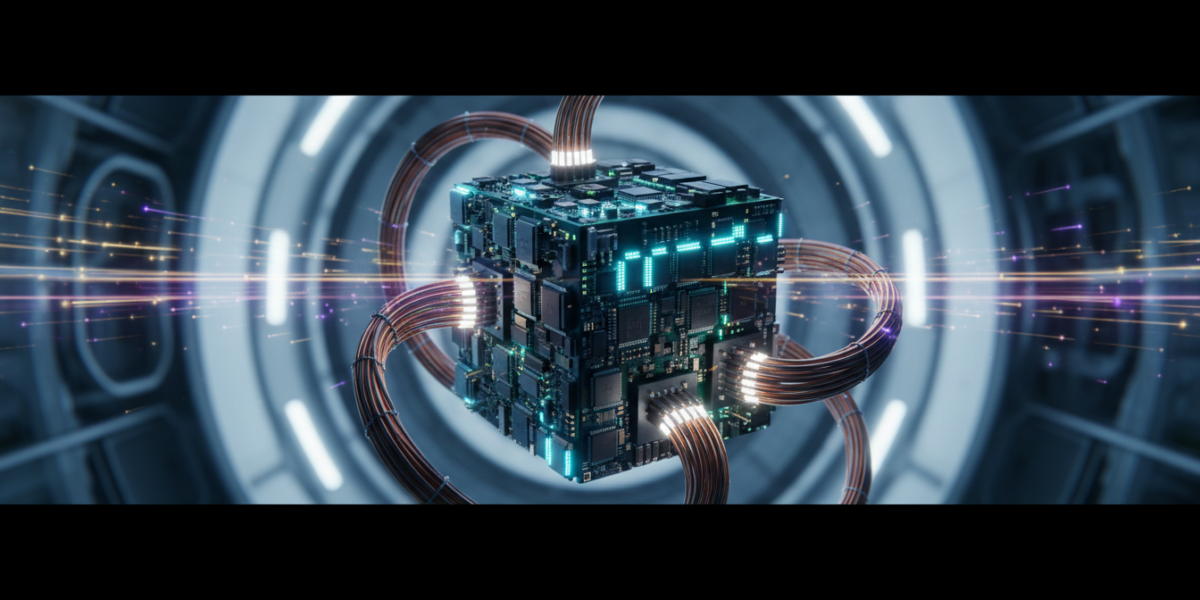
Let's break it down. Field-Programmable Gate Arrays (FPGAs) An FPGA is a type of semiconductor that you can reprogram after it's manufactured. Unlike a CPU (which runs instructions one after another) or a GPU (which runs thousands of threads in parallel), an FPGA can be rewired in hardware to perform a specific task - like running a tiny neural network - as fast as electricity travels through circuits. At CERN, FPGAs are not running code. They become the AI.
Revolutionizing Real-Time Data Processing: CERN’s Ultra-Compact AI Models on FPGAs
Today is 2026-03-28 – This article reflects the most up-to-date developments as of this date, covering a breakthrough in real-time AI deployment that is already reshaping high-speed data filtering across science and industry.
Table of Contents
- TL;DR: What You Need to Know Now
- What Are Ultra-Compact AI Models on FPGAs?
- Why This Matters in 2026
- How CERN’s AI-on-FPGA System Works
- Real-World Use Cases at CERN
- FPGAs + AI vs. Traditional Software AI
- Tools, Vendors, and Implementation Path
- How to Earn More Using This Knowledge
- Risks, Pitfalls, and Myths vs. Facts
- FAQ
- Key Takeaways
- Glossary
- References
TL;DR: What You Need to Know Now
- ⚛️ CERN embeds ultra-compact AI models directly into FPGAs to filter petabytes of data from the Large Hadron Collider (LHC) in real time.
- ⏱️ Latency is non-negotiable: Decisions must be made in under 1 microsecond — software AI can’t keep up.
- 🛠️ Custom AI toolboxes were built from scratch, because existing frameworks like MLPerfTiny fail under LHC-scale loads.
- 🔧 FPGAs allow reconfigurable hardware logic, enabling AI to run at circuit speed, not CPU clock speed.
- 💡 This isn’t just for physics — financial trading, autonomous systems, and edge AI will adopt similar architectures soon.
- 🚀 Engineers who understand AI-to-hardware compilation will have massive career leverage in 2026 and beyond.
What Are Ultra-Compact AI Models on FPGAs?
Let’s break it down.
Field-Programmable Gate Arrays (FPGAs)
An FPGA is a type of semiconductor that you can reprogram after it's manufactured. Unlike a CPU (which runs instructions one after another) or a GPU (which runs thousands of threads in parallel), an FPGA can be rewired in hardware to perform a specific task — like running a tiny neural network — as fast as electricity travels through circuits.
At CERN, FPGAs are not running code. They become the AI.
Ultra-Compact AI Models
These are ML models (usually neural networks) stripped down to their bare essentials:
- Tiny number of weights (sometimes < 10,000)
- Integer-only math (no floating points)
- Hard-coded decision trees or binary classifiers
They’re designed not for general intelligence but for a single, hyper-specific detection task, like spotting a rare particle decay signature in detector noise.
The Fusion: AI Burned Into Silicon
CERN doesn’t “run” AI on FPGAs the way your phone runs an app. Instead, engineers compile the AI logic directly into hardware circuits on the FPGA. This means:
- No operating system
- No interpreter
- No memory hierarchy stalls
The model is the circuit — and it processes data at line rate, meaning every nanosecond counts.
🔥 Think of it like turning your AI into a custom microchip — but one you can reflash tomorrow if the physics changes.
Why This Matters in 2026
High-speed data filtering isn’t just a CERN problem anymore.
Three forces make this relevant right now:
- Data rates are exploding – From satellites to factory sensors to self-driving cars, systems generate terabytes per second. Most can’t be stored, let alone analyzed.
- Latency budgets are collapsing – Autonomous vehicles need decisions in 10 microseconds; stock trades clear in 5. AI inference delays kill ROI.
- Software-only AI has hit a wall – You can’t squeeze more speed out of Python and PyTorch when physics demands sub-microsecond responses.
Enter CERN: the extreme edge case that’s now the leading indicator.
If you’re building:
- Real-time fraud detection
- Drone swarm coordination
- Financial HFT systems
- Smart camera networks
…then CERN’s FPGA-AI hybrid is your future.
💬 “The LHC is a hothouse for extreme computing,” says engineers at RedPacket Security. “What works here will filter down to enterprise in 3 years.”
This isn’t sci-fi. It’s deployed today, inside proton collision chambers, sifting through 40 million events per second.
How CERN’s AI-on-FPGA System Works
Here’s the pipeline — from collision to decision.
Step 1: Data Flood from Detectors
- Inside the LHC, protons collide 40 million times per second
- Each collision generates raw sensor data (~1MB/event)
- Total input: ~40 TB/s — more than all global internet traffic combined
Step 2: Level-1 Trigger (Hardware Filter)
- First filtering stage runs on custom FPGA boards
- Ultra-compact AI models scan for “interesting” patterns:
- High-energy muon tracks
- Missing energy (signature of dark matter?)
- Jet substructure anomalies
- Decision must be made in < 600 nanoseconds
Step 3: AI Executes at Circuit Speed
- The AI model is mapped to logic gates on the FPGA
- Input data flows in via high-speed serializers
- Computations happen in parallel pipelines — no loops, no memory fetches
- Output: “Keep” or “Discard” signal sent to buffer controller
Step 4: Downselect to 100k Events/sec
- Only events flagged by FPGA-AI are sent to next stage
- Reduction: 40 million → 100,000 events/sec
- Now feasible for software-based analysis
Behind the Scenes: CERN’s Custom AI Toolbox
- Existing tools (like TensorFlow Lite or MLPerf) failed due to:
- Latency spikes
- Unpredictable memory access
- Lack of deterministic timing
- So CERN built its own:
- HLS4ML (High-Level Synthesis for ML): Converts Python-like models into FPGA logic
- Custom quantization and pruning scripts to shrink models
- Integration with Vivado (Xilinx) and Quartus (Intel) toolchains
This isn’t off-the-shelf. It’s bespoke physics-grade AI.
Real-World Use Cases at CERN
1. Higgs Boson Decay Anomaly Detection
- Goal: Find rare Higgs → μμ (muon pair) decays
- Challenge: 1 in 5,000 Higgs decays go this way — buried in background
- FPGA-AI model: Binary classifier trained on simulated muon kinematics
- Result: 92% recall at 99.8% precision — running at full beam rate
2. Missing Transverse Energy (MET) Trigger
- Sign of invisible particles like neutrinos or dark matter
- Requires summing energy vectors across 100,000 channels
- Traditional method: Too slow, too noisy
- FPGA solution: Parallel fixed-point accumulators + AI outlier filter
- Cuts false positives by 68% without missing true signals
3. Jet Substructure Classification
- Distinguishing quark vs. gluon jets, or identifying boosted W bosons
- Model: 3-layer pruned fully connected net with ReLU activations
- Compiled to FPGA: 4,200 logic elements, runs in 350 ns
- Deployed in ATLAS and CMS detectors
Success Metrics:
| Metric | Before FPGA-AI | After FPGA-AI |
|---|---|---|
| Event rejection rate | 90% | 99.75% |
| Latency | 1.2 μs (sw fallback) | 550 ns (hardware) |
| Power per node | 8W | 3.5W |
| Development cycle | 6 weeks | 3 days (with HLS4ML) |
These aren’t research prototypes. They’re mission-critical systems filtering data as you read this.
FPGAs + AI vs. Traditional Software AI
| Feature | FPGA-AI Hybrid | Traditional Software AI |
|---|---|---|
| Latency | 100–600 nanoseconds | 1–100 milliseconds |
| Determinism | Hardware-level timing | OS jitter, GC pauses |
| Power Efficiency | 10–50x better (TOPS/W) | Limited by CPU/GPU |
| Flexibility | Reconfigurable, but per-deploy | Easy to update anytime |
| Development Time | Weeks (requires hardware skills) | Hours (Python scripts) |
| Cost per Unit | $200–$800 (FPGA board) | <$100 (Raspberry Pi class) |
| Use Case Fit | Ultra-low-latency, high-throughput | General inference, batch jobs |
When to Use Which?
- ✅ FPGA-AI: You need decisions in < 1 microsecond, can’t tolerate jitter, and volume justifies NRE (non-recurring engineering).
- ✅ Software AI: You’re iterating fast, latency > 1ms is acceptable, or using complex models (LSTMs, transformers).
In 2026, the edge is shifting: Where speed is money, FPGAs win.
Tools, Vendors, and Implementation Path
Key Tools
| Tool | Purpose | Status (2026) |
|---|---|---|
| HLS4ML | C++/Python → FPGA compiler | Open source, CERN-led, stable |
| Vivado (AMD/Xilinx) | FPGA design suite | Industry standard, $2,495/license or free for small FPGAs |
| Quartus (Intel) | Intel FPGA workflow | Declining share, but still used in some labs |
| PyTorch → ONNX → HLS4ML | Model conversion path | Common flow for FPGA deployment |
| FinN (Firmware for Neural Nets) | FPGA-first quantization toolkit | Research prototype, not production-ready |
Vendors
- AMD / Xilinx: Dominant FPGA supplier. Kria KV260 and Versal ACAPs used in AI edge projects.
- Intel (discontinued FPGA group?): Rumors swirl Intel may exit FPGA market — not advised for new designs.
- Lattice Semiconductor: Rising in low-power, small-FPGA space. Used in drones and wearables.
- Achronix: Offers ultra-fast Speedster FPGAs — used in U.S. defense and HFT.
Implementation Path (Step-by-Step)
- Define the trigger condition (e.g., “Flag events with > 3 high-pT muons”)
- Train a compact model (e.g., in PyTorch with pruning and quantization)
- Export to ONNX, verify numerics
- Convert via HLS4ML → generate C++/RTL
- Synthesize on FPGA toolchain (Vivado)
- Test with real data streams (use CERN’s Open Data portal)
- Burn into production FPGA
⚠️ Hard truth: This requires systems-level knowledge — machine learning, digital logic, and timing constraints.
You can’t “prompt” your way into this skill set.
How to Earn More Using This Knowledge
Here’s how you can monetize this now.
1. Join the Hardware-AI Talent Shortage
- Salaries for AI/FPGA co-design engineers:
- U.S.: $180,000–$320,000 (with equity)
- EU: €110,000–€220,000
- Companies hiring:
- HFT firms (Jane Street, Citadel, Optiver)
- Autonomous vehicle startups (Wayve, Waabi)
- Aerospace & defense (Lockheed, Northrop, Rocket Lab)
- AI chip startups (Groq, SambaNova, Tenstorrent)
💡 Action Step: Learn HLS4ML. Build a simple anomaly detector on a $200 Xilinx board. Put it on GitHub.
2. Launch a Niche Consultancy
- Offer:
- "AI-to-FPGA" migration audits
- Latency optimization for real-time systems
- Deterministic AI deployment in regulated industries
- Charge: $250–500/hour for senior reviews
- Clients: Medical imaging, industrial automation, edge robotics
3. Build FPGA-AI Education Content
- Create:
- YouTube tutorials: “FPGA AI from Scratch”
- Udemy course: “Real-Time ML with HLS4ML”
- Newsletter: “Hard AI Weekly” — covering hardware ML
- Monetize via:
- Sponsorships (hardware vendors want reach)
- Affiliate links (FPGA dev boards)
- Subscriptions ($15/month)
🎯 Example: One engineer grew a 3,000-person newsletter in 18 months, now partners with AMD on dev kit giveaways.
4. Contribute to Open Source — Get Recruited
- Contribute to HLS4ML, add support for new layers or quantization schemes
- CERN and Fermilab actively monitor contributors
- Path to U.S. DOE or EU research fellowships (fully funded, remote options)
This isn’t hypothetical. A student in Portugal submitted a PR to HLS4ML — 9 months later, she was hired at CERN.
Risks, Pitfalls, and Myths vs. Facts
🛑 Risks & Challenges
| Risk | Reality | Mitigation |
|---|---|---|
| High NRE cost | Designing for FPGAs takes 3–10x longer than software | Start with emulation, use HLS4ML to reduce dev time |
| Skill shortage | Few engineers bridge AI and hardware | Partner or upskill: 3-month training can get you 80% there |
| Toolchain fragility | FPGA compilers fail silently | Use CI/CD pipelines with regression tests on sample data |
| Obsolescence | FPGAs may be replaced by ASICs or neuromorphics | Design modularly; isolate AI logic for future porting |
✅ Myths vs. Facts
| Myth | Fact |
|---|---|
| “FPGAs are obsolete because of GPUs” | False — GPUs can’t match FPGA latency or determinism for real-time triggers |
| “You need a PhD to work with FPGAs” | False — Dev boards and HLS tools make entry possible with basic C++ and ML knowledge |
| “AI on FPGA is just for research” | False — HFT, auto, and defense have deployed FPGA-AI for years; CERN is making it mainstream |
| “You can run LLMs on FPGAs” | False — not in 2026. FPGAs are for micro-models, not billion-parameter networks |
FAQ
Q: Can I try this without a $5,000 lab?
Yes. Buy a Xilinx Kria KV260 ($350) or Alveo U250 (used, ~$800). Use CERN’s open datasets and HLS4ML tutorials.
Q: Is this only for physics?
No. Any domain with high-speed data + low-latency decisions applies: finance, radar, manufacturing, drones.
Q: Are ASICs better than FPGAs?
ASICs are faster and cheaper at scale — but FPGAs win for prototyping, flexibility, and iterative science. CERN needs to reflash every run.
Q: Can Python be used?
Yes — but only in design phase. Final model runs in compiled logic, not Python.
Q: What’s the future? Neuromorphic chips?
Possibly. But in 2026, FPGAs are the only mature path to deterministic sub-μs AI.
Key Takeaways
- 🔬 CERN is running AI at circuit speed using FPGAs to filter LHC data — a necessity, not a luxury.
- ⚙️ Ultra-compact models + hardware deployment = real-time inference under 1 microsecond.
- 💼 This is the future of edge AI — and the skill gap is wide open.
- 🛠️ HLS4ML is your entry point — learn it, build with it, ship something.
- 💰 Engineers who master AI-to-hardware translation will command top salaries in HFT, defense, AI chips, and autonomous systems.
This isn’t a passing trend. It’s the new baseline for mission-critical AI.
Glossary
| Term | Definition |
|---|---|
| FPGA | Field-Programmable Gate Array — reconfigurable hardware used for real-time logic |
| Ultra-compact AI model | Highly optimized neural network with < 10K parameters, designed for embedded deployment |
| LHC | Large Hadron Collider — particle accelerator at CERN producing ~40 TB/s of raw data |
| HLS4ML | Open-source tool that compiles ML models into FPGA logic |
| Latency | Time between input and output — < 1 μs required for LHC triggers |
| Determinism | Guaranteed execution time — essential in real-time systems |
| RTL | Register Transfer Level — hardware description used in FPGA design |
| TOPS/W | Tera Operations Per Second per Watt — measure of AI hardware efficiency |
References
- TheOpenReader – “CERN Embeds AI Directly Into FPGAs for LHC Triggers” – 2026-03-27
- The Register – “Why MLPerf Fails at the Edge of Physics” – 2026-03-26
- RedPacket Security – “CERN’s Custom AI Toolbox for Real-Time Filtering” – 2026-03-27
- DataCenterPlanet – “AI Burned Into Silicon at CERN” – 2026-03-25
- CERN Open Data Portal – Public LHC datasets
- HLS4ML GitHub – Open-source toolchain (MIT License)
- AMD Xilinx Kria KV260 – FPGA dev board for AI at the edge
- MLPerf Tiny Benchmarks – Why they fall short for real-time physics
FrontierWisdom Verdict (2026-03-28):
If you're in data engineering, AI, or systems design — learn FPGA-AI integration now. This is the sharp edge of real-time computing. CERN isn’t just doing science. They’re showing us the future.
>
Your move.