

As of May 2026, the three job categories most resilient to AI automation and poised for significant growth are those requiring deep human understanding and interaction (e.g., doctors, therapists), advanced creativity and complex problem-solving (e.g., entrepreneurs, research scientists), and roles directly involved in AI development, management, and oversight (e.g., AI engineers, AI ethics specialists). These roles leverage uniquely human capabilities that current AI systems cannot replicate.
Contrary to popular fears, AI isn’t eliminating jobs but transforming them through task substitution. Macro-economic data from March 2026 shows stable unemployment. Jobs requiring deep human connection, advanced creativity, and direct AI development are thriving, while repetitive, information-processing roles are more vulnerable. Future-proofing your career involves focusing on human-centric skills like AI orchestration, critical thinking, and emotional intelligence, and proactively adapting by learning to leverage AI tools.
Which 3 Jobs Will Survive AI: The Complete 2026 Guide
Jobs involving deep human interaction, advanced creativity, and direct AI development are not just surviving but thriving as of May 2026. The narrative of mass AI-driven unemployment is a fantasy; macro-economic data shows stable employment (4.3% unemployment rate in March 2026) despite rapid automation. AI transforms jobs through task substitution, not elimination. The roles with the greatest longevity leverage uniquely human skills—empathy, creativity, strategic oversight—that current AI cannot replicate.
The Myth of the AI Job Apocalypse
Macro-economic data consistently debunks the fear of widespread job loss. The unemployment rate in March 2026 stood at 4.3%, nearly identical to the 4.4% rate in March 2020, before the current AI acceleration. Average hourly earnings have also remained stable. This stability occurs alongside significant AI adoption.
Anthropic’s 2026 Economic Index reports that approximately 49% of jobs have already incorporated AI like Claude to perform at least a quarter of their tasks. The impact is task substitution—AI handles specific duties, freeing humans for higher-value work—not mass displacement. For more context on the broader AI landscape, consider The State of AI in 2026: Read the Signal, Not Just the Headlines.
How AI Actually Impacts Jobs: Task Substitution vs. Elimination
Job transformation, not destruction, defines the current AI era. Microsoft’s 2025 occupational AI study found the highest exposure to AI in information-heavy roles: writing, translation, office administration, sales, and customer service. In these fields, AI doesn’t take the whole job; it takes over tasks.
Salesforce’s AI now autonomously handles 50% of all customer queries. IBM’s AskHR system processes 11.5 million employee interactions annually with minimal human oversight. For customer service representatives, this means less time spent on repetitive queries and more time solving complex, high-value problems.
Mid-skill professional roles like paralegals, junior analysts, and copy editors are seeing the same pattern. AI handles initial document review, data sorting, and draft generation. The human professional then applies judgment, strategy, and nuance—increasing overall output per person. This is task substitution in action.
The 3 Job Categories Most Likely to Survive and Thrive with AI
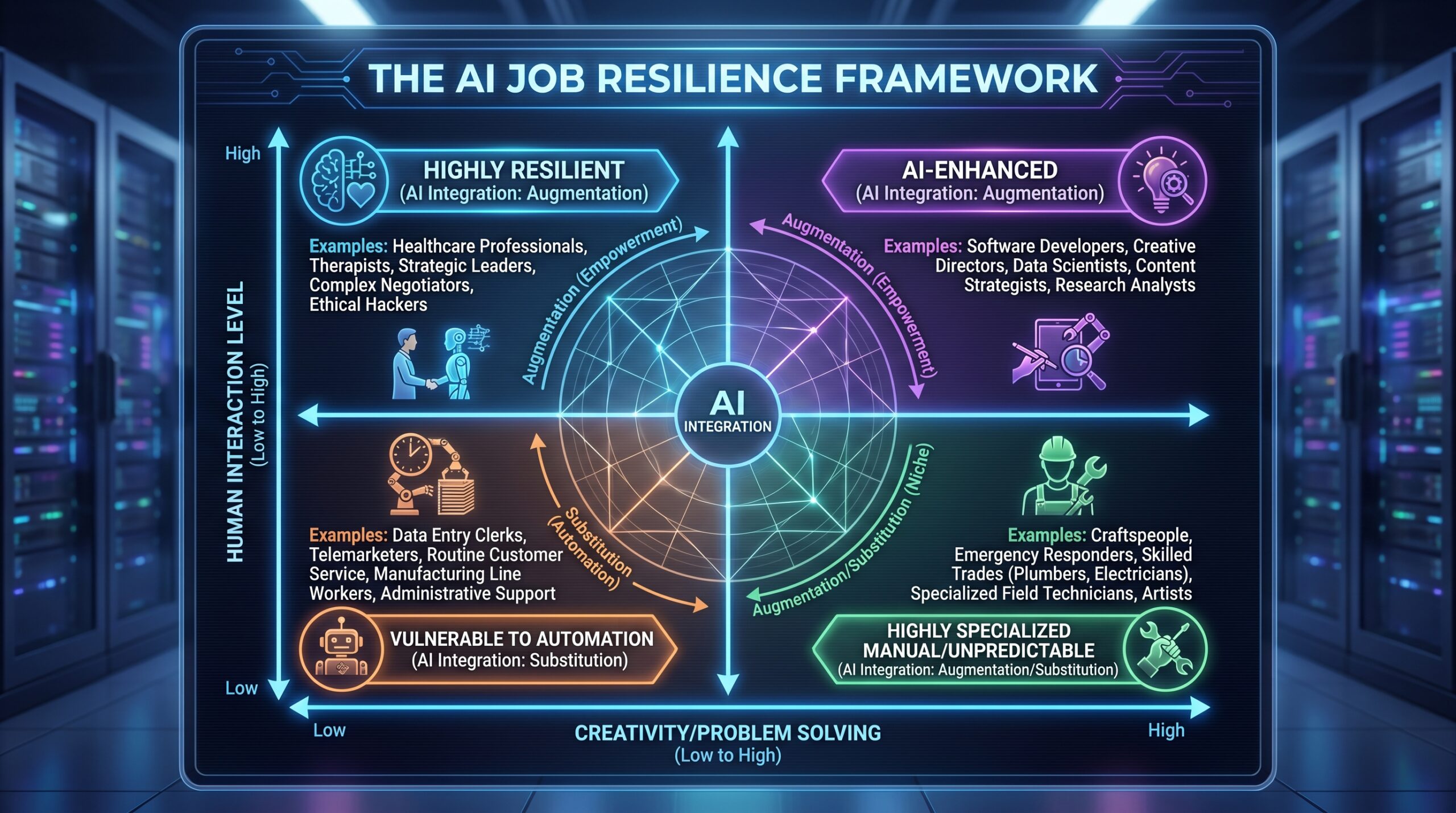
Surviving AI isn’t about finding a single safe job; it’s about positioning yourself in a resilient category. These three categories leverage the irreplaceable human edge.
1. Jobs Requiring Deep Human Understanding and Interaction
AI struggles profoundly with genuine empathy, complex emotional intelligence, and nuanced interpersonal dynamics. Jobs built on these skills are not just safe; they are becoming more valuable.
Examples: Doctors, Nurses, Therapists, Teachers, Social Workers, Senior Caregivers, Conflict Mediators.
- Doctors: AI excels at diagnosing from scans and data patterns (e.g., spotting tumors in MRIs). However, it cannot perform a physical examination with adaptive touch, deliver a terminal diagnosis with compassion, consider a patient’s unique socio-economic context when creating a treatment plan, or build the trust required for patient compliance. The doctor’s role shifts from information processor to empathetic decision-maker and trusted advisor.
- Teachers: AI can create personalized learning plans and generate practice exercises. It cannot manage a classroom’s dynamic social environment, recognize a student’s unspoken emotional distress, inspire a love of learning, or tailor motivational strategies to individual personalities. The teacher becomes a mentor, coach, and motivator—roles AI cannot fulfill.
These roles survive because the core of the job is human-to-human connection.
2. Jobs Demanding Advanced Creativity and Complex Problem-Solving
While AI can generate content, true creativity—solving novel problems, inventing entirely new concepts, and producing art with authentic intent—remains a human domain.
Examples: Research Scientists, Entrepreneurs, Strategic Leaders, Artists, Writers, Architects, Product Designers.
- Entrepreneurs: AI can analyze market data and write business plans. It cannot have a visionary “aha!” moment, tirelessly pitch an idea with passion, build a company culture, or make a high-stakes strategic pivot based on intuition and incomplete information. AI is a powerful tool for entrepreneurs, but the core creative and risk-taking drive is human.
- Research Scientists: AI can process vast datasets and run millions of simulations. It cannot form a groundbreaking hypothesis from seemingly unrelated fields, design a truly novel experiment, or interpret ambiguous results with creative intuition. The scientist uses AI to explore possibilities but leads the research with human curiosity. Explore new benchmarks for AI progress, like Agent Island: New Benchmark for Agentic AI Progress, to understand where creativity challenges persist.
AI becomes a collaborator, not a replacement, in these fields.
3. Jobs in AI Development, Management, and Oversight
The people who build, maintain, and steer AI systems are in unprecedented demand. As AI grows more powerful, the need for human oversight becomes more critical, not less.
Examples: AI/ML Engineers, Research Scientists, AI Ethics Specialists, AI Product Managers, AI Systems Orchestrators.
- AI Engineers & Research Scientists: These are the architects of the AI revolution. Demand is skyrocketing. Indeed Hiring Lab reported in January 2026 that AI hiring grew even while layoffs occurred in other tech sectors. Starting salaries for computer science majors are expected to increase by nearly 7% year-over-year. Roles like “Research Scientist – Intelligent Editing and AI Agent – Multimodality” are examples of new, highly specialized positions. For a look at the tools these professionals use, see Best AI Agents for Developers in 2026: The Ultimate Guide.
- AI Ethics Specialists & Orchestrators: This is a burgeoning field. As AI systems like Claude Code, ChatGPT Enterprise, and Codex become more integrated, professionals are needed to ensure they are used responsibly, ethically, and effectively. “Orchestration”—the skill of coordinating multiple AI tools to achieve a complex goal—is a critical new competency. The increase in organizations deepening AI adoption is highlighted in OpenAI B2B Signals: Frontier Firms Deepen AI Adoption.
This category survives because it is the source of the transformation itself.
Jobs That Are Highly Vulnerable to AI Automation
Understanding which jobs are fading is crucial for making informed career decisions. The most vulnerable jobs are those centered on predictable, repetitive information processing.
| Job Category | Impact Level (as of May 2026) | Key Data Points & Examples |
|---|---|---|
| Customer Service | Extreme Automation | 80% of tasks could be automated by 2030. Salesforce’s AI handles 50% of queries; IBM AskHR manages 11.5M interactions/year. |
| Data Entry & Clerical Work | Rapid Disappearance | 95,100 data entry specialists in London are directly affected. Roles are being consolidated into higher-skill data analysis positions. |
| Information-Heavy Roles | High Exposure | Microsoft’s 2025 study flagged writing, translation, office admin, and secretarial work. AI excels at structuring and processing information. |
Comparison: Jobs Most vs. Least Affected by AI
This table breaks down the primary differences between the jobs AI is transforming and those it is augmenting.
| Jobs MOST Affected by AI | Jobs LEAST Affected by AI | |
|---|---|---|
| Primary Focus | Processing information, following set rules, repetitive tasks. | Empathy, creativity, complex judgment, managing unpredictability. |
| 2026 Examples | Data Entry Clerks, Customer Service Agents (routine queries), Translators (simple text). | Surgeons, Psychologists, AI Ethics Researchers, Strategic Planners. |
| AI’s Role | Task Substitution: AI performs the core tasks of the role. | Task Augmentation: AI is a tool that enhances human capability. |
| Human Adaption | Must upskill into oversight or more complex niches (e.g., data clerk -> data analyst). | Must learn to leverage AI tools effectively (e.g., a doctor using diagnostic AI). |
| Future Outlook | Decline in pure roles, consolidation into higher-skill positions. | Growth in demand and value, with AI integration creating new specialties. |
The New AI-Essential Skills for 2026 and Beyond
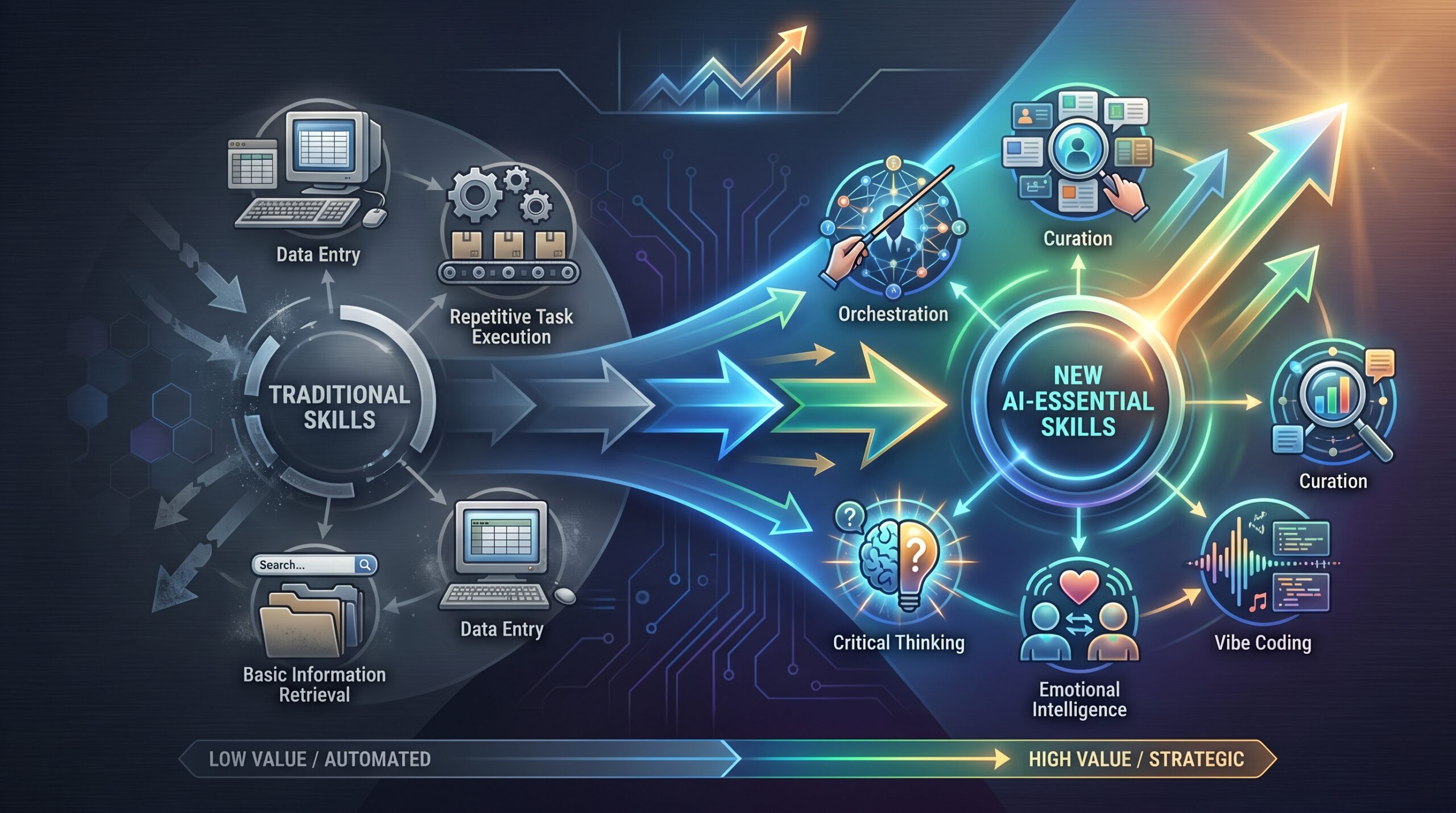
Surviving AI means adopting a new set of core skills. These are not about fighting AI but about harnessing it.
- Orchestration: The #1 most critical skill. This is the ability to coordinate multiple AI agents and tools (e.g., using ChatGPT for brainstorming, Claude for coding, and Midjourney for design) into a single, coherent workflow to solve complex problems. It’s being the conductor of an AI orchestra. The progress in multi-agent systems is significant; consider Multi-Agent RL Secures Urban Airspace for Heterogeneous sUAS Fleets and HDFlow: Hierarchical AI for Long-Horizon Robot Tasks.
- Curation over Creation: The value is shifting from generating raw output to refining, editing, and contextualizing AI-generated material. An editor who can turn an AI-generated article draft into a compelling piece with a unique voice is more valuable than a writer starting from a blank page.
- Vibe Coding: An emerging term for 2026, this refers to the human-centric, artistic, and intuitive aspects of software development. It’s about understanding the user’s emotional experience and “vibe” and using AI code generators (like Claude Code) to build software that feels intuitive and engaging, not just functional.
- Critical Thinking & AI Interpretation: The ability to question AI output, identify potential biases, discern nuance, and apply real-world context that the AI lacks. Even advanced models can have limitations, as shown in SWE-WebDevBench Exposes AI Coding Agents’ Full-Stack Flaws.
- Emotional Intelligence (EQ): The ultimate human advantage. Skills like empathy, leadership, persuasion, and mentoring are becoming more valuable as pure technical skills are automated.
Case Study 1: From Data Entry Clerk to Data Analyst
Scenario: A data entry clerk spends 8 hours a day inputting sales figures from PDF reports into a spreadsheet.
AI Impact: An AI tool is implemented that automatically extracts all data from the PDFs and populates the spreadsheet in minutes with 99.9% accuracy.
The Threat: The pure data entry task is completely eliminated.
The Adaptation: The clerk is offered upskilling training. They learn:
- Excel (Advanced): PivotTables, Power Query, advanced formulas to analyze the data.
- SQL: To pull and manipulate data from company databases.
- Basic Python/Data Visualization: Using libraries like Pandas and Matplotlib to create insights and reports.
New Role: Instead of inputting data, they now interpret it. They become a junior data analyst, identifying trends, creating dashboards for managers, and providing insights that drive business decisions. Their job didn’t disappear; it was transformed into a higher-value, more engaging, and better-paid role.
Case Study 2: The AI-Augmented Medical Diagnostician
Scenario: A radiologist reviews hundreds of medical scans daily to identify anomalies like tumors.
AI Impact: An FDA-approved AI diagnostic tool (e.g., leveraging insights from OralMLLM-Bench: New Standard for Dental AI Evaluation) is integrated into their workflow. The AI scans each image first, flagging high-probability areas of concern with incredibly high accuracy.
The Myth: “AI will replace radiologists.”
The Reality: The radiologist’s job transforms. They spend less time on the tedious search through normal scans and more time on complex tasks:
- Validating AI Findings: Applying their expertise to confirm or refute the AI’s suggestions.
- Analyzing Complex Cases: Focusing on the subtle, ambiguous, or rare cases the AI might miss or misinterpret.
- Patient Consultation: Communicating findings directly with patients and referring physicians, explaining treatment options, and providing human reassurance.
Productivity soars, diagnostic accuracy improves, and the radiologist’s role focuses on the highest levels of expertise and human interaction.
AI in Healthcare: A Paradigm Shift
AI’s integration in medicine isn’t about replacing practitioners but enhancing their capabilities. From diagnostic assistance to personalized treatment plans, AI acts as a powerful co-pilot, freeing up human medical professionals to focus on empathy, complex decisions, and direct patient care—skills AI cannot replicate. This leads to better patient outcomes and more efficient healthcare systems, rather than job displacement.
Unique Insights on AI and the Future of Work
- The Hazardous Job Paradox: Not all manual labor is vulnerable. Jobs that are physically dangerous and operate in unpredictable environments are resistant. Power-line installers, for example, have a high fatality rate (18.4 deaths per 100,000 workers in 2023) precisely because the work is so complex and fraught with variables. AI and robots cannot reliably navigate these real-world complexities.
- The Specialized Trade Resilience: Jobs like master electricians, plumbers, and skilled tile layers involve complex problem-solving in unique physical settings. Every job site is different. This adaptability and specialized motor skills protect these trades from full automation for the foreseeable future.
- The Creator Economy Boom: AI is democratizing content creation. A single person with AI video, writing, and music tools can produce content at the scale of a small studio. This is creating new entrepreneurial roles centered on personal branding and content curation (again, curation over creation).
5-Step Action Plan: Future-Proof Your Career
- Audit Your Current Role: List every task you do. Categorize them into “Automation-Friendly” (repetitive, data-driven) and “Human-Centric” (creative, empathetic, strategic). Be brutally honest.
- Identify Your AI Leverage Point: How can AI automate your “Automation-Friendly” tasks? Proactively experiment with tools like ChatGPT Enterprise, Claude, or industry-specific AI agents. Become the office expert on using it.
- Upskill into Human-Centric Skills: Use the time saved by AI to develop irreplaceable skills. Take courses on communication, project management, strategic thinking, or data interpretation. Learn the skills from the “New AI-Essential Skills” section above.
- Pivot Your Role Description: Officially transition your responsibilities. If you were a writer, rebrand as a “Content Strategist and AI Editor.” If you were a data clerk, become a “Data Analyst.”
- Consider a Strategic Pivot: If your role is in a high-vulnerability category, plan a transition. Use resources like career transition guides to move into a more resilient field like healthcare, skilled trades, or tech development.
Career Future-Proofing Checklist: Embrace the AI Era
- Self-Assessment & Adaptation
- [ ] Audit existing tasks: identify automation-friendly vs. human-centric.
- [ ] Explore AI tools relevant to your industry and role (e.g., The Best AI Models of 2026).
- [ ] Seek training or courses for high-value human-centric skills.
- [ ] Reframe your job title and responsibilities to reflect AI augmentation.
- Skill Development
- [ ] Cultivate AI orchestration (managing multiple AI tools).
- [ ] Master curation of AI-generated content/data.
- [ ] Develop “vibe coding” for intuitive human-computer interaction.
- [ ] Enhance critical thinking to interpret and validate AI outputs.
- [ ] Prioritize emotional intelligence (EQ), leadership, and persuasive communication.
- Strategic Planning
- [ ] Network with professionals in AI-resilient fields.
- [ ] Monitor industry trends and AI advancements (AI News Roundup, 2026-05-07).
- [ ] Mentor others on AI adoption within your organization.
- [ ] Advocate for ethical AI deployment and oversight.
Risk Mitigation Checklist
- [ ] Don’t Panic: The data shows widespread unemployment is not happening. Focus on adaptation.
- [ ] Embrace AI Tools: Don’t resist them. The employees who thrive are those who learn to use new tools fastest.
- [ ] Focus on Human Skills: Double down on what makes you human: creativity, empathy, leadership.
- [ ] Stay Informed: Follow industry news to anticipate how AI might impact your specific field next.
- [ ] Build a Network: Connections in your industry can provide opportunities and insights into new roles created by AI.
FAQ
Q: Which 3 jobs will survive AI according to Bill Gates?
A: Bill Gates did not authoritatively state only three jobs will survive. This is a common media misinterpretation. His broader point aligns with this article: jobs requiring high levels of human empathy, creativity, and complex problem-solving are the most resilient. The focus should be on job categories, not three specific titles.
Q: Are software engineers being replaced by AI?
A: No. Demand for software engineers is booming. As of 2026, AI tools like Claude Code are acting as “force multipliers,” helping engineers write code faster and debug more effectively. This increases productivity and demand for engineers who can oversee and orchestrate these complex AI systems, as seen in evaluations of AI coding agents. Professionals in this field might also find interest in new LLM optimizations, such as those described in TensorRT-LLM v1.3.0rc14.
Q: Is AI going to cause mass unemployment?
A: Macro-economic data as of March 2026 does not support this. The unemployment rate is 4.3%, nearly identical to pre-AI boom levels. While certain jobs decline (like data entry), new jobs are created in AI oversight, tech development, and other fields, leading to a transformation of the workforce, not its collapse. This transformation requires understanding the “signal, not just the headlines,” as discussed in The State of AI in 2026.
Q: What jobs are completely AI-proof?
A: No job is 100% AI-proof, as AI will likely augment nearly every role. However, jobs that are highly resistant to full automation include therapists, medical professionals, skilled trade workers in unpredictable environments, AI researchers, and strategic leaders. Their core responsibilities rely on human-only skills.
Q: What should I study now to avoid AI taking my job?
A: Focus on fields that combine technical knowledge with irreplaceable human skills. Good options include healthcare, AI and data science, skilled trades (electrical, plumbing), creative arts, and entrepreneurship. Learn to use AI as a tool within these fields. Engaging with new AI paradigms, like those described in Grokarium: What Is It? A 2026 Explainer, can also provide a distinct advantage.