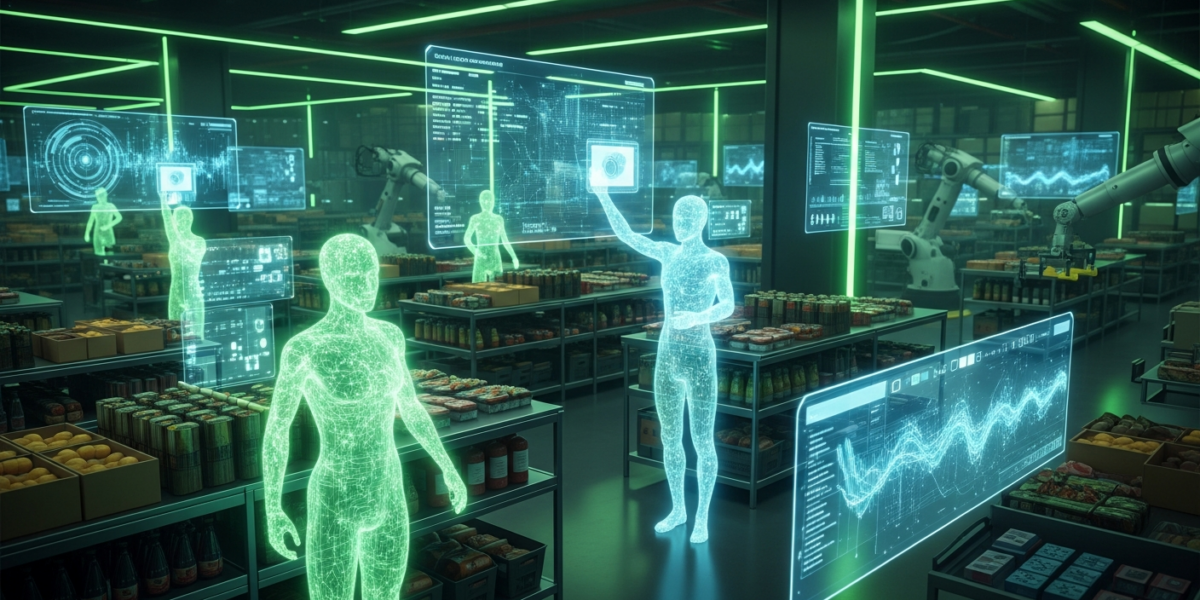
Choco leverages OpenAI APIs to automate and streamline food distribution processes, enhancing productivity and enabling growth within the food supply chain. This collaboration deepens the role of AI agents in executing complex operational workflows, transforming how food businesses manage their logistics and operations.
| Attribute | Detail |
|---|---|
| Released by | OpenAI |
| Release Date | |
| What it is | A customer story detailing Choco’s use of OpenAI APIs for food distribution automation. |
| Who it is for | Businesses in food distribution, logistics, and supply chain management. |
| Where to get it | OpenAI’s website |
| Price | Not yet disclosed. |
- Choco uses OpenAI APIs to automate food distribution.
- AI agents execute complex operational workflows.
- The collaboration aims to boost productivity.
- It also seeks to unlock growth for food businesses.
- This is an in-depth customer story by OpenAI.
- Choco employs OpenAI APIs to automate food distribution.
- AI agents are central to managing complex operational workflows.
- This initiative aims to improve productivity and foster growth.
- The technology focuses on streamlining the food supply chain.
- It represents a real-world application of AI’s impact.
What is Choco’s AI Agent Initiative?
Choco’s AI Agent Initiative involves using OpenAI APIs to automate and streamline various aspects of food distribution. This project expands AI capabilities across the food distribution ecosystem [1]. The goal is to deepen the role of agents in executing complex operational workflows [1].
How do AI Agents Work in Food Distribution?
AI agents in food distribution work by managing complex operational workflows, from order processing to logistics. These agents can handle tasks that typically require human intervention, making processes more efficient [1].
- Workflow Execution: AI agents are programmed to execute complex operational workflows [1]. This includes tasks like order management and inventory tracking.
- API Integration: Choco integrates OpenAI APIs to power these AI agents [1]. This allows the agents to leverage advanced AI capabilities.
- Productivity Boost: By automating tasks, AI agents help boost productivity within the distribution network [1]. This frees up human resources for more strategic roles.
- Growth Enablement: Streamlined operations and increased efficiency unlock growth opportunities for food businesses [1].
Benchmarks and Evidence
| Area of Impact | Evidence/Description | Source |
|---|---|---|
| Operational Workflows | AI agents deepen their role in executing complex operational workflows. | [1] |
| Productivity | The initiative aims to boost productivity in food distribution. | [1] |
| Growth | AI agents are designed to unlock growth for food businesses. | [1] |
| Automation Expansion | Choco is expanding AI capabilities across the food distribution ecosystem. | [1] |
Who Should Care?
Builders
Builders interested in AI and automation should care about Choco’s use of OpenAI APIs. This case study demonstrates practical applications of AI agents in complex industries. It highlights how APIs can create robust automation solutions.
Enterprise
Enterprises in food distribution and supply chain management should care about Choco’s success. The initiative shows how AI agents can streamline operations and improve efficiency [1]. It offers a model for leveraging AI to boost productivity and growth [1].
End Users
End users, including restaurants and grocery stores, may benefit from more efficient food delivery. Automated systems can lead to faster and more reliable supply chains.
Investors
Investors should note the potential for AI to transform traditional industries like food distribution. Choco’s story suggests a growing market for AI-powered solutions in logistics. This could indicate future investment opportunities in automation and AI agents.
Risks, Limits, and Myths
- Prompt Injection: AI models face a technical vulnerability called prompt injection [2]. This occurs when users manipulate system prompts, potentially altering the bot’s behavior [2].
- Automation Challenges: Automating food delivery faces challenges due to the expense of human labor [4]. Robotics startups are working to address these issues [4].
- AI Agent Control: The idea of AI agents replacing apps is emerging [5]. This shift could change how users interact with technology [5].
- Physical AI Integration: Commercial bakeries are increasingly pairing AI with automation robotics [8]. Chef Robotics also automates produce packing with physical AI models [6].
FAQ
- What is Choco’s main goal with AI agents? Choco’s main goal is to automate and streamline food distribution processes using OpenAI APIs, boosting productivity and enabling growth [1].
- How do AI agents help in food distribution? AI agents help by executing complex operational workflows, such as order management and logistics, making processes more efficient [1].
- Which OpenAI technology does Choco use? Choco uses OpenAI APIs to power its AI agents for food distribution automation [1].
- What are the benefits of using AI agents in food distribution? Benefits include increased productivity, streamlined operations, and unlocked growth opportunities for food businesses [1].
- Is this technology available today? The OpenAI customer story about Choco was published on [1].
- Are there any risks associated with AI agents? Yes, prompt injection is a real and dangerous technical vulnerability for AI models [2].
- Can AI agents replace human workers in food distribution? AI agents deepen their role in executing complex operational workflows, but the extent of replacement is not fully detailed [1].
- Are other companies using AI in food delivery? Yes, companies like Coco Robotics deploy autonomous delivery robots [3], and Loman AI offers AI phone answering for restaurants [7].
Glossary
- AI Agents
- Autonomous programs that can perform tasks or make decisions based on their environment and goals, often interacting with other systems or users.
- OpenAI APIs
- Application Programming Interfaces provided by OpenAI, allowing developers to integrate OpenAI’s AI models and capabilities into their own applications.
- Food Distribution Ecosystem
- The complex network of organizations, processes, and technologies involved in moving food products from producers to consumers.
- Operational Workflows
- The sequence of tasks and activities required to complete a business process, such as order fulfillment or inventory management.
- Prompt Injection
- A security vulnerability where malicious input to an AI model can override its system prompts, causing it to behave unexpectedly or maliciously [2].
Sources
- Choco automates food distribution with AI agents | OpenAI
- There’s no rogue McDonald’s AI bot, but ‘prompt injection’ is still a risk for companies – Fast Company
- Meet Coco, downtown San Jose’s new autonomous delivery robot — https://www.mercurynews.com/2026/04/21/meet-coco-downtown-san-joses-new-autonomous-delivery-robot/
- A startup reimagines restaurant delivery for the AI era — https://www.restaurantbusinessonline.com/technology/startup-reimagines-restaurant-delivery-ai-era
- OpenAI could be making a phone with AI agents replacing apps | TechCrunch
- Chef Robotics Physical AI Models Can Automate Produce Packing | Refrigerated & Frozen Foods
- Loman AI | 24/7 AI Phone Answering for Restaurants
- How AI Is ALREADY Changing YOUR Cottage Food Business