
AI for Detecting Crypto Insider Trading
AI for detecting insider trading in crypto refers to systems that use machine learning, natural language processing, and graph analysis to identify suspicious trading patterns based on non-public information. These tools analyze on-chain transactions, exchange data, social sentiment, and news feeds in real time to flag anomalies, correlate events, and alert compliance teams, making them indispensable in a high-speed, pseudonymous market where manual oversight fails.
TL;DR: AI in Crypto Insider Trading – Key Takeaways
- AI detects crypto insider trading by analyzing huge data volumes from blockchains, exchanges, social media, and off-chain sources.
- It identifies patterns like wash trading, front-running, and unusual pre-news activity that humans miss.
- Leading tools include Solidus Labs, NICE Actimize, and Chainalysis—each with strengths in real-time alerts, DeFi monitoring, or forensic tracing.
- Implementation costs include data infrastructure and skilled staff, but ROI comes from avoiding fines, building trust, and attracting institutional capital.
- AI doesn’t replace humans; it augments analysts by prioritizing alerts and providing evidence—intent and prosecution still require human judgment.
- Regulatory pressure (e.g., South Korea’s FSS) and rising DeFi risks are accelerating adoption in 2026.
Key Takeaways: AI’s Role in Crypto Market Integrity
AI transforms crypto market surveillance by processing data at scale and speed impossible for humans. It correlates on-chain moves with off-chain events, spots complex manipulation patterns, and adapts to new threats. For exchanges, projects, and regulators, AI-driven detection is no longer optional—it’s a core requirement for integrity, compliance, and growth in 2026’s matured crypto landscape.
What is Crypto Insider Trading and Why is AI Critical for Detection?
Defining Crypto Insider Trading for Smart Investors
Crypto insider trading involves executing trades based on material, non-public information—like upcoming exchange listings, undisclosed exploits, token burns, or large institutional orders. Examples include buying a token before a Binance listing announcement, shorting a project ahead of a smart contract bug disclosure, or front-running a public NFT mint.
Crypto’s pseudonymous blockchains, 24/7 global markets, terabytes of daily data, and near-instant trade execution make it uniquely prone to insider abuse. Without AI, detecting these acts is like finding a needle in a billion haystacks.
Why Manual Detection Fails in the Rapid Crypto Market
Human analysts cannot monitor millions of transactions across chains, correlate them with Discord messages or GitHub commits, or spot sophisticated patterns like wash trading pairs in real time. They lack the computational power to process blockchain data at scale or keep pace with manipulators using bots and algorithms.
AI handles these tasks continuously, connecting off-chain events to on-chain activity and flagging anomalies for investigation—making it the only viable solution.
Why AI for Detecting Crypto Insider Trading Matters Now (2026 Perspective)
Global Regulatory Push for Crypto Integrity
Regulators worldwide are demanding stricter crypto market surveillance. South Korea’s Financial Supervisory Service (FSS) now uses AI to monitor exchanges 24/7 for unfair trading, setting a precedent others follow.
The EU’s MiCA regulations and US SEC guidelines emphasize real-time oversight, forcing exchanges and projects to adopt AI tools to avoid penalties and maintain licensing. This trend underscores the critical need for advanced surveillance.
Maturity of Crypto Markets and Institutional Influx
Institutional investors require compliant, manipulation-free environments. Major players like BlackRock and Fidelity prioritize platforms with robust surveillance. AI-driven integrity becomes a crucial competitive advantage in crypto investment, attracting capital and boosting trading volumes by ensuring fair markets.
This institutional influx drastically increases the stakes for market integrity, making AI detection systems indispensable.
DeFi’s Unique Vulnerabilities and AI’s Role
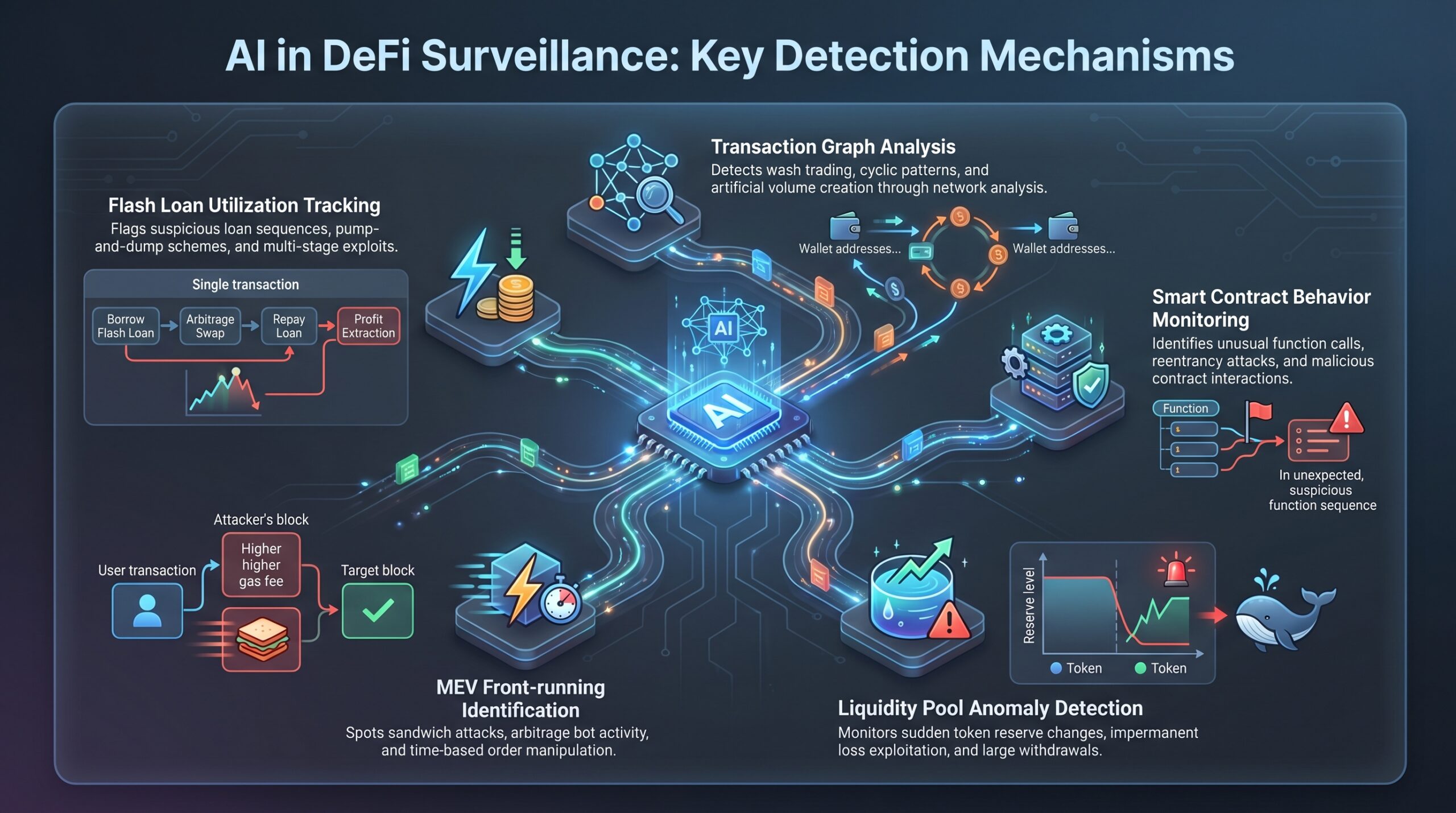
DeFi introduces unique risks, including MEV front-running, oracle manipulation, and flash loan exploits. Traditional surveillance methods often miss these complex on-chain activities.
AI analyzes smart contract interactions, liquidity pool changes, and miner extractable value to detect manipulation in real time. This capability is critical as DeFi volumes continue to grow and evolve.
Evolving Sophistication of Malicious Actors in Crypto
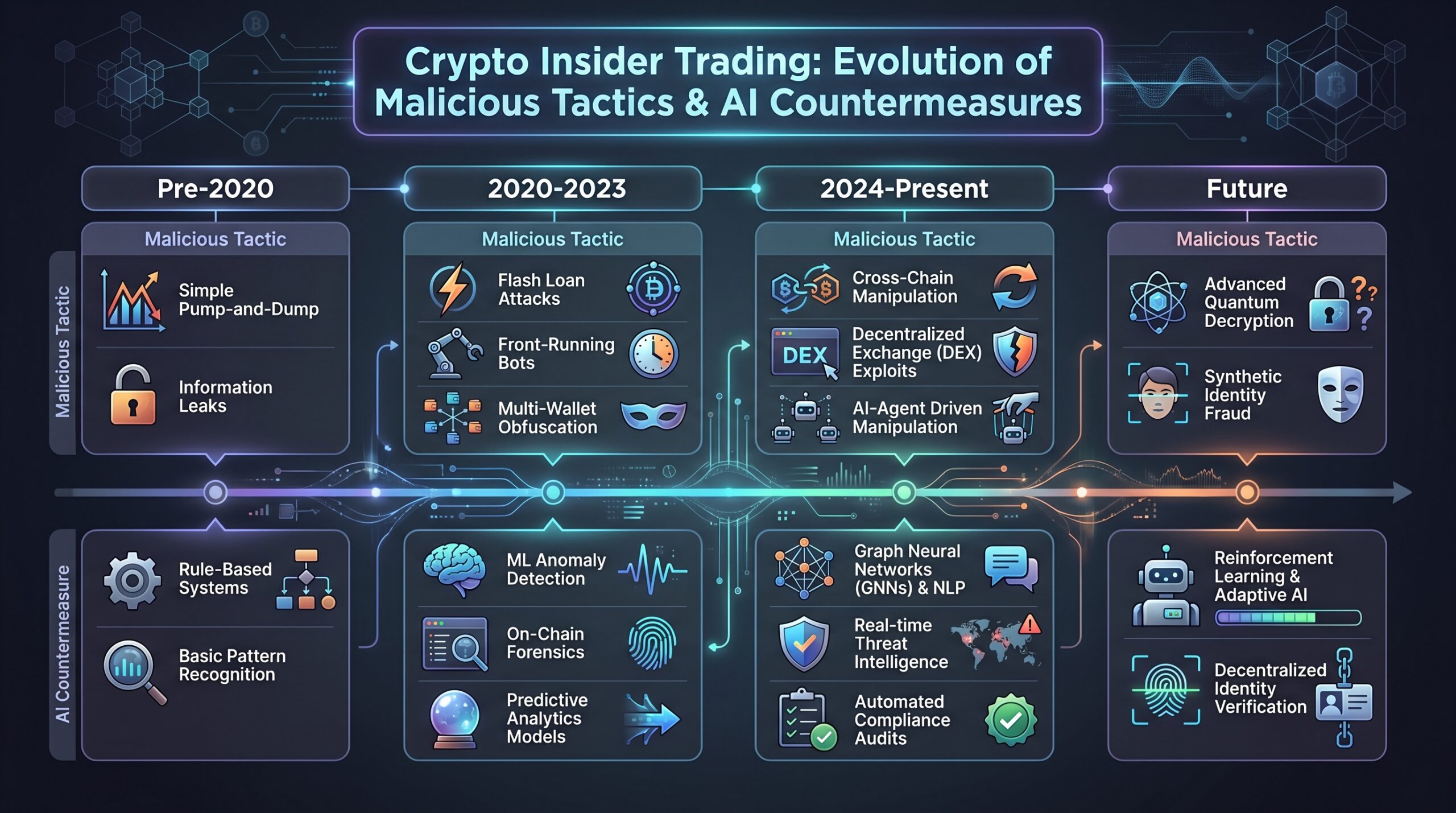
Manipulators now employ advanced techniques such as multi-wallet schemes, cross-chain swaps, and even AI-generated fake news. This escalating sophistication demands equally advanced countermeasures.
AI fights fire with fire, using adaptive learning to identify new patterns and stay ahead of emerging threats. This constant evolution is key to maintaining market fairness.
How AI Detects Insider Trading in Crypto: Mechanics and Methodologies
Comprehensive Data Sources for AI Analysis
AI systems ingest vast amounts of data from diverse sources to achieve comprehensive detection. This includes both on-chain and off-chain information.
- On-chain data: This refers to transactions, wallet addresses, and smart contract calls from various blockchains like Ethereum and Solana, accessed via nodes or indexers such as The Graph.
- Off-chain data: This encompasses exchange order books, user KYC data, OTC desk trades, and dark pool activity, typically gathered through APIs.
- Social/media: Data from X (formerly Twitter), Reddit, Discord, and Telegram is analyzed for sentiment spikes, potential leaks, or coordinated messaging.
- News and code: Web scrapers continuously monitor news sites and GitHub repositories for undisclosed updates or vulnerabilities.
Correlating these disparate sources is complex but absolutely necessary for accurate and effective detection of insider trading.
Key AI Techniques Powering Detection of Crypto Insider Trading
Several advanced AI techniques are employed to identify suspicious activities in the crypto market.
- Machine Learning: Supervised models are trained to flag known patterns, such as pump-and-dump schemes, while unsupervised models are used to discover novel anomalies that do not fit predefined rules. Reinforcement learning adapts to new manipulation tactics as they emerge.
- Natural Language Processing (NLP): NLP analyzes text from social media, forums, and news feeds for sentiment spikes, insider hints, or coordinated messaging. Systems from providers like NICE Actimize excel in this area.
- Graph Neural Networks (GNNs): GNNs are crucial for mapping relationships between wallets, exchanges, and various entities. They help to uncover hidden networks and complex transaction flows that might indicate collusion or illicit activities.
- Behavioral Analytics: This technique involves profiling normal user activity and then flagging significant deviations. For instance, sudden large trades from previously inactive wallets could be an indicator of insider activity.
These techniques, when combined, create a powerful surveillance system capable of intricate pattern recognition.
Identifying Specific Manipulation Patterns with AI
AI systems are adept at detecting a wide range of specific manipulative patterns that are difficult for human analysts to spot.
- Wash trading: AI identifies instances of fake volume creation through self-trading pairs, which can mislead other market participants.
- Spoofing/layering: AI detects the placement of fake orders intended to manipulate prices and create false market depth.
- MEV front-running: Bots exploiting transaction ordering, particularly in DeFi, are quickly identified by AI algorithms.
- Pre-news pumps: Unusual buying activity occurring just before significant public announcements is a classic indicator that AI can flag.
Advanced tools often integrate AI analysis for algorithmic trading, allowing for visualization and backtesting of detected patterns.
Predictive Modeling and Real-time Monitoring
Beyond retrospective analysis, AI uses historical data to predict potential manipulation scenarios. For example, it can forecast token volatility following a potential leak.
Real-time engines, such as those used by Kuey.net, process data streams instantly, alerting analysts within seconds of suspicious activity. This immediate response capacity is vital in fast-moving crypto markets.
Real-World Examples & Use Cases of AI in Detecting Crypto Insider Trading
Regulatory Bodies Leveraging AI for Surveillance
Regulatory bodies globally are increasingly adopting AI to strengthen market integrity. South Korea’s FSS (Financial Supervisory Service) exemplifies this trend.
The FSS utilizes AI to continuously monitor all domestic crypto exchanges, detecting insider trading and market manipulation. This sophisticated system cross-references transaction data with news and social media feeds, drastically reducing investigation time from weeks to mere hours.
Exchanges Deploying AI for Internal and External Threats
Major exchanges understand the dual threat of internal and external insider trading. Binance, for instance, employs AI to address both.
Their AI systems analyze trade patterns, account behaviors, and access logs to prevent incidents. This proactive approach helped in preventing potential insider trading cases involving listing team members, demonstrating AI’s efficacy in safeguarding exchange operations and user trust.
AI’s Role in Protecting DeFi Protocols from Manipulation
The decentralized nature of DeFi presents unique challenges that AI is uniquely suited to address. Solidus Labs’ AI solution is a prime example.
Their AI actively monitors DeFi protocols for MEV bots front-running users and for oracle manipulation attacks. In a recent incident, it flagged a trader who used flash loans to artificially depress an asset’s price before making large purchases. This allowed for prompt protocol interventions, protecting market fairness.
Forensic Analysis and Law Enforcement Applications
Beyond real-time detection, AI plays a crucial role in post-incident forensic analysis, aiding law enforcement in complex crypto investigations.
Following events like the 2024 HyperVerse collapse, AI was instrumental in tracing funds. It tracked assets through mixer services and across various cross-chain bridges, linking pseudonymous wallets to real entities. This capability significantly assisted in asset seizures and subsequent prosecutions, demonstrating AI’s profound value in bringing accountability to the crypto space.
Comparison: AI Surveillance Platforms vs. Traditional Methods
What Most People Get Wrong: AI is an Augmentation, Not a Replacement
A common misconception is that AI autonomously prosecutes insiders. In reality, AI serves as a powerful augmentation tool.
It flags anomalies for human analysts who then assess intent and context. While AI significantly reduces false positives, prioritizes alerts, and provides compelling evidence, legal outcomes ultimately depend on human judgment and robust risk mitigation strategies.
| Capability Aspect | Traditional Methods (Manual/Basic Alerts) | AI-Powered Systems | Advantage |
|---|---|---|---|
| Speed of analysis | Hours to days for data review | Real-time, seconds for alerts | AI wins |
| Data volume handling | Limited to samples and summaries | Full dataset processing | AI wins |
| Pattern complexity | Misses cross-chain or subtle patterns | Detects wash trading, spoofing, MEV | AI wins |
| Cross-market correlation | Manual correlation, often missed | Automated across exchanges/chains | AI wins |
| Predictive capabilities | Reactive only | Forecasts potential manipulation | AI wins |
| Alert accuracy | High false positive rate | Lower false positives via ML tuning | AI wins |
| Continuous monitoring | Intermittent checks | 24/7 without fatigue | AI wins |
| Resource intensity | High human labor needs | Automated, scalable with cloud | AI wins |
| Adaptability to new tactics | Slow rule updates | Learns and adapts continuously | AI wins |
Key AI Tools, Vendors, and Implementation Paths for Crypto Surveillance
Leading AI Surveillance Platforms for Crypto Markets (2026 Review)
Several key players dominate the AI-powered crypto surveillance landscape, each offering specialized strengths:
- Solidus Labs: Offers Halis for market surveillance and RECON for forensic tracing. They are strong in DeFi monitoring and real-time alerts, with a crypto-native focus. Pricing is typically SaaS.
- NICE Actimize: Adapts its traditional finance surveillance tools for crypto markets. It excels in NLP and cross-market monitoring, often deployed via enterprise licensing agreements.
- Chainalysis: Primarily focuses on blockchain tracing and entity clustering, integrating well with existing compliance workflows. They offer both SaaS and enterprise models.
- Anomalie Inc. (emerging): Specializes in low-latency anomaly detection specifically for exchanges. They present a lower-cost SaaS option, making advanced surveillance more accessible.
| Platform | Key Features for Insider Trading Detection | Crypto Market Focus | Pricing Model | Regulatory Integrations |
|---|---|---|---|---|
| Solidus Labs | Real-time alerts, DeFi MEV monitoring, cross-chain analysis | Crypto-native | SaaS subscriptions | FATF travel rule, MiCA ready |
| NICE Actimize | NLP for news/social, behavioral analytics, cross-asset correlation | TradFi with crypto integration | Enterprise licensing | SEC, FCA compatible |
| Chainalysis | Blockchain tracing, wallet clustering, investigation tools | Mixed (gov + enterprise) | SaaS/enterprise | Global law enforcement APIs |
| Anomalie Inc. | Low-latency anomaly detection, exchange API integration | Exchanges and brokers | SaaS tiered pricing | Basic compliance exports |
A Step-by-Step Guide to Implementing AI for Insider Trading Detection
Implementing a robust AI-driven surveillance system requires careful planning and execution.
- Data integration: Connect all relevant data sources. This includes on-chain sources (node APIs, The Graph), off-chain data (exchange APIs, social scrapers), and any internal proprietary data.
- Model selection: Choose the appropriate AI models for your specific needs. Use supervised machine learning for known patterns, unsupervised models for novel anomalies, and Graph Neural Networks (GNNs) for network mapping. This is similar to how agentic AI trading infrastructure is built.
- Customization and training: Feed historical data, including past insider trading cases, to train your models. This ensures the models are tailored to your specific assets, market dynamics, and risk profile.
- Workflow integration: Integrate the AI-generated alerts into your existing compliance dashboards, such as Salesforce CRM. Establish clear assignment protocols for investigators and define escalation procedures.
- Continuous improvement: Regularly retrain your models (at least quarterly) with new data. Monitor false positives and negatives, and adapt your system to continuously address emerging threats and market changes.
Costs, ROI, and Monetization Upside of AI in Crypto Insider Trading Detection
Understanding the Investment: Costs of AI for Crypto Surveillance
Implementing AI for crypto surveillance involves significant but justifiable investments. These costs can be broken down into several categories:
- Initial setup: This typically ranges from $50,000 to $500,000. It covers infrastructure build-out, software licenses for core platforms, and the development of necessary data pipelines to aggregate diverse information.
- Operational costs: Ongoing expenses can be between $10,000 and $100,000 per month. These primarily include cloud processing fees for compute and storage, API access fees for external data sources, and recurring subscriptions for AI tools and specialized data feeds.
- Personnel: Staffing costs range from $150,000 to $300,000 annually. This covers salaries for skilled professionals such as data scientists (who build and refine models), compliance analysts (who interpret alerts and conduct investigations), and DevOps engineers (who maintain the system infrastructure).
While these figures represent a substantial investment, the long-term benefits often far outweigh the upfront and ongoing expenses.
Costs & ROI of AI in Crypto Surveillance: Decision Framework
- Initial Investment Components:
- Data Infrastructure: Hardware, cloud services, data lakes/warehouses.
- Software Licensing: AI surveillance platforms, ML libraries, visualization tools.
- Integration & Customization: API development, workflow automation.
- Talent Acquisition: Data scientists, ML engineers, compliance specialists.
- Operational Costs:
- Cloud Compute & Storage: Ongoing data processing and retention.
- API Fees: Third-party data providers (on-chain, social, news).
- Maintenance & Updates: Software patches, model recalibration.
- Team Salaries: Sustaining expert personnel.
- Key ROI Drivers:
- Avoidance of Regulatory Fines: Mitigating penalties like those faced by BitMEX for non-compliance.
- Enhanced Market Integrity: Attracting more institutional investors and trading volume due to perceived fairness.
- Prevention of Financial Losses: Protecting against market manipulation (e.g., flash crashes) and asset depreciation from insider sell-offs.
- Reputational Gains: Building trust with users and partners, leading to sustained growth.
- Operational Efficiency: Reducing manual investigative hours and false positives.
Calculating the Return on Investment (ROI) for AI Detection Systems
The return on investment for AI detection systems extends beyond simply preventing direct financial losses. It encapsulates broader benefits that contribute to organizational health and market standing.
- Avoiding fines: A primary driver of ROI is the prevention of substantial regulatory penalties. For example, the BitMEX exchange faced a $100 million penalty for its lax surveillance practices. AI helps mitigate such risks.
- Enhanced reputation: A robust, AI-driven surveillance system signals commitment to market integrity. This attracts more users and bolsters trading volume, as participants seek trustworthy platforms.
- Preventing losses from manipulated markets: AI can preemptively identify and mitigate events such as flash crashes or other forms of market manipulation, thus protecting investors and the platform itself from significant financial losses.
- Protecting project valuations from insider sell-offs: By detecting early signs of insider trading, AI safeguards the fair valuation of digital assets and prevents premature sell-offs that could undermine investor confidence.
These combined benefits demonstrate a strong case for investing in AI surveillance.
Monetization Upside: Opportunities for Exchanges and Service Providers
For exchanges and service providers, embracing AI for market surveillance isn’t just about compliance; it opens up new avenues for monetization and competitive advantage.
Exchanges can monetize their enhanced integrity by potentially charging higher trading fees or attracting premium institutional clients who prioritize secure and fair trading environments. This creates a virtuous cycle where trust translates directly into revenue.
Furthermore, vendors specializing in AI surveillance can develop and sell their advanced SaaS tools to smaller exchanges, individual DeFi projects, or even traditional financial institutions venturing into crypto. Regulators themselves can also realize significant savings by automating large portions of their monitoring tasks, freeing up resources for more complex oversight.
Risks, Pitfalls, and Myths vs. Facts in AI-Powered Detection
Inherited Risks and Technical Pitfalls of AI in Crypto Surveillance
While AI offers significant advantages, its deployment in crypto surveillance comes with inherent risks and technical challenges that need careful management.
- Data privacy: A critical challenge involves balancing the need for comprehensive surveillance with the expectation of pseudonymity prevalent in crypto. Ensuring data security and adherence to privacy regulations is paramount.
- False positives/negatives: An AI system that generates too many false positives can overwhelm compliance teams and waste resources. Conversely, false negatives—missed insider trading instances—can lead to severe reputational damage and regulatory fines.
- Adversarial AI: Sophisticated manipulators might attempt to poison AI models with fake data or introduce subtle patterns designed to evade detection. This requires robust, adaptive AI defenses.
- Black-box problem: Many advanced AI models operate as “black boxes,” making it difficult to fully explain their decisions. This lack of transparency can be problematic when presenting evidence in court or to regulators.
- Regulatory lag: The rapid evolution of AI capabilities often outpaces the development of regulatory frameworks. This gap can create uncertainties regarding compliance and legal enforceability.
Common Misconceptions: Myths vs. Facts about AI for Detecting Crypto Insider Trading
Several myths surround AI’s role in crypto insider trading detection, often leading to unrealistic expectations or undue skepticism. It’s important to distinguish fact from fiction.
- Myth: AI proves intent. Fact: AI is excellent at flagging suspicious patterns and anomalies, but it cannot definitively prove criminal intent. That remains the domain of human investigation and legal processes.
- Myth: AI solves all fraud. Fact: AI is a powerful tool, but it is not a silver bullet. It significantly enhances detection capabilities but requires integration with human oversight, continuous refinement, and a comprehensive compliance strategy. For example, some AI tools are great for identifying AI exploit crypto exchange software flaws, but this is only one facet of overall security.
- Myth: AI is too expensive. Fact: While enterprise solutions can be costly, the emergence of SaaS models and tiered pricing from vendors like Anomalie Inc. makes AI-powered surveillance increasingly accessible to midsize firms and projects.
- Myth: The “30% rule” is universal. Fact: There is no standard “30% rule” in the industry. Any percentage threshold for anomaly detection is a model-specific parameter configured based on the system, asset, and risk appetite of the deploying entity.
Frequently Asked Questions (FAQ) about AI for Detecting Crypto Insider Trading
Which AI is best for crypto trading analysis?
The “best” AI for crypto trading analysis depends heavily on your specific needs and use cases. For real-time alerts and comprehensive DeFi monitoring, Solidus Labs is a strong contender. If your focus is on cross-market monitoring and leveraging Natural Language Processing (NLP) for sentiment and news analysis, NICE Actimize offers robust solutions. For powerful blockchain tracing and entity clustering, especially valued by investigators and law enforcement, Chainalysis stands out. It’s crucial to evaluate factors such as data coverage, customization options, integration capabilities, and cost when making a choice, as no single tool universally leads in all areas. For general crypto AI trading apps, other solutions may be more suitable.
What is the 30% rule in AI?
The “30% rule” is not a universal or standardized rule within AI or the financial industry. It sometimes refers to a configurable threshold within specific AI models, where an anomaly score exceeding 30% might trigger an alert for further investigation. However, this percentage is highly variable and depends entirely on the design of the particular AI system, the type of data being analyzed, the acceptable level of risk, and the desired sensitivity for detection. It is a parameter that is set and tuned by data scientists and compliance teams to balance the trade-off between detecting legitimate suspicious activity and minimizing false positives, rather than an industry-wide standard.
Can AI predict crypto trading?
AI can certainly forecast short-term price movements or identify specific manipulation risks based on observed patterns and market anomalies. Its strength lies in processing vast datasets to uncover correlations that humans would miss, providing valuable insights into potential market shifts or illicit activities. However, it is crucial to understand that AI does not reliably predict long-term price movements or perfectly foresee the future of crypto markets. Its primary strength in this context is detecting illicit activity and behavioral patterns, not market divination or guaranteeing future profits. For making money with bots, focus on quantum AI trading bots that manage risk effectively and adhere to bankroll management principles.
Can AI track crypto?
Yes, AI is highly capable of tracking crypto transactions. It can trace assets across various blockchains, wallets, and exchanges by analyzing complex transaction graphs and combining this on-chain data with relevant off-chain information (e.g., exchange data, social media sentiment, news). This capability is absolutely essential for purposes such as tracing the flow of funds involved in insider trading, identifying the origin and destination of illicit funds, and recovering stolen assets. AI’s ability to handle the sheer volume and complexity of blockchain data makes it an indispensable tool for crypto forensics and compliance.
Glossary of Key Terms for AI in Crypto Market Surveillance
- On-chain data: All transaction records, smart contract interactions, and other data permanently recorded on a blockchain ledger.
- Off-chain data: Information not directly stored on a blockchain, including exchange order books, user KYC details, social media posts, and traditional news articles.
- MEV (Miner Extractable Value): The profit that miners (or validators in PoS) and bots can extract by reordering, censoring, or inserting transactions within blocks, often through front-running or sandwich attacks.
- Graph Neural Network (GNN): A type of artificial neural network designed to process data that can be represented as graphs, useful for analyzing relationships between entities like wallets or users.
- False positive: An instance where an AI system incorrectly flags a normal or legitimate activity as suspicious or illicit.
- Behavioral analytics: The process of collecting, analyzing, and understanding patterns of user behavior to identify deviations from typical activity, often indicative of fraud or compromise.
References & Further Reading on AI for Crypto Integrity
- South Korea FSS AI Deployment Report (2025)
- NICE Actimize: “NLP in Financial Surveillance” (2026)
- Solidus Labs: “DeFi Market Monitoring” whitepaper
- Chainalysis: “Crypto Crime Trends” (2026 edition)
- EU MiCA Regulation Documentation