
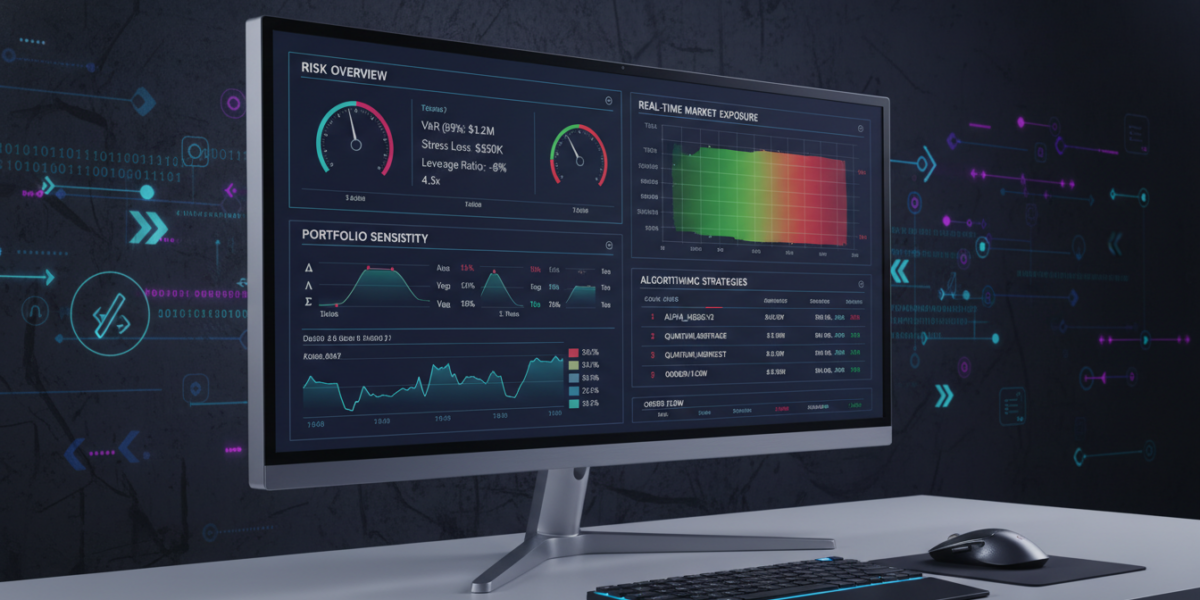
Effective bankroll management is the foundational discipline that separates sustainable trading operations from those that blow up during inevitable market volatility. It involves systematic rules for position sizing, risk allocation, and capital preservation that ensure your automated trading systems survive long enough to compound returns.
TL;DR
- Fractional Kelly sizing reduces variance and improves long-term performance—half-Kelly or quarter-Kelly are standard in professional systems.
- Exposure limits (e.g., 20% per strategy) prevent overconcentration and protect against black swan events.
- Modular architecture (separating execution, risk, signals) allows precise control and easier debugging.
- Unified dashboards like TradersPost simplify multi-account, multi-bot oversight.
- Live trade calibration is essential—what worked in backtests often fails without real-world frictions.
- Cost structures matter—VPS, data, and exchange fees can erase thin margins if not factored into sizing.
- Career leverage comes from showing you can manage real capital systematically, not just theorize.
Key takeaways
- Use half-Kelly or quarter-Kelly instead of full Kelly for real trading.
- Set hard exposure limits—20% per strategy, 1-2% per trade.
- Build a modular bot so you can change risk rules without changing strategy logic.
- Start small—test with dry-run and small capital before scaling.
- Stick to your rules—do not override them during drawdowns.
What Bankroll Management Means in Algorithmic Trading
Bankroll management is the system of rules and controls you put in place to decide how much capital to risk per trade, per strategy, and across your entire automated portfolio. It is not a trading strategy itself—it is the meta-layer that determines position sizing, risk exposure, and capital allocation.
A well-designed bankroll management system answers:
- How much do I risk on this signal?
- How much total exposure do I allow this bot to have?
- How do I adjust sizing after a drawdown or a streak?
- When do I pause a strategy entirely?
Without clear answers to these questions, you are not running a trading system—you are gambling with extra steps.
Why This Matters Now
Automated trading is no longer niche. Retail traders deploy bots on major exchanges, and institutional tools have trickled down. But easy access has a downside: more people blow up.
Three trends make disciplined bankroll management urgent:
- AI integration: Signal generators are increasingly driven by advanced models. They can produce more signals, faster. Without tight position controls, you can overexpose in minutes.
- Multi-strategy bots: It’s common to run momentum, mean-reversion, and arbitrage strategies simultaneously. Without allocation rules, correlations can compound risk.
- Real-time leverage markets: Platforms offering perpetual swaps with high leverage mean poor sizing can lead to liquidation even if the trade idea was correct.
If you’re not controlling risk at the system level, you’re not building a sustainable operation.
Professional Insight: The most successful algorithmic traders spend more time on risk management than on signal generation. Your edge comes from surviving long enough to compound, not from predicting markets perfectly.
How Bankroll Management Works in Practice
The Kelly Criterion
The Kelly Criterion is a mathematical formula used to determine the optimal bet size given your edge and the odds. The goal is to maximize logarithmic wealth over time.
The formula is:
f* = (bp – q)/b
Where:
- f* is the fraction of your bankroll to bet
- b is the net odds (e.g., if you risk 1 to win 2, then b = 2)
- p is the probability of winning
- q is the probability of losing (1 – p)
Example: Your bot has a strategy that wins 55% of the time. When it wins, the profit is 1.5 times the amount risked. When it loses, you lose the full amount risked.
Here:
- p = 0.55
- q = 0.45
- b = 1.5
f* = ((1.5)(0.55) – 0.45)/1.5 = (0.825 – 0.45)/1.5 = 0.25
So the full Kelly suggests risking 25% of your bankroll per trade.
Why You Should Use Fractional Kelly
Full Kelly is too aggressive for real-world trading. It assumes you know your edge precisely, which you don’t. It also leads to high volatility—a string of losses can decimate your capital.
Most professional systems use half-Kelly or quarter-Kelly. In the example above, that would mean risking 12.5% or 6.25% per trade instead of 25%.
This is non-negotiable. Unless you have years of validated live data, you are overestimating your edge. Fractional Kelly reduces risk of ruin and smooths equity curves.
Setting Bankroll Exposure Limits
You should never let a single strategy consume your entire bankroll. A common practice is to cap each strategy at 20% of total capital. This way, a full wipeout in one strategy doesn’t take you out of the game.
You should also set per-trade limits. For example, no single trade can risk more than 2% of the strategy’s allocated capital.
These rules are implemented as hard checks in your bot’s order execution logic.
Modular Architecture for Risk Control
Your trading bot should not be a monolith. A modular design separates:
- Signal generation: The logic that generates buy/sell signals
- Risk engine: Calculates position size based on current bankroll, exposure limits, and Kelly sizing
- Order execution: Handles order placement, slippage, and exchange communication
- Monitoring and logging: Tracks trades, balances, and exposures
This separation allows you to change your risk parameters without touching your strategy code. It also makes it easier to backtest and simulate sizing changes.
Real Examples and Use Cases
Case Study: Half-Kelly on a Crypto Momentum Bot
A trader built a momentum bot trading perpetual swaps. Backtests showed a 58% win rate with an average win/loss ratio of 1.8. Full Kelly suggested 28% per trade.
Instead, they used half-Kelly (14%). Over six months, the bot had a drawdown of 22%—significant but manageable. The full-Kelly simulation had a 65% drawdown during the same period, which would have triggered a mental stop or full liquidation.
Takeaway: Fractional Kelly let them stay in the game during a volatile period. The full-Kelly approach would have blown up the account.
Case Study: Exposure Limits on a Multi-Strategy Bot
A team ran three strategies:
- A market-making bot
- An arbitrage bot between exchanges
- A trend-following bot
They allocated:
- 30% to market-making
- 40% to arbitrage
- 30% to trend-following
Each strategy had its own internal position limits. When the arbitrage bot encountered a series of failed trades (due to sudden exchange outages), its drawdown was contained. The overall portfolio dipped by 9% instead of a potential 40%+ if all capital was allocated to one strategy.
Takeaway: Compartmentalization saves you from unforeseen failures.
Comparison of Risk Management Approaches
| Method | Pros | Cons | Best For |
|---|---|---|---|
| Full Kelly | Maximizes long-term growth | Extremely high volatility, risky | Theorists with proven edges |
| Half-Kelly | Good balance of growth and safety | Still requires accurate edge estimate | Most live trading bots |
| Fixed Fractional | Simple to implement | Doesn’t adapt to changing edge | Beginners or low-frequency strategies |
| Fixed Ratio | Reduces risk after drawdowns | Complex to calibrate | High-capital traders |
Static vs Dynamic Exposure Limits
- Static: You set a fixed cap (e.g., 2% per trade, 20% per strategy). Simple and robust.
- Dynamic: Adjust limits based on volatility, recent performance, or market regime. More adaptive but introduces complexity.
Most traders should start with static limits. Once you have a year of live data, consider dynamic adjustments.
Tools and Platforms
TradersPost: Unified Management Interface
TradersPost lets you connect multiple brokerage and exchange accounts into one dashboard. You can see your total exposure across bots, set global risk limits, and monitor performance in real-time.
Use Case: If you’re running bots on multiple exchanges, TradersPost gives you a single view of your total equity and risk. You can set alerts when any strategy breaches its exposure limit.
Modular Bot Frameworks
Open-source frameworks like Freqtrade or Hummingbot allow you to build modular trading systems with custom risk management layers. This requires coding but offers maximum flexibility.
Example: You can modify the position sizing function to implement Kelly-based sizing with exposure caps.
Tool Selection Tip: Choose platforms that enforce risk controls at the system level, not just as afterthoughts. Look for features like hard exposure limits, real-time monitoring, and comprehensive logging.
Step-by-Step Implementation
- Start with a backtest: Calculate your strategy’s win rate and profit factor. Estimate edge and odds.
- Compute full Kelly: Use the formula to get the theoretical optimum.
- Apply fractional Kelly: Start with half or quarter. This is your max per-trade risk.
- Set exposure limits: Cap each strategy at 20% of total bankroll. Cap each trade at 1-2% of strategy allocation.
- Code the risk engine: Implement the logic in your bot. Use hard stops—prevent orders that exceed limits.
- Run in dry-run mode: Test with fake money. Check that orders are sized correctly.
- Go live with small capital: Start with 10% of your planned bankroll. Monitor for a month.
- Adjust based on live data: Update your edge estimates and resize accordingly.
Costs, ROI, and How to Monetize
Costs
- VPS: $20–$100/month for a reliable server
- Data: Real-time data feeds can cost $100–$500/month
- Exchange fees: Maker/taker fees, withdrawal fees
- Software: Some platforms charge per trade or a monthly fee
Example: If you’re trading $50,000, expect to spend $200–$500 monthly on infrastructure and data.
ROI and Earning Potential
Good bankroll management won’t make a losing strategy profitable. But it turns a winning strategy into a sustainable business.
Example: A bot with a 5% monthly return becomes reliable compounder if drawdowns are kept below 15%. Without risk controls, the same bot might have a 40% drawdown and get shut down prematurely.
Career Leverage
Hedge funds and prop firms hire traders who can demonstrate systematic risk management. If you can show:
- Live track record with controlled drawdowns
- Clear documentation of your sizing methodology
- Experience with multi-strategy allocation
You can move into full-time roles or manage outside capital.
Risks and Pitfalls
Common Mistakes
- Overestimating edge: Your backtest win rate is inflated. Assume live performance will be 20% worse.
- Ignoring slippage and fees: These reduce your effective edge. Factor them into your Kelly calculation.
- Changing rules during drawdowns: Stick to your system. Do not increase size to “make back losses.”
- Correlation between strategies: Your momentum bot and mean-reversion bot might both fail in the same market regime. Diversify logic rather than just instruments.
Myths vs Facts
Myth: “Kelly sizing is too theoretical for crypto.”
Fact: It works in any probabilistic setting. But you must use fractional Kelly and adapt to live conditions.
Myth: “You should risk more when you’re on a winning streak.”
Fact: Unless your edge has fundamentally improved, increasing risk after wins is like doubling down at the casino.
Myth: “If you’re not using full Kelly, you’re leaving money on the table.”
Fact: Full Kelly leads to ruin for almost everyone. The goal is survival, not theoretical maxima.
FAQ
How do I calculate the optimal bet size using the Kelly criterion?
You need:
- Win rate (p)
- Loss rate (q = 1 – p)
- Net odds (b): (average profit on win) / (average loss on loss)
Then apply: f* = (bp – q)/b
Start with half of f* for real trading.
What are the benefits of fractional Kelly sizing?
It reduces volatility and risk of ruin. It accounts for the fact that your edge is uncertain. It lets you stay comfortable during drawdowns.
How can I implement bankroll exposure limits in my trading bot?
Add logic that:
- Tracks total capital per strategy
- Rejects any trade that would exceed the per-trade or per-strategy limit
- Examples: In Python, use conditional checks before order execution
Glossary
Bankroll: Total capital allocated to trading.
Kelly Criterion: A formula for optimal bet sizing based on edge and odds.
Fractional Kelly: Using a fraction (e.g., half) of the Kelly-recommended size.
Exposure Limit: A cap on how much capital can be risked in a given context.
Drawdown: Decline from peak capital.
Edge: The advantage your strategy has over random chance.
References
- TradersPost Official Documentation – Unified trading interface platform
- Freqtrade Documentation – Open-source algorithmic trading platform
- Hummingbot Documentation – Open-source market making bot framework
- TensorRT-LLM Optimization Guide – Performance optimization techniques
- LLM Evaluation and Winner’s Curse – Statistical evaluation methodologies
- KV Cache Compression Techniques – Optimization and efficiency methods