
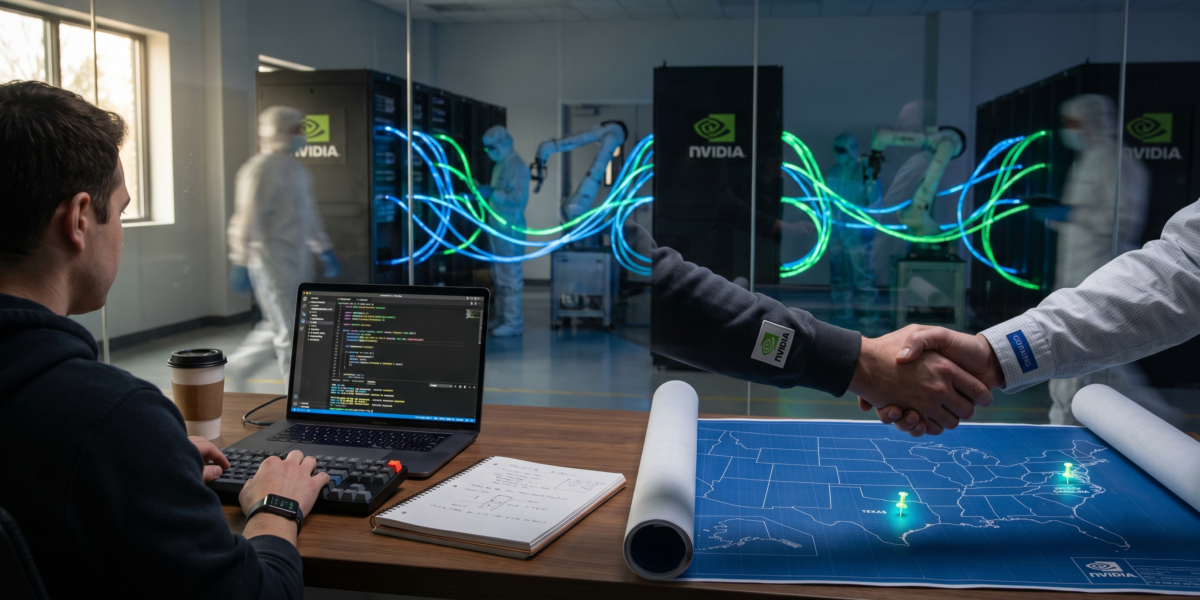
NVIDIA and Corning have launched a major long-term partnership to bolster U.S. manufacturing of advanced optical connectivity solutions crucial for next-generation AI infrastructure. This collaboration involves Corning building three new domestic manufacturing plants across North Carolina and Texas, significantly expanding its optical connectivity capacity tenfold and increasing domestic fiber production by over 50%. NVIDIA is providing substantial investment, potentially up to $3.2 billion, to support this strategic expansion, aiming to secure resilient, high-performance supply chains for its rapidly growing AI data center ecosystem. This initiative is set to create over 3,000 high-paying American jobs and mitigate supply chain risks while enabling the extreme bandwidth and low latency required by advanced AI workloads.
NVIDIA and Corning announced a long-term partnership on May 6, 2026, to dramatically expand U.S.-based manufacturing of advanced optical connectivity solutions essential for powering next-generation AI infrastructure. The collaboration involves Corning building three new manufacturing plants in North Carolina and Texas, boosting its U.S. optical connectivity capacity tenfold, increasing domestic fiber production by over 50%, and creating more than 3,000 high-paying American jobs. NVIDIA is providing substantial investment—figures range from $300 million to potentially $3.2 billion—to support this expansion, aiming to secure resilient, high-performance supply chains for AI data centers.
Why NVIDIA and Corning Partnered for AI Infrastructure Manufacturing
AI data centers demand unprecedented bandwidth and ultra-low latency. NVIDIA’s GPUs, like the H100 and B200, generate massive data flows that require specialized optical interconnects. Traditional copper cabling and generic fiber optics simply cannot keep pace with these extreme demands.
Corning, with over 50 years of materials science expertise, manufactures the high-precision glass fibers, transceivers, and connectors needed for these intense AI workloads. This partnership directly addresses a critical bottleneck: the U.S. currently lacks sufficient manufacturing capacity for the optical backbone essential for advanced AI infrastructure.
Jensen Huang, NVIDIA’s CEO, stated: "AI is driving the largest infrastructure buildout of our time—and a once-in-a-generation opportunity to reinvigorate American manufacturing and supply chains." This strategic move significantly reduces dependency on overseas suppliers, mitigating geopolitical risks and aligning with U.S. policy initiatives such as the CHIPS Act. For Corning, securing NVIDIA as a flagship customer in the high-growth AI sector leverages its existing innovations in low-loss fiber and high-density connectivity.
The strategic alliance between NVIDIA and Corning exemplifies a critical trend: leading tech companies actively investing in supply chain resilience and domestic manufacturing to support rapid technological advancement. This model could inspire similar partnerships across other critical components of the AI ecosystem.
What Advanced Optical Connectivity Solutions Mean for AI
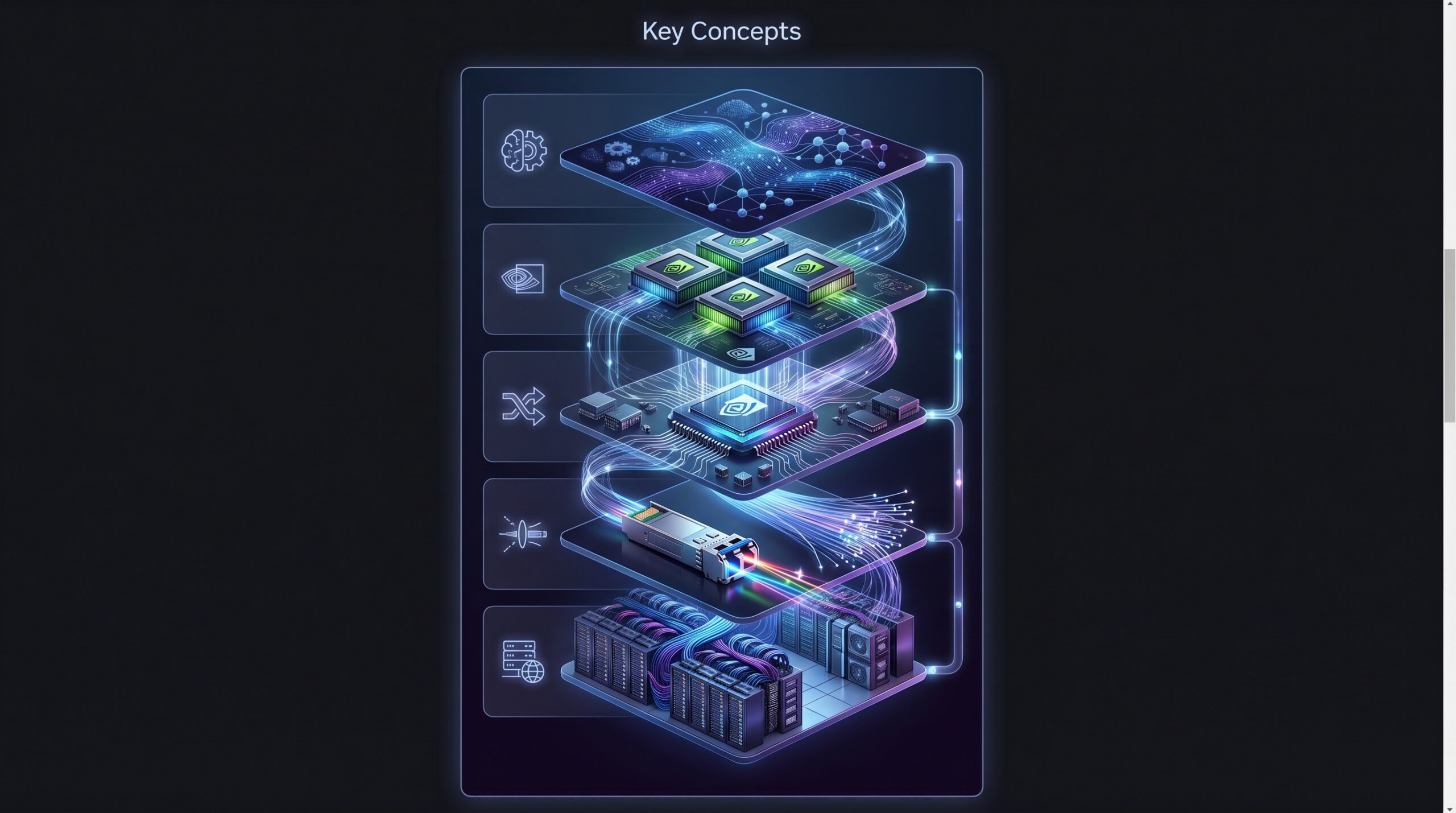
Optical connectivity solutions leverage light to transmit data through fiber optic cables, providing substantially higher bandwidth and significantly lower latency compared to traditional electrical signals. For AI infrastructure, this is not merely about faster internet; it is fundamental to enabling real-time, high-speed communication between thousands of GPUs within a single data center.
Key components essential for AI optical connectivity include:
- Advanced Optical Fiber: These are specialized glass fibers meticulously engineered for minimal signal loss over long distances. They are absolutely crucial for reliably linking vast AI supercomputers across expansive data halls.
- Transceivers: These vital devices convert electrical signals originating from NVIDIA GPUs into optical signals suitable for transmission through fiber. Modern transceivers must proficiently handle speeds exceeding 400Gbps, with a rapid progression towards 1.6Tbps to meet escalating AI demands.
- Optical Cables & Connectors: High-density cabling systems are designed to minimize physical space while simultaneously maximizing data throughput. This is an essential attribute for deploying scalable and efficient AI clusters, where every millimeter and byte per second counts.
These sophisticated components are integral to NVIDIA’s NVLink technology, which facilitates direct GPU-to-GPU connections at memory speeds, and Data Center Interconnect (DCI) systems that link multiple facilities. Without these advanced optical solutions, AI training times would become prohibitively long, and real-time inference, which is critical for many AI applications, would be practically impossible. Learn more about how AI performance is being pushed to new limits, such as with TensorRT-LLM v1.3.0rc14 Boosts Mamba, Qwen, Nemotron Performance.
Breakdown of Corning’s Manufacturing Expansion Plans
Corning is set to construct three groundbreaking new facilities in the U.S., with locations strategically selected in North Carolina and Texas. This initiative goes far beyond a simple capacity addition; it represents a fundamental redesign of the domestic supply chain for critical AI hardware, aiming for resilience and high performance.
North Carolina Plants: Two distinct facilities are expected to be established in North Carolina. These locations will likely capitalize on the state’s vibrant existing tech corridor, benefiting from close proximity to leading research universities and a readily available, skilled engineering workforce. These plants will specialize in precision glass melting and advanced fiber drawing—processes that demand incredibly sterile environments and exacting manufacturing tolerances to produce the highest quality optical fiber.
Texas Plant: A single, large-scale plant will be positioned in Texas, chosen for its strategic proximity to major data center hubs and robust logistics networks. This site will focus specifically on cable assembly and advanced transceiver production. Texas further offers advantages such as generally lower operational costs and a well-established infrastructure for efficient shipping and distribution to AI deployments across the entire nation.
This substantial expansion is projected to increase Corning’s U.S. optical connectivity manufacturing capacity by a remarkable 10x and boost domestic fiber production by over 50%. This unprecedented scale is absolutely necessary to support NVIDIA’s aggressive projected demand, which anticipates AI training workloads growing an astonishing 100x by 2030.
NVIDIA’s Investment: $300M, $500M, or $3.2B? Clarifying the Numbers
Multiple figures have been reported regarding NVIDIA’s investment in this partnership: $300 million (Tom’s Hardware), $500 million (Fierce Network), and potentially up to $3.2 billion (CNBC). This discrepancy likely reflects different phases or distinct aspects of the overall commitment and financial structure.
- $300-$500 million: This range most likely represents the initial capital injection earmarked for the fundamental construction and essential equipment procurement for the first two plants. This would cover the immediate, tangible setup costs.
- Up to $3.2 billion: This larger figure probably signifies the total potential investment over an extended period, spanning 5-10 years. This comprehensive amount would encompass future expansions as demand dictates, ongoing joint Research & Development (R&D) partnerships between NVIDIA and Corning, and crucial long-term volume purchase agreements to secure a stable supply of optical components.
The tiered and layered investment strategy suggests that NVIDIA is prudently hedging against potential supply chain volatility while simultaneously working to secure favorable, long-term pricing for its critical optical components. For context, NVIDIA’s quarterly data center revenue exceeded $20 billion in Q1 2026. Therefore, this investment, while significant, represents a strategic and calculated allocation of resources designed to protect and fuel that impressive growth trajectory. This cautious yet robust approach is similar to how companies evaluate AI benchmarks, as discussed in arXiv: SIREN Corrects Winner’s Curse in LLM Benchmarking.
Job Creation and Economic Impact: 3,000+ New U.S. Jobs
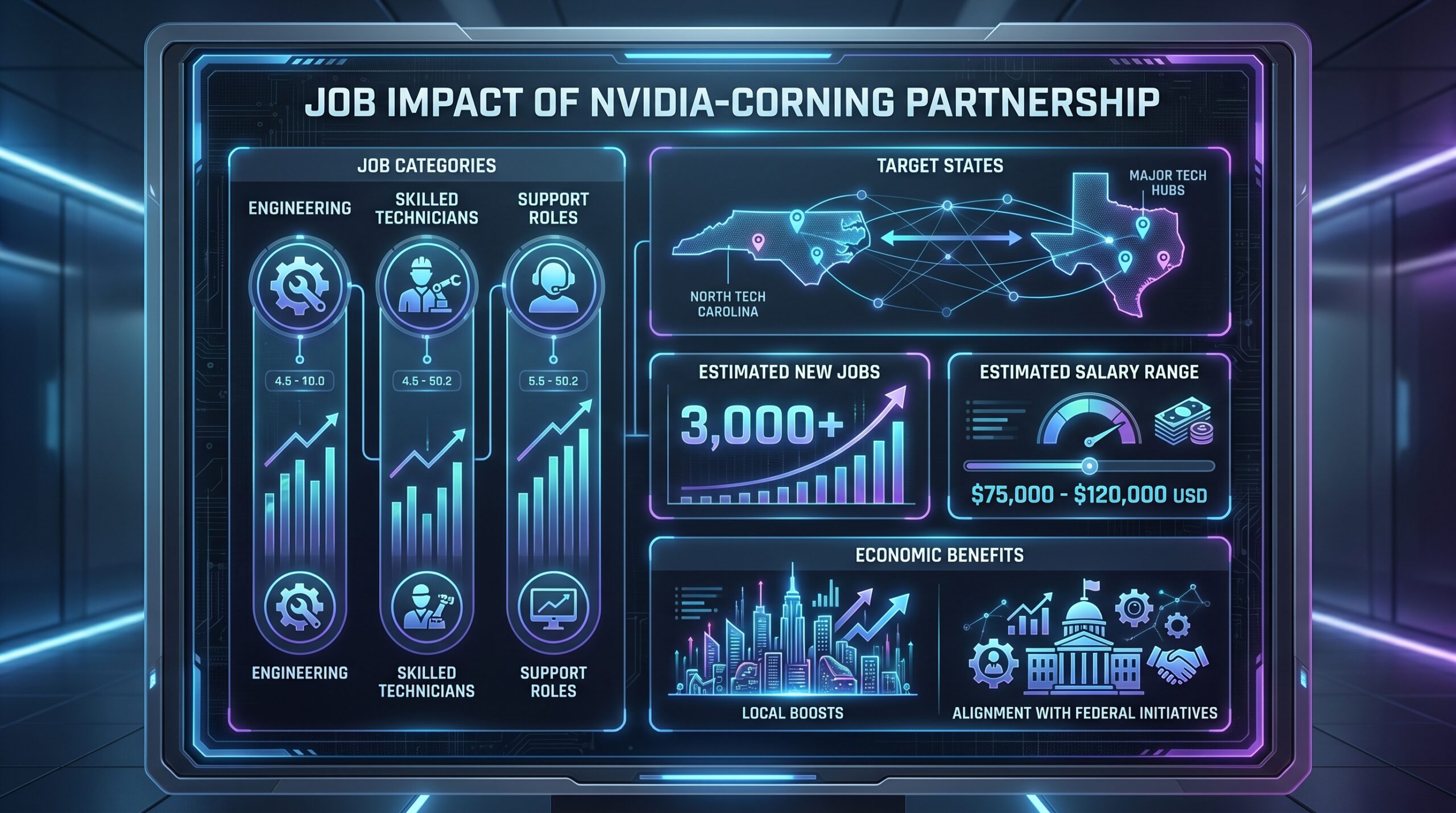
The NVIDIA-Corning partnership is projected to generate over 3,000 high-paying American jobs, representing a significant boost to the U.S. economy and a critical investment in skilled labor. These new roles will span a diverse range of specializations within the advanced manufacturing sector.
- Engineering: This category will include highly specialized roles such as optical engineers, materials scientists focused on glass technology, and automation specialists to optimize production lines.
- Skilled Technicians: Essential operational roles will include fiber drawing operators, precision assembly workers for intricate optical components, and meticulous quality control auditors to ensure product excellence.
- Support Roles: A variety of support functions will also be created, encompassing critical areas such as logistics management, IT infrastructure support, and overall facility management to maintain state-of-the-art manufacturing environments.
These jobs will be primarily concentrated in North Carolina and Texas, states that offer favorable business environments and boast existing, growing tech hubs. Salaries for these positions are expected to be highly competitive, averaging between $75,000 and $120,000, which will significantly bolster local economies. The strong focus on U.S. manufacturing also aligns with federal initiatives aimed at reshoring critical technologies, potentially unlocking additional governmental grants or tax incentives for the project. For more context on the broader economic landscape of AI, see AI News May 2026: IREN’s AI Pivot & Animoca Brands’ Web3 Push.
Timeline for Deployment and Production Ramp-Up
The ambitious timeline for this partnership sees construction on the first manufacturing facility commencing in the third quarter of 2026. The goal is to have all three new plants fully operational and contributing to production by the end of 2028. The ramp-up of production will occur in carefully managed phases to ensure efficient scaling and integration.
- Phase 1 (Late 2027): The initial phase will focus on the commencement of fiber production from one of the new plants. This early output is crucial for supporting the anticipated demand stemming from NVIDIA’s next-generation 2028 GPU architectures.
- Phase 2 (2028): By this phase, the full transceiver and cable assembly lines are expected to come online across the new facilities. This will enable the production of comprehensive, integrated optical solutions, critical for large-scale AI deployments.
- Phase 3 (2029+): The final phase involves scaling production to meet the ever-increasing demand for advanced AI clusters, particularly those exceeding the immense scale of 100,000 GPUs.
This carefully orchestrated timeline is designed to synchronize precisely with NVIDIA’s rapid GPU release cycles, ensuring that the supply of critical optical components can keep pace with the introduction of new, more powerful chip generations. This proactive approach underscores the strategic importance of aligning hardware development with infrastructure readiness. Such comprehensive planning is also seen in other cutting-edge AI developments, like OpenAI in 2026: A Comprehensive Guide to Innovations and Practical Applications.
How This Partnership Fits Into NVIDIA’s Broader AI Strategy
NVIDIA’s overarching strategy extends far beyond merely producing high-performance GPUs; it encompasses the development and optimization of a full-stack AI infrastructure. From this perspective, gaining significant control and influence over advanced optical networking solutions is a natural and logical extension of their strategic vision.
- Vertical Integration: This partnership is a clear step towards reducing NVIDIA’s dependency on third-party suppliers, such as companies like Broadcom or Intel-owned Barefoot Networks, for critical interconnect components. By integrating vertically, NVIDIA gains more control over quality, innovation, and supply.
- Performance Optimization: The collaboration allows for the co-design of optical solutions directly with NVIDIA’s GPU architectures. This synergistic approach aims to minimize latency and maximize bandwidth, ensuring that the optical interconnects are perfectly tuned to unlock the full potential of their cutting-edge AI processors.
- Supply Chain Security: In an era of increasing geopolitical uncertainty and potential global shortages, securing a domestic, dedicated supply of essential optical components significantly mitigates risks associated with trade disputes or disruption in global manufacturing lines.
This strategic move by NVIDIA mirrors the approach taken by other tech giants, such as Apple, which often opts to own the critical path for key components like custom silicon. By ensuring direct control over this vital aspect of AI infrastructure, NVIDIA is positioning itself to guarantee both the highest quality and reliable availability of its essential networking components, directly impacting its ability to deliver leading-edge AI solutions. This reflects a broader trend of control over components, as explored in discussions around The On-Device AI Shift: Building Android Apps with Gemma 4.
Risks and Challenges in Scaling U.S. Optical Manufacturing
Despite the immense promise and strategic significance of this manufacturing expansion, it is not without its inherent risks and challenges. Scaling U.S. optical manufacturing for AI infrastructure presents several complex hurdles that must be effectively addressed.
Risks and Mitigation Strategies for NVIDIA-Corning Partnership
| Risk Factor | Description | Mitigation Strategy |
|---|---|---|
| Supply Chain Over-reliance | Over-dependence on Corning could create single points of failure. | NVIDIA maintains multi-sourcing for non-critical components, but may dual-source optics long-term. |
| Workforce Readiness | Finding 3,000 skilled workers in a tight labor market for specialized roles. | Partnerships with community colleges, robust internal training programs, and competitive wages. |
| Technological Obsolescence | AI hardware evolves rapidly; optical solutions must adapt and keep pace. | Joint R&D focus on next-gen technologies like co-packaged optics and advanced materials. |
| Investment Return Volatility | If future AI demand slows, significant capacity could become underutilized. | Phased investment allows for scaling back if necessary; Corning can also serve other high-demand markets. |
| Geopolitical/Economic Shocks | Tariffs, recessions, or material shortages could disrupt plans and production. | Strategic stockpiling of key materials and selecting politically stable states like TX and NC reduces exposure. |
Addressing these challenges proactively through thoughtful planning and adaptive strategies will be crucial for the long-term success and sustainability of the NVIDIA-Corning partnership. The inherent dynamism of the AI sector demands continuous vigilance and innovation in manufacturing processes and supply chain management. The lessons learned from similar industry shifts, such as those discussed in Creating Android Apps with AI: A Definitive Guide for 2026, underscore the importance of adaptability.
Comparison: NVIDIA-Corning vs. Other AI Infrastructure Partnerships
To fully appreciate the scope and uniqueness of the NVIDIA-Corning partnership, it’s beneficial to compare it with other significant AI infrastructure collaborations in the industry. This comparison highlights NVIDIA’s more hands-on and capital-intensive approach.
| Aspect | NVIDIA-Corning | Google-TPAC (Taiwan) | Amazon-Anritsu |
|---|---|---|---|
| Focus Area | Domestic optical manufacturing for AI interconnects. | Asian supply chain efficiency for network devices. | Testing and validation of optical components. |
| Scale of Expansion | 10x U.S. capacity increase, 3,000+ new U.S. jobs. | Limited public job creation numbers, focus on existing supply chain. | No manufacturing expansion, focuses on quality assurance. |
| Investment Scope | Up to $3.2 Billion (potential total investment). | Undisclosed capital investment, likely operational partnerships. | Minimal capital outlay, equipment for testing labs. |
| Key Strategic Advantage | Enhanced supply chain control, deep performance optimization at hardware level. | Cost savings through established Asian manufacturing expertise. | Faster validation cycles, ensuring component reliability. |
| Primary Risks | High capital intensity, significant workforce recruitment challenges. | Potential geopolitical exposure, less direct control over IP. | No control over actual production capacity or design. |
This comparative analysis clearly demonstrates that NVIDIA is adopting a distinctly more hands-on and significantly more capital-intensive approach to secure its AI future. By investing directly in domestic manufacturing, NVIDIA aims to exert greater control over critical components, optimize performance at a fundamental level, and fortify its supply chain resilience in a competitive and rapidly evolving AI landscape. This strategy contrasts with more financially conservative or geographically diversified approaches seen elsewhere, indicating NVIDIA’s deep commitment to next-generation AI infrastructure.
Consideration of similar challenges in other cutting-edge areas, such as AI-Powered Drone Deconfliction for Urban Airspace, shows the broad impact of strategic partnerships and infrastructure development.
Immediate Next Steps for AI Operators and Data Center Teams
For organizations actively involved in building, operating, or planning AI infrastructure, the NVIDIA-Corning partnership signals significant shifts that require proactive engagement. Taking immediate steps can ensure your operations remain competitive and optimized for future AI demands.
- Audit Current Optical Supply: Begin by thoroughly reviewing your existing optical interconnect supply chain. Identify any dependencies on non-U.S. sources or single suppliers to understand potential vulnerabilities and opportunities for diversification.
- Engage with NVIDIA and Corning: Proactively reach out to your NVIDIA account teams and explore opportunities for early engagement with Corning. Look for potential early access programs for new optical products expected to launch in 2027 to gain a competitive edge.
- Plan for Higher Bandwidth: Future-proof your data center designs. Actively plan for and integrate infrastructure that can efficiently support 400G, 800G, and even 1.6Tbps optics. This ensures seamless compatibility with forthcoming NVIDIA and Corning products, avoiding costly retrofits.
- Invest in Training: Recognize the increasing sophistication of optical technologies. Invest in specialized training programs for your network engineers to enhance their expertise in advanced optical concepts, such as Dense Wave Division Multiplexing (DWDM) or coherent optics, which are becoming critical for AI data centers.
Case Study: AI Lab Upgrade
A leading AI research laboratory recently achieved a remarkable 30% reduction in its AI model training times by strategically upgrading to NVIDIA’s NVLink technology, leveraging custom-designed optical interconnects. Building on this success, the facility is now actively planning to adopt Corning’s next-generation cables. These advanced optical solutions are intended to connect their future clusters of NVIDIA B200 GPUs, further pushing the boundaries of computational performance and efficiency.
These actions will position your organization to fully leverage the performance and supply chain advantages unlocked by this landmark partnership. Understanding the intricacies of high-performance networking is vital for any AI deployment, as highlighted in topics like HDFlow: Hierarchical AI for Long-Horizon Robot Tasks.
FAQ
What exactly is being manufactured?
Corning will produce advanced optical fibers, high-speed transceivers, and comprehensive connectivity solutions explicitly engineered for high-performance AI data centers. These components are crucial for enabling ultra-fast, efficient communication between NVIDIA GPUs and across data halls within large-scale AI deployments.
Where are the new plants located?
Three brand-new manufacturing facilities will be strategically built in key locations across North Carolina and Texas. These states were selected due to their existing robust tech infrastructure, availability of skilled labor pools, and favorable logistics for efficiently supplying U.S. data centers with critical optical components.
When will these facilities be operational?
Construction on these next-generation facilities is slated to commence in mid-2026. The first plant is projected to become fully operational and begin production by late 2027. Full production capabilities across all three facilities are anticipated to be completely online by the end of 2028.
How will this impact AI infrastructure costs?
Initially, costs for these cutting-edge optical components may remain at a premium due to significant research and development investments and setup expenditures. However, in the long term, the establishment of domestic production is expected to stabilize prices and potentially reduce overall logistics expenses compared to relying solely on imported alternatives.
Does this mean NVIDIA is moving away from TSMC?
No, this partnership does not impact NVIDIA’s relationship with TSMC. This collaboration with Corning specifically addresses the manufacturing of advanced optical connectivity solutions, which are distinct from semiconductor chip fabrication. NVIDIA will continue its reliance on TSMC for its leading-edge semiconductor manufacturing needs.
Key Takeaways
- NVIDIA and Corning are investing significantly in U.S. manufacturing of AI optical interconnects.
- Three new plants in North Carolina and Texas will boost U.S. capacity tenfold and domestic fiber production by over 50%.
- NVIDIA’s investment could reach $3.2 billion, securing supply chains for its rapidly growing AI data center business.
- The partnership aims to create over 3,000 high-paying American jobs in advanced manufacturing.
- This strategic move mitigates supply chain risks, ensures performance optimization, and aligns with U.S. reshoring initiatives.
- AI operators should audit current optical suppliers, plan for higher bandwidth, and invest in optical networking training.
What to Do Next
The NVIDIA-Corning partnership marks a pivotal moment for AI infrastructure development. To capitalize on these advancements and prepare your organization, consider the following concrete steps:
- Schedule a meeting with your NVIDIA account team. Align your organization’s future AI roadmap with NVIDIA’s upcoming optical interconnect technologies and discussed deployment timelines.
- Review your 2027-2028 data center expansion plans. Ensure your budgets and architectural designs account for the transition to higher-bandwidth optics (400G, 800G, 1.6Tbps) that will become increasingly available through this domestic manufacturing effort.
- Explore specialized training programs for your technical team. Equipping your engineers with advanced knowledge in optical networking fundamentals and emerging technologies is crucial for managing next-generation AI infrastructure.
- Monitor Corning’s investor updates and press releases. Keep an eye out for specific announcements regarding exact plant locations and detailed timelines for hiring, which can offer valuable insights for regional talent acquisition or partnership opportunities.
This groundbreaking partnership signals a new era for U.S.-based AI infrastructure manufacturing, emphasizing resilience, innovation, and domestic capabilities. Proactive engagement with these developments now will ensure your organization is well-positioned to benefit from the significant performance enhancements and robust supply chain advantages it promises to unlock. The strategic importance of such a move resonates with the broader enterprise adoption patterns discussed in OpenAI B2B Signals: Frontier Firms Deepen AI Adoption.