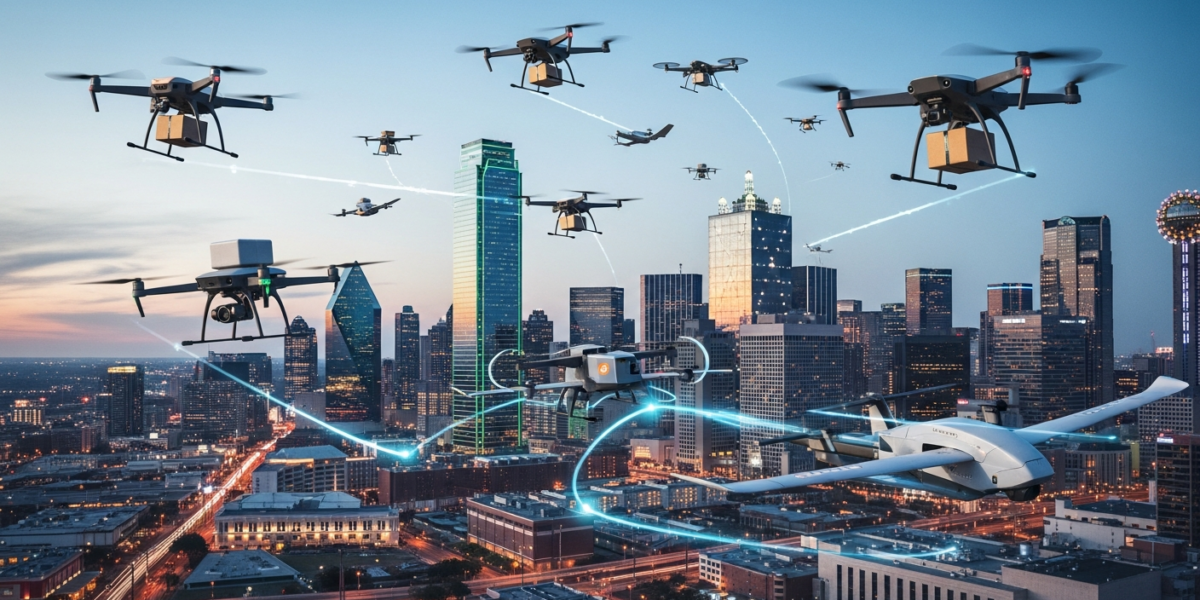
New research from arXiv proposes an attention-enhanced Proximal Policy Optimization-based Advantage Actor-Critic (PPOA2C) framework to enable safe separation and tactical deconfliction for heterogeneous fleets of small unmanned aerial systems (sUASs) in dense urban airspaces. The study, simulated over Dallas, Texas, demonstrates that independent, privacy-preserving policies trained with this multi-agent reinforcement learning (MARL) approach can achieve conflict-free operations, outperforming rule-based systems. However, the research highlights a critical challenge: equilibria between these policies tend to favor fleets with stronger configurations, underscoring the need for fairness-aware conflict management in future urban air mobility (UAM) systems.
- A new MARL framework, PPOA2C, enables heterogeneous drone fleets to independently learn deconfliction policies, maintaining safe separation in dense urban airspace.
- PPOA2C policies achieved equilibrium and outperformed rule-based baselines in conflict resolution during simulations over Dallas, Texas.
- The study revealed that in competitive scenarios, fleets with “stronger” configurations (e.g., better sensing, communication) are inherently favored by the learned equilibria.
- This research points to a significant future challenge for UAM: ensuring fair access and operation for all participants, regardless of their fleet’s technical specifications.
What changed
The core challenge addressed by this arXiv paper is the tactical deconfliction of multiple, distinct drone fleets operating concurrently within the same dense urban airspace [1]. Previous approaches often assume homogeneous fleets or centralized control, which is unrealistic for a future where multiple companies will operate diverse sUASs, each with its own configurations and policies [1].
This research introduces a multi-agent reinforcement learning (MARL) paradigm using an attention-enhanced Proximal Policy Optimization-based Advantage Actor-Critic (PPOA2C) algorithm. What’s new is the demonstration that individual fleets can independently train their own PPOA2C policies while preserving privacy, yet still achieve safe separation in a shared environment [1]. This moves beyond traditional rule-based systems or single-agent learning by allowing multiple intelligent agents to learn to interact and deconflict dynamically. The study specifically investigated whether such policies could converge to a conflict-free equilibrium and if this equilibrium would inherently discriminate against fleets with “weaker” configurations [1].
How it works
The system employs a multi-agent reinforcement learning (MARL) framework, where each drone fleet acts as an independent agent, learning its own deconfliction policy [1, 2]. The specific algorithm used is an attention-enhanced Proximal Policy Optimization-based Advantage Actor-Critic (PPOA2C). Reinforcement learning, in general, involves an agent taking actions in an environment to maximize a reward signal [5]. In this context, the “environment” is the simulated Dallas airspace, and the “reward” is tied to successful package delivery missions while avoiding conflicts [1, 2].
The “attention-enhanced” aspect of PPOA2C means the agents can selectively focus on relevant information from their surroundings, which is crucial in a dense, dynamic airspace with many other drones [1]. Each fleet trains its policy independently, a critical design choice for real-world application as it allows companies to maintain proprietary control over their operational strategies and data [1].
During training, the PPOA2C policies learn to resolve both intra-fleet conflicts (between drones of the same company) and inter-fleet conflicts (between drones of different companies) [1]. The researchers evaluated these learned policies against strong rule-based baselines. A key finding was that while two PPOA2C policies could achieve a safe equilibrium, a PPOA2C policy also showed adaptive capabilities when interacting with a rule-based policy, suggesting robustness in mixed operational environments [1].
Why it matters for operators
For operators in the burgeoning Urban Air Mobility (UAM) sector, this research is both promising and a stark warning. The ability for heterogeneous drone fleets to autonomously learn deconfliction policies and achieve safe separation without a central, omniscient controller is a fundamental requirement for scaling UAM operations. This PPOA2C framework, by allowing independent policy training, aligns well with a competitive market where multiple companies will operate proprietary systems. This means less reliance on a single, potentially bottlenecked, air traffic management system and more on distributed intelligence. For a drone delivery startup, this implies a potential path to deploying sophisticated, self-managing fleets that can adapt to complex airspace conditions.
However, the finding that equilibria tend to favor fleets with “stronger” configurations—even with similar policy types—is a critical red flag. This isn’t just about faster drones; “stronger” configurations could mean superior sensors, more robust communication links (as explored in other research on multi-connectivity for UAVs [7]), or more sophisticated onboard processing. If the learned deconfliction policies inherently give an advantage to these better-equipped fleets, it creates a significant barrier to entry for smaller operators or those with less capital-intensive hardware. Regulators and industry consortia must proactively address this “fairness” issue. A future UAM ecosystem where only the best-equipped can thrive will stifle innovation and competition. Operators should advocate for, and invest in, standards and protocols that ensure equitable access and operational safety, rather than allowing a technological arms race to dictate airspace access. This could involve mandated communication standards, minimum sensor requirements, or even dynamic airspace allocation mechanisms that account for varying fleet capabilities. Ignoring this now will lead to a fragmented, inequitable, and potentially less safe urban airspace in the future.
Risks and open questions
- Fairness and Equity: The most significant risk identified by the research is the inherent bias towards “stronger” configurations in learned equilibria. This raises questions about how to ensure fair access and operation for all UAM participants, regardless of their hardware capabilities. Will regulatory bodies need to mandate minimum equipment standards or implement fairness-aware conflict management protocols?
- Policy Generalization and Robustness: While the PPOA2C policies showed adaptive capabilities, their performance in highly dynamic, unpredictable real-world urban environments, with unforeseen events (e.g., sudden weather changes, unauthorized drones), remains to be fully tested. How well do these policies generalize beyond the simulated Dallas airspace?
- Scalability to Many Fleets: The study primarily focused on two fleets [1]. Scaling to dozens or hundreds of heterogeneous fleets, each with multiple drones, presents a combinatorial explosion of interaction possibilities. Will the independent training approach remain viable, or will some form of hierarchical or federated learning be necessary?
- Real-world Deployment Challenges: Transitioning from simulation to real-world deployment introduces challenges related to sensor noise, communication latency, GPS inaccuracies, and regulatory compliance. How will the privacy-preserving aspect of independent policy training be reconciled with potential needs for transparency or oversight by air traffic authorities?
- Ethical Considerations: As AI systems take on more autonomy in safety-critical domains, ethical considerations around accountability in the event of a conflict or accident become paramount. Who is liable when an AI-driven deconfliction policy makes a suboptimal decision?
Sources
- Separation Assurance between Heterogeneous Fleets of Small Unmanned Aerial Systems via Multi-Agent Reinforcement Learning — arXiv
- [2605.01041v1] Separation Assurance between Heterogeneous Fleets of Small Unmanned Aerial Systems via Multi-Agent Reinforcement Learning — arXiv
- [2605.01041] Separation Assurance between Heterogeneous Fleets of Small Unmanned Aerial Systems via Multi-Agent Reinforcement Learning — arXiv
- Heterogeneous agents, unified missions: A survey and taxonomy on air–ground cooperative systems – ScienceDirect
- Reinforcement learning – Wikipedia
- Intelligent Unmanned Aerial Vehicle Swarm Control Under Electronic Warfare: A Cognitive–Intent Dual-Stream Reinforcement Learning Framework — MDPI
- Multi-Connectivity for UAVs: A Measurement Study of Integrating Cellular, Aerial Mesh, and LEO Satellite Links — arXiv