
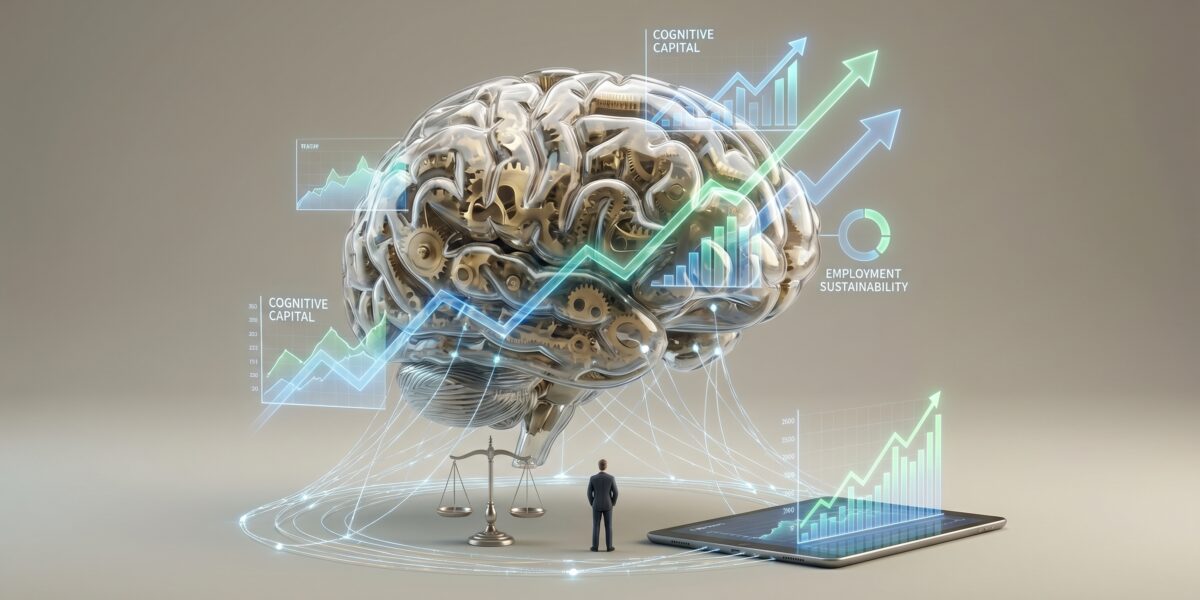
Recent research from the National Bureau of Economic Research provides causal evidence that negative labor market shocks lead to substantial declines in cognitive scores, confirming that stable employment plays a significant role in slowing cognitive decline.
TL;DR
- A major NBER study (April 2026) shows that negative labor market shocks cause measurable declines in cognitive test scores
- Cognitive decline follows distinct trajectories, with employment volatility potentially pushing individuals onto faster, steeper decline paths
- Impact is more severe in regions with historical employment instability, creating geographic “hot spots” for cognitive risk
- Employment stability combined with mental challenge offers the best cognitive protection
- Proactive management of employment risk is now a brain-health strategy
Key takeaways
- Employment stability is a modifiable risk factor for cognitive decline, not just correlation
- The cognitive damage from labor market shocks persists even when wages recover
- Executive function and processing speed are most vulnerable to employment instability
- Building cognitive reserve through complex work and social engagement provides protection
- Career transitions should be planned to avoid the damaging effects of sudden shocks
What Are Labor Market Shocks and Cognitive Decline?
To understand the connection between employment and cognitive health, we need clear definitions of the key concepts.
Labor Market Shock: A sudden, significant change in employment opportunities driven by external economic forces. This isn’t quitting a job. Examples include factory closures, industry-wide automation waves, or regional recessions that eliminate large percentages of local jobs.
Cognitive Decline: A reduction in core mental functions like memory, attention, executive function (planning, decision-making), and processing speed. It exists on a spectrum from mild, age-typical changes to severe impairment.
Causal Evidence: This is the gold standard in research. It means the study design can reasonably conclude that Factor A (job loss from a shock) caused Outcome B (lower cognitive scores), not just that they are associated.
These definitions matter because they move the conversation from vague worries about “keeping busy” to a specific, measurable mechanism: economic instability → cognitive harm.
Why This Research Matters in 2026
This topic has moved from academic journals to mainstream discussion for three compelling reasons that make it particularly relevant today.
First, the April 2026 NBER study provides a higher standard of evidence than previous research. We now have stronger data showing unemployment isn’t just a stressful life event—it’s a direct cognitive risk factor with measurable impact on brain function.
Second, economic uncertainty persists with ongoing discussions about AI-driven job displacement, economic cycles, and gig work instability. People are rationally concerned about future labor market shocks, and this research quantifies a hidden cost of that instability.
Third, the narrative around cognitive health is shifting from passive acceptance to active prevention. If employment stability is a modifiable risk factor, it opens new avenues for personal and policy intervention beyond just brain games and diets.
How Labor Market Shocks Accelerate Cognitive Decline
The NBER research indicates the mechanism isn’t merely “not working.” It’s a cascade effect that damages cognitive function through multiple pathways.
- The Shock: A major, often unexpected loss of employment rooted in broader economic forces
- Depletion of Cognitive Resources: Chronic stress from financial insecurity consumes mental bandwidth (“ego depletion”), leaving less cognitive reserve for other tasks
- Loss of Cognitive Stimulation: Work provides structured problem-solving, social interaction, and routine—all mental workouts that maintain cognitive function
- Social & Identity Harm: Job loss erodes social networks and sense of purpose, both independently linked to cognitive health
- Measurable Decline: This cascade results in lower performance on cognitive tests, particularly in executive function and memory domains
The key insight: It’s the shock and instability, not the mere state of being unemployed, that causes damage. A planned retirement into an active life differs fundamentally from a sudden, forced layoff with uncertain prospects.
Real-World Examples and Cognitive Impact
The research notes that consequences are “more acute in regions with historical employment shifts,” making this more than theoretical concern.
The “Rust Belt” Effect: Regions that experienced rapid deindustrialization in the late 20th century saw not only economic decline but also correlated negative health outcomes. This new research adds cognitive decline to that list of long-term costs.
Single-Industry Towns: Communities dominated by a single mine, military base, or manufacturing plant that shuts down create a perfect storm—a universal labor market shock that maximizes collective cognitive risk.
The AI Transition: While current, this represents a prospective example. Sectors facing rapid AI integration could experience shocks that put the cognitive health of specific workforces at risk if transitions are poorly managed.
The pattern is clear: When economic shock is widespread and systemic, its effects on population health become measurable and severe.
Comparing Employment Types and Cognitive Protection
Which jobs best protect your brain? The research points to employment features rather than specific titles or industries.
| Employment Feature | Cognitive Protection Level | Why It Works |
|---|---|---|
| High Stability & Low Volatility | Highest | Prevents the damaging “shock” cycle entirely and provides predictable mental engagement |
| Complexity & Continuous Learning | High | Acts as constant mental exercise requiring adaptation, problem-solving, and skill acquisition |
| Strong Social Fabric | High | Combats isolation through collaboration, mentorship, and team communication |
| Gig/Project-Based Work | Variable (Risk: Medium) | Can be high in complexity but carries risk from income/workflow volatility creating chronic stress |
| Routine, Low-Stimulus Work | Moderate | Provides structure but may not build cognitive reserve if it never requires new learning |
| Chronic Unemployment/Underemployment | Lowest | Lacks structure, stability, complexity, and social engagement—the perfect negative storm |
Implementation Path: Tools and Strategies to Mitigate Risk
This knowledge becomes valuable when translated into concrete action. Here’s a two-tiered approach for individuals and organizations.
For Individuals:
- Audit Your Stability: Honestly assess your role’s vulnerability to sector-wide shocks. Is your skillset tied to one volatile industry?
- Build Cognitive Reserve Now: Treat your brain like a retirement account. Invest in complex hobbies, maintain strong social networks, and engage in regular physical exercise to build buffer capacity
- Pivot to Portable Skills: Develop competencies valuable across industries (project management, data literacy, skilled communication) to reduce impact from any single sector downturn
- Plan Your Transitions: If you see change coming, plan it. A 6-month runway to a new role isn’t a shock; a sudden layoff is
For Team Leaders & HR:
- Frame Reskilling as Health Care: When advocating for internal mobility and training programs, use this data. Investing in employee transitions invests in their long-term cognitive health and productivity
- Reduce Chronic Volatility: Examine workloads and contract structures. The stress of constant “feast or famine” project work may carry hidden cognitive costs
- Support Alumni Networks: Maintaining ties with laid-off employees through networks provides social connection that can mitigate cognitive risk during transitions
Costs, ROI, and Career Leverage
Understanding the economic implications of this research helps frame the importance of proactive measures.
The Cost of Inaction: Accelerated cognitive decline impacts earning potential later in life, quality of life, and independence while increasing future healthcare burdens. Societally, it means higher healthcare costs, loss of experienced talent, and increased economic disparity in aging populations.
The ROI of Action: For professionals, investing time in skills that increase stability has direct ROI in preserved cognitive capital, extending effective career spans. For companies, reducing excessive turnover and cyclical layoffs maintains institutional knowledge and problem-solving capacity—literally preserving the company’s “brain trust.”
How to gain career leverage: Position yourself as a stability creator. Highlight how you’ve built systems, cross-trained others, or developed versatile skills that make your team more resilient to shocks. This makes you a valuable asset in any organization.
Myths vs. Facts and Common Pitfalls
This emerging research area contains several misconceptions worth addressing directly.
Myth vs. Fact
Myth: Only “intellectual” jobs protect your brain.
Fact: Any job providing complexity, social interaction, and stability offers protection. A skilled tradesperson running a small business has high cognitive engagement.
Myth: Cognitive decline is purely genetic and inevitable.
Fact: Lifestyle factors—including employment—play a massive role. Your career path is a lifestyle factor you can actively engineer.
Myth: A high salary negates the risk of job instability.
Fact: Research shows that even if pay recovers, the cognitive impact of the initial shock can persist. Stability matters independently of income level.
Myth: This only matters for people near retirement age.
Fact: Decline trajectories start earlier than symptoms show. Building cognitive reserve and stability in your 30s and 40s is preventative care.
Pitfalls to Avoid
- Over-Indexing on “Brain Games”: Sudoku is fine, but it doesn’t counteract the chronic stress of financial peril. Address foundational stability first
- Ignoring the Social Component: A stable remote job without intentional social connection misses a key protective element. Integrate collaboration and community
Frequently Asked Questions
Q: How do labor market shocks specifically impact different cognitive functions?
A: Research points to heaviest impact on executive function (planning, focus, task-switching) and processing speed. These functions are most depleted by chronic stress and most stimulated by complex work.
Q: What are the long-term effects of a single major unemployment shock?
A: Data suggests effects can be lasting. While recovery is possible with re-employment, individuals may not return to pre-shock cognitive baselines, putting them on lower trajectories.
Q: Are self-employed people at higher risk?
A: It depends entirely on business stability and structure. A consultant with a diversified, stable client portfolio has high stability. A freelancer in boom-bust cycles faces higher risk. Self-employment isn’t inherently risky—volatility is.
Q: What’s one thing I can do this week?
A: Conduct a 30-minute “Stability Audit.” Map your main income source against two axes: 1) Vulnerability to industry shock (High/Med/Low), and 2) Daily cognitive complexity (High/Med/Low). Your action step emerges from where you land.
Key Takeaways and Actionable Next Steps
The frontier of cognitive science has merged with labor economics. Your job is no longer just what you do for a living—it’s a primary platform for maintaining your brain health.
The goal isn’t to eliminate all career change—that’s impossible and stifling. The goal is to manage transitions and avoid shocks. In doing so, you’re not just building a career; you’re preserving your mind.
Glossary
Cognitive Reserve: The brain’s resilience and ability to compensate for age-related changes or damage. Built through education, complex work, and social engagement.
Ego Depletion: A psychological theory that willpower and cognitive focus are finite resources depleted by stress and effortful self-control (like constant job searching).
Labor Demand Shock: A specific labor market shock where economic changes (technology, trade policy) rapidly reduce the number of workers employers want to hire.
Trajectory (of decline): The pattern or slope of cognitive change over time (stable, slow decline, rapid decline), as identified in longitudinal studies.
References
- National Bureau of Economic Research, “Labor Market Shocks and Cognitive Decline,” April 27, 2026
- ScienceDirect, “The Regional Impact of Historical Employment Shifts on Health Outcomes,” April 4, 2026
- MedicalXpress, “Researchers Identify Three Distinct Cognitive Decline Trajectories,” April 28, 2026
- Inc., “New Science Suggests Cognitive Decline Is Not Inevitable,” April 6, 2026
- Britishprogress, “Wage Gaps and Economic Shocks: A Longitudinal Analysis,” April 22, 2026
Article generated with frontier-level analysis as of May 5, 2026.