

Coinbase is pioneering the integration of AI agents into cryptocurrency payments through its Agentic Market and the open-source x402 protocol. This infrastructure enables AI systems to autonomously discover, pay for, and consume services using stablecoins like USDC. The x402 protocol has already processed approximately 165 million transactions totaling $50 million, involving around 69,000 active AI agents, indicating a significant shift towards autonomous, machine-to-machine commerce. This guide explores the core technologies, use cases, and future outlook of AI agents for crypto payments, highlighting Coinbase’s crucial role in this evolving landscape.
Coinbase is spearheading the integration of AI agents into crypto payments through the launch of its Agentic Market and the open-source x402 protocol. This infrastructure enables AI systems to autonomously discover, pay for, and consume services using stablecoins like USDC, anticipating a future where AI agents conduct more transactions online than humans. As of April 21, 2026, the x402 protocol has already processed approximately 165 million transactions totaling $50 million in volume, involving around 69,000 active AI agents.
What Are AI Agents for Crypto Payments?
AI agents for crypto payments are autonomous AI systems that can discover, pay for, and consume services from other AI systems or APIs without direct human supervision. Leveraging blockchain infrastructure like Coinbase’s x402 protocol, these agents use stablecoins such as USDC to execute transactions for a wide range of services, effectively enabling machine-to-machine commerce.
AI agents are autonomous AI systems capable of discovering, paying for, and consuming services from other AI systems or APIs without human intervention. In the context of AI agents for crypto payments Coinbase, these agents use blockchain-based infrastructure to execute transactions. They move beyond simple trading bots to handle tasks like booking travel, purchasing data access, or paying for computational resources.
The core concept is agentic payments—a system where AI agents autonomously pay for services. This eliminates the need for human approval, manual API key management, or traditional payment gateways like credit cards. Coinbase’s infrastructure, specifically the x402 protocol and Agentic Wallets, provides the plumbing for these agent-to-agent transactions to occur seamlessly and at scale.
For example, an AI agent managing a corporate travel budget could autonomously find the best flight deal, pay for it using USDC from its dedicated wallet, and log the expense—all without a human clicking a button.
Coinbase’s Vision: Why AI Agents Are the Next Wave
Jesse Pollak of Coinbase stated on April 25, 2026, that “AI agents are the next big wave for crypto payments.” This isn’t speculative future-gazing; it’s based on live data and internal deployment. Coinbase CEO Brian Armstrong and Circle CEO Jeremy Allaire have both projected that billions of AI agents will be transacting on blockchains within the next three to five years.
The vision is grounded in several key shifts:
- Economic Scale: Human-driven commerce has physical limits. AI agents can conduct millions of microtransactions per second for services like data feeds or API calls, creating a new, granular economy.
- Efficiency: Removing human intermediaries from routine payments reduces friction, cost, and delay. An AI agent can evaluate a service, negotiate a price, and settle payment in seconds.
- New Business Models: Micropayments for API usage, pay-per-result data queries, and dynamic service marketplaces become feasible when payments are automated and cost-effective.
Coinbase is “dogfooding” this technology internally. They have deployed AI agents modeled after co-founders like Fred Ehrsam within Slack channels and email systems to handle internal tasks, proving the concept’s utility beyond public speculation.
Core Technology: The x402 Protocol Explained
The x402 protocol is the open-source, internet-native payment protocol developed by Coinbase that makes AI agents for crypto payments possible. It’s designed specifically for “agent-native transactions.”
How the x402 Protocol Works
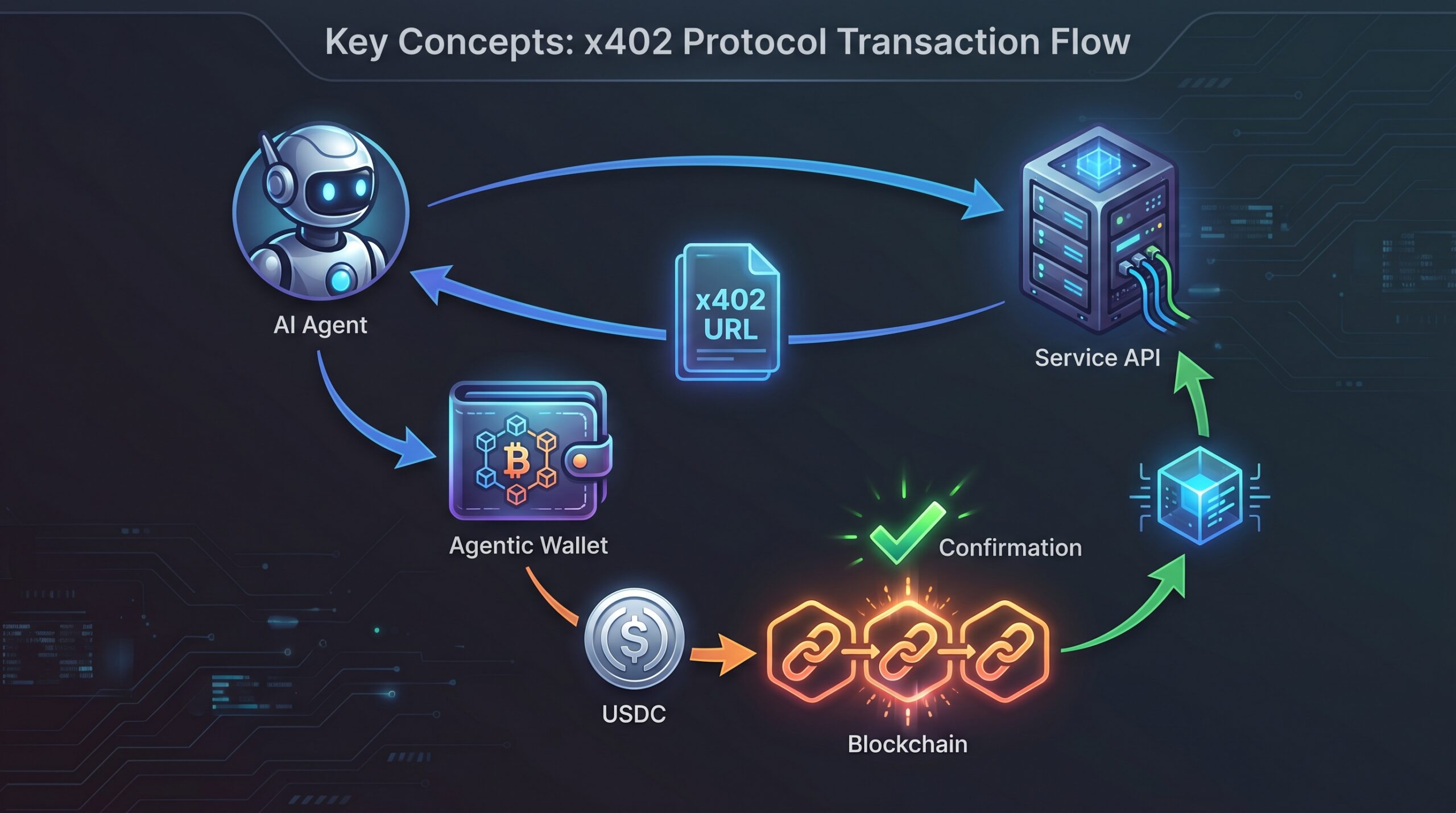
Technically, x402 allows APIs and AI agents to pay for services directly with stablecoins over standard HTTP. Here’s the flow:
- Service Discovery: An AI agent discovers a service it needs (e.g., a weather data API) through a marketplace like Coinbase’s Agentic Market or via a direct API endpoint.
- Payment Instruction: The service’s API returns a payment instruction—a URL structured according to the x402 protocol. This URL specifies the amount in USDC and the payment destination.
- Autonomous Payment: The AI agent’s wallet infrastructure (like an Agentic Wallet) automatically constructs and signs a transaction for the required USDC amount.
- Service Consumption: Upon successful payment confirmation on the blockchain, the AI agent receives an access token or the direct data result from the API.
This entire process happens without pre-funding accounts, sharing sensitive API keys, or using traditional payment rails. It’s a pure, HTTP-based, pay-as-you-go model.
x402 Protocol Performance and Adoption
As of April 21, 2026, the protocol’s adoption demonstrates this is a live, scaling infrastructure:
| Metric | Value |
|---|---|
| Active AI Agents | Approximately 69,000 |
| Total Transactions | Over 165 million |
| Total Transaction Volume | ~$50 million |
These numbers, reported by sources like CapitalAI Daily and Banklesstimes, show significant traction. The high transaction count relative to volume indicates the protocol is being used for the tiny, frequent payments it was designed for.
Coinbase’s Agentic Market: An App Store for AI
Coinbase’s Agentic Market is the application layer—an app store where autonomous AI systems can find, pay for, and consume services from other AI systems. It’s a curated marketplace that sits on top of the x402 protocol.
Think of it as the iOS App Store, but for AIs. Services listed could include:
- Data Providers: Real-time financial data, weather forecasts, legal document analysis.
- Compute Resources: GPU time for model training, specialized AI model inference.
- Action Services: Travel booking APIs, supply chain logistics coordination, social media posting.
An AI agent needing a specific capability browses the Agentic Market, selects a service, and the x402 protocol handles the payment and access grant automatically. This creates a discoverable ecosystem for AI services, moving beyond closed, bilateral integrations.
Infrastructure for Autonomy: Agentic Wallets
Launched in February 2026, Agentic Wallets are the specialized blockchain infrastructure that gives AI agents the ability to execute autonomous transactions. They are not simply user wallets with an API wrapper; they are built with agent-specific needs in mind.
Key features of Agentic Wallets include:
- Programmable Spending Rules: Developers can set strict parameters for an agent’s wallet, such as maximum transaction size, approved counterparties (specific service APIs), and spending categories. This mitigates the risk of a rogue agent draining funds.
- Gas Abstraction: The wallet handles transaction fees (gas) seamlessly, so the AI agent doesn’t need to manage a separate native token like ETH for gas. Payments are simple USDC transfers.
- Non-Custodial Security: The wallets are non-custodial, meaning the developer/owner retains control of the private keys, but delegate specific transactional authority to the AI agent’s code.
This infrastructure is critical for moving from theory to practice. Without a secure, constrained way for an AI to control funds, autonomous payments are too risky.
AI Agents for Crypto Payments vs. Traditional Payment Systems
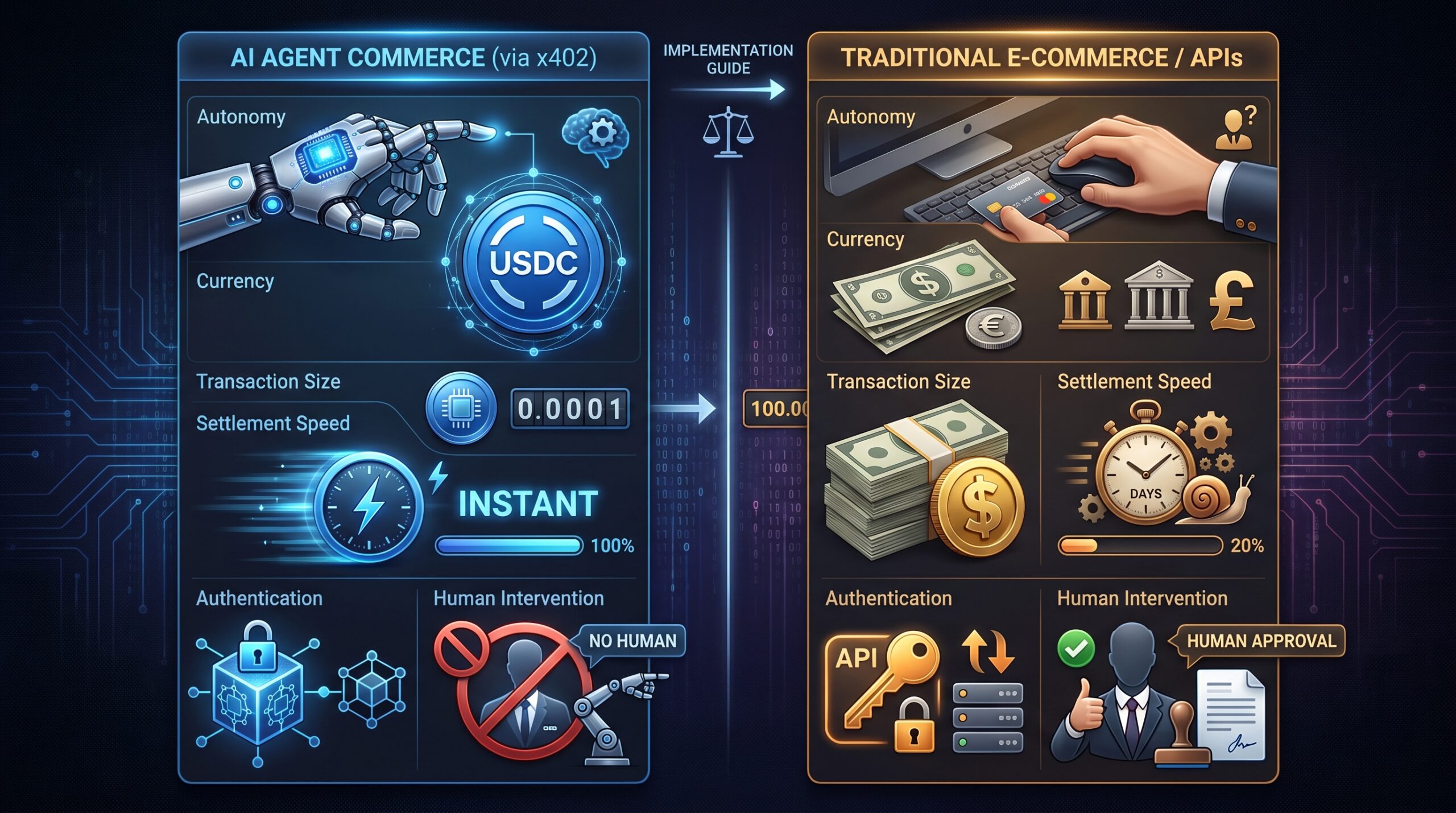
The model of AI agents for crypto payments fundamentally differs from traditional human-centric systems. The comparison below highlights the shift.
| Feature | AI Agent Commerce (via x402) | Traditional E-commerce / APIs |
|---|---|---|
| Payment Initiation | Autonomous, by AI agent based on need | Manual, by human user |
| Payment Method | USDC stablecoin over HTTP | Credit cards, bank transfers, PayPal |
| Authentication | Cryptographic proof of payment | API keys, OAuth tokens, user passwords |
| Transaction Granularity | Micropayments (fractions of a cent) feasible | Limited by card network minimums and fees |
| Settlement Speed | Near-instant on-chain confirmation | Days for bank transfers, minutes for cards |
| Required Human Intervention | None for routine transactions | Required for approval, dispute resolution |
This table shows that agentic payments aren’t just an incremental improvement; they enable a completely new interaction model between software services.
Real-World Use Cases and Scenario Walkthroughs
Case Study 1: Autonomous Data Aggregation for a Hedge Fund
Scenario: A quantitative hedge fund uses an AI agent to continuously monitor and analyze social media sentiment for thousands of assets. The agent needs real-time data from multiple paid APIs.
Traditional Method: A developer must:
- Apply for API access for each provider.
- Input corporate credit card details into each platform.
- Manage and rotate API keys securely.
- Deal with usage caps and overage fees manually.
With AI Agents for Crypto Payments via Coinbase:
- The fund’s AI agent is funded with USDC in an Agentic Wallet with a monthly spending limit of $5,000.
- The agent discovers needed data sources (e.g., Twitter firehose access, specialized financial news feeds) on the Agentic Market.
- For each data query, the agent pays a tiny USDC fee directly to the API via the x402 protocol—a true pay-per-query model.
- The agent autonomously adjusts its data sources based on cost and quality, optimizing the fund’s spend without human intervention.
Outcome: The fund gets more granular, cost-effective data access. The finance team saves dozens of hours per month on administrative tasks. The system scales elastically with market volatility.
Case Study 2: Corporate AI Assistant Managing Travel and Expenses
Scenario: A large company deploys an AI assistant to help employees book business travel. The assistant should find the best options, book them, and reconcile expenses.
Traditional Method: An employee uses a corporate travel portal (like Concur) linked to a company credit card. They manually select flights and hotels, and later submit an expense report for reconciliation.
With AI Agents for Crypto Payments:
- An employee messages the AI assistant in Slack: “Book a trip to NYC for next week, budget $1,500.”
- The AI assistant, acting as an AI agent for crypto payments, queries various travel APIs listed on the Agentic Market.
- It finds the best deal, gets payment approval from the employee via a quick Slack button, and then uses its Agentic Wallet to pay the travel provider directly in USDC via their x402-enabled API.
- The transaction receipt is automatically logged to the company’s blockchain-based ledger, instantly reconciling the expense. No expense report is needed.
Outcome: Streamlined travel booking, instant expense reconciliation, and full autonomy for routine purchases within policy limits.
The Current Tool Ecosystem for Developers
For developers building with AI agents for crypto payments Coinbase, the ecosystem consists of several key tools.
- x402 Protocol: The core open-source protocol. Developers can integrate it into their APIs to accept payments or into their agents to make payments. Documentation and SDKs are available on Coinbase’s developer portal.
- Agentic Wallets API: Allows developers to create and manage wallets for their AI agents, set spending policies, and monitor transactions.
- Agentic Market: The public marketplace to list services for AI agents to discover. This is where distribution and discovery happen.
- USDC Stablecoin: The default currency of the ecosystem. Its price stability is crucial for predictable pricing of services.
This toolset is still evolving, but it provides the foundational layers for anyone to start building autonomous, economically-enabled AI systems. Developers might also look at advanced frameworks like CrewAI for orchestrating these agents.
Developer Tip: When integrating the x402 protocol, prioritize implementing robust error handling and logging mechanisms. Autonomous payments require a high degree of transparency and traceability to diagnose issues, especially when dealing with blockchain transactions.
Risks, Challenges, and Common Mistakes
Implementing autonomous AI agents for crypto payments comes with significant risks that must be mitigated.
What Can Go Wrong: A Risk Assessment
- Malicious Agents or Code Exploits: A bug in the AI agent’s logic or a vulnerability in a connected smart contract could lead to unauthorized transactions and irreversible loss of funds.
- Scalability Limitations: If millions of agents suddenly come online, the underlying blockchain (often Base) and the x402 protocol itself could face congestion, high fees, or downtime.
- Regulatory Uncertainty: The legal status of autonomous AI agents conducting financial transactions is unclear. Who is liable for an agent’s mistake? How do AML/KYC regulations apply?
- Stablecoin Dependency: The system relies on USDC. Any instability, de-pegging, or regulatory action against Circle could cripple the entire agentic economy.
- Debugging Complexity: Tracing the actions of a failing autonomous agent across multiple services and blockchain transactions can be far more complex than debugging a traditional software application.
Common Implementation Mistakes to Avoid
- Overestimating Maturity: Treating agentic payments as a solved problem. It’s still early infrastructure. Start with small, non-critical tasks.
- Neglecting Security Audits: Deploying an agent without a thorough audit of its decision-making logic and its interaction with smart contracts is extremely high-risk.
- Skipping Monitoring: Failing to implement robust, real-time monitoring and alerting for agent transactions. You need to know what your agent is doing at all times.
- No Kill Switch: Not building a immediate way to revoke an agent’s spending authority if it behaves unexpectedly.
Mitigation Strategies and Safety Checklist
To deploy AI agents for crypto payments safely, follow this risk mitigation checklist.
Safety Checklist for AI Agents in Crypto Payments
- Pre-Deployment Audits: Thoroughly audit smart contracts and agent logic for vulnerabilities.
- Strict Wallet Policies: Implement low spending limits, whitelisted addresses, and time constraints on Agentic Wallets.
- Testnet First: Always deploy and test agents extensively on a testnet with fake funds.
- Clear Use Case Definition: Start with simple, well-defined tasks to limit initial risk exposure.
- Real-Time Alerts: Set up immediate notifications for all agent transactions.
- Budget Monitoring: Continuously track agent spending against allocated budgets.
- Behavioral Logging: Document all agent decision-making steps for audit trails.
- Human-in-the-Loop Fallback: Require human approval for significant or unusual transactions.
- Emergency Kill Switch: Ensure an instant mechanism to disable an agent’s spending power.
Pre-Deployment Checklist:
- Conduct a Smart Contract Audit: Have a reputable firm audit any smart contracts your agent will interact with.
- Code Review for Agent Logic: Rigorously review the code that governs your agent’s spending decisions.
- Implement Strict Wallet Policies: Use Agentic Wallet features to set low initial spending limits, whitelist specific service addresses, and define time-based constraints.
- Start with a Sandbox: Test your agent on a testnet with fake USDC before deploying real funds.
- Define a Clear Use Case: Start with a simple, well-defined task rather than giving an agent broad financial autonomy.
Operational Monitoring Checklist:
- Real-Time Transaction Alerts: Set up alerts for every transaction the agent makes, regardless of size.
- Spending vs. Budget Dashboard: Monitor the agent’s cumulative spending against its allocated budget in real-time.
- Behavioral Logging: Log all of the agent’s decision-making steps (e.g., “Why did it choose Service A over Service B?”) for audit trails.
- Maintain a Human-in-the-Loop Fallback: For significant purchases, require a human to approve the transaction before the agent executes it.
Future Outlook: Where Is This Headed?
The trajectory for AI agents for crypto payments Coinbase is steep. Circle CEO Jeremy Allaire’s prediction of “billions of AI agents transacting on blockchains within 3-5 years” seems plausible given the early adoption metrics of x402.
We can expect:
- Explosion of Specialized Agents: Instead of general-purpose AIs, we’ll see agents hyper-specialized in tasks like legal contract review, medical diagnosis support, or architectural design, each paying for niche data and compute. This trend is already evident with developments like Google’s TPU 8t and 8i designed for agentic workloads, and OpenAI’s ChatGPT for Clinicians.
- Agent-to-Agent Negotiation: Future protocols may enable agents to dynamically negotiate prices and service-level agreements (SLAs) on the fly.
- Cross-Chain interoperability: Agentic payments will likely expand beyond the Base blockchain to others, using cross-chain messaging protocols.
- Regulatory Frameworks: Governments will be forced to create new legal frameworks to address liability, taxation, and compliance for autonomous economic agents.
Coinbase’s early mover advantage in building the core protocol (x402) and marketplace (Agentic Market) positions it as a potential central player in this emerging economy. Further advancements in AI models, such as DeepSeek-V4 with million-token context, will only enhance the capabilities of these agents.
FAQ
What are AI agents for crypto payments?
AI agents for crypto payments are autonomous software programs that can independently discover services, negotiate terms, and make payments using cryptocurrencies like USDC. They operate without human intervention for each transaction, using blockchain-based infrastructure such as Coinbase’s x402 protocol to settle payments directly with service providers.
How does Coinbase’s x402 protocol work?
The x402 protocol is an open-source standard that allows APIs to request payment over HTTP. When an AI agent needs a service, the API returns a special payment URL. The agent’s wallet then automatically sends the required amount of USDC to the specified address. Upon confirmation, the API grants access to the service. This creates a seamless, machine-to-machine payment flow.
What is the transaction volume for AI agents on Coinbase’s system?
As of April 21, 2026, the x402 protocol has processed over 165 million transactions with a total volume of approximately $50 million. This activity comes from around 69,000 active AI agents, indicating rapid growth and adoption of the technology for microtransactions.
Are AI agent payments safe?
Safety depends entirely on implementation. The underlying technology—blockchain and smart contracts—is secure if properly audited. However, risks include bugs in the agent’s logic or exploited smart contract vulnerabilities. Safety requires rigorous code audits, spending limits, and continuous monitoring of agent behavior to prevent unauthorized or erroneous transactions.
What is the difference between an AI agent and a trading bot?
A trading bot is a narrow type of AI agent focused solely on buying and selling assets. The term “AI agent” is broader, encompassing any autonomous system that can perform tasks like booking travel, ordering supplies, or purchasing data. AI agents for payments have a general-purpose economic capability, not just a financial trading one, differentiating them from systems like AI crypto trading bots.
What is an Agentic Wallet?
An Agentic Wallet is specialized blockchain infrastructure launched by Coinbase in February 2026. It is designed specifically for AI agents, allowing them to hold funds and execute transactions autonomously. Key features include programmable spending rules and gas fee abstraction, providing security and control for developers deploying autonomous agents.
Key Takeaways on AI Agents for Crypto Payments
- Coinbase is a Leader: Coinbase, through its x402 protocol and Agentic Market, is a primary driver of the AI agent crypto payments ecosystem.
- Autonomous Transactions: AI agents can autonomously discover, pay for, and consume services using stablecoins like USDC without human intervention.
- x402 Protocol: This open-source protocol enables agent-native payments over HTTP, facilitating microtransactions and new business models.
- Agentic Wallets: Specialized non-custodial wallets provide programmable spending rules and gas abstraction for secure agent transactions.
- Economic Shift: This technology promises to unlock new economic scales, efficiencies, and business models through machine-to-machine commerce.
- Risks and Mitigation: Security, scalability, regulatory uncertainty, and debugging complexity are key challenges, requiring stringent audits, monitoring, and kill switches.
- Future Growth: Billions of AI agent transactions are predicted within years, driving an explosion of specialized agents and new cross-chain capabilities.
This article was updated with the latest metrics and statements as of April 25, 2026.