
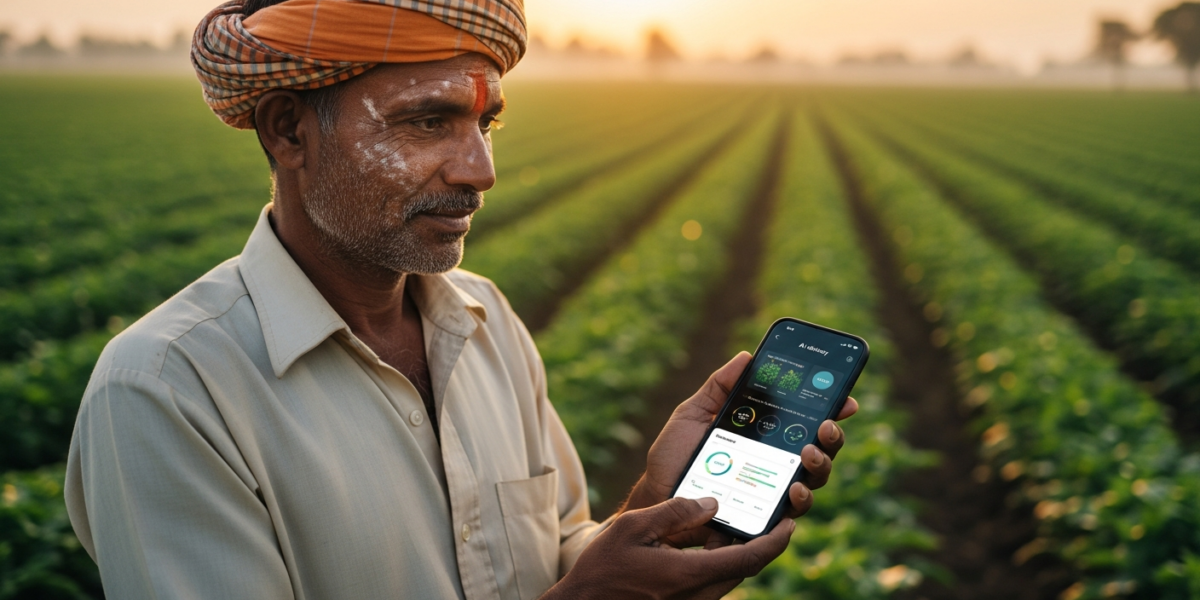
Kisan AI is a new profit-aware crop advisory system designed for Indian farmers, aiming to overcome the “economic blindness” of traditional agricultural advice. Unlike existing systems that primarily optimize for biological yield, Kisan AI integrates market price forecasts into its recommendations, enabling farmers to make financially viable decisions. The system leverages a Random Forest model, a Facebook Prophet price forecasting engine, and a MobileNetV2 disease detection module, all accessible via a multilingual Progressive Web App powered by Anthropic’s Claude API.
- Kisan AI introduces market price forecasting into crop advisory, moving beyond yield-only optimization.
- The system uses a Random Forest model, achieving 99.3% accuracy in predicting optimal crop choices with market price data.
- It includes a six-month price forecasting engine (Facebook Prophet) and a MobileNetV2 disease detection module.
- The platform is a multilingual Progressive Web App, unifying modules via an Anthropic Claude API-powered chatbot for Indian farmers.
What changed
Historically, crop advisory systems have focused predominantly on agronomic factors, guiding farmers toward decisions that maximize biological yield. This approach, termed “economic blindness” by the developers of Kisan AI, often overlooks the crucial aspect of market price, leading farmers to cultivate crops that are technically successful but financially unprofitable. The core innovation of Kisan AI is its direct integration of a market_price variable into its predictive models, fundamentally shifting the optimization goal from mere yield to profit. This contrasts with broader trends in precision agriculture, where AI and data analytics improve decision-making and optimize farm operations, but often without explicit, real-time market price integration at the advisory level [1].
While AI is increasingly used to improve food quality, automate tasks, and optimize crop growth through monitoring [5], and even to provide query support and advisory services [2, 7], Kisan AI’s explicit focus on profit-awareness via market price forecasting is a notable evolution. Other AI applications in agriculture, such as Syngenta’s Cropwise AI, focus on yield improvements through detailed soil and weather data [8], or AI for grading and sorting to access better markets [3]. Kisan AI, however, directly addresses the upstream decision of what to plant and when, with an eye on the farmer’s bottom line.
How it works
Kisan AI operates on a multi-component architecture, unified within a Progressive Web App (PWA) accessible on mobile devices. At its heart is a Random Forest (RF) classifier model, trained on a nine-feature benchmark dataset. This dataset augments standard agronomic attributes with the critical market_price variable. The RF model’s role is to provide profit-aware crop recommendations. The system also incorporates a Facebook Prophet engine for six-month market price forecasting, offering a forward-looking perspective on potential crop profitability. For on-the-ground support, a MobileNetV2 module handles disease detection, using computer vision to identify crop ailments from images.
The entire system is integrated into a user-friendly interface via a nine-language AI chatbot, powered by Anthropic’s Claude API. This chatbot acts as the central point of interaction, allowing farmers to query the system, receive recommendations, and access insights in their local language. This modular design, combining predictive analytics, forecasting, computer vision, and natural language processing, aims to provide a comprehensive and accessible advisory service.
Why it matters for operators
For operators in agricultural technology, investment, or supply chain management, Kisan AI represents a critical pivot point: the shift from yield-centric to profit-centric agricultural intelligence. This isn’t merely an incremental improvement; it’s a recalibration of the fundamental objective function for farm advisory systems. The “economic blindness” identified by Kisan AI’s developers is a pervasive flaw in many existing ag-tech solutions, which often optimize for biological outcomes without fully accounting for market dynamics. Operators should recognize that a system like Kisan AI, by explicitly incorporating market price forecasts, moves beyond just “improving decision-making” to actively driving financial viability for farmers.
This means two things for operators. First, any ag-tech solution that doesn’t explicitly address market price volatility and profitability will increasingly be seen as incomplete or even detrimental to farmers’ economic well-being. The market will demand solutions that directly contribute to the bottom line, not just the top-line yield. Second, the architecture of Kisan AI—a PWA integrating multiple AI models (Random Forest, Prophet, MobileNetV2) and a large language model (Claude API) for multilingual access—demonstrates a scalable, accessible blueprint for deploying sophisticated AI in underserved agricultural markets. Operators should look to replicate this full-stack, mobile-first, and multilingual approach when designing solutions for diverse farming communities, particularly in developing economies. The emphasis should be on practical, actionable intelligence that translates directly into improved farmer income, not just better agronomic practices. This approach will be key to unlocking broader adoption and impact in a sector where AI is increasingly seen as vital for food security and efficiency [6].
Benchmarks and evidence
The core Random Forest (RF) classifier model within Kisan AI was evaluated against eight baseline models. The RF model achieved a 99.3% accuracy, which was the highest among all tested models. Furthermore, it demonstrated the lowest Log Loss, indicating superior predictive performance. These results, as reported by the arXiv paper, confirm that the inclusion of the market_price variable as a predictive feature is both valid and impactful, significantly enhancing the model’s ability to provide relevant recommendations.
Risks and open questions
- Data availability and quality: The accuracy of market price forecasts and agronomic recommendations heavily relies on robust, localized, and up-to-date data. The paper does not detail the specifics of data acquisition, especially for market prices across diverse regional Indian markets.
- Market volatility: While Facebook Prophet is used for six-month price forecasting, agricultural markets are notoriously volatile due to weather, policy changes, and global events. The robustness of a six-month forecast in rapidly changing conditions remains an open question.
- Farmer adoption and digital literacy: While the multilingual chatbot and PWA design aim for accessibility, the actual adoption rate among Indian farmers, many of whom may have limited digital literacy or smartphone access, will be critical.
- Integration with existing infrastructure: The system’s ability to integrate with existing agricultural extension services, government programs, or supply chain logistics is not detailed, which could impact its real-world effectiveness.
- Ethical implications of AI recommendations: As the system directly influences farmers’ income, the ethical considerations around potential biases in recommendations or unforeseen market impacts of widespread adoption need careful consideration.
Sources
- Top 15 Precision Agriculture & AgTech Companies (2026) — https://www.omdena.com/blog/top-precision-agriculture-companies
- AI-Based Farmer Query Support and Advisory System – IJERT — https://www.ijert.org/ai-based-farmer-query-support-and-advisory-system-ijertv15is042397
- How Agrograde’s AI Machine Is Helping Onion Farmers Prevent Post-Harvest Losses And Earn Profits — https://thebetterindia.com/web-stories/farming/agrograde-ai-onion-farmers-post-harvest-losses-sorting-grading-crops-better-market-prices-11779126
- Kisan Mitra Chhadi: Indian scientists develop a smart stick for farmers to detect and catch snakes in fields | – The Times of India — https://timesofindia.indiatimes.com/etimes/animals/kisan-mitra-chhadi-indian-scientists-develop-a-smart-stick-for-farmers-to-detect-and-catch-snakes-in-fields/articleshow/130281806.cms
- Agriculture Statistics 2026 – AI, Robotics, and Climate Resilience by the Numbers – North American Community Hub — https://nchstats.com/agriculture-statistics/
- Role of Artificial Intelligence in Agriculture — https://sageuniversity.edu.in/blogs/role-of-artificial-intelligence-in-agriculture
- How AI is Revolutionizing Agriculture: Enhancing Crop Yields and Ensuring Global Food Security | Daily AI & Tech Trends — https://uitg.co/blog/ai/post/674
- Syngenta’s AI vision at World Agri-Tech 2026 — https://www.syngentagroup.com/newsroom/blogs/making-agricultural-intelligence-happen