
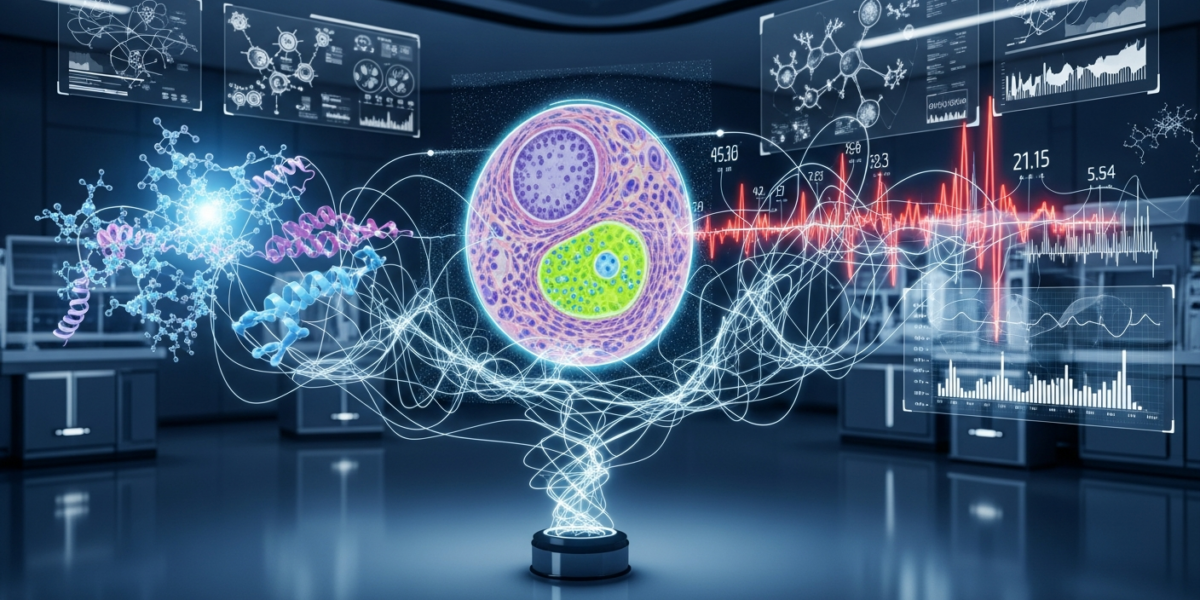
Haiku, a new tri-modal contrastive learning model, integrates spatial proteomics, hematoxylin and eosin (H&E) histology, and clinical metadata into a shared embedding space, enabling enhanced cross-modal retrieval, improved downstream classification, and zero-shot biomarker inference. Released on via arXiv, this model represents a significant step towards a systematic framework for jointly modeling diverse biomedical data types, offering new avenues for biological exploration and clinical prediction.
- Haiku is a tri-modal contrastive learning model trained on 26.7 million spatial proteomics patches from 3,218 tissue sections across 1,606 patients.
- It aligns multiplexed immunofluorescence (mIF) spatial proteomics, H&E histology, and clinical metadata into a single, unified embedding space.
- The model achieves cross-modal retrieval (e.g., finding relevant histology from clinical text) with up to 0.611 Recall@50, significantly outperforming unimodal baselines.
- Haiku improves survival prediction (C-index 0.737, a 7.91% relative improvement) and enables zero-shot biomarker inference with a mean Pearson correlation of 0.718 across 52 biomarkers.
- A novel counterfactual prediction framework allows researchers to explore molecular shifts by modifying clinical metadata while fixing tissue morphology, generating hypotheses for disease progression.
What changed
The core innovation with Haiku is its ability to systematically integrate three distinct, yet complementary, modalities of biomedical data: spatial proteomics from multiplexed immunofluorescence (mIF), standard hematoxylin and eosin (H&E) histology images, and structured clinical metadata [1, 2]. Prior approaches often struggle with the joint modeling of such diverse data types, typically relying on sequential analyses or less sophisticated fusion methods. Haiku, through its tri-modal contrastive learning architecture, creates a shared embedding space where these disparate data points are aligned, allowing for seamless cross-modal retrieval and analysis [1].
This alignment fundamentally changes how researchers can interact with and interpret complex biomedical datasets. Instead of siloed analyses, Haiku enables queries like “show me histology images matching this clinical profile” or “identify molecular biomarkers associated with this tissue morphology and patient outcome” [1]. This capability moves beyond simple correlation to a more integrated understanding, as demonstrated by its ability to perform zero-shot biomarker inference and improve clinical prediction tasks over unimodal baselines [1]. The introduction of a counterfactual prediction framework further distinguishes Haiku, allowing for exploratory “what-if” scenarios where clinical parameters are altered to observe predicted molecular shifts, offering a powerful tool for hypothesis generation in disease progression [1].
How it works
Haiku operates on a principle of tri-modal contrastive learning. This means it learns to embed data from three different sources – mIF spatial proteomics, H&E histology, and clinical metadata – into a common, high-dimensional vector space. The model is trained to pull representations of “matching” data points (e.g., a specific tissue patch, its corresponding H&E image, and the patient’s clinical data) closer together in this space, while pushing “non-matching” points further apart [2].
The training dataset is substantial, comprising 26.7 million spatial proteomics patches derived from 3,218 tissue sections across 1,606 patients, spanning 11 organ types [1]. Each patch has matched H&E histology and associated clinical metadata. This extensive, multi-modal dataset is crucial for the model to learn robust and generalizable representations.
Once trained, the shared embedding space allows for several powerful applications:
- Cross-modal Retrieval: Given an input from one modality (e.g., a clinical text description), the model can retrieve relevant data from another modality (e.g., specific H&E images or mIF patches) [1].
- Improved Downstream Tasks: The rich, integrated embeddings can be used as features for various downstream machine learning tasks, such as disease classification or survival prediction, often outperforming models trained on single modalities [1].
- Zero-shot Biomarker Inference: By conditioning retrieval on clinical metadata-only text descriptions, Haiku can infer potential biomarkers without explicit prior training on those specific markers [1]. This is particularly useful for discovering novel associations.
- Counterfactual Prediction: A unique framework allows researchers to modify clinical metadata inputs (e.g., changing a cancer stage) while keeping the tissue morphology fixed. The model then predicts the corresponding molecular shifts, providing insights into how molecular profiles might change under different clinical conditions. This is presented as a hypothesis-generating tool, not a definitive mechanistic claim [1]. For instance, in a lung adenocarcinoma case study, modifying clinical parameters recovered niche-specific shifts in CD8, granzyme B, PD-L1, and Ki67, consistent with patterns reported for favorable outcomes [1].
Why it matters for operators
For operators in biotech, pharmaceuticals, and clinical research, Haiku represents a significant shift from siloed data analysis to integrated, hypothesis-generating systems. The immediate implication is the potential to accelerate biomarker discovery and drug target identification. Instead of laboriously correlating molecular findings with clinical outcomes post-hoc, Haiku offers a framework to proactively explore these relationships, even in a zero-shot manner [1]. This could drastically reduce the time and cost associated with early-stage research.
Consider a drug development team. With Haiku, they could input a desired clinical outcome (e.g., “patients with improved survival in lung cancer”) and retrieve associated molecular profiles or tissue morphologies, and even infer potential biomarkers that were not explicitly part of their initial hypothesis. This capability moves beyond traditional bioinformatics pipelines that often require explicit queries and extensive manual curation. Furthermore, the counterfactual prediction framework is a powerful tool for experimental design. A team could simulate the molecular impact of different clinical interventions or disease progressions on a fixed tissue morphology, guiding their in vitro or in vivo experiments towards the most promising avenues. This allows operators to be more strategic in their resource allocation, focusing on experiments with higher predicted relevance.
However, operators must approach Haiku’s “hypothesis-generating” nature with appropriate caution. While the model shows strong performance, its outputs, especially from counterfactual analysis, are signals for further investigation, not definitive mechanistic claims [1]. Integrating Haiku’s insights with targeted validation methods, such as immunohistochemistry or spatial transcriptomics, as suggested by other research in the field, will be crucial for translating these computational findings into robust biological understanding [4]. The real value for operators lies in using Haiku to intelligently prune the vast search space of biological possibilities, making their research efforts more efficient and impactful.
Benchmarks and evidence
Haiku demonstrates substantial improvements over unimodal baselines across several critical tasks:
- Cross-modal Retrieval: The model achieved a Recall@50 of up to 0.611, significantly outperforming near-zero baseline performance for cross-modal queries [1]. This indicates a strong ability to find relevant data across different modalities.
- Survival Prediction: In clinical prediction tasks, Haiku achieved a C-index of 0.737, representing a 7.91% relative improvement over unimodal approaches [1]. This suggests enhanced prognostic capabilities by integrating diverse data.
- Zero-shot Biomarker Inference: For inferring biomarkers without prior explicit training, Haiku demonstrated a mean Pearson correlation of 0.718 across 52 biomarkers [1]. This strong correlation indicates the model’s ability to accurately predict molecular markers based on other modalities and clinical context.
Risks and open questions
- Generalizability: While trained on a large dataset spanning 11 organ types, the model’s performance on rare diseases, specific patient cohorts, or tissue types not well-represented in the training data remains an open question.
- Interpretability of Embeddings: The shared embedding space is powerful, but fully interpreting the biological meaning of specific vectors or dimensions within that space can be challenging. This black-box aspect is common in deep learning models and requires further research.
- Causality vs. Correlation: The counterfactual prediction framework generates hypotheses about molecular shifts. It’s crucial to remember that these are correlations learned from data, not direct causal mechanisms. Experimental validation is always necessary to establish causality [1].
- Data Bias: The model’s performance is inherently tied to the quality and representativeness of its training data. Biases in patient demographics, disease stages, or data acquisition protocols could propagate into the model’s predictions.
- Clinical Integration: While promising for research, the path to direct clinical application requires rigorous validation in prospective studies and integration into existing clinical workflows, which can be complex.
Sources
- [2605.00925] Linking spatial biology and clinical histology via Haiku
- Linking spatial biology and clinical histology via Haiku
- spatiAlytica: Viewer-Grounded Multimodal Agentic System …
- Biologically inspired digital histology for deep phenotyping of placental composition changes across major lesion types – ScienceDirect
- Deep Histological Margins Do Not Increase cSCC Recurrence Risk if Tumor is Fully Excised | Dermatology Times