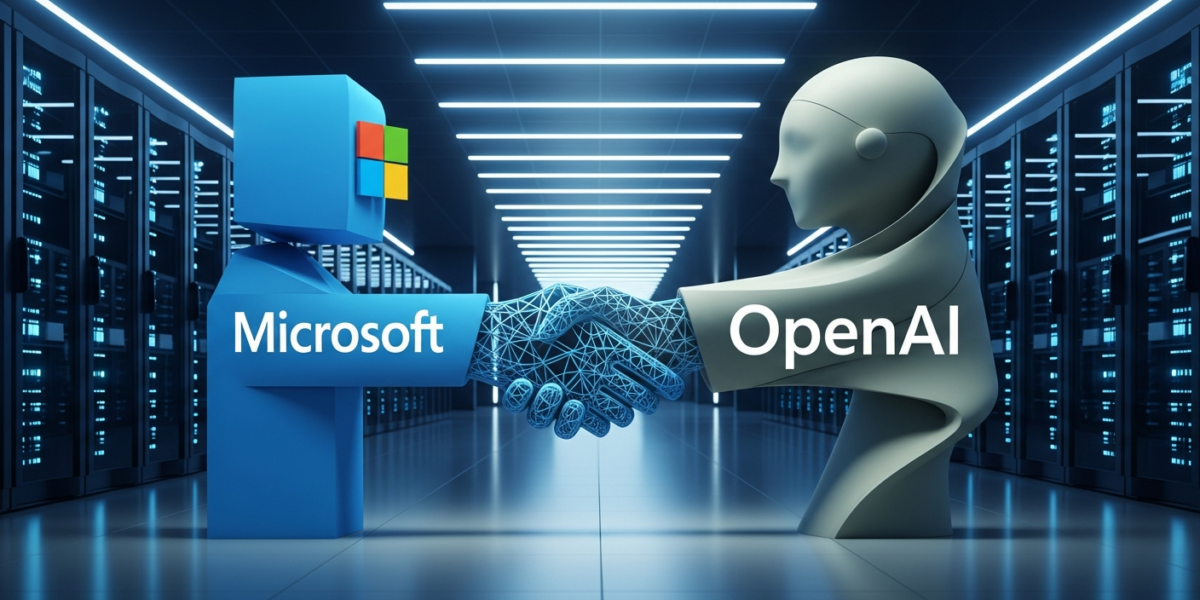
Microsoft and OpenAI have renegotiated their partnership agreement, allowing OpenAI greater flexibility to use other cloud providers while maintaining Microsoft as its primary cloud partner. The updated terms also simplify revenue sharing and grant Microsoft a non-exclusive license to OpenAI’s intellectual property, supporting continued AI innovation and strategic alliances for both companies.
| Category | Detail |
|---|---|
| Released by | OpenAI and Microsoft |
| Release date | |
| What it is | An amended agreement between OpenAI and Microsoft |
| Who it is for | AI developers, cloud providers, investors, and enterprise customers |
| Where to get it | Not applicable; a business agreement |
| Price | Not applicable |
- Microsoft remains OpenAI’s primary cloud partner for AI development.
- OpenAI products will ship first on Azure, unless Microsoft cannot support capabilities [1, 2].
- OpenAI can now serve customers on any cloud provider [4, 5].
- Microsoft retains a non-exclusive license to OpenAI IP through 2032 [4].
- Revenue sharing terms are simplified, with Microsoft no longer paying OpenAI revenue share [4, 5].
- The agreement simplifies the partnership and adds long-term clarity for both companies [1].
- OpenAI gains more cloud freedom, allowing it to serve customers on any cloud provider [4, 6].
- Microsoft secures a non-exclusive license to OpenAI’s IP, ensuring continued access to technology [4].
- The new terms reflect a shift towards flexible alliances and compute access in AI competition [8].
- Both companies continue collaborating on datacenter capacity, silicon, and AI cybersecurity [4].
What is the Renegotiated Microsoft-OpenAI Partnership?
The renegotiated Microsoft-OpenAI partnership is an amended agreement that updates the terms of their collaboration. This agreement simplifies the partnership and provides long-term clarity [1, 2]. It supports continued AI innovation at scale for both companies [1, 2]. The new deal gives OpenAI more cloud freedom [6]. Microsoft remains OpenAI’s primary cloud partner [1, 2].
What is New vs. the Previous Version?
The updated agreement introduces several key changes compared to the previous partnership terms. These changes impact cloud usage, intellectual property rights, and financial arrangements.
| Feature | Previous Terms | New Terms |
|---|---|---|
| Cloud Partner Status | Microsoft was OpenAI’s exclusive cloud partner [3]. | Microsoft remains primary cloud partner, but OpenAI can use other providers [1, 4]. |
| OpenAI Product Deployment | OpenAI products shipped exclusively on Azure [3]. | OpenAI products ship first on Azure, but OpenAI can serve customers on any cloud [1, 4]. |
| Microsoft IP License | Microsoft had an exclusive license to OpenAI’s technology [3]. | Microsoft retains a non-exclusive license to OpenAI IP through 2032 [4]. |
| Microsoft Revenue Share to OpenAI | Microsoft paid revenue share to OpenAI [5]. | Microsoft will no longer pay revenue share to OpenAI [4, 5]. |
| OpenAI Revenue Share to Microsoft | Not yet disclosed. | OpenAI’s revenue share payments to Microsoft continue through 2030 with a total cap [4]. |
| Strategic Focus | Exclusive partnership for AI technology [3]. | Focus on infrastructure, optionality, and compute needs [6]. |
How Does the New Partnership Work?
The new partnership operates under revised terms that balance collaboration with increased flexibility for OpenAI.
- Primary Cloud Partnership: Microsoft remains OpenAI’s primary cloud partner [1, 2].
- First-on-Azure Deployment: OpenAI products will ship first on Azure [1, 2].
- Cloud Provider Flexibility: OpenAI can serve customers on any cloud provider [4, 5].
- Non-Exclusive IP License: Microsoft holds a non-exclusive license to OpenAI IP until 2032 [4].
- Simplified Revenue Sharing: Microsoft no longer pays revenue share to OpenAI [4, 5].
- Continued Collaboration: Companies collaborate on datacenter capacity, silicon, and AI cybersecurity [4].
Benchmarks and Evidence
| Claim | Evidence | Source |
|---|---|---|
| Microsoft remains OpenAI’s primary cloud partner. | The agreement explicitly states this [1, 2]. | [1], [2] |
| OpenAI products will ship first on Azure. | This is a condition unless Microsoft cannot support capabilities [1, 2]. | [1], [2] |
| OpenAI can now serve customers on any cloud provider. | Key changes include this ability [4, 5]. | [4], [5] |
| Microsoft retains a non-exclusive license to OpenAI IP through 2032. | This is a key change in the agreement [4]. | [4] |
| Microsoft will no longer pay revenue share to OpenAI. | This is a specific change in the financial terms [4, 5]. | [4], [5] |
| OpenAI’s revenue share payments to Microsoft continue through 2030 with a total cap. | This is a key change in the financial terms [4]. | [4] |
| The agreement simplifies the partnership and adds long-term clarity. | The summary of the agreement states this [1, 2]. | [1], [2] |
Who Should Care?
Builders
Builders should care because OpenAI’s increased cloud flexibility could mean broader access to its models. Developers might see OpenAI models available on diverse cloud platforms. This could simplify integration into existing multi-cloud architectures.
Enterprise
Enterprise customers gain more options for deploying OpenAI solutions. They can integrate OpenAI models with their preferred cloud infrastructure. This flexibility supports diverse enterprise IT strategies.
End users
End users may experience more robust and widely available AI applications. Increased competition among cloud providers could lead to better service. The partnership aims to support continued AI innovation at scale [1, 2].
Investors
Investors should note the strategic implications for both Microsoft and OpenAI. The deal signals a shift towards flexible alliances and compute access [8]. This could impact valuations and future growth trajectories.
How to Use the New Partnership Today
The renegotiated partnership primarily affects the strategic business operations of Microsoft and OpenAI.
- For OpenAI customers: Continue to access OpenAI products through existing channels. Expect potential future availability on a wider range of cloud platforms.
- For Microsoft Azure customers: Continue to leverage OpenAI models integrated into Azure services. Microsoft remains OpenAI’s primary cloud partner [1, 2].
- For other cloud providers: Prepare for potential future partnerships with OpenAI. OpenAI can now serve customers on any cloud provider [4].
Microsoft-OpenAI vs. Competitors
The renegotiated partnership positions Microsoft and OpenAI differently against competitors.
| Feature | Microsoft-OpenAI (New Terms) | AWS (e.g., Anthropic, Amazon Bedrock) | Google Cloud (e.g., Gemini, Vertex AI) |
|---|---|---|---|
| Cloud Provider Flexibility for AI Partner | OpenAI can use any cloud provider [4]. | Anthropic models primarily on AWS. | Gemini models primarily on Google Cloud. |
| Primary Cloud Partner | Microsoft Azure for OpenAI [1]. | AWS for Anthropic. | Google Cloud for internal models. |
| IP Licensing | Microsoft has non-exclusive license to OpenAI IP through 2032 [4]. | AWS licenses Anthropic models. | Google develops proprietary AI models. |
| Revenue Sharing Model | Microsoft no longer pays OpenAI revenue share; OpenAI pays Microsoft until 2030 [4]. | Not yet disclosed. | Not yet disclosed. |
| Strategic Focus | Infrastructure, optionality, trillion-dollar compute [6]. | Comprehensive AI services and partnerships. | Integrated AI platform and proprietary models. |
Risks, Limits, and Myths
- Risk of Fragmentation: OpenAI’s multi-cloud strategy could lead to fragmented development efforts.
- Limit on Exclusivity: Microsoft’s exclusive license to OpenAI’s technology has ended [3].
- Myth of Partnership Weakening: The changes do not indicate a weakening partnership [8].
- Myth of Immediate Broad Availability: While OpenAI can use other clouds, widespread immediate deployment is not guaranteed.
- Risk of Vendor Lock-in (for others): Other cloud providers might still face challenges in attracting OpenAI.
FAQ
- What is the main change in the Microsoft-OpenAI partnership?
- The main change is that OpenAI can now serve customers on any cloud provider, not just Azure [4, 5].
- Does Microsoft remain OpenAI’s primary cloud partner?
- Yes, Microsoft remains OpenAI’s primary cloud partner [1, 2].
- Will OpenAI products still launch on Azure first?
- Yes, OpenAI products will ship first on Azure, unless Microsoft cannot support necessary capabilities [1, 2].
- What is Microsoft’s new IP license agreement with OpenAI?
- Microsoft retains a non-exclusive license to OpenAI IP through 2032 [4].
- How does the new agreement affect revenue sharing?
- Microsoft will no longer pay revenue share to OpenAI, but OpenAI’s payments to Microsoft continue through 2030 with a cap [4, 5].
- When was this new agreement announced?
- The new agreement was announced on [1, 2].
- Why did Microsoft and OpenAI renegotiate their deal?
- They renegotiated to simplify the partnership, add long-term clarity, and support continued AI innovation [1, 2].
- Can OpenAI now partner with Amazon or Google?
- Yes, the new agreement clears the way for OpenAI to forge new deals with rivals [3].
- What areas will Microsoft and OpenAI continue to collaborate on?
- They will continue collaborating on datacenter capacity, next-generation silicon, and AI-powered cybersecurity [4].
- Does this change affect Microsoft’s investment in OpenAI?
- Microsoft remains a major OpenAI shareholder [4].
Glossary
- Azure
- Microsoft’s cloud computing platform, offering a range of services.
- Cloud Provider
- A company that offers cloud computing services, such as AWS, Azure, or Google Cloud.
- Intellectual Property (IP)
- Creations of the mind, such as inventions, literary and artistic works, designs, and symbols.
- Non-Exclusive License
- A license that allows the licensor to grant the same rights to multiple licensees.
- Revenue Share
- A portion of the revenue generated from a product or service that is paid to a partner.
Sources
- The next phase of the Microsoft-OpenAI partnership – The Official Microsoft Blog
- The next phase of the Microsoft OpenAI partnership | OpenAI
- Microsoft, OpenAI change terms of deal so startup can court Amazon and others | Reuters
- The next phase of the Microsoft-OpenAI partnership | daily.dev
- OpenAI ends Microsoft legal peril over its $50B Amazon deal | TechCrunch
- Microsoft and OpenAI Rewrote their Marriage Contract
- Microsoft and OpenAI Update AI Partnership with New Business Terms – The National CIO Review
- Microsoft, OpenAI change contract terms–again