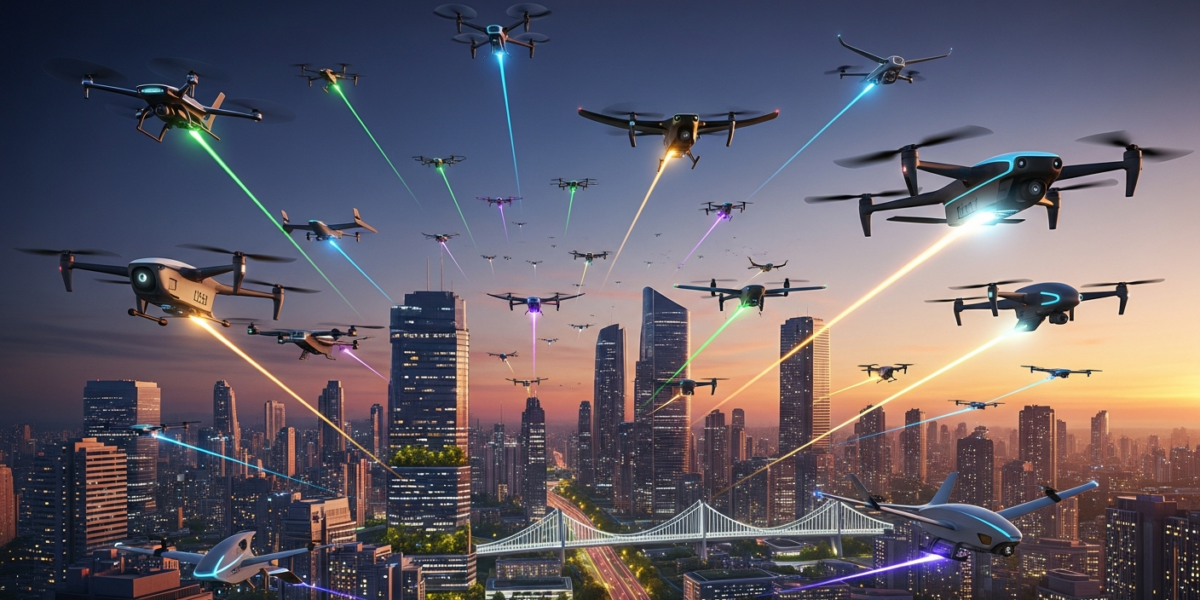
New research published on arXiv on , demonstrates that multi-agent reinforcement learning (MARL) can effectively manage tactical deconfliction for heterogeneous fleets of small unmanned aerial systems (sUASs) in dense urban airspaces. The study, which simulated package delivery missions over Dallas, Texas, used an attention-enhanced Proximal Policy Optimization-based Advantage Actor-Critic (PPOA2C) framework. It found that independently trained PPOA2C policies for different fleets could reach stable equilibria, ensuring safe separation even when interacting with rule-based systems, though the research also highlighted potential biases favoring fleets with stronger configurations.
- Multi-agent reinforcement learning (MARL) using an attention-enhanced PPOA2C algorithm successfully achieved safe separation for heterogeneous sUAS fleets in simulated urban environments.
- Independently trained PPOA2C policies demonstrated the ability to converge to a conflict-free equilibrium, even when fleets had differing configurations and policies.
- The PPOA2C policies outperformed traditional rule-based deconfliction baselines in conflict resolution and showed adaptive capabilities when interacting with rule-based systems.
- A key finding indicates that equilibria between similar policy types tend to favor sUAS fleets with stronger configurations, suggesting a need for fairness-aware conflict management strategies.
What changed
The paper introduces a novel application of multi-agent reinforcement learning (MARL) to address a critical challenge in future urban air mobility (UAM): the tactical deconfliction of heterogeneous fleets of small unmanned aerial systems (sUASs) [1]. Unlike previous work that might focus on homogeneous fleets or centralized control, this research specifically tackles scenarios where multiple companies operate diverse fleets, each with its own configurations (e.g., sensing, communication ranges) and potentially independent policies [2, 3].
The core change is the demonstration that independent, privacy-preserving MARL policies, specifically an attention-enhanced Proximal Policy Optimization-based Advantage Actor-Critic (PPOA2C) framework, can achieve stable, conflict-free airspace separation. This is significant because it moves beyond theoretical models to evaluate policy convergence and fairness implications in a realistic, dense urban simulation over Dallas, Texas [1, 2]. The study explores whether such policies can not only converge but also whether they inadvertently discriminate against fleets with “weaker” configurations, a crucial operational consideration for equitable airspace access [1]. This contrasts with earlier research that might focus on cooperative target tracking or swarm control without explicitly addressing inter-fleet fairness in deconfliction [6, 7].
How it works
The system employs a multi-agent reinforcement learning (MARL) paradigm where each sUAS fleet independently trains its own deconfliction policy using an attention-enhanced Proximal Policy Optimization-based Advantage Actor-Critic (PPOA2C) algorithm [1]. Reinforcement learning, at its core, involves an agent learning optimal actions in an environment to maximize a reward signal [5]. In this context, each sUAS within a fleet acts as an agent, and the environment is the shared urban airspace with other sUASs.
The “attention-enhanced” aspect of PPOA2C allows the agents to focus on the most relevant information from their surroundings, crucial for navigating complex, multi-agent scenarios [1]. The “Proximal Policy Optimization” (PPO) is a popular, robust algorithm known for its balance of performance and stability in policy optimization. “Advantage Actor-Critic” (A2C) combines value-based and policy-based methods, with an actor determining actions and a critic evaluating those actions.
The training process involves each fleet’s sUASs performing simulated package delivery missions over a realistic model of Dallas, Texas [2, 3]. During these missions, the sUASs encounter potential conflicts with other aircraft, both from their own fleet (intra-fleet) and from other companies’ fleets (inter-fleet). The PPOA2C algorithm learns to adjust the sUASs’ trajectories to avoid collisions while still progressing towards their delivery goals. A key design choice was allowing each fleet to train its policy independently while preserving privacy, reflecting a likely real-world scenario where companies would not share proprietary operational data [1]. The research then evaluates if these independently trained policies can converge to an equilibrium where conflicts are minimized, and analyzes the implications of differing fleet configurations on this equilibrium.
Why it matters for operators
For operators in the burgeoning Urban Air Mobility (UAM) and drone delivery sectors, this research offers a critical glimpse into the future of airspace management. The finding that multi-agent reinforcement learning (MARL) can achieve conflict-free equilibria for heterogeneous sUAS fleets is a significant step towards scalable, automated air traffic control. This means less reliance on human intervention for tactical deconfliction, which is essential for the high-density operations envisioned for urban environments. Operators should recognize that investing in AI-driven deconfliction systems, particularly those leveraging MARL, will be paramount for gaining competitive advantages and securing operational licenses in future regulated airspaces.
However, the study’s caveat regarding “fairness-aware conflict management” is equally important. The observation that equilibria tend to favor fleets with “stronger configurations” (e.g., better sensors, communication) is a red flag for smaller operators or those with legacy hardware. This implies that early adopters with advanced sUAS technology might inherently gain preferential airspace access or efficiency, potentially creating an uneven playing field. Operators must advocate for regulatory frameworks that mandate or incentivize equitable access, perhaps through standardized communication protocols or minimum equipment requirements, to prevent a “rich get richer” scenario in the skies. Furthermore, the adaptive capabilities of PPOA2C policies when interacting with rule-based systems suggest a viable path for gradual integration, where advanced AI systems can coexist and safely interact with current, more rigid air traffic management protocols during a transition phase. This flexibility will be crucial for operators navigating the complex regulatory landscape of UAM.
Risks and open questions
- Fairness and Equity: The research explicitly states that equilibria between similar policy types tend to favor fleets with stronger configurations [1]. This raises significant questions about equitable access to urban airspace. How will regulators ensure smaller operators or those with less advanced sUASs are not unfairly disadvantaged? What mechanisms can be put in place to enforce fairness-aware conflict management?
- Policy Robustness to Adversarial Actions: While the PPOA2C policies showed adaptive capabilities, the study doesn’t fully explore their robustness against potentially adversarial or intentionally disruptive actions from other agents or fleets. In a competitive commercial environment, could a fleet intentionally exploit weaknesses in another’s policy?
- Scalability to Real-World Complexity: The simulation over Dallas, Texas, is a step towards realism, but real urban airspaces involve far more variables: unpredictable weather, emergency landings, unauthorized aircraft, and dynamic no-fly zones. How well will these MARL policies scale to hundreds or thousands of sUASs and unforeseen events?
- Data Privacy and Interoperability: The study notes that fleets independently train policies while preserving privacy [1]. While beneficial for proprietary operations, this also raises questions about how much information sharing (e.g., intent, trajectory predictions) is truly necessary for optimal safety and efficiency across diverse operators. What are the minimum data exchange requirements for a truly safe and fair ecosystem?
- Certification and Validation: How will such complex, adaptive AI systems be certified for safety by aviation authorities? Traditional certification relies on deterministic behavior, which is challenging for reinforcement learning models. New methodologies for AI assurance and validation will be required.
Sources
- Separation Assurance between Heterogeneous Fleets of Small Unmanned Aerial Systems via Multi-Agent Reinforcement Learning
- [2605.01041v1] Separation Assurance between Heterogeneous Fleets of Small Unmanned Aerial Systems via Multi-Agent Reinforcement Learning
- [2605.01041] Separation Assurance between Heterogeneous Fleets of Small Unmanned Aerial Systems via Multi-Agent Reinforcement Learning
- Heterogeneous agents, unified missions: A survey and taxonomy on air–ground cooperative systems – ScienceDirect
- Reinforcement learning – Wikipedia
- When to Measure: A Multi-Agent Reinforcement Learning Approach for Efficient Tracking | The International FLAIRS Conference Proceedings
- Intelligent Unmanned Aerial Vehicle Swarm Control Under Electronic Warfare: A Cognitive–Intent Dual-Stream Reinforcement Learning Framework