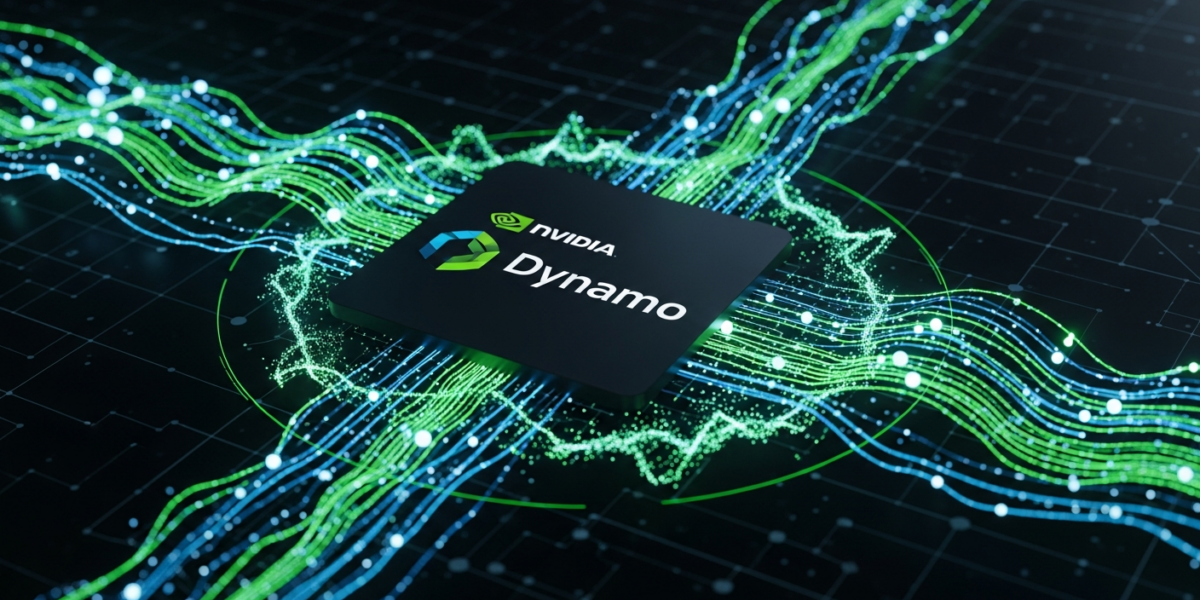
NVIDIA Dynamo 1.0, released on , is an open-source, production-grade foundation designed to optimize large-scale agentic AI inference, particularly for complex, multi-turn applications like coding agents. It addresses the computational demands of these workflows by integrating full-stack optimizations across NVIDIA’s hardware and software ecosystem, aiming to reduce latency and cost for AI agents generating production-level code at scale.
- NVIDIA Dynamo 1.0 is a new open-source framework for optimizing agentic AI inference, targeting production-grade performance.
- It’s built to accelerate complex, multi-turn AI agent workflows, such as coding agents that make numerous API calls and maintain conversation history.
- The framework leverages NVIDIA’s full stack, including Blackwell Ultra GPUs, NVLink, NVFP4, TensorRT-LLM, and community frameworks like SGLang and vLLM.
- Dynamo aims to reduce the latency and cost associated with the extensive KV cache management and context window demands of agentic AI.
- Major companies like Stripe, Ramp, and Spotify are already deploying coding agents at scale, generating thousands of PRs weekly or monthly.
What changed
The core change is the formal introduction of NVIDIA Dynamo 1.0 as a production-grade, open-source foundation specifically engineered for large-scale agentic inference [5]. While NVIDIA has long focused on AI acceleration, Dynamo represents a consolidated effort to address the unique challenges of agentic AI workflows. These workflows, unlike single-turn prompts, involve multiple API calls, continuous conversation history, and dynamic context windows, placing significant demands on KV cache management and overall inference efficiency.
Before Dynamo, optimizing such complex, multi-turn interactions often required custom engineering across various components of the AI stack. Now, Dynamo integrates optimizations across NVIDIA’s hardware (like Blackwell Ultra GPUs with NVLink and NVFP4 for low-precision accuracy) and software (TensorRT-LLM for real-time inference, and support for community frameworks like SGLang and vLLM) [2, 7]. This full-stack approach is designed to simplify and accelerate the deployment of agents that are already seeing significant adoption in production environments. For instance, Stripe’s agents generate over 1,300 pull requests (PRs) per week, Ramp attributes 30% of merged PRs to agents, and Spotify reports more than 650 agent-generated PRs per month. These figures highlight the existing demand for robust, scalable agentic inference solutions that Dynamo aims to meet.
How it works
NVIDIA Dynamo operates by orchestrating optimizations across the entire AI inference stack, from hardware to software, specifically tailored for agentic workflows. Agentic AI, especially coding agents, involves multi-turn interactions where models like Claude Code and Codex make numerous API calls, each requiring the full conversation history. This necessitates efficient management of the KV cache (key-value cache), which stores past attention states to avoid recomputing them. As context windows grow, so does the KV cache, leading to increased memory bandwidth and latency challenges.
Dynamo addresses this by leveraging NVIDIA’s latest hardware and software innovations [2]:
- Blackwell Ultra GPUs: These GPUs are designed for breakthrough inference performance, particularly for low-latency and long-context use cases essential for agentic AI [2].
- NVLink and NVLink Switch: These technologies enable scale-out architectures, allowing multiple GPUs to communicate efficiently, crucial for handling large models and extensive context windows across distributed systems [2].
- NVFP4: This low-precision floating-point format helps reduce memory footprint and increase throughput without significant accuracy loss, further optimizing inference [2].
- TensorRT-LLM: An open-source library, TensorRT-LLM provides high-performance, real-time inference optimization for large language models, a core component for agentic applications [7]. It is integrated to accelerate model execution.
- Community Framework Support: Dynamo works with popular community frameworks such as SGLang and vLLM, providing flexibility for developers to integrate their existing tools while benefiting from NVIDIA’s optimizations [2].
- AIPerf Benchmarking: NVIDIA also provides AIPerf, a benchmarking tool available on GitHub, which allows operators to measure the performance of generative AI models served by their inference solutions. This tool can generate multi-turn coding-agent traces specifically for KV cache benchmarking, helping to validate and fine-tune Dynamo’s performance in real-world scenarios [1].
By combining these elements, Dynamo aims to provide a cohesive solution that minimizes the overhead of context management and maximizes throughput for the demanding, iterative nature of agentic AI applications.
Why it matters for operators
For operators deploying or considering agentic AI, NVIDIA Dynamo 1.0 is more than just another optimization library; it signifies a maturing ecosystem for production-grade AI agents. The key takeaway is that the infrastructure burden for complex, multi-turn AI is being explicitly addressed, moving beyond single-shot inference. This is critical because the real-world utility of agents—like those generating thousands of PRs for Stripe or Ramp—hinges on their ability to maintain context, iterate, and perform reliably over extended interactions. Dynamo’s full-stack approach, from Blackwell Ultra silicon to TensorRT-LLM, aims to reduce the operational overhead and cost associated with managing the expansive KV caches and dynamic context windows inherent in these workflows.
What the press release understates is the strategic shift this enables: operators can now realistically plan for agentic AI to be a significant, rather than experimental, part of their software development lifecycle or business processes. The challenge has always been moving from impressive demos to cost-effective, scalable production. Dynamo aims to bridge that gap by offering a standardized, optimized path. Operators should view this as an opportunity to accelerate their internal agent development, but also critically, to scrutinize the actual cost-per-interaction. While NVIDIA touts performance, the true measure for an operator will be the total cost of ownership (TCO) for a robust agent farm. This means not just GPU cycles, but memory bandwidth, network latency for API calls, and the engineering effort to integrate and maintain these systems. Dynamo provides the technical foundation, but operators must still validate its economic viability against their specific agentic workloads and existing infrastructure. The open-source nature of Dynamo, coupled with benchmarking tools like AIPerf, offers transparency, but requires diligent testing to confirm the promised efficiency gains translate into tangible operational savings.
How to try it today
Operators can begin exploring NVIDIA Dynamo’s capabilities by leveraging the associated tools and resources:
- AIPerf Benchmarking Tool: The AIPerf tool is available on GitHub (
ai-dynamo/aiperf) [1]. This comprehensive benchmarking tool allows you to measure the performance of generative AI models served by your preferred inference solution. It includes features to generate multi-turn coding-agent traces specifically for KV cache benchmarking, which is crucial for evaluating agentic inference performance [1]. - NVIDIA NIM APIs: While not directly Dynamo, NVIDIA NIM microservices can be woven into agentic AI applications using the NVIDIA AgentIQ library [6]. You can explore step-by-step playbooks for setting up secure personal AI agents, such as NemoClaw, via the NVIDIA NIM APIs portal [8]. This provides a practical way to experiment with deploying and integrating AI agents.
- NVIDIA Developer Resources: Keep an eye on the NVIDIA Developer blog and AI Models page for updates and deployment guides related to Dynamo and agentic AI. The NVIDIA-accelerated AI Models page provides information on cloud providers like Microsoft, CoreWeave, and Oracle Cloud Infrastructure deploying NVIDIA GB300 NVL72 systems, which are optimized for low-latency, long-context agentic use cases [2].
For direct deployment of models optimized for these systems, operators can look into services offering NVIDIA Nemotron 3 Nano Omni, an efficient multimodal model, which is already deployed on platforms like Vultr [3]. This provides a concrete pathway to deploy and test agentic models on optimized infrastructure.
Risks and open questions
- Real-world Cost-Effectiveness: While Dynamo promises performance gains, the actual cost savings for operators will depend on their specific agentic workloads, existing infrastructure, and the total cost of ownership for NVIDIA’s latest hardware (e.g., Blackwell Ultra GPUs). The economic viability for smaller operations or those with less demanding agentic tasks remains an open question.
- Integration Complexity: Despite being open-source and supporting community frameworks, integrating Dynamo into diverse existing inference pipelines might still present engineering challenges. Operators will need to assess the effort required to adapt their current setups to fully leverage Dynamo’s optimizations.
- Vendor Lock-in Concerns: Relying heavily on NVIDIA’s full-stack optimizations, from hardware to software, could lead to increased vendor lock-in. Operators need to weigh the performance benefits against the potential for reduced flexibility in hardware choices or alternative inference solutions.
- Benchmarking Transparency and Reproducibility: While AIPerf is provided for benchmarking, ensuring that real-world agentic workloads are accurately represented and that benchmark results are reproducible across different environments will be crucial for operators to make informed decisions.
- Evolving Agentic Paradigms: The field of agentic AI is rapidly evolving. Dynamo’s optimizations are tailored to current paradigms, but future advancements in agent architectures or interaction models might introduce new bottlenecks that require further adaptation.
Sources
- GitHub – ai-dynamo/aiperf: AIPerf is a comprehensive benchmarking tool that measures the performance of generative AI models served by your preferred inference solution. · GitHub — https://github.com/ai-dynamo/aiperf
- NVIDIA-accelerated AI Models — https://developer.nvidia.com/ai-models
- NVIDIA Nemotron™ 3 Nano Omni Now Deployed on Vultr | Vultr Blogs — https://blogs.vultr.com/nvidia-nemotron-nano-3-omni
- Nebius. The ultimate cloud for AI explorers — https://nebius.com/
- World Leader in Artificial Intelligence Computing | NVIDIA — https://www.nvidia.com/en-us/
- NIM for Developers | NVIDIA Developer — https://developer.nvidia.com/nim
- Nemotron AI Models | NVIDIA Developer — https://developer.nvidia.com/nemotron
- Try NVIDIA NIM APIs — https://build.nvidia.com/